The Rewarded Silence of the Cadre

The Manchester Exit — Study Leave, Cadre Reviews, and the Quiet Machinery by Which the Indian State Certifies Its Administrators Clean, 1996–2021
To make a man vanish, the state needs a policeman.
To make the vanishing respectable, it needs a clearance form, a selection committee, and a foreign degree.
The first is a crime. The second is a career.
A Note on Evidentiary Method
This article applies the standing evidentiary framework of The Death Certificate Project: [PF] Proved Finding, [DA] Documented Allegation, [AI] Analytical Inference, [PM] Panthic Memory, [Q] Unanswered Public Question, and [Q-RTI] an RTI-ready record request whose production or formal denial is itself evidence. The full statement of the framework appears in the companion study The Audit of the Silent Pen.
Two cautions govern this article, because its subject is a decorated and credentialed public official and the terrain is therefore legally exposed. First, this article makes no claim that any officer fled, absconded, or removed himself from the jurisdiction to evade accountability; it asserts a documented chronology and the institutional mechanics that the chronology required, and it leaves questions of motive expressly open. Second, the load-bearing facts in this article are drawn from the officers’ own published biographical records, the findings of the Central Bureau of Investigation and the Supreme Court of India, and the documented operation of the All India Services rules. Where a record is inferred but not in hand, it is marked as a record request, not asserted as a finding.
I. The Form, Not the Gun
There is a popular image of impunity, and it is misleading. The popular image is dramatic: the destruction of files, the threatened witness, the buried order, the conspiracy of silence enforced by intimidation. That image exists because such things do happen, and because they make a story. But it misdirects attention, because the most durable impunity is not dramatic at all. It is administrative. It does not destroy files; it keeps them clean. It does not threaten witnesses; it promotes them. It does not bury orders; it issues clearances. It operates not through the gun but through the form — the annual confidential report marked satisfactory, the vigilance clearance certifying no pending proceedings, the study-leave sanction, the empanelment for higher office, the citation read at the superannuation function. Each of these is an ordinary administrative act, performed by ordinary officials following ordinary procedure. And it is precisely their ordinariness that makes them invisible, and their invisibility that makes them effective.
This article concerns that quieter machinery — the certification apparatus of the Indian civil service — and a single proposition about it: that across the twelve years in which 2,097 persons were illegally cremated in Amritsar District, and across the twenty-five years that followed, this machinery functioned for the district’s administrators exactly as it functions for officers of unblemished record, without interruption, without inquiry, and without the smallest deviation from the path of distinguished career advancement. [AI] No file was destroyed, because no adverse file was ever created. No witness was silenced, because the administrators were not witnesses to be silenced but officers to be certified. The impunity required no conspiracy. It required only that the selection committees meet, the clearances issue, and the promotions confirm — that the machine run normally. In Punjab, the machine ran normally. The thesis of this article is that the normal running of the machine, in the presence of a confirmed mass atrocity in the district its beneficiaries administered, is itself the scandal — and that a clean file, in such circumstances, is not the absence of a finding but a finding in its own right.
The distinction between the two forms of impunity is not academic, because it determines where accountability must look. If impunity were always dramatic, accountability could content itself with searching for the destroyed file and the silenced witness. But the impunity documented in this archive left no destroyed file to find. It left, instead, a pristine administrative record — a record of certifications, clearances, promotions, and honours, each one regular on its face, each one issued by an authority acting within its powers, and the sum of which is a career of unbroken distinction superimposed upon a district of unburied dead. To understand that impunity, one must learn to read the clean record as evidence — to see, in the very smoothness of the career, the signature of a system that declined, at every certification point, to ask the one question that would have interrupted it. This article is an exercise in reading the clean record.
II. The Record Tenure, As the State Remembers It
Begin with how the relevant tenure is officially remembered, because the curation of that memory is the first and most revealing artifact in the file.
Karan Bir Singh Sidhu served as Deputy Commissioner and District Magistrate of Amritsar from 1992 to 1996, having served in the same district as Additional Deputy Commissioner from 1990 to 1992. [PF] His own published biographical record — circulated over the years through official and semi-official channels — summarises the Amritsar tenure with precision, and it is worth attending to exactly what that summary contains and what it omits. The tenure is recorded as a period of distinction. It notes that he handled two aircraft-hijacking incidents successfully, securing the surrender of a hijacker at Amritsar’s airport without casualty, and that he received the Prime Minister’s appreciation for this. [PF] It records the scale of his charge — a district of some two and a half million people across five thousand square kilometres, including what is today Tarn Taran. [PF] It records his ex-officio chairmanship of the District Sainik Welfare Board and his sustained engagement with the concerns of the district’s ex-servicemen, among the highest concentration in Punjab. [PF]
This is the official memory of the tenure: hijackings resolved, a Prime Minister’s appreciation earned, a great district administered, the welfare of soldiers attended to. It is the memory of a record tenure — a tenure catalogued by its commendations. And it is, on its own terms, accurate. He did resolve the hijackings. He did receive the appreciation. The omission is not a falsehood. The omission is the 2,097.
For nowhere in the curated record of that tenure — not in the biographical summaries, not in the published reflections, not in the catalogue of its distinctions — does there appear the single most consequential fact about the district of Amritsar between 1992 and 1996: that it was, in those years, the most heavily documented epicentre of illegal cremation in Punjab, that the Central Bureau of Investigation would confirm 2,097 unlawful cremations at the district’s three grounds, that 1,238 of the cremated would never be identified, and that the Supreme Court of India would characterise what occurred there as a flagrant violation of human rights on a mass scale. [PF] The tenure remembers its hijackings and forgets its cremation grounds. It remembers the Prime Minister’s appreciation and forgets the Supreme Court’s condemnation. It records the welfare of the district’s soldiers and is silent on the disappearance of the district’s sons. [AI]
This selective memory is not incidental to the argument of this article; it is its overture. The official curation of the tenure — the cataloguing of an administrative career by its honours, with the atrocity that occurred under its authority simply absent from the ledger — is the certification machinery operating at the level of biography. Before any selection committee certified the officer clean, the officer’s own record had already been composed in the key of distinction, with the dead edited out. The clean file begins here, in the curated memory of the tenure, where a District Magistracy that presided over 2,097 unaccounted deaths is remembered as the office that resolved two hijackings and earned a Prime Minister’s thanks. [AI]
There is a further detail that belongs to this section, because it is the officer’s own articulation of the ethos within which such a career is built, and it is remarkable for its candour. He has written publicly — in the persona of the retired insider speaking hard truths — that people do not enter the civil services merely to serve the nation, nor even primarily to make money, but to claim a share in what he called the country’s Raj Darbar Yog: the aura, the proximity, the access, and the authority of the ruling establishment. [PF] This is his own characterisation of the service he entered, offered not as criticism but as worldly observation. It is also, read against the record this article examines, an unintended key to the entire reward structure. A service understood by its own members as a claim upon proximity to power — upon aura and access and authority — is a service whose system of reward will track proximity to power, not service to the powerless. It will reward the officer who manages the establishment’s difficulties smoothly, and it will have no category at all for the officer who failed the district’s dead, because the dead were never the constituency the Raj Darbar Yog was organised to serve. The officer described the ethos exactly. This article merely traces its consequences.
III. The Manchester Year
In August 1996, Karan Bir Singh Sidhu left the District Magistracy of Amritsar. [PF] Four months later, on 12 December 1996, the Supreme Court of India, in Paramjit Kaur Khalra v. State of Punjab, characterised the emerging findings on the Amritsar cremations as a flagrant violation of human rights on a mass scale and referred the investigation to the National Human Rights Commission. [PF] In 1997, Sidhu was awarded a Master of Arts in Economics, in the field of Development Administration and Management, by the Institute for Development Policy and Management at the University of Manchester, in the United Kingdom. [PF] His dissertation was titled The Politics of Decentralisation in the Indian Punjab. [PF]
These four facts are not arranged here to insinuate; they are arranged here because their sequence is documented and their juxtaposition is extraordinary, and an archive that declined to notice it would be failing its purpose. The chronology, stated plainly, is this: the officer left the District Magistracy of Amritsar in the late summer of 1996; in the academic year that immediately followed, he was resident at a British university, completing a postgraduate degree in development administration; during that same period, in December 1996, the Supreme Court of India placed the cremations of his former district before the national human rights body; and the academic work he produced in that year was a scholarly study of the politics of governance in the very Punjab whose governance, in his own district, was at that moment the subject of the apex court’s gravest characterisation. [PF] The District Magistrate of record during the cremations spent the year of the Supreme Court’s reference studying, in England, the theory of how Punjab is governed.
This article does not assert — and the discipline of this archive forbids it to assert — that the timing was chosen to remove the officer from the jurisdiction during a period of scrutiny. That is a claim about motive, and the documented record does not establish it. The officer’s study at Manchester may have been planned long in advance, sanctioned through ordinary channels, and entirely unconnected to the proceedings in Punjab. The question of why the Manchester year fell where it did is left open. [Q] What is not left open is the chronology itself, which is documented in the officer’s own biographical record, and the questions that the chronology fairly raises.
The first question concerns the dissertation. A scholarly study titled The Politics of Decentralisation in the Indian Punjab, written in 1996–97 by the man who had just completed four years as District Magistrate of Amritsar, is a document of obvious relevance to the accountability record, because the District Magistracy is the central institution of district-level governance — the very subject of any study of decentralisation. The question whether that dissertation engaged, in any way, with the catastrophic failure of district governance that had occurred under its author’s own authority — the disappearances, the custodial deaths, the 2,097 uninquired cremations — or whether it treated the politics of Punjab’s governance as an abstraction unmarked by the specific governance failure its author had just presided over, cannot be answered from the title alone. The dissertation text is a record that should be available, and its examination would be illuminating. [Q-RTI] This archive does not assert what the dissertation contains. It records that the dissertation exists, that its subject is precisely the field in which its author’s own record is most gravely implicated, and that the document should be produced and read.
The second question concerns the mechanism by which the Manchester year was made possible. Sidhu was, throughout this period, a serving officer of the Indian Administrative Service; he did not resign in 1996 and re-enter the service later, but served continuously from 1984 until his superannuation in 2021, a span of thirty-seven years. [PF] A serving All India Services officer does not absent himself for a year of foreign postgraduate study without official sanction. The Manchester year was therefore, by necessary inference, undertaken on some form of officially sanctioned leave — most plausibly the study leave for which the All India Services rules provide. [AI] And here the certification machinery makes its first documented appearance in this officer’s career, because the sanction of study leave, like every significant personnel action affecting an All India Services officer, was a moment at which the system was required to certify the officer’s standing — and did. The specific sanction order, the application on which it was granted, the vigilance clearance that preceded it, and the conditions attached to it are all records that should exist and that would establish exactly what the state knew, and what it certified, about the officer’s record at the moment it released him for foreign study. [Q-RTI]
The Manchester year, in short, is not offered here as evidence of flight. It is offered as the first visible operation of the machinery this article exists to examine. At the precise moment the Supreme Court was placing his former district’s dead before the human rights commission, the system that employed the district’s former magistrate was processing his release for a year of scholarly study abroad — a release that required, and presumably received, the system’s certification that nothing in his record stood in the way. The dead of Amritsar were entering the docket of the National Human Rights Commission. Their District Magistrate was entering the Institute for Development Policy and Management. Both things happened in the same months, through the operation of two different institutions of the same state, and only one of them has ever been completed. The human rights proceedings drag on, decades later, unresolved. The degree was conferred in 1997.
There is a deeper irony in the particular discipline the officer chose, and it deserves to be drawn out, because it is documented and not invented. The Institute for Development Policy and Management at Manchester is, as its name declares, a centre for the study of how states administer development and govern their populations — the academic discipline of public administration in the developing world. The degree the officer earned was in Development Administration and Management. And the dissertation he wrote within that discipline was, specifically, a study of decentralisation in Indian Punjab — the distribution of governmental authority downward through the tiers of the state, of which the district, headed by the District Magistrate, is the pivotal unit. [PF] The officer chose, in other words, to make the academic study of district-level Punjab governance the subject of his postgraduate work, in the same months in which his own exercise of district-level Punjab governance was the subject of the Supreme Court’s gravest characterisation. He went abroad to theorise the institution he had just administered, at the moment that institution’s administration of his district was being placed before the national human rights body.
This article does not assert what the dissertation says, because it does not possess the text, and it will not invent its contents. But the configuration is itself remarkable, and it sharpens a single question to a fine point. The scholarly study of decentralisation concerns how power is exercised and held accountable at the district level — the responsibilities of the district administration, the relationship between the civil magistracy and the agencies operating within the district, the mechanisms by which district-level power is checked. These are precisely the questions on which the author’s own record was, at that very moment, most gravely in issue: the responsibilities of the District Magistracy of Amritsar, its relationship to the police operating within the district, the mechanisms of oversight that were not exercised. A dissertation on Punjab decentralisation that engaged honestly with the contemporaneous collapse of district-level accountability in Amritsar would be one kind of document. A dissertation on Punjab decentralisation that treated the subject as an abstraction — that examined the architecture of district governance while passing in silence over the most catastrophic district-governance failure of its author’s own experience — would be another. Which of the two it is, this archive cannot say from the title. That the question exists, and that the document which would answer it should be available, this archive does record. [Q-RTI]
The configuration also illuminates the relationship between the scholar and the administrator that the rest of this article examines. A man may administer a district and then, in retirement, write about governance as a detached analyst; the companion study documents exactly that pattern in his later commentary. But the Manchester year shows that the pattern began at once, in 1996, in the immediate aftermath of the tenure — that the transformation of the District Magistrate of record into the scholar of governance was not a late-life turn but a step taken in the very year the apex court took up his district’s dead. The earliest layer of the scholarly reframing examined later in this article was laid down in Manchester in 1996–97, while the proceedings were beginning in Punjab. The scholar’s first credential and the court’s reference are contemporaneous. The administrator began becoming a scholar at the precise moment the administration he had led was being called to account, and the becoming has continued, layer upon layer, ever since. [AI]
IV. The Machinery of Certification
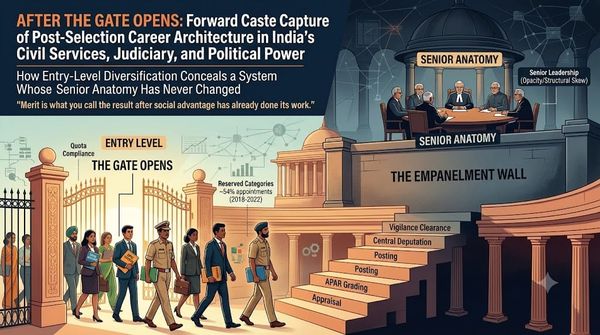
To understand how a career proceeds without interruption past a confirmed atrocity, one must understand the certification points — the moments in the life of an All India Services officer at which the state is required to look at his record and pronounce upon it. These are not occasional or exceptional. They are routine, frequent, and cumulative, and each of them is an opportunity, mandated by the system’s own rules, to register that something is amiss. The career examined in this article passed every one of them, across twenty-five years, without a single adverse mark surfacing in the public record. The machinery is worth describing precisely, because its very thoroughness is what converts the unbroken career into evidence. A system that never looked could fail to notice an atrocity through mere inattention. A system that looked repeatedly, at every mandated point, and pronounced clean each time, has done something more affirmative than fail to notice. It has certified. [AI]
The first and most pervasive instrument is the annual performance appraisal — in the relevant period, the Annual Confidential Report. Every year of an officer’s service generates such a report, written by a Reporting Officer, reviewed by a Reviewing Officer, and finalised by an Accepting Authority — typically the senior officers in the appraised officer’s administrative chain. The report grades the officer’s performance and integrity and forms the foundational record on which every subsequent personnel decision rests. [PF, as to the structure of the ACR system] For the District Magistrate of Amritsar, the Annual Confidential Reports of the years 1992 through 1996 were written, reviewed, and accepted by the senior officers of the Punjab administration — the Divisional Commissioner, the Chief Secretary, and the political executive of the state — during the very years the cremations were occurring and, in the case of the later reports, after Jaswant Singh Khalra’s January 1995 disclosures had made the allegations public. Those reports are the single most important documentary record of what the state’s own supervisory apparatus recorded about the officer’s tenure. [Q-RTI] That his career advanced without interruption establishes, by necessary inference, that those reports were favourable. A career does not ascend to the apex of the service on the strength of adverse appraisals. The ACRs of the cremation years were clean. [AI]
The second instrument is the vigilance clearance — the certification, required at numerous junctures, that no disciplinary or vigilance proceeding is pending against the officer, and that his integrity is not in doubt. This clearance is a precondition for promotion, for empanelment to higher office, for deputation, for the sanction of study leave, and for the release of retirement benefits. [PF, as to the requirement of vigilance clearance] Each time the officer was promoted, deputed, empanelled, or granted leave, the system was required to certify that no proceeding stood against him — and each time, it did, because no such proceeding was ever initiated. The vigilance machinery of the state, which exists precisely to flag officers whose conduct raises questions, raised none. [AI]
The third instrument is study-leave sanction. As established above, the Manchester year required sanction under the All India Services rules governing leave, including the certification of the officer’s standing and the determination that his absence for foreign study was consistent with the interests of the service. [PF, as to the requirement of sanction] The state sanctioned it. [AI]
The fourth instrument is empanelment for central deputation. The officer’s published record establishes that he served as Joint Secretary and Additional Secretary with the Government of India on central deputation. [PF] Empanelment for such posts is conducted by the Department of Personnel and Training on the basis of the officer’s appraisal record and vigilance status — a screening that exists to ensure that only officers of suitable record are posted to the senior echelons of the central government. The officer was empanelled. The central screening machinery, examining his record, found it suitable for the highest levels of national administration. [AI]
The fifth instrument is promotion within the cadre to its senior-most grades. The officer rose through the secretariat of Punjab — Secretary of numerous departments, Principal Secretary of others — to retire, on 31 July 2021, as Special Chief Secretary, among the apex ranks of the state’s civil service, concurrently holding charge as Director General of the state’s institute of public administration. [PF] Each elevation required the cadre’s promotion machinery to confirm the officer’s fitness on the basis of his cumulative record. Each confirmed it.
The sixth and final instrument is superannuation itself. The release of an officer’s pension and retirement benefits requires certification that no proceedings are pending and that his record is clear. [PF, as to the requirement] The officer superannuated after thirty-seven years of unbroken service, his benefits presumably released without impediment, his retirement marked — as such retirements are — by the honours and citations appropriate to a distinguished career. [AI]
Six instruments; dozens of individual certification events across twenty-five years; and at every one, the state’s own machinery — the appraisal authorities, the vigilance apparatus, the DoPT empanelment screening, the cadre promotion boards, the pension sanctioning authorities — examined the record of the District Magistrate of Amritsar during the cremation period and pronounced it clean. This is not the impunity of the destroyed file. It is the impunity of the file repeatedly examined and repeatedly approved. And it raises a question that the next section confronts directly: what does a clean file mean, when the events it omits are a confirmed mass atrocity in the district the officer administered?
V. The Clean File as an Artifact
The intuition that a clean record is exculpatory is deep, and in ordinary circumstances it is sound. An officer whose decades of service generated no adverse appraisal, no vigilance proceeding, and no disciplinary mark is, ordinarily, an officer who did nothing to warrant one. The clean file is ordinarily the record of clean conduct. But the inference from clean file to clean conduct depends entirely on a premise that does not hold in this case: the premise that the system generating the file was functioning — that it was looking, that it would have recorded misconduct had misconduct occurred, that its silence reflects the absence of wrongdoing rather than the absence of inquiry. Where that premise fails, the clean file inverts its meaning. It ceases to be evidence that nothing was wrong and becomes evidence that the system declined to record what was wrong. [AI]
The premise fails here, and it fails on the strength of the state’s own findings. The same state whose appraisal authorities marked the District Magistrate’s tenure satisfactory is the state whose Central Bureau of Investigation confirmed that 2,097 persons were illegally cremated in his district. The same state whose vigilance machinery found no proceeding to initiate against him is the state whose Supreme Court characterised what occurred in his jurisdiction as a flagrant violation of human rights on a mass scale. [PF] These two records — the clean personnel file and the confirmed atrocity — were generated by the same government, about the same district, during overlapping periods. They cannot both be a faithful account of what occurred. Either the atrocity did not happen, which the state’s own courts have foreclosed, or the personnel system that pronounced the district’s administration clean was not recording what its own investigative arm would confirm. The clean file is not corroborated by the atrocity record. It is contradicted by it. [AI]
This is the sense in which the clean file is an artifact rather than a vindication. An artifact is a thing made — and the clean file of the District Magistrate of Amritsar was made, deliberately and repeatedly, by a sequence of affirmative administrative acts. Each favourable appraisal was a positive statement by named authorities that the officer’s performance and integrity were satisfactory. Each vigilance clearance was a positive certification that nothing stood against him. Each empanelment, each promotion, each sanction of leave was a positive determination that his record warranted advancement. These were not absences. They were assertions — dozens of them, across twenty-five years, each one a moment at which the state, looking at the record of an officer who had administered a district of confirmed mass cremation, affirmatively declared that there was nothing to see. The clean file is the accumulated record of those declarations. It is the documentary form of the state’s denial — the paper proof that the apparatus charged with scrutinising its officers chose, at every opportunity, not to scrutinise this one. [AI]
Read this way, the smoothness of the career is not the officer’s alibi. It is the institution’s confession. A career that ascended without interruption from the District Magistracy of Amritsar to the apex of the Punjab civil service, past every certification point the system provides, is the record of a system that was asked, dozens of times, whether anything was wrong with the administration of a district where two thousand and ninety-seven people were cremated without inquest, and that answered, dozens of times, no. The clean file does not tell us the officer was innocent. It tells us the state declined to ask whether he was. And in a matter of mass custodial death, the state’s repeated, documented refusal to ask is not a neutral fact. It is the architecture of the impunity itself, recorded in the state’s own hand, one clearance form at a time. [AI]
VI. The Scholar-Administrator and the Reframing of a Record
There is a dimension to this career beyond the internal machinery of the service — a dimension that operates not within the files of the Department of Personnel and Training but in the wider field of public reputation, and that must be examined with the same care, and the same restraint about motive, applied to the Manchester chronology above.
Consider the public figure that the documented career has produced. He is a University of Manchester postgraduate in development administration and a Harvard leadership alumnus. [PF] He retired at the apex rank of his service after thirty-seven years. [PF] He is the founder and editor of a widely read publication on governance and public affairs, received by an appreciative readership as a model of the engaged, rigorous, public-spirited retired administrator. [PF] He is, in the composite, the very portrait of the scholar-administrator — the bureaucrat-intellectual whose foreign degrees, apex rank, and prolific commentary establish him, in the public eye, as a figure of learning, distinction, and conscience. This is the reputation the documented career has built, and this article does not dispute any of the credentials on which it rests. They are real. He did earn the Manchester degree; he did attain the apex rank; he does edit the publication.
The observation this article makes is structural, and it is the same observation made of the publishing record in the companion study, applied now to the credentials. The composite figure of the scholar-administrator functions, whatever its author’s intention, to reframe the record — to position the name, in the public mind, as belonging to a learned and distinguished public servant rather than to the District Magistrate of record during a confirmed mass cremation. Each credential is a layer of reframing. The foreign degree reframes the officer as a scholar. The apex rank reframes him as a statesman. The governance commentary reframes him as a public conscience. And the cumulative effect of the layers is that the single most consequential fact about his most consequential posting — that 2,097 people were cremated without inquest in the district he administered — recedes beneath a reputation of learning and distinction so thoroughly composed that the casual observer would never think to look for it. The record is not erased. It is buried beneath the credentials, exactly as, in the companion study, it is buried beneath the volume of commentary. [AI]
Whether this reframing is a purpose or merely an effect is a question this article does not resolve, and the boundary is the same one observed throughout this archive. To assert that the officer pursued his degrees, attained his rank, and built his publication in order to launder the record would be a claim about motive that the documented evidence does not establish, and this archive does not make claims it cannot support. [Q] The credentials may have been pursued for the ordinary reasons any able officer pursues credentials — ambition, intellect, the genuine desire to learn and to serve. The reframing effect does not require any laundering intent; it is produced by the credentials themselves, regardless of why they were sought. What can be said is what the structural analysis establishes: that the composite scholar-administrator persona operates, in the field of public reputation, to the benefit of the name and to the obscuring of the record; that the obscuring is real whether or not it is intended; and that a public should be capable of holding both facts in view at once — that the man is a credentialed scholar-administrator of genuine attainment, and that he is the District Magistrate of record during the cremations of Amritsar — without permitting the first fact to dissolve the second. [AI]
The term that suggests itself for this process — laundering — is apt as to its effect and must be disciplined as to its implication. A record is laundered, in the structural sense, when a reputation of sufficient distinction is composed over it that the record ceases to be visible. By that structural measure, the record of the District Magistracy of Amritsar has been laundered, not by any single act of concealment, but by the accumulation of genuine distinctions — the degree, the rank, the publication, the appreciations — beneath which the 2,097 have disappeared from the public image of the name as completely as the 1,238 disappeared from the registers of the dead. The laundering, if the word is used, is a laundering by distinction. And it is the most effective kind, because it requires no falsehood. Every credential is true. It is only their sum that buries the dead. [AI]
VII. The Pattern Across the Office
The certification of a single officer might be explained as the system’s judgment about one man. The certification of three successive holders of the same office, across the same atrocity, cannot. The District Magistracy of Amritsar was held, across the twelve years from 1984 to 1996, by three officers in succession, and the reward structure operated for all three. It is the constancy of the operation across three different men that establishes the pattern as a feature of the institution rather than a judgment about any individual. [AI]
The first of the three was Ramesh Inder Singh, who held the District Magistracy of Amritsar from June 1984 — taking charge in the immediate aftermath of Operation Blue Star — until July 1987. [PF] Originally an officer of the West Bengal cadre, later transferred to Punjab, he administered the district through the period in which the counterinsurgency’s administrative template was first established. His subsequent career is a matter of public record, and it is a record of unbroken ascent: Principal Secretary to the Chief Minister of Punjab, Chief Secretary of Punjab, Chief Information Commissioner of Punjab, consultant to the World Bank. [PF] And in 1986 — during his tenure as District Magistrate of Amritsar, two years into the posting — he was awarded the Padma Shri, among the highest civilian honours the Republic of India confers. [PF] The civil officer of record in the district through Operation Blue Star and the first phase of the disappearances was decorated by the nation while still in the post, and rose thereafter to the summit of the state’s administration. His own published account, decades later, would argue that he held no authority to prevent or order the events of Blue Star. [DA] That argument, whatever its merits as to Blue Star itself, does not address the oversight obligations of the District Magistracy across the years that followed, and it does not explain the Padma Shri, which was an award not for institutional survival but for distinguished service.
The second of the three was the officer who held the District Magistracy in the intervening years, from approximately 1987 to 1992 — the period in which, on the documented record, the scale of illegal cremation rose toward its peak. The Project’s prior research documents that he, too, received national civilian honour. [PF, per the Project’s prior documentation; date subject to confirmation in the standing record] The middle incumbent is treated here, as throughout this archive, not as an interchangeable individual but as a successive holder of the same statutory office, subject to the same oversight duties and the same eventual reward.
The third was Karan Bir Singh Sidhu, whose certification machinery this article has examined in detail, and whose ascent to Special Chief Secretary completed the pattern. [PF] Three officers; one office; one atrocity occurring under its authority across all three tenures; and three careers of national honour and apex advancement, not one of them interrupted by a single departmental inquiry into the oversight record of the shared office. [PF] The governing observation of the Project’s prior work on this pattern states it with precision: the Republic rewarded the office. It did not reward three men for three unrelated records of merit. It rewarded the successive holders of the civil office that presided over the cremation grounds, and it did so through the normal operation of its honours and promotion machinery, without any of that machinery ever pausing to ask what had occurred in the district those honours were decorating. [AI] The pattern is not a coincidence of three biographies. It is the signature of an institution that had no category for the failure in question — that could see hijackings resolved and development administered and integrity unblemished, and could not see, or would not record, two thousand and ninety-seven unburied dead.
VIII. The Asymmetry — Convicted Hands, Certified Office
The reward structure examined in this article acquires its full meaning only when set beside the one accountability the same history did eventually produce, because the contrast between the two reveals the precise shape of the impunity. The state was not, in the end, wholly incapable of holding anyone responsible for the events of Amritsar. It convicted the police.
In the matter of the abduction and murder of Jaswant Singh Khalra — the human rights defender who exposed the cremation grounds and was himself abducted in September 1995 and killed — the criminal justice system, carried through the trial court, the High Court, and ultimately the Supreme Court, convicted six Punjab Police officials, and four life sentences were upheld by the Supreme Court on 4 November 2011. [PF] This was real accountability, hard-won across sixteen years, and it establishes that the state’s machinery was capable of reaching the perpetrators of the killing when sufficient pressure was applied. The hands that did the killing were, eventually, convicted.
Now set that against the record this article has documented. The hands that did the killing were prosecuted and, in part, convicted. The office that was statutorily charged with overseeing the district in which the killing occurred — the District Magistracy, with its duties of inquest, inquiry, and oversight — was never the subject of a single departmental inquiry, was certified clean at every appraisal and clearance point across twenty-five years, was empanelled for the highest levels of national administration, was released for foreign study, was promoted to the apex of the state’s service, and was, in the cases of two of its three holders, decorated by the Republic. [PF] The asymmetry is exact and it is structural: the state will, under sufficient pressure, prosecute the hand that pulled the trigger; it will never certify against the office that held the pen. The policeman who killed Khalra is in prison. The civil administration that presided over the district where Khalra and two thousand others were cremated is decorated and at rest. [AI]
This asymmetry is not an accident of the particular cases. It reflects a deep feature of how the Indian state apportions accountability for the violence of its own apparatus. The constable and the inspector are expendable; they can be tried, convicted, and disowned without the system suffering, because they are the system’s hands and a state may lose a hand. The senior civil administrator is not expendable; he is the system’s brain and face, the embodiment of its claim to legality and propriety, and to certify against him — to record that the District Magistracy itself failed in its statutory duty across a mass atrocity — would be to indict not a man but the administrative legitimacy of the state. So the state does the one and not the other. It prosecutes the hand and certifies the office, because the conviction of the hand preserves the fiction that the killing was the aberration of subordinates, while the certification of the office preserves the fiction that the administration was sound. Both fictions are necessary, and both are served by the asymmetry. [AI]
There is a final contrast that belongs here, because it is the officer’s own, and it completes the impeachment begun in the companion study. In 2026, the same retired administrator amplified, approvingly, a judicial observation that detention without trial amounts to punishment — that to hold a person in custody without bringing him to trial is itself a penalty the Constitution does not permit. [PF] The principle is sound. It is also a judgment upon his own tenure, rendered in his own voice. For the district he administered was a district in which persons were detained without trial on a scale the registers of the cremation grounds would later disclose — detained without charge, without production before a magistrate, without record, and in many cases never tried at all, because they did not survive their custody. The man who in 2026 endorses the principle that detention without trial is punishment administered, in 1992 to 1996, a district where detention without trial was not merely punishment but, for hundreds, a death sentence executed in secret. The principle he now champions condemns the tenure he will not discuss. [AI]
The asymmetry deserves one further analysis, because it inverts a principle that every serious system of accountability — domestic and international alike — treats as foundational: that responsibility runs upward with authority, not only downward to the hands. In the law of command and superior responsibility, the more senior the official and the greater his authority, the heavier his accountability for what occurs under his charge, because authority and responsibility are two names for the same thing — a man is responsible for precisely that over which he has power. [PF, as to the principle] This is why the law reaches the commander and not merely the soldier, the minister and not merely the clerk: because the capacity to prevent, to inquire, and to report rises with rank, and so does the duty. A junior officer who pulls a trigger on a superior’s order bears responsibility, but a lesser share than the superior whose authority set the conditions and whose oversight failed.
The Amritsar accountability record inverts this principle exactly. The state reached downward, to the police officials who executed the killing of Khalra, and convicted them. It did not reach upward, to the civil administration whose oversight authority was, by the very logic of command responsibility, the locus of the greater duty. The constable and the inspector — the hands, the lowest rungs of authority — were tried. The District Magistracy — the apex of the district’s civil authority, the office whose statutory duty of oversight was precisely the duty that command responsibility makes heaviest at the top — was certified clean and decorated. The state applied the principle of responsibility upside down: it punished where authority was least and rewarded where authority, and therefore duty, was greatest. [AI]
This inversion is not a flaw in the state’s accountability machinery. It is the machinery’s purpose. To apply command responsibility correctly — to reach upward from the convicted hands to the office that held the oversight authority — would be to indict the administrative apparatus itself, to record that the civil magistracy of the district failed in the duty that its very seniority made gravest. The state cannot do this, because the civil administration is the embodiment of its claim to legality; to certify against the District Magistracy is to certify against the state’s own legitimacy. So the state convicts downward and certifies upward, applies responsibility to the hands and immunity to the office, and calls the result justice. The conviction of Khalra’s killers is real and was hard-won; this archive honours it. But it is also, structurally, the alibi that permits the larger impunity — the demonstration of accountability at the bottom that licenses the certification of the top. The hands were guilty. The office was clean. Both findings were necessary, and the second is the one this archive exists to contest. [AI]
IX. The Anticipated Defences and Their Answers
This article advances a serious charge against an institution and documents the career of a decorated officer in service of that charge, and it must therefore be tested against the strongest defences available. They are set out below in their most forceful form, and each is answered on the record.
First: the officer was examined and cleared at every certification point across twenty-five years, and a clean record sustained through decades of scrutiny is the strongest possible evidence of clean conduct. The answer is the burden of this article’s fifth section. A clean record is evidence of clean conduct only where the system generating it was functioning — looking, and prepared to record what it found. Here the same state that generated the clean record also generated, through its Central Bureau of Investigation and its Supreme Court, the confirmed finding of a mass atrocity in the officer’s district. The two records contradict one another, and the contradiction means the clean file cannot be taken at face value as a faithful account of the tenure. The clean file does not establish clean conduct; it establishes that the personnel machinery declined to record what the investigative machinery confirmed. [AI]
Second: foreign study, central deputation, promotion, and national honours are the ordinary furniture of a successful civil service career, and to treat them as evidence of anything sinister is to criminalise success itself. The answer is that this article does not treat the credentials as sinister, and says so expressly; it treats them as real attainments that nonetheless function, structurally, to reframe and obscure a record. The objection misstates the argument. The point is not that a foreign degree is suspicious. The point is that a foreign degree, an apex rank, and a body of governance commentary, accumulated by the District Magistrate of record during a confirmed mass cremation, together compose a public reputation beneath which the cremation disappears from view — and that the public is entitled to see the record as well as the reputation. To ask that the 2,097 remain visible alongside the credentials is not to criminalise success. It is to decline to let success erase the dead. [AI]
Third: the Manchester chronology is mere coincidence; correlation is not causation; the officer’s study abroad in 1996–97 had nothing to do with the Supreme Court’s reference in December 1996. The answer is that this article expressly declines to assert causation and leaves the question of motive open. It asserts only the documented chronology and the institutional mechanics the chronology required. The coincidence objection answers a claim this article does not make. What the article does assert — that the Manchester year required study-leave sanction, that the sanction required certification of the officer’s standing, and that the state issued that certification at the moment its courts were taking up his former district’s dead — is not coincidence but documented institutional fact, and it stands regardless of why the Manchester year fell where it did. [AI]
Fourth: the conditions of the Punjab counterinsurgency were extreme, the demands on administrators genuine, and the civil officer’s actual power over the armed apparatus limited; to judge the certification of these officers by the standards of normal times is to ignore the abnormality of the times. The answer is twofold. The extremity of conditions, addressed at length in the companion studies, does not explain a uniform failure sustained across three incumbents and the full range of insurgency intensity, and it does not relax the statutory oversight duties of the District Magistracy, which the law did not suspend. But more directly relevant to this article: the conditions defence, even if accepted in full as to the officers’ conduct during their tenures, says nothing whatever about the certification machinery that operated for twenty-five years afterward. Whatever the constraints of 1992 to 1996, there were no insurgency conditions in 2009, or 2016, or 2021, to explain why the appraisal authorities, the vigilance apparatus, the empanelment screening, and the promotion boards never once, across a quarter-century of peacetime, paused to examine the oversight record of an officer whose district had seen 2,097 confirmed illegal cremations. The conditions defence addresses the tenure. It cannot reach the certification. [AI]
Fifth: to single out a decorated and credentialed officer for this examination, on the basis of an office he held three decades ago, is unfair, and amounts to the persecution of a distinguished public servant through guilt by association with events he did not personally commit. The answer is that this article does not allege that the officer personally committed the killings, and is careful throughout to distinguish the oversight failure of the office from the acts of the hands. The subject of this article is the certification machinery of the state and the documented public record of officers who held a specific public office — measured against the documented consequences of that office. Accountability for the conduct of public office is not persecution; it is the ordinary obligation of a public that was harmed by the failure of that office. The 1,238 unidentified dead of Amritsar were not persecuted by a hostile diaspora archive. They were rendered nameless by the failure of the administration whose holders this article examines. To ask that the administration answer for that failure is to honour the dead, not to persecute the living. [AI]
Sixth: the administrators were not the killers; certifying them clean was therefore not wrong, because they committed no crime that any clearance should have flagged. The answer is that the oversight failure of the District Magistracy — the systematic non-exercise of the inquest and inquiry duties documented in the companion study — was itself a dereliction of statutory duty that a functioning vigilance and appraisal system existed to detect and record. The objection assumes that only the physical act of killing could warrant an adverse mark. But the All India Services appraisal and vigilance machinery exists precisely to assess the discharge of an officer’s duties, including his duties of oversight, and a District Magistrate who failed, across his entire tenure, to perform the statutory oversight functions of his office during a mass atrocity in his district is an officer whose discharge of duty the system was obligated to examine and did not. The certification was not innocent merely because the officer held no weapon. It was a certification of the discharge of duties that were, in fact, not discharged. [AI]
When the six defences are answered, the residue is not a distinguished officer unfairly maligned. It is a documented institutional pattern — a certification machinery that examined the record of the District Magistracy of Amritsar dozens of times across twenty-five years and pronounced it clean at every turn, in the presence of a mass atrocity confirmed by the state’s own courts, and that operated identically for all three holders of the office. That residue is not insulated by any defence the situation affords. It stands.
X. The Records That Should Exist
This archive holds its questions open until they are answered on the record. The following are the documentary categories whose production, or formal denial, would establish exactly what the state knew and certified about the administration of Amritsar during the cremation period. They are framed as standing requests, addressable through the Right to Information machinery to the Government of Punjab, the Department of Personnel and Training, and the relevant central authorities.
The Annual Confidential Reports of the Deputy Commissioner and District Magistrate of Amritsar for the years 1990 through 1996, including the entries of the Reporting, Reviewing, and Accepting authorities, which would establish what the state’s own supervisory apparatus recorded about the tenure during which the cremations occurred. [Q-RTI]
The vigilance clearances and integrity certifications issued in respect of the officer at each point of promotion, deputation, empanelment, study leave, and superannuation across his service, which would establish each occasion on which the state certified that no proceeding stood against him. [Q-RTI]
The study-leave sanction order for the Manchester year of 1996–97, together with the application on which it was granted and any conditions attached, which would establish the basis on which a serving officer was released for foreign study at the moment his former district’s dead were placed before the National Human Rights Commission. [Q-RTI]
The Department of Personnel and Training empanelment records by which the officer was approved for central deputation as Joint Secretary and Additional Secretary, which would establish what the central screening apparatus examined and approved. [Q-RTI]
The text of the dissertation The Politics of Decentralisation in the Indian Punjab, submitted to the University of Manchester in 1997, the examination of which would establish whether its author, writing on the politics of Punjab governance in the year of the Supreme Court’s reference, engaged in any way with the governance failure that had occurred under his own authority. [Q-RTI]
The complete record of any inquiry, departmental proceeding, show-cause notice, or government-directed examination ever proposed or initiated, by any authority, into the oversight record of any of the three District Magistrates of Amritsar during the cremation period — a record this archive expects to be empty, and whose emptiness would itself be the finding. [Q-RTI]
The Project will hold these questions open and will record each production and each refusal. A clearance that should exist and is produced will be examined. A record that should exist and cannot be located will be recorded as the state’s own admission of what it never created. And the empty inquiry file — the proceeding that was never opened — will stand as the most eloquent document of all: the proof that across thirty years, in the presence of a confirmed mass atrocity, the state never once asked its own administrators what they had done, or failed to do, in the district of the dead.
XI. The Architecture of Managed Impunity
The impunity examined in this article is not the impunity of the destroyed file or the silenced witness. It is the impunity of the form — the appraisal marked satisfactory, the clearance certifying nothing pending, the leave sanctioned, the deputation approved, the promotion confirmed, the honour conferred, the citation read. It required no conspiracy, no suppression, no act that any participant need have recognised as wrongful. It required only that the machinery of the civil service run normally, in the presence of a mass atrocity, without anyone pausing to ask the question that would have interrupted it. The machinery ran normally. That is the whole of the mechanism, and it is enough.
The Project’s prior work named this the Architecture of Managed Impunity, and observed that it does not require active suppression of inquiry but only that the institutional machinery of reward and promotion function normally, without interruption, in the absence of any formal demand for reckoning. This article has traced that architecture through a single career — from the curated memory of a record tenure, through the Manchester year, through the dozens of certification points at which the state examined the record and pronounced it clean, to the apex rank and the credentialed reputation beneath which the dead have disappeared. And it has set that career beside the one accountability the same history produced — the conviction of the police who killed the witness — to show the exact shape of the asymmetry: the state will prosecute the hand and certify the office, because to do otherwise would be to indict its own legitimacy.
The governing principle of this Project holds that the moral sequence demands going to the dead first — before the Word, the cremation ground. The certification machinery inverts that principle as thoroughly as the silent pen did. It goes to the file first — the clean appraisal, the issued clearance — and never to the cremation ground at all. The dead of Amritsar are not in the file the state keeps clean. They were never entered in it, because the machinery that composed the file had no field for them, no category, no line. The file records the hijackings and the appreciation and the satisfactory integrity. It does not record the 1,238, because the 1,238 were never the kind of fact the certification machinery was built to see.
A clean file, the state believes, closes a question. This archive holds the opposite. A clean file, composed over a confirmed mass atrocity by an apparatus that examined the record dozens of times and recorded nothing, does not close the question. It is the question — asked now, in the only forum left to ask it, of a Republic that decorated the office and never once inquired of the dead. The form was signed. The dead were not consulted. The Project will keep asking on their behalf, one record request at a time, until the file the state keeps clean is made to account for the ground it was composed to forget.
This article forms part of the Punjab ‘95 Forensic Series and The Death Certificate Project. It is a forensic and historical analysis of the institutional reward and certification machinery of the Indian civil service, prepared on the officers’ own published biographical records, the findings of the Central Bureau of Investigation and the Supreme Court of India, and the documented operation of the All India Services rules. It makes no claim that any officer fled the jurisdiction or committed any killing; questions of motive are left expressly open, and inferred records are identified as record requests rather than asserted as findings. Claims are graded by evidentiary tier. Corrections supported by documentary evidence will be recorded in the Project’s public corrections register.