The Open Ledger

Filing Into the Void — The Records the State Was Bound to Create, the Archive of Their Absence, and the Right to Information as the Instrument That Will Not Let the Question Close
A record that should exist and does not is not a neutral absence.
In a matter of mass death, it is the most eloquent document in the file — and this archive will read it aloud, one request at a time, until the page it names is produced or its destruction confessed.
A Note on Evidentiary Method
This article applies the standing evidentiary framework of The Death Certificate Project: [PF] Proved Finding, [DA] Documented Allegation, [AI] Analytical Inference, [PM] Panthic Memory, [Q] Unanswered Public Question, and [Q-RTI] an RTI-ready record request whose production or formal denial is itself evidence. The full statement of the framework appears in the companion study The Audit of the Silent Pen.
This article differs from the six that precede it. They were works of documentation; this is a work of demand. They established what the record contains and what it omits; this one converts those omissions into a standing instrument — a consolidated set of requests, addressable through the machinery of the Right to Information, by which the absence the archive has documented can be made to answer. The evidentiary tier that governs this article is therefore the [Q-RTI]: the record request whose production corroborates, whose denial must be contested, and whose formal non-existence is itself a finding. This article gathers every such request scattered across the series into a single ledger, and explains the logic that makes that ledger an instrument of accountability rather than a list of grievances.
I. The Archive That Acts
An archive of atrocity faces a permanent temptation, and the temptation is to mistake documentation for accomplishment. It is possible to assemble the record, establish the facts, grade the evidence, and publish the findings, and to feel that the work is done — that the truth, once written, has discharged its obligation to the dead. But the truth written is not the truth acted upon, and an archive that only documents is an archive that the passage of time can absorb. The institutions it indicts can wait. Silence has patience. A finding that is never converted into a demand becomes, in the end, one more entry in the long literature of injustices recorded and unredressed.
This Project refuses that fate, and the present article is the instrument of the refusal. The six companion studies have done the work of documentation. The Audit of the Silent Pen established the statutory architecture and the engineered void; The Chronicle of the Out-Published History and The Durgiana Discrepancy and The Absent Defense examined the conduct and the claims of the office’s last holder; The Rewarded Silence of the Cadre traced the machinery that certified the silence clean; The Unbroken Line established the continuity across all three holders of the office. Together they constitute a complete account of what the District Magistracy of Amritsar did and did not do across the cremation period, and of how the institution and the state have treated that conduct since. But an account, however complete, is not yet a demand. This article makes the demand.
The demand takes a specific and deliberate form, because the form is what makes it durable. It is not an appeal to conscience, which the responsible institutions have shown, across thirty years, that they do not possess in this matter. It is not a call for a commission, which the state has declined to convene. It is a consolidated set of requests for specific, identifiable documents — records that the law required the state to create, that the state therefore either holds or destroyed, and that the Right to Information Act entitles a citizen to demand. The genius of the instrument is its modesty: it asks only for the records the state’s own law obliged it to make. It does not ask the state to confess; it asks the state to produce its files. And in a matter where the central fact is the engineered absence of the records that should exist, the demand for those records is the most precise possible form of accountability, because every possible response to it — production, exempted refusal, or the admission that the record does not exist — advances the truth. [AI]
This is what it means for an archive to act. The Project does not merely record that the inquests were never conducted; it demands the inquest registers, so that the state must either produce them or confirm, in its own hand, that they were never made. It does not merely assert that the District Magistrate’s claimed inquiry into Khalra’s abduction left no trace; it demands the order and the file of that inquiry, so that the claim must be substantiated or its emptiness established. It does not merely observe that the office was certified clean; it demands the appraisals and the clearances, so that the certification can be examined. The archive that acts is the archive that converts each documented absence into a request, and holds the request open until it is answered. The remainder of this article sets out the logic of that conversion, the consolidated ledger of the requests, and the architecture by which the void will be made to answer.
II. The Logic of the Absent Record
The instrument depends on a principle that must be stated precisely, because it is the principle that distinguishes a forensic demand from a fishing expedition. The principle is this: in a bureaucratic state, the performance of a legal duty leaves a documentary trace, and therefore the absence of the trace is evidence about the performance of the duty. Bureaucracy is, above all, a machine for generating paper. Every inquest conducted produces an inquest report; every magisterial inquiry produces a file; every arrest reported produces an entry; every death registered produces a certificate; every clearance issued produces a record. These traces are not incidental to the duties; they are the form in which the duties are discharged. A duty performed without a trace is, in a bureaucratic state, a contradiction in terms — because the trace is how performance is constituted and proven. [AI]
It follows that the absence of the trace is not a neutral fact from which nothing can be inferred. It is a fact that bears directly on whether the duty was performed. Where a duty was mandatory, and where its performance would necessarily have generated a specific document, the absence of that document is evidence that the duty was not performed — or, at the least, it places upon the state the burden of explaining how a duty was discharged without leaving the trace that discharge necessarily creates. This is the foundation of the [Q-RTI] tier. A record request in this tier is not a hope that something useful might turn up. It is a demand for a specific document whose existence is entailed by the performance of a known duty, framed so that every possible response is probative. If the document is produced, it corroborates or complicates the record. If the document is withheld under a claimed exemption, the claim of exemption is itself a contest worth having and a fact worth recording. And if the state responds that the document does not exist, cannot be located, or was never created, then the state has confirmed, in its own hand, the absence that the archive alleged — and the absence of a mandatory record is a finding of the first order. [AI]
This is why the demand for the absent record is the most powerful instrument available to this archive, and why it is more powerful than any rhetorical assertion of the same point. When the Project asserts that no §176 inquiry was conducted into the 2,097 deaths, the assertion can be doubted, contested, or ignored. When the Project demands the register of §176 inquiries for Amritsar District across the relevant years, the state is placed in a position from which every exit confirms something. It can produce a register showing the inquiries — which it cannot, because the Central Bureau of Investigation already found there were none. It can refuse the register under an exemption — which concedes the register’s existence while resisting its disclosure, and invites the appeal that tests the refusal. Or it can state that no such register exists or that no such inquiries were recorded — which is the documentary confession of the very dereliction the archive has alleged. The demand converts an assertion that could be ignored into a question that cannot be answered without advancing the truth. [AI]
There is a particular elegance to this logic in the specific case of mass custodial death, and it deserves to be named. The crime at the heart of this archive was, in large part, a documentary crime — the deliberate non-creation of the records that would have made the killings accountable, the engineering of absence examined in The Audit of the Silent Pen. The perpetrating method was the withholding of paper. And the instrument of accountability is therefore, fittingly, the demand for paper — the insistence that the records be produced or their absence confessed. The same documentary terrain on which the crime was committed is the terrain on which it can be exposed. The state that erased the dead by not recording them can be made to acknowledge the erasure by being asked, formally and on the record, to produce the recordings it never made. The void was the weapon. The demand to fill the void is the answer. And because the void is, by the state’s own design, unfillable — the records were never created — the demand to fill it produces, with each refusal, a fresh confirmation that the crime was committed exactly as alleged. [AI]
This instrument is not new to the Project; it is the continuation of the method by which the entire history was first exposed, and recognising that lineage is essential to understanding its power. Jaswant Singh Khalra held no subpoena, no commission, no statutory authority to compel anything. What he had was a method: the recovery and reading of the state’s own ordinary administrative records. He obtained the municipal firewood and cremation-material registers — the most mundane of bureaucratic documents, records of wood purchased and consumed — and he read in them the secret cremation of thousands, because the wood that was bought and burned could not be reconciled with the deaths the state acknowledged. [PF] The cremations had been hidden from the inquest registers and the death registers, but they could not be hidden from the firewood accounts, because the fire required wood and the wood required a purchase and the purchase left a record. Khalra found the crime in the one place the perpetrators had not thought to erase it — the financial ledger of the cremation ground. [AI] The founding act of this entire archive was, in other words, the recovery of an administrative document the state had not destroyed, and the reading of the void into it. The open ledger is that method, systematised and turned outward: where Khalra recovered the firewood registers, the Project now demands the inquest registers, the death registers, the appraisal files, and the rest — the documents the state was bound to create, sought through the citizen’s statutory right, so that the void Khalra first read in the firewood accounts may be confirmed across the whole documentary record. The man who began this work did so by demanding the state’s own paper, and he was killed for it. This article demands it still. [AI]
The demand also rests on a principle that the law of nations has come to recognise and name: the right to truth. Where persons have been disappeared by the state, their families and their society hold a right to know their fate — a right that grounds a corresponding duty on the state to preserve, and to disclose, the records bearing on what was done. [PF, as to the content of the principle] The right to truth is not satisfied by the passage of time or by the state’s preference for silence; it persists for as long as the fate of the disappeared remains unacknowledged, and it entitles those who hold it to demand the documentary record of the state’s conduct. The open ledger is the exercise of that right through the specific machinery the Indian state itself provides. It asks no more than the right to truth entitles the families to ask: the production of the records by which the fate of the disappeared of Amritsar might at last be known, or the state’s acknowledgment that those records were never made. A state that withholds such records does not merely decline a request; it continues the violation, extending into the present the denial of acknowledgment that is the defining cruelty of the enforced disappearance. The demand for the records is therefore not a historical inquiry into a closed past; it is the assertion of a living right against a continuing wrong. [AI]
The open ledger that follows is the catalogue of those demands.
III. The Master Ledger
What follows is the consolidated ledger of the record demands generated across this series — the specific documents whose production, exempted refusal, or confirmed non-existence would advance the accountability the archive seeks. Each is a document the law required the state to create or hold. They are organised by the authority to which the demand is addressed, and they are framed as standing requests under the Right to Information Act, 2005, addressable by any citizen. The Project files them; it invites others to file them; and it will record every response. The ledger is not exhaustive, and it will grow as the archive grows. But it is the spine of the demand, and it is set out here so that the void the archive has documented may be addressed, systematically and on the record, by anyone willing to ask.
To the Office of the Deputy Commissioner and District Magistrate, Amritsar. The outgoing and incoming correspondence registers of the office for the years 1984 to 1996, which would record every communication concerning custodial deaths, disappearances, inquests, search warrants, and the disposition of bodies across the cremation period — and, with particular specificity, the registers for September and October 1995, which would record any communication concerning the abduction of Jaswant Singh Khalra and any inquiry marked in response. The register of magisterial inquiries conducted under Section 176 of the Code of Criminal Procedure across 1984 to 1996, together with the inquiry reports, which would establish directly whether any inquiry into any custodial death was ever held. The inquest registers maintained under Section 174 for the same period, with reference to bodies brought for cremation by police personnel. The registers of applications for, and warrants issued under, Section 97 in response to the families who reported disappearances. The order or marking by which an inquiry into Khalra’s abduction is said to have been tasked to a subordinate officer, together with that officer’s file, working papers, and report. And the charge-handover notes exchanged between each outgoing and incoming District Magistrate across the relevant handovers, which would establish what understanding of the office’s practices was transmitted from holder to holder. [Q-RTI]
To the Government of Punjab — Departments of Home, Personnel, and General Administration. The Annual Confidential Reports of all three Deputy Commissioners and District Magistrates of Amritsar across 1984 to 1996, with the entries of the Reporting, Reviewing, and Accepting authorities, which would establish what the state’s own supervisory apparatus recorded about each tenure. The vigilance clearances and integrity certifications issued in respect of each officer at every point of promotion, deputation, empanelment, study leave, and superannuation. The study-leave sanction order for the Manchester year of 1996 to 1997, with the application on which it was granted. And the complete record of any inquiry, departmental proceeding, show-cause notice, or government-directed examination ever initiated into the oversight conduct of any of the three District Magistrates — a record the archive expects to be empty, and whose emptiness, confirmed in the state’s own hand, is itself a finding of the first order. [Q-RTI]
To the Director General of Police, Punjab, and the relevant police authorities. The registers maintained under the Police Rules for the disposal of unclaimed and unidentified bodies, recording the descriptions taken and the identification attempts made before disposal, for the 1,238 unidentified persons. The records of arrests made under the counterinsurgency operations that should have been reported to the District Magistrate under Section 58. And any record establishing a connection between any administrative inquiry of 1995 and the eventual identification of the Special Police Officer Kuldip Singh as a witness — the document that would support a claim the documented chronology refutes. [Q-RTI]
To the municipal authorities of Amritsar, Tarn Taran, and Patti. The firewood and cremation-material purchase and requisition registers for the three cremation grounds across the relevant years — the documents through which Jaswant Singh Khalra originally reconstructed the scale of the illegal cremations, and which remain the most direct documentary index of the traffic in bodies. The death registers maintained under the Registration of Births and Deaths Act, 1969, for the divisions encompassing the three grounds, which would establish the absence of registration for the cremated dead. And the survey and locational records establishing the spatial relationship between the Durgiana Mandir and the Durgiana cremation ground. [Q-RTI]
To the Department of Personnel and Training, Government of India. The empanelment records by which the third District Magistrate was approved for central deputation as Joint Secretary and Additional Secretary, which would establish what the central screening apparatus examined and approved in the record of an officer whose district had seen a confirmed mass atrocity. [Q-RTI]
To the National Human Rights Commission. The custodial-death intimations transmitted from Amritsar District under the Commission’s reporting directions from October 1993 onward, which would establish whether the office complied with the post-1993 obligation to report custodial deaths within twenty-four hours. And the record of any administrative inquiry into Khalra’s abduction ever transmitted to the Commission. [Q-RTI]
To the University of Manchester. The text of the dissertation The Politics of Decentralisation in the Indian Punjab, submitted in 1997, the examination of which would establish whether its author, writing on the politics of Punjab governance in the year of the Supreme Court’s reference of his district’s dead, engaged in any way with the governance failure that had occurred under his own authority. [Q-RTI]
To the office-holders themselves, as standing public questions. Whether each of the three chroniclers, in his published account of the period — the first’s account of his role, the second’s book on Operation Black Thunder, the third’s Substack archive — engaged the cremations, the disappearances, and the inquests his office did not conduct, or omitted them. And the specific questions the third District Magistrate has invited by his own May 2026 account: whether his office received arrest reports under Section 58 from the counterinsurgency operations; whether it issued any search warrant under Section 97 in response to the families of the disappeared; whether he ordered any magisterial inquiry under Section 176 into any of the 2,097 deaths; whether he was aware, during his tenure, of the volume of cremations recorded in the municipal accounts that reported to his office; and what producible record exists of any action his office took, in either direction, concerning the disappeared and the dead of his district. [Q]
This is the ledger. Every entry is a document the law required, addressed to the authority that holds it or destroyed it. Together they constitute the standing demand of this archive: that the state produce the records of how it treated the dead of Amritsar, or confess, document by document, that the records were never made. The Project will file these requests, record their fate, and publish the result. And it invites every reader who is a citizen entitled to file — every journalist, every advocate, every member of the affected families — to file them as well, so that the demand is not a single voice the state can ignore but a chorus it cannot, made on the record, through its own statutory machinery, in the names of the dead it did not record.
IV. How the Void Answers
A demand is only an instrument if every possible response to it advances the truth, and the architecture of the Right to Information ensures that, for the records this archive seeks, every response does. It is worth setting out the architecture precisely, because understanding it is what transforms the ledger from a list into a mechanism.
A request under the Right to Information Act, 2005, must be answered by the Public Information Officer of the relevant authority within thirty days. [PF] Three responses are possible, and each is probative in this matter. The first is production: the authority discloses the record. For most of the documents in the ledger, production would be devastating to the official narrative, because the records, if they exist, would confirm the void — a §176 register with no entries, a death register with no registration of the cremated, a correspondence file with no communication about the disappeared. Production does not threaten the archive; it corroborates it. The second is refusal under a claimed exemption — the assertion that the record exists but is exempt from disclosure under one of the Act’s enumerated grounds. A refusal of this kind concedes the record’s existence while resisting its disclosure, and it triggers the Act’s appellate machinery: a first appeal to a senior officer of the same authority, and a second appeal to the State or Central Information Commission, which has the power to order disclosure. [PF] A refusal is thus not the end of the demand but the beginning of a contest the archive is prepared to wage, and the contest itself generates a record — of what the state holds and will not show, and of the grounds on which it resists. The third response is the admission of non-existence: the statement that the record does not exist, cannot be located, or was never created. For the documents at the heart of this archive, this is the most likely response, and it is the most consequential, because it is the documentary confession of the dereliction. When the state responds that no §176 inquiry register exists for Amritsar across the cremation years, it has confirmed, in its own hand and through its own statutory process, that the mandatory inquiries were never held. The void, asked to produce itself, has confessed that it is a void. [AI]
This is the architecture that makes the ledger an instrument rather than a gesture. There is no response the state can give that does not advance the truth. It cannot produce records that would exonerate the office, because the records that would have exonerated it — the inquests, the inquiries, the registrations — were never made. It can only produce records that confirm the void, refuse records whose refusal concedes their existence and invites the appeal, or confess that the records do not exist. Every path leads toward the same destination: the documentary establishment, through the state’s own machinery, of the absence the archive has alleged. The demand is, in this precise sense, unlosable. The state designed the void by withholding the records; the Right to Information now requires the state to account for the records; and because the void cannot be filled with documents that were never created, the accounting can only confirm the void. [AI]
There is one further feature of the architecture that deserves emphasis, because it is what makes the instrument durable beyond any single requester. The Right to Information is a right of every citizen, and a request denied to one may be filed by another. The demand is therefore replicable without limit. No single refusal disposes of the question, because the next citizen may ask again; no harassment of one requester silences the demand, because the demand belongs to all. The ledger is not the property of this archive; it is a template, set out here for anyone to use, so that the demand for the records of Amritsar’s dead becomes a standing feature of the relationship between the citizenry and the state — asked and re-asked, recorded and re-recorded, until the records are produced or their absence is so thoroughly confessed that the void is beyond dispute. The void answers, in the end, not because any one requester compels it, but because the right to ask cannot be exhausted. [AI]
There is a discipline that makes this mechanism cumulative rather than merely repetitive, and the Project commits to it: the recording of every response. Each request filed, each reference number assigned, each thirty-day deadline met or missed, each refusal and the ground stated for it, each appeal and its outcome, each admission of non-existence — all of it is itself entered into the archive, so that the demand generates its own growing record. A single refusal proves little; a documented pattern of refusals, across years and requesters and record categories, proves a great deal. It establishes that the demand was made, lawfully and repeatedly; that the state was given every opportunity to produce the records; and that it produced nothing, or confessed that nothing existed, or resisted disclosure on grounds that an Information Commission may be asked to test. The ledger of refusals becomes, over time, a second archive layered atop the first — not the record of what the state did to the dead in the 1990s, but the record of what the state did with the demand for accountability in the present. And the second archive indicts as surely as the first, because a state that responds to a lawful, repeated, narrowly framed demand for the records of a confirmed mass atrocity with a sustained pattern of refusal and non-production has told the public, through its own conduct in the present, exactly what it told the dead in the past: that these deaths will not be accounted for. The contest is not a delay in the accountability. The contest is the accountability, conducted in real time, on the record. [AI]
V. The State That Blocks the Question
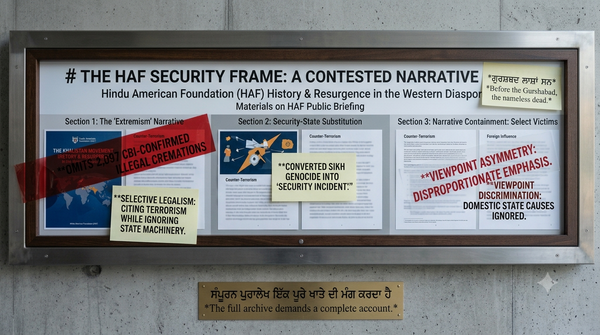
There is a response to this archive that the state has, in fact, already given — and it is the most revealing response of all, because it is the opposite of the one a state confident in its records would give. Confronted with a publication that documents the void and demands the records, the state has moved not to produce the records but to block the publication.
The publication that hosts much of this Project, KPSGILL.COM, has been made the subject of a proceeding by the Ministry of Electronics and Information Technology under Section 69A of the Information Technology Act — the provision by which the Government of India may direct the blocking of online content. [PF] The Project has contested that proceeding through formal submission, documenting among other things the overbreadth of a blocking request that reached the entire publication while challenging only a fraction of its specific pages, and raising the question of viewpoint discrimination in the selective targeting of a Sikh accountability archive. [PF] The merits of that proceeding are the subject of the Project’s submissions and not of this article. What this article observes is the posture the proceeding discloses, because the posture is the point.
Consider the two responses available to a state that holds the records of how it treated the dead of Amritsar. The first response is production: open the files, produce the inquest registers and the death registers and the appraisals, and let the record show what the administration did. A state confident that its records would vindicate its officers would choose this response without hesitation, because the records would be its defense — the documentary proof that the duties were performed, the inquiries held, the dead accounted for. Production is the response of a state with nothing to hide. The second response is suppression: leave the records unproduced and move instead to block the publication that demands them. This is the response of a state that does not wish the question asked — that prefers to erase the demand rather than answer it. [AI]
The state has chosen the second response. It has not produced the records of Amritsar’s dead; it has moved to block the publication that requests them. And the choice is eloquent, because it inverts the behaviour that innocence would produce. A state whose records would exonerate its officers does not suppress the publication asking for those records; it produces the records and lets them speak. Only a state whose records would not exonerate — whose files would confirm the void, or whose void the files cannot fill — has a reason to prefer suppression of the question to production of the answer. The move to block KPSGILL.COM is not, of course, a confession; the state has its stated grounds, and the Project contests them. But as a matter of revealed posture, the choice to suppress the demand rather than satisfy it is the choice of an institution that does not want the records examined — which is precisely the posture this archive has alleged from the beginning. The state that engineered the void by withholding the records now moves to block the demand that the void be filled. The suppression and the original silence are two expressions of a single disposition: that the dead of Amritsar shall not be accounted for, and that those who insist they be accounted for shall, if possible, be silenced. [AI]
This is why the instrument of the open ledger matters more, not less, in the face of the blocking. A demand that can be defeated by blocking a single website is fragile. But the Right to Information is not lodged in any website; it is a statutory right of every citizen, exercisable through every Public Information Officer in the country, replicable without limit. The state may move to block a publication. It cannot block the right to file a request. It may suppress an archive. It cannot suppress the citizenry’s standing entitlement to ask, of the state’s own machinery, for the records the law required the state to keep. The blocking of the publication and the openness of the ledger are therefore in direct tension, and the ledger is the more durable of the two — because the publication can be blocked, but the demand it carries has been set loose, in this article, into the hands of anyone who will file it. The state may erase the messenger. The message — file for the records of Amritsar’s dead — is now beyond its reach. [AI]
It is worth naming the inversion at its most general, because it recurs wherever states confront demands for accountability and it is always diagnostic. A state in possession of exculpatory records and a clear conscience meets a demand for those records with disclosure; it has every incentive to produce them, because the records are its vindication. A state whose records would not exculpate meets the same demand with procedural resistance, with exemptions, with delay, and — where the law permits — with the suppression of the demand itself. The choice between disclosure and suppression is therefore not a neutral choice between two equally available administrative options; it is a revealed preference that tracks what the records would show. The history of accountability for state atrocity is, in large part, the history of this inversion: the regimes with the least to fear from their archives opened them, and the regimes with the most to fear sealed them, blocked them, and prosecuted those who sought them. A state’s posture toward the demand for its records is, in this sense, a confession of what it expects the records to contain. [AI]
Measured against this, the Indian state’s posture toward the Amritsar record is unambiguous. It has not opened the archive of how it treated the district’s dead; it has moved to block the publication that asks for it. It has not produced the inquest registers, the death registers, the appraisals, the inquiry files; it has invoked the machinery of content-blocking against the demand. This is the posture of a state that does not expect its records to exculpate — and the posture is consistent, across thirty years, with everything else this archive has documented: the engineered void in the 1990s, the certified silence across the careers, the curated forgetting in the memoirs, and now the suppression of the demand in the present. Each is an expression of the same settled disposition, that the dead of Amritsar shall not be accounted for. The blocking is not an aberration in an otherwise forthcoming record. It is the most recent entry in an unbroken ledger of refusal — and, like every entry in that ledger, it tells the public, by the state’s own conduct, what the state will not say in words. [AI]
VI. The Archive That Cannot Be Closed
Impunity, in the end, is a wager on time. It is the bet that the institutions can outlast the demand — that the documenters will tire, the families will pass, the public will forget, and the question will close of its own exhaustion. Every silence examined in this archive is, at bottom, an instance of that wager: the bet that if the records are withheld long enough and the demand suppressed thoroughly enough, the matter will simply end, unredressed, as so many matters have ended. The open ledger is designed to make that wager unwinnable.
It is designed to do so by being unclosable. An archive that depended on a single documenter could be outlasted; the documenter is mortal. An archive that depended on a single publication could be blocked; the publication is vulnerable. But an archive whose central instrument is a replicable demand, set loose into a citizenry that holds an inexhaustible statutory right to ask, cannot be outlasted or blocked, because it does not depend on any single person or platform. Each refusal the state issues becomes a new entry in the record — proof of what was asked and what was withheld. Each confession of non-existence becomes a finding — the state’s own acknowledgment of the void. Each new citizen who files renews the demand the state hoped had died. The archive does not close because the right that animates it does not close, and the dead it holds remain, in its pages, a standing claim on the record that the passage of time does not extinguish and that no single act of suppression can erase. [AI]
This is the answer to the wager on time. The institutions bet that the question would close; the open ledger ensures that it cannot. For as long as the records remain unproduced, the demand for them remains live, and every year of continued withholding is not a year closer to the matter’s end but one more year of documented refusal added to the record. Time, which impunity counts as its ally, becomes instead the medium in which the unanswered demand accumulates. The longer the state withholds the records, the longer the ledger of its refusals grows, and the more completely the void it engineered is documented as a void it continues to maintain. The archive that cannot be closed converts the patience of impunity into the evidence of impunity. The wager on time is lost the moment the demand is made unclosable — and this article makes it unclosable. [AI]
The dead of Amritsar are held in this open ledger not as a memorial but as a claim. A memorial commemorates the past and asks nothing; a claim asserts a debt and demands payment. The 1,238 unidentified, the 2,097 cremated, the disappeared whose families still search — they are entered in this ledger as creditors, not as the commemorated, and the debt they are owed is precisely the record the state withheld: the inquest, the registration, the name, the account. The open ledger keeps that debt on the books. It does not let the account be closed by the death of the creditors or the passage of the years or the blocking of the archive. It holds the claim open against the state, in the state’s own machinery, until the debt is paid in the only currency that can pay it — the production of the records, or the confession that they were never made. [AI]
There is a moral logic to the metaphor of the debt that should be made explicit, because it answers the deepest objection of all — the objection that the dead are beyond help and the demand therefore futile. A debt does not lapse because the creditor has died; it passes to those who stand in the creditor’s place, and it remains owed until it is paid or formally forgiven. The debt the state owes the dead of Amritsar — the inquest it did not conduct, the registration it did not make, the name it did not record, the account it did not give — did not lapse when the dead were killed, and it does not lapse as the years pass. It passes to their families, who hold the right to truth in the dead’s place, and through them to the society whose covenant with its members the state violated. The dead cannot be restored; that is not what is owed. What is owed is the acknowledgment — the record, the name, the account — and the acknowledgment can still be made, because acknowledgment is not bounded by the lifetime of the acknowledged. A name can be restored to a man thirty years dead. A death can be recorded thirty years late. An account can be given of what was done, however long after it was done. The debt is payable still, and its payability is what makes the demand for it not futile but obligatory. The open ledger keeps the debt on the books precisely because it can still be paid, and a debt that can be paid and is not is not a closed matter but an outstanding one — outstanding against the state, in the names of the dead, for as long as the records remain withheld. [AI]
VII. The Anticipated Defences and Their Answers
This article advances an instrument of demand, and the instrument must be tested against the objections it will meet. They are set out below and answered on the record.
First: the records are decades old, and many categories of official record are routinely destroyed under retention schedules; their absence today proves only the ordinary attrition of old files, not concealment. The answer is threefold. Many of the records in the ledger fall outside any routine destruction schedule: inquest registers, death registers, the appraisal records of senior officers, and files relevant to matters of judicial and human rights concern are subject to long or permanent retention precisely because of their enduring significance. Where a destruction schedule is invoked, it is itself testable: the state can be asked to produce the destruction certificate, the authorisation, and the record of what was destroyed and when — and the absence of those, in turn, becomes a finding. And decisively, the substantive omission is not in doubt and does not depend on the records: the Central Bureau of Investigation already established that the inquiries were not conducted and the dead not accounted for. “Lost records” cannot explain a void that the state’s own investigative agency confirmed substantively. The retention-schedule defense addresses the paper; it does not touch the established fact of the dereliction the paper would have documented. [AI]
Second: the Right to Information is being weaponised to harass retired officials and to pursue a political agenda against the state. The answer is that the demand is for records the law required the state to create, in a matter of confirmed mass atrocity adjudicated by the state’s own Supreme Court. To seek the documentary basis of accountability for 2,097 illegal cremations is not harassment; it is the exercise of a constitutional and statutory right in the service of the most serious public interest a society can have — the accountability of the state for the killing of its own citizens. The “harassment” framing is, moreover, the same instrument of delegitimisation as the move to block the publication: it recasts the demand for accountability as an attack on the officials, inverting the moral structure so that the comfort of the powerful is protected and the claim of the dead is dismissed. A society that treats the demand for atrocity records as harassment has decided that its dead may not be counted. This archive declines that decision. [AI]
Third: the demand serves no purpose three decades on; it cannot restore the dead or convict the responsible, and it only reopens wounds that time has begun to close. The answer is that the purpose is the rule of law and the discharge of a debt that time does not extinguish. The records are owed to the families regardless of whether any prosecution follows; the right to know the fate of one’s disappeared, to recover the name of one’s dead, to compel the state’s acknowledgment of what it did, is not contingent on the prospect of conviction. And the premise that time has closed the wounds is false: the wounds remain open precisely because the records were never produced, the dead never named, the account never given. One cannot reopen a wound that never closed. The demand does not reopen the wound; it seeks the only thing that could ever begin to close it — the truth the state has withheld. [AI]
Fourth: the state has legitimate security and privacy exemptions, and some of these records are properly withheld under the law. The answer is that genuine exemptions exist and may be claimed — and that the appellate machinery of the Right to Information exists precisely to test whether a claimed exemption is genuine or pretextual. The archive does not assert that no exemption could ever apply to any record; it asserts that the blanket invocation of security or privacy to shield the administrative records of a confirmed mass atrocity, thirty years on, is a claim that must be contested and adjudicated, not accepted on the state’s say-so. A thirty-year-old inquest register, a death register, an appraisal record — these rarely meet the genuine threshold of a security exemption, and where the state claims they do, the claim itself becomes a matter of record and a subject of appeal. The exemptions are a contest to be had, not a wall that ends the demand. [AI]
Fifth, and strongest: even the confirmed absence of a record does not prove that the underlying duty was not performed; records are lost, misfiled, and destroyed, and an absent inquest register does not establish that no inquest was held. The answer distinguishes what the records are sought to do. They are not sought to prove the omission, which is already established substantively by the Central Bureau of Investigation’s findings and the Supreme Court’s characterisation; the omission does not depend on the absence of the registers. They are sought to complete the documentary record and to compel the state’s formal acknowledgment of what its own investigation already found. And as a matter of inference, the principle established earlier in this article holds: where a mandatory duty would necessarily have generated a specific record, the confirmed absence of that record is strong evidence of non-performance, and it shifts to the state the burden of explaining how the duty was discharged without leaving the trace that discharge necessarily creates. The state is free to offer that explanation. It has never done so, because the explanation does not exist: the duties were not performed, the records were not made, and the absence is not the accident of lost paper but the designed result of a documentary crime. [AI]
When the objections are answered, the instrument stands: a consolidated, replicable, unclosable demand for the records the state was bound to create, framed so that every response advances the truth, lodged in a right the state cannot suppress, and held open against the state until the records are produced or their absence finally confessed.
VIII. The Open Ledger
Every silence this Project has documented was a bet that the question would close. The silent pen bet that the unwritten inquest would never be missed. The out-published archive bet that the dead could be buried beneath the volume of other words. The rewarded cadre bet that the clean file would settle the matter. The absent defense bet that an inquiry could be named and never produced. The unbroken line bet that an office could transmit its silence across three hands and outlast every demand. And the state, confronted at last with an archive that would not accept the silence, bet that it could block the publication and erase the demand. Every one of these is a wager that time and power, between them, would close the question of Amritsar’s dead.
The open ledger is the refusal of that wager. It is the conversion of the archive from a record into an instrument — from a documentation of the void into a standing demand that the void be filled or confessed. It gathers every record the state was bound to create and could not, every document whose absence is itself a finding, and it sets them loose as a template that any citizen may file, through a right that cannot be exhausted, in a matter that cannot, while the records remain unproduced, be closed. It holds the dead of Amritsar on the books as creditors of the Republic, and it keeps the account open against the day the debt is paid.
The governing principle of this Project holds that the moral sequence demands going to the dead first — before the Word, the cremation ground. For twelve years, three District Magistrates went to the cremation ground and never wrote the Word — never the inquest, never the registration, never the name. The open ledger is the demand that the Word be written at last: that the records be produced, the dead be named, the account be given, even now, even thirty years on, even against a state that would prefer to block the question than answer it. The Word the office refused to write in 1995 is the Word this ledger demands in 2026 — and will go on demanding, through every refusal and every confession of absence, for as long as the records remain unproduced.
A ledger is closed when the account is settled. This one is open, and it will remain open, because the account of Amritsar’s dead has never been settled and the state has chosen suppression over settlement. The Project will keep filing. It will keep recording the refusals. It will keep the names of the demanded records before the public, and the claim of the dead before the state, until the files are opened or their emptiness is so completely confessed that the void stands beyond any denial. The dead were entered in no register thirty years ago. They are entered in this one now. And this ledger does not close.
This article forms part of the Punjab ‘95 Forensic Series and The Death Certificate Project. It is a consolidation of the standing record demands generated across the series and an account of the Right to Information as an instrument of accountability. The records identified are documents the law required the state to create or hold; the proceeding under Section 69A is referenced as a matter of public record, its merits being the subject of the Project’s separate submissions. Claims are graded by evidentiary tier. The ledger is offered as a template for any citizen entitled to file, and the Project will record the fate of every request. Corrections supported by documentary evidence will be recorded in the Project’s public corrections register.