The Forty-Nine Days: Satluj on Screen, the CBI on Paper, and the File the District Magistrate Never Opened

ਗੁਰਸ਼ਬਦ ਤੋਂ ਪਹਿਲਾਂ, ਸ਼ਮਸ਼ਾਨਘਾਟ Before the Gurshabad, the cremation ground.
A forensic reconciliation of cinematic chronology and documentary record in the captivity of Jaswant Singh Khalra, September–October 1995, with an accounting of what Amritsar's civil administration left undone
By Dr. Kanwar Partap Singh Gill, M.D. Publisher and Editorial Director, TheDeathCertificate.org and KPSGILL.COM (No relation to the late Kanwar Pal Singh "K.P.S." Gill, IPS, Director General of Police, Punjab.)
I watched Satluj on the weekend of its uncut global release, three years and two title changes after the Central Board of Film Certification first opened a file on a script then called Ghallughara. I watched it, as I suspect most viewers connected to this history did, with the documentary record open on a second screen. What I found was not the wholesale invention that cinematic treatments of state violence often produce. It was something more interesting and, for the purposes of this publication, more useful: a broadly faithful screen rendering of a custodial sequence — Kang, then Jhabal, then a room in Manawala, then Jhabal again, then Harike — compressed into the pacing a feature film requires, alongside one omission that no compression can excuse. The film has no scene set inside the Deputy Commissioner's office. Neither, as this essay will show, does the documentary record.
That absence is the actual subject of this piece. The location-by-location sequence Diljit Dosanjh's Khalra moves through on screen tracks, with reasonable fidelity, the sequence established by CBI evidence and credited by three levels of the Indian judiciary. Where cinema and record diverge is not principally in geography. It is in duration, in the specific mechanism of institutional failure, and in the fact that the civilian officer with statutory authority over every police station Khalra passed through — Karanbir Singh Sidhu, IAS, Deputy Commissioner and District Magistrate of Amritsar from 11 May 1992 to 11 August 1996 — appears in neither the film nor the case record as having done anything at all.
This essay proceeds in the four-tier register this publication uses throughout its work: Proved Finding [PF] for what courts, CBI evidence, and contemporaneous documentation establish; Documented Allegation [DA] for serious claims resting on identifiable testimony or sourcing not yet tested to that standard; Analytical Inference [AI] for reasoned conclusions drawn from pattern, statute, and omission; and Panthic Memory [PM] where the civilizational record, rather than the case file, is the appropriate register. Readers should hold the categories apart. The strength of an accountability argument lies precisely in not needing to blur them.
I. What the Screen Shows
As rendered on screen, Khalra's abduction from outside his home is followed by a custodial sequence that runs, in the film's own internal logic, across an extended and clearly marked span of weeks rather than days: an initial detention at Kang, a transfer to what plays, dramatically, as a "safe house" adjoining Jhabal police station, a journey to a private residence in Manawala for a confrontation staged in the presence of the Director General of Police, a return to Jhabal, and the killing there before the disposal of the body at the Harike headworks on the Sutlej.
I want to be precise about what I am and am not claiming in this section. This is a description of the film as I experienced it, not an independently authenticated transcript, and I have not had access to a shot-by-shot record against which to check my own memory of pacing. Readers who watch the film and note discrepancies from this account — in dialogue, in the compression or expansion of any single leg of the journey, in details of characterization — should treat the documentary reconstruction in Section II, not my viewing notes, as the governing record. What I can say with confidence is the structural point: the film does not invent a geography. It dramatizes one that the CBI investigation and the subsequent trial independently established. That is worth stating plainly, because it cuts against the easier and lazier criticism — that a Bollywood treatment fabricated a persecution narrative. It did not. If anything, the film's sin is compression, not invention, and compression is the occupational hazard of the two-hour form, not evidence of dishonesty.
II. What the Record Establishes — [PF]
The documentary spine is not drawn from advocacy literature alone. It is drawn substantially from the judgment of the Supreme Court of India in Prithipal Singh Etc. v. State of Punjab & Anr. Etc., decided 4 November 2011, and from the testimony that judgment credits.
The abduction. On 6 September 1995, while washing his car outside his home in Amritsar, Jaswant Singh Khalra — director of a cooperative bank in the city and General Secretary of the Human Rights Wing of the Shiromani Akali Dal — was taken by Punjab Police personnel. The police denied, then and for years afterward, that he was ever in their custody. His wife, Paramjit Kaur Khalra, filed a habeas corpus petition before the Supreme Court within days.
The forty-eight days at Kang. Kikkar Singh, himself illegally detained at Kang police station in Tarn Taran, testified to the CBI that he saw Khalra there — severely tortured, fed by Kikkar Singh himself — forty-eight days after the abduction, and that Khalra was moved out of Kang on 24 October 1995. Amnesty International's contemporaneous reporting on the CBI investigation corroborates the Kang detention independently of the film, the Project's prior work, or Kikkar Singh's testimony alone.
Jhabal, and the room with the keys. Special Police Officer Kuldip Singh — attached to SHO Satnam Singh at Jhabal police station, and the witness whose 2005 testimony the trial court and the Supreme Court both credited — stated that Khalra was detained in a room at Police Station Jhabal, that Kuldip Singh himself was assigned to feed him under instructions to keep the matter secret, and that Khalra had grown weak and showed scratch marks consistent with the beatings Kikkar Singh had already described.
Manawala. According to Kuldip Singh's testimony as recorded in the Supreme Court's judgment, Satnam Singh took Khalra — with the witness present — to the Tarn Taran residence of Senior Superintendent of Police Ajit Singh Sandhu, where, in the witness's words as credited by the Court, "some high officials of police including the then Director General of Police, Punjab, came there and they talked to Shri Jaswant Singh Khalra in a closed room." Kuldip Singh separately told the Special CBI Court in February 2005 that he saw K.P.S. Gill enter that room and remain inside it for roughly half an hour. Khalra was then returned to Jhabal.
The killing. Some days later, at approximately 7 p.m., DSP Jaspal Singh returned to Jhabal with his bodyguard; SHO Surinderpal Singh, SHO Jasbir Singh, and Head Constable Prithipal Singh followed. Khalra was shot and his body was disposed of in the Harike canal.
Adjudication. Six Punjab Police officials were convicted on 18 November 2005; DSP Jaspal Singh and Amarjit Singh received life sentences at trial, while Satnam Singh, Surinder Pal Singh, Jasbir Singh, and Prithipal Singh initially received seven years. On 16 October 2007, a Division Bench of the Punjab and Haryana High Court enhanced the latter four sentences to life imprisonment. On 4 November 2011, the Supreme Court dismissed the final appeals, upholding life imprisonment for the four whose sentences had been enhanced. Senior Superintendent of Police Ajit Singh Sandhu did not stand trial; he died in May 1997 in circumstances officially recorded as suicide — a circumstance this publication treats, absent further documentary substantiation, as a Documented Allegation rather than a Proved Finding as to cause. K.P.S. Gill was never charged in connection with Khalra's abduction or murder, notwithstanding Kuldip Singh's testimony placing him in the room at Manawala; Paramjit Kaur Khalra publicly and repeatedly pressed the CBI to reconsider that omission from the chargesheet. That Gill was named by credited testimony but never personally tried is itself part of the record this essay is reconstructing — it belongs in the ledger as a Documented Allegation, not as an adjudicated finding against a man who did not answer for it in court.
I want to flag one point of internal discipline here, because this publication holds itself to it elsewhere: the sequence above — Kang, Jhabal, Manawala, Jhabal, Harike — is a Proved Finding, resting on testimony credited across three judicial levels. The precise calendar dates separating the Jhabal, Manawala, and killing phases are not uniformly fixed in the public record with the same specificity as the Kang phase, where Kikkar Singh's "forty-eight days" gives a hard anchor (6 September plus forty-eight days lands on 24 October 1995, and the arithmetic holds exactly). The testimony governing the later legs is expressed in relative terms — "after four to five days," "after about three days" — rather than fixed dates. Readers should treat any calendar-date reconstruction of the final week of Khalra's life, including any such reconstruction this Project has previously published, as an Analytical Inference built on the relative sequence rather than as a directly quoted date from the judgment itself. Precision about the limits of precision is not a concession; it is what makes the rest of the argument durable.
III. Where Cinema and Record Actually Diverge
Given the above, the "discrepancy" worth publishing is narrower than it might first appear, and more damning for being narrower. The film did not relocate Khalra to fictional black sites. It kept him inside two named police stations and one police officer's private residence — the exact institutional footprint the record establishes. The real distortion is temporal: a captivity that ran to roughly seven weeks is necessarily compressed on screen into a sequence of scenes that plays, to an audience without the chronology in front of them, as a matter of days. That compression is not dishonest; it is what narrative cinema does with any extended ordeal. But it has a side effect worth naming precisely because this publication's entire project is the restoration of duration and place to abstracted violence: a viewer who did not already know the record will walk away from Satluj without registering that a Deputy Commissioner's entire summer and autumn passed, that a Supreme Court habeas corpus petition sat unanswered by result for weeks, and that no scene — because no evidence exists to dramatize — shows a District Magistrate doing the one thing his office existed to do.
IV. The Statutory Architecture That Went Unused — [PF] and [AI]
None of what follows requires speculation about what Karanbir Singh Sidhu knew in real time in September and October 1995. It requires only the statute book, his undisputed tenure dates, and the absence of any surviving trace of their use.
Section 4 of the Police Act of 1861 subordinates district police administration to "the general control and direction" of the District Magistrate. Rule 1.15 of the Punjab Police Rules, 1934, designates the District Magistrate as head of the district's criminal administration and the police as "the instrument provided by Government to enable him to enforce his authority." Rule 1.11 requires the DM's concurrence for changes in the force's disposition; Rule 1.7 positions the range DIG as his advisor, not his superior. None of this authority was suspended by the counterinsurgency emergency. AFSPA, TADA, and the National Security Act expanded police power; they did not, on their text, extinguish the civil magistracy's oversight of that power.
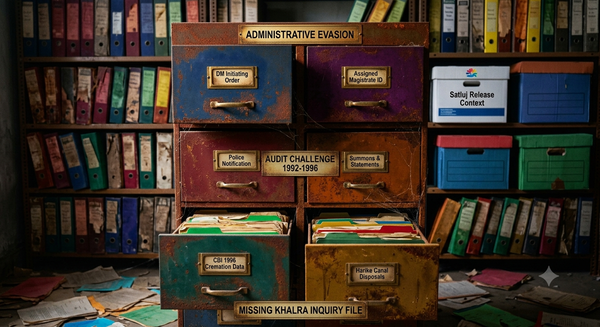
Most directly relevant to the Khalra captivity is Section 97 of the CrPC, which permits a District Magistrate, Sub-Divisional Magistrate, or first-class Magistrate to issue a search warrant on nothing more than "reason to believe" that a person is confined under circumstances amounting to an offence. Indian courts — in Anuara Begum v. Habil Mea and Jay Engineering Works v. State of West Bengal — have held that the threshold is deliberately low precisely because the provision exists to move faster than a full inquiry would allow. By September 1995, a sitting Supreme Court habeas corpus petition, filed by Khalra's own wife, supplied more than "reason to believe." It supplied a live proceeding in the country's highest court. No Section 97 warrant naming Kang, Jhabal, or any Tarn Taran chowki appears in any reported proceeding I have located, in this Project's prior work, or in the two internal analyses this essay draws on.
Rule 16.38 of the Punjab Police Rules required that any complaint alleging a criminal offence by a police officer in connection with official duties be routed to the District Magistrate for a decision on departmental versus judicial proceeding, with an Executive Magistrate available to conduct an independent inquiry. The Supreme Court has since held, in Delhi Administration v. Chanan Shah and Union of India v. Ram Kishan, that this procedure is mandatory rather than directory. Whether that mandatory channel was ever invoked in relation to the disappearance of a sitting bank director and known human-rights investigator, during the exact months of his illegal detention, is a question this Project has been unable to answer in the affirmative from any document in the public record.
None of this establishes that Sidhu knew, on any given day in October 1995, that Khalra was at Jhabal. It establishes something narrower and, for accountability purposes, sufficient: that the office existed to find out, that the threshold for using it had been met by any reasonable reading of Section 97, and that thirty-one years later, no document has surfaced showing it was used.
V. Omission and Commission, Properly Distinguished
This publication has previously framed the district magistracy's conduct in the Khalra matter as "misconduct by omission and commission." That phrase deserves more precision than a headline usually allows, and precision is owed here in particular, because collapsing the two registers is exactly the kind of imprecision that lets a defensible argument be dismissed alongside an indefensible one.
The omission is 1995 conduct: the non-use of Section 97, the absence of any surfaced station-diary demand, the absence of any Rule 16.38 referral, sustained across roughly seven weeks in which a named individual was known to the public, to the press, and to the Supreme Court of India to be missing. This is Proved Finding as to what the record does not contain, and Analytical Inference as to what that absence means about the discharge of a non-delegable statutory duty.
The commission, if the term is to be used honestly, cannot refer to the murder itself — no court, no CBI chargesheet, and no witness this Project has identified places Sidhu inside Jhabal, Manawala, or Harike, and it would be a serious misstatement of the record to imply otherwise. What "commission" can properly refer to, and what this essay treats as a live and separate question, is conduct in 2026: a public claim, reported to have been made in a televised interview earlier this year, that an inquiry into Khalra's disappearance was ordered from the Deputy Commissioner's office at the time. I have engaged directly with Mr. Sidhu on this specific point on several occasions over recent months, and as of this writing — 4 July 2026 — no inquiry file, no docket number, no Section 176 report, and no correspondence substantiating that claim has been produced, by him or by any archive this Project has been able to locate. A claim of institutional action, made three decades after the fact and unaccompanied by the file that would prove it, is not itself proof of anything — but it is a fact about the present, not the past, and it belongs in this essay as a Documented Allegation resting on the author's own direct engagement: serious enough to record, not yet substantiated to the standard this publication otherwise insists on. I would be glad to correct this section immediately upon sight of the file.
VI. The Screen Cut and the File That Was Never Filed
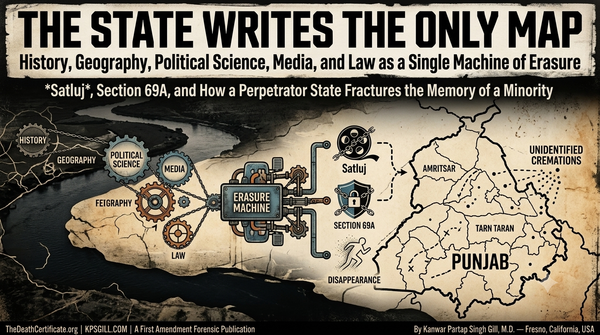
The censorship history of Ghallughara/Punjab '95/Satluj is, on its own terms, well documented: an Examining Committee review beginning in late 2022 that cleared the film only with cuts and a mandated title change away from a word — Ghallughara — that names atrocity directly; a Revising Committee escalation that public reporting places anywhere from the mid-eighties to the one-hundred-and-twenties in cumulative cut demands, a spread this essay will not resolve further than to note it, since even this Project's own prior audit and the wire reporting following the film's release do not agree on a single figure; and a final release, uncut, under a third title, on 3 July 2026 — nearly thirty-one years after the events it depicts.
That history matters here for one reason. The Central Board of Film Certification's cuts targeted place names — the removal of direct references to Amritsar and Tarn Taran was itself demanded and, in earlier certification rounds, accepted. A censor board spent three years negotiating over whether audiences could be told where this happened. The Deputy Commissioner's office of the district in question has spent thirty-one years without producing a single document showing that anyone in it asked the same question in real time. The state's twenty-first-century anxiety about naming the place on screen is, in that light, a strange mirror of its twentieth-century silence about investigating the place in fact. Both are acts of place-management; only one carries a censor's stamp.
VII. Why This Distinction Should Not Be Softened
I am aware that a comparison of this kind will be read by some as insufficiently forgiving of a retired civil servant operating inside an emergency architecture not of his own design, and by others as insufficiently severe toward a man who, on this record, held every legal tool needed to find a missing human-rights defender and left no trace of having reached for one. Both readings deserve a direct answer.
To the first: nothing in the CrPC, the Police Act, or the Punjab Police Rules was suspended by the counterinsurgency, and Indian courts have said so in terms — the "reason to believe" threshold under Section 97 was designed for exactly this kind of emergency, not despite it. To the second: this essay has deliberately not asserted that Karanbir Singh Sidhu knew where Jaswant Singh Khalra was being held, because no evidence available to this Project supports that specific claim, and the distinction between failing to use a power that would likely have found him and knowing and concealing his location is not a technicality — it is the difference between an indictable act and an institutional failure, and this Project's credibility depends on not blurring the two for rhetorical convenience.
What can be said without hedging is this: the office existed, the threshold was met, the silence has now outlasted the emergency that might once have excused it by three decades, and the public statement that an inquiry was undertaken remains, as of today, a claim without a file.
VIII. Closing
Satluj got the map right. Kang, Jhabal, Manawala, Jhabal, Harike — the film's geography is the CBI's geography, credited by the Supreme Court of India in 2011 and now, at last, visible on a streaming platform without the place names cut out of it. What the film could not show, because no one has ever produced the material to show it, is a single scene inside the office of the man whose statutory desk sat above every one of those stations. Cinema compressed seven weeks into two hours. The civil administration, given seven weeks in real time and a Supreme Court petition to prompt it, produced nothing at all. Between those two silences — one a function of running time, the other of thirty-one years — this publication chooses to keep asking the second to explain itself.
ਗੁਰਸ਼ਬਦ ਉੱਠਣ ਤੋਂ ਪਹਿਲਾਂ, ਸ਼ਮਸ਼ਾਨਘਾਟ ਸੜ ਚੁੱਕਾ ਸੀ। Before the Gurshabad could rise, the cremation ground had already burned.
Waheguru Ji Ka Khalsa, Waheguru Ji Ki Fateh.
Sources consulted: Prithipal Singh Etc. v. State of Punjab & Anr. Etc., Supreme Court of India, 4 November 2011 (Indian Kanoon); Jangveer Singh, "K.P.S. Gill visited Khalra in jail, says witness," The Tribune, 17 February 2005; Amnesty International, India: A Mockery of Justice (ASA 20/007/1998); coverage of the Satluj release, 3–4 July 2026, including Variety, Bollywood Hungama, PTI/Babushahi, and The Tribune's report of Paramjit Kaur Khalra's statement on the released cut; the Project's prior audit, "Punjab '95 and the Silence of KBS Sidhu" (KPSGILL.COM); and the two internal Project analyses on the Amritsar civilian-oversight failure and the CBFC certification history that this essay reconciles against the above primary and press sourcing.