The Audit of the Silent Pen

The 1,238 Unnamed Inquests — Sections 174 and 176 of the Code of Criminal Procedure and the Engineered Collapse of the Amritsar Magisterial Ledger, 1984–1996
ਸ਼ਬਦ ਤੋਂ ਪਹਿਲਾਂ, ਸ਼ਮਸ਼ਾਨਘਾਟ
Before the Gurbani, the cremation ground.
A Note on Evidentiary Method
This article grades every material claim according to the standing framework of The Death Certificate Project. [PF] denotes a Proved Finding — a fact established by judicial record, official document, statutory text, or convergent documentary evidence of the highest reliability. [DA] denotes a Documented Allegation — a serious, sourced claim not yet conclusively adjudicated. [AI] denotes an Analytical Inference — a conclusion drawn from the structure, timing, omissions, and internal contradictions of the record. [PM] denotes Panthic Memory — the inherited, lived, and morally continuous record preserved by Sikh families, institutions, and witnesses. [Q] denotes an Unanswered Public Question, and [Q-RTI] an RTI-ready record request whose production or formal denial would itself constitute evidence. Statutory provisions are stated as matters of law and are not tiered; where the law of a given period differs from the law as later amended, that difference is identified expressly, because an argument that misstates the governing statute is an argument that does not survive its first encounter with hostile counsel.
This article does not repeat the ground covered in the Project’s earlier study, 2,097 Deaths. Zero Inquest Reports., which established the gross statutory failure of the inquest function across Amritsar District. It proceeds instead to a narrower and more disturbing question. Not why the inquests were absent — but how their absence was manufactured. How a civil administration holding comprehensive statutory authority arranged for the mandatory predicates of inquiry never to enter the record. And how that arrangement converted 1,238 human beings into a permanent administrative silence from which no name has yet been recovered.
I. The Question the Ledger Was Built to Avoid
The Central Bureau of Investigation confirmed, in the matter that reached the Supreme Court of India, that 2,097 persons were illegally cremated in the single district of Amritsar. [PF] Of these, 585 were fully identified, 274 were partially identified, and 1,238 were entirely unidentified — cremated as anonymous matter, without a recorded name, without a notified family, without a post-mortem examination, and without the single document that the law of every civilised jurisdiction treats as the irreducible minimum owed to a human death: a record of who died, and how. [PF]
It is on the 1,238 that this article fixes its attention, because the 1,238 are where the machinery shows itself most clearly. A body that is identified and then cremated without inquest is a documented dereliction; the family knows, the name survives, and the failure can in principle be reconstructed. A body that is cremated as unidentified is something categorically worse. It is a person from whom the state has removed not only life but legibility — the capacity to be named, mourned, counted, and litigated. The fire destroyed the body. The absent inquest destroyed the record of the body. This is double erasure, and it was not the accidental by-product of administrative overload. It was the designed output of a process whose entire purpose was to ensure that the dead could never be reassembled into persons.
The conventional framing of this history asks why the District Magistrate did not order inquiries. That framing concedes too much. It assumes a model in which the deaths arrived at the magistrate’s desk as recognised facts, and the magistrate then declined to act upon them. The truth is structurally prior to that. The deaths were arranged so that they never arrived at the desk as facts at all. The mandatory duty to inquire is triggered only by a predicate — a recorded arrest, a recorded custody, a body presented as suspicious. The Amritsar system did not openly refuse the duty. It dismantled the predicate. And it is precisely because the dismantling was quiet, distributed, and procedurally invisible that it has been mistaken, for thirty years, for inaction rather than for what it was: a coordinated administrative method.
This is the distinction the present article exists to draw. Inaction is the failure to perform a duty. The engineering of absence is the construction of a state of affairs in which the duty never legally arises. The first is negligence and can be excused by the conditions of the time. The second is design and cannot. To establish which of the two occurred in Amritsar, one must hold three things in view at once: the documented factual record of what happened at the cremation grounds, the precise content of the statutory duties that the law imposed, and the relationship between the two. The remainder of this article takes them in that order.
II. The Factual Record — The Three Grounds, the Firewood Ledger, and the Arithmetic of Erasure
Before the law can be applied, the facts must be stated, and they must be stated as the Indian State’s own record establishes them, because the strength of this archive lies in its refusal to rest on anything a hostile reader could dismiss as diaspora assertion. Every load-bearing fact in the paragraphs that follow is drawn from the findings of the Central Bureau of Investigation, the orders of the Supreme Court of India, the proceedings of the National Human Rights Commission, or the judgments of the criminal courts. They are not the allegations of the aggrieved. They are the conclusions of the state’s own investigative and judicial machinery. [PF]
The discovery did not begin with a commission or a court. It began with a single human rights worker and a set of municipal financial records. Jaswant Singh Khalra, a bank employee and General Secretary of the Human Rights Wing of the Shiromani Akali Dal, undertook in the mid-1990s to establish what had become of the disappeared of Amritsar — the persons whose families said they had been lifted by the police and never returned, and whose status the administration recognised under no legal category at all. His method was not the method of an investigator with subpoena power. It was the method of an accountant. He cross-referenced the purchase registers of the municipal cremation grounds — the records of firewood requisitioned and consumed — against the cremations the state acknowledged. Firewood is not consumed by an empty pyre. Where the wood was bought and burned but no death was registered, no family was present, and no name was recorded, the only explanation consistent with the arithmetic was a body cremated in secret. [PF] From these ordinary administrative ledgers, Khalra reconstructed a pattern of thousands of unacknowledged cremations across three grounds in Amritsar District: the cremation grounds at Patti, at Tarn Taran, and at Durgiana. [PF]
That these were public administrative documents is a fact this article will return to with some force, because it disposes of the central defence of the magistracy before that defence is even raised. The firewood registers belonged to the Municipal Committee. The Municipal Committee reported, on routine matters of expenditure, to the office of the Deputy Commissioner. [PF] The records from which a bank officer with no administrative authority reconstructed the secret cremation of thousands were the same records that crossed, or could have crossed, the desk of the district’s chief civil officer. The information was not buried in a classified file. It was buried in a firewood account.
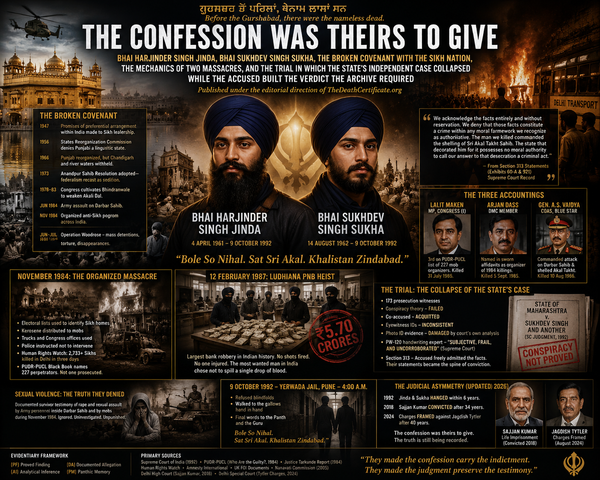
Khalra made his findings public. In January 1995 he held a press conference and issued documentation alleging the secret mass cremation of thousands. On 6 September 1995, he was abducted from outside his home in Amritsar by Punjab Police personnel. [PF] The last evidence of his being alive in custody dates to 24 October 1995 — a span of forty-nine days, inclusive, during which the man who had exposed the cremation grounds was himself held in the custody of the force he had exposed, in the jurisdiction of the District Magistrate, while the constitutional courts were being petitioned for his production. [PF] He did not emerge. His abduction and murder later produced the only criminal convictions this entire history has yielded: in proceedings carried through the trial court, the High Court, and the Supreme Court, six Punjab Police officials were convicted in connection with his abduction and murder, and four life sentences were upheld by the Supreme Court on 4 November 2011. [PF]
The forty-nine days are the subject of other studies in this archive. What matters here is the forensic asymmetry they establish. The state proved capable, eventually, of convicting the men who killed the witness. It has never been capable — because it has never tried — of holding to account the administrative offices that permitted the thousands of cremations the witness had exposed. The man who documented the erasure was avenged, after sixteen years, in a single criminal case. The erasure itself remains, three decades on, without a single inquest, a single magisterial inquiry, or a single administrator answering for the office he held. The conviction of the killers and the impunity of the system are not in tension. They are the same fact viewed from two angles: a state will, under sufficient pressure, prosecute the hands that did the killing, while leaving wholly untouched the architecture that made the killing administratively invisible.
Khalra’s disclosures forced the matter into the courts. The Supreme Court of India, seised of the question through habeas and public-interest proceedings, characterised the emerging findings, on 12 December 1996, as disclosing a “flagrant violation of human rights on a mass scale,” and referred the investigation of the Amritsar cremations to the National Human Rights Commission. [PF] The Central Bureau of Investigation, directed to inquire, produced the figure that anchors this archive: 2,097 illegal cremations at the three Amritsar grounds, with the breakdown into 585 fully identified, 274 partially identified, and 1,238 entirely unidentified. [PF]
Hold that arithmetic to the light, because it contains its own indictment. The state’s own investigators, working years after the fact and without the benefit of the inquest descriptions that should have existed, were nonetheless able to fully identify 585 of the cremated and partially identify a further 274 — to put names, or fragments of names, to 859 of the 2,097. [PF] If identification was achievable retrospectively, by investigators working from the ashes of a destroyed record, it was achievable contemporaneously, by the officers whose statutory duty was to perform it at the moment of death, when the bodies were whole and the families were searching. The 859 who were identified after the fact are the proof that the 1,238 who were not could have been. The unidentified are not unidentified because identification was impossible. They are unidentified because the act of identification — the inquest description, the photograph, the recorded measurement, the matched complaint — was foreclosed at the time it would have worked, and the foreclosure was never undone. [AI]
This is the factual record on which the legal analysis now proceeds: a documented pattern of 2,097 secret cremations, reconstructed from the administration’s own financial ledgers, confirmed by the state’s own investigative bureau, characterised by the state’s own highest court as a mass violation, and partially reversed by retrospective identification that demonstrates the contemporaneous identification was always within reach. Against that record, the question is what the law required, and of whom.
III. The Statutory Architecture of an Unnatural Death
The Code of Criminal Procedure, 1973, did not leave the handling of suspicious and custodial deaths to administrative discretion. It built a sequence of interlocking obligations, each of which was supposed to make the concealment of a violent death progressively harder. The architecture is worth setting out precisely, because its coherence is the measure of how comprehensively it was defeated, and because the defence of the magistracy depends entirely on the public never being shown how many independent statutory tripwires a single secret cremation was required to cut.
The sequence begins before death, at the moment of arrest, and it begins in the Constitution. Article 22 of the Constitution of India required that a person arrested be produced before the nearest magistrate within twenty-four hours of arrest, and Section 57 of the Code reproduced that command in the language of criminal procedure. [PF] A person produced before a magistrate within a day of arrest is a person whose existence in custody is judicially recorded — a person who cannot afterward be said never to have been detained. The twenty-four-hour rule is the first and most fundamental guarantee against disappearance, because disappearance is, in its essence, the indefinite suspension of the moment of production.
Alongside it stood Section 58, which required the officer in charge of a police station to report to the District Magistrate, or to the Sub-Divisional Magistrate, all cases of persons arrested without warrant within the limits of the station, whether or not those persons had been admitted to bail. [PF] This was not a courtesy. It was the documentary tripwire by which the civil administration was to know, in something close to real time, who had been taken into the custody of the district’s police. A person whose arrest was reported under Section 58 was a person the system had acknowledged exists. Read together with the Identification of Prisoners Act, 1920, which permitted the taking of measurements and photographs of arrested persons, the law placed in the state’s own hands, at the point of arrest, both the record that a person had been detained and the means by which that person could later be identified. [PF]
The sequence continues at the moment of death. Section 174 required the officer in charge of a police station, on receiving information that a person had died under circumstances raising a reasonable suspicion that another person had committed an offence, to give intimation to the nearest magistrate empowered to hold inquests and to proceed to the place where the body lay and there make an investigation. Critically, Section 174 specified the content of the inquest report. The officer was to draw up a report of the apparent cause of death, describing such wounds, fractures, bruises, and other marks of injury as might be found on the body, and stating in what manner, or by what weapon or instrument, if any, such marks appeared to have been inflicted. Where the cause of death remained in doubt, or the circumstances otherwise warranted, the body was to be forwarded for post-mortem examination. [PF]
The phrase “describing such wounds, fractures, bruises, and other marks of injury” is the hinge of this entire article, and it returns below. For an identified body, that description is corroborative. For an unidentified body, that description is the single most important act the state can perform, because the catalogue of a person’s scars, fractures, dental peculiarities, stature, complexion, clothing, and distinguishing marks is the only bridge by which a nameless corpse can later be matched to a name. To omit the inquest description for an unidentified body is not to skip a formality. It is to sever the only rope by which that person could ever be hauled back into the world of the named.
The sequence then reaches the office that is the true subject of this archive. Section 176 of the Code, as it stood throughout the years 1984 to 1996, provided that when any person died while in the custody of the police, the nearest magistrate empowered to hold inquests shall — the word is mandatory — hold an inquiry into the cause of death, either instead of or in addition to the investigation held by the police officer. In any other case of suspicious death falling under Section 174, the magistrate may hold such an inquiry. [PF] This is the precise statutory texture that must be stated with care, because it is routinely flattened in accounts that wish to make the argument simpler than the law. For deaths genuinely in police custody, the magisterial inquiry was mandatory before 2005 and was not a matter of discretion. For other suspicious deaths, the magistrate possessed an independent and permissive power to inquire — a power he could exercise on his own motion, without waiting to be asked, and without requiring the police to invite his scrutiny.
Two further instruments complete the architecture, and both are routinely omitted from accounts that treat this history as a matter of the Criminal Procedure Code alone.
The first is the Registration of Births and Deaths Act, 1969, which made the registration of every death a mandatory statutory act, to be effected through the registration machinery of the local administration, and which required that the cause of death be recorded. The absence of a death certificate — the founding fact of this Project’s name — is therefore not only an inquest failure under the Criminal Procedure Code. It is, independently and additionally, a violation of a separate statute whose entire purpose was to ensure that no death in the territory of the state went unrecorded. [PF] A single unregistered death is an administrative lapse. One thousand two hundred and thirty-eight unregistered deaths in one district is the suspension of an Act of Parliament.
The second is the body of Police Rules governing the disposal of unclaimed and unidentified bodies, which required the police, before any such disposal, to record a description of the body, to attempt identification, and to preserve the record of that attempt. The cremation of an unidentified body was never, under the rules, supposed to be a private police act conducted at a municipal ground on the strength of a firewood requisition. It was supposed to generate a documentary residue. [PF]
And after October 1993, one further obligation attached, relevant to the final and most heavily documented phase of the Amritsar killings. With the establishment of the National Human Rights Commission under the Protection of Human Rights Act, 1993, the Commission issued directions requiring that every death in police or judicial custody be reported to it within twenty-four hours. [PF] This obligation did not exist during the tenures of the first two District Magistrates examined in this Project’s continuity studies. It existed for the entirety of the period during which the third incumbent held the office. That distinction is not a technicality. It is a date, and dates assign responsibility.
Set side by side, these instruments form a web, not a thread. Section 57 and Article 22 were supposed to produce the arrested person before a judge within a day. Section 58 was supposed to report the arrest to the civil administration. The Identification of Prisoners Act was supposed to record the means of identification. Section 174 was supposed to record the body and its injuries. Section 176 was supposed to compel an independent magisterial inquiry into the death. The Registration Act was supposed to register the death and its cause. The Police Rules were supposed to document the disposal. The Human Rights Commission directions were supposed to surface the death to an external constitutional body within a day. For a violent death to disappear completely, every one of these had to fail at once. In Amritsar, for the cremated dead, every one of them did. [PF]
A web does not fail strand by strand through coincidence. When seven or eight independent statutory channels, administered by different officers under different statutes for different purposes, all produce a null result for the same 2,097 deaths across twelve years and three successive incumbents, the correct inference is not that a series of separate accidents occurred in parallel. The correct inference is that the deaths were being processed through a method designed to leave no documentary residue in any channel. [AI] The remainder of this article establishes how that method worked, why the magistracy bears responsibility for it despite not having held the weapon, and what the record demands by way of answer.
IV. The 1,238 — What the Law Demanded for the Nameless
Return now to the inquest description, and to the 1,238.
The law’s treatment of the unidentified dead reflects an old and serious intuition: that anonymity in death is itself a danger to the living, because the body that cannot be named is the body whose killing cannot be prosecuted. This is why the inquest provisions are at their most demanding precisely where the identity is unknown. The officer conducting the inquest over an unidentified body was required to record the apparent age, the stature, the complexion, the distinctive marks, the deformities, the condition of the teeth, the clothing and ornaments, and the marks of injury — the entire physical catalogue by which a stranger’s body becomes a retrievable record. The Identification of Prisoners Act, 1920, supplied a parallel logic at the point of arrest, permitting the taking of measurements and photographs of arrested persons, so that the state held, in its own files, the means of identifying those who passed through its custody. [PF]
The architecture, in other words, contained two independent opportunities to fix the identity of every person who entered police custody and did not leave it alive. The first was at arrest, under the Identification of Prisoners Act and the Section 58 reporting duty. The second was at death, under the Section 174 inquest description and the Police Rules on unidentified bodies. A person could become permanently unidentifiable only if both opportunities were defeated — only if the arrest was never recorded and the inquest description was never made.
For 1,238 persons in Amritsar District, both were defeated. [PF]
Consider what this means as a matter of physical fact rather than legal abstraction. Each of the 1,238 was a person with a face, a height, a set of teeth, a manner of dress, and very frequently a body marked by the specific injuries of custodial violence — the healed and unhealed fractures, the ligature marks, the burns, the surgical evidence of the methods documented elsewhere in this archive. [DA] Each was, at the moment of death, a fully describable individual. The catalogue of that individual’s body, recorded on a single inquest sheet, would in many cases have been sufficient, when set beside a missing-person complaint, to restore the name. The families were searching. The descriptions, had they existed, were waiting to be matched. The bridge between the searching family and the anonymous body was a single document that the law required to be created and that was not created.
It bears repeating, because the point is decisive and is too easily lost in the language of statute: the inquest report over an unidentified body is not a bureaucratic redundancy. It is a forensic instrument with a single function — to preserve the identity of a person whose name is not yet known, so that the name can be supplied later by anyone who recognises the description. It is the documentary equivalent of a death mask. Its destruction, or its non-creation, does not merely leave a gap in a file. It extinguishes the only mechanism by which the dead person and the searching family could ever be brought into contact. The state that omits the inquest description for an unidentified body has not been careless with paperwork. It has severed a family from its dead with an act of administrative scissors, and it has done so at precisely the moment, and in precisely the manner, that makes the severance irreversible.
It is essential to be precise about the nature of the wrong here, because moral force without evidentiary discipline is merely volume. The wrong is not that 1,238 people died; that is the subject of other articles in this archive, concerning the policing and the executions themselves. The wrong examined here is that 1,238 people were rendered permanently unidentifiable by an act of documentary omission — that the state, having taken their lives, then took the records by which their deaths might have been redressed. The cremation was the destruction of the body. The omitted inquest was the destruction of the body’s only documentary shadow. After both, the person is gone twice: once from the world, and once from the record of the world. This is the specific cruelty that the inquest provisions exist to prevent, and it is the specific cruelty that the Amritsar administration produced at the scale of a small town’s worth of the dead.
There is a defence that hostile counsel would raise at this point, and it must be confronted directly rather than evaded. The defence runs: the police, not the magistracy, conducted these cremations; the failure to describe the bodies was a police failure; the District Magistrate cannot be held to a duty he was never given the facts to discharge. The defence is not frivolous, and it is precisely because it is not frivolous that the next two sections are necessary. For the answer to it is that the District Magistrate’s authority was not contingent on the police choosing to inform him. He held independent power to compel the very records whose absence the defence relies upon. The engineered absence of the predicate was not a shield for the magistracy. It was the thing the magistracy existed to pierce.
V. The Engineering of Absence — How the Mandatory Trigger Was Defeated
The most important sentence in the law of custodial death is the one that makes the magisterial inquiry mandatory: when any person dies while in the custody of the police, the inquiry shall be held. The mandatory force of that provision rests entirely on a single predicate fact — that the death occurred in custody. Establish the custody, and the inquiry becomes compulsory. Defeat the record of the custody, and the compulsory inquiry never attaches, because, on the face of the paper, no one ever died in custody at all.
This is the mechanism. It is worth stating with the flat clarity of a charge sheet, because its very simplicity is what has allowed it to be overlooked for three decades, and because the mistaking of design for negligence has been the single greatest gift this history has given to the men who administered it.
The first link in the chain was the recorded arrest. Section 57 and Article 22 required production before a magistrate within twenty-four hours. Section 58 required the arrest to be reported to the District Magistrate. The Identification of Prisoners Act permitted the recording of the arrested person’s identifying features. A person whose arrest was reported, whose production was effected, and whose features were recorded was a person the system could not later pretend had never existed. [PF] The counterinsurgency method broke this first link systematically. Persons were lifted without the arrest being entered in the station diary, without the report to the District Magistrate, without the production before a magistrate within the constitutional twenty-four hours. [DA] The person became, in the language of the families, missing — a status the law did not recognise but the practice manufactured. The disappearance was not a failure of the system to record an arrest. It was the deliberate non-recording of an arrest in order to produce a disappearance.
Once the first link was broken, the rest followed with grim logic. A person whose custody was never recorded could be killed without the death being a custodial death on paper. A death that was not a custodial death on paper did not trigger the mandatory Section 176 inquiry. A body that arrived at a cremation ground without a recorded identity, accompanied by police and a firewood requisition rather than by a family and a death certificate, was classified as unidentified — and an unidentified body, cremated without the inquest description the Police Rules and Section 174 required, left no shadow against which the missing-person complaint could be matched. The 1,238 are the terminal output of this sequence. They are unidentified not because identification was impossible but because identification was foreclosed at the very first link, and then foreclosed again at the last. [AI]
This is why the conventional framing — that the magistrate “failed to order inquiries” — understates the matter. One does not order an inquiry into a death the paper says never happened. The genius, if that word can be used of something so depraved, of the Amritsar method was that it did not require the magistracy to refuse its duty. It required only that the magistracy not look — that it accept the engineered absence of the predicate facts and decline to exercise the independent powers by which it could have forced those facts into the open.
For the magistracy did possess those powers, and this is the answer to the defence raised at the close of the previous section.
The District Magistrate was not a passive recipient of whatever the police chose to disclose. Section 36 of the Code placed officers superior in rank to a station house officer in the same position, with respect to the powers and duties of investigation, as the officer in charge of the station — a provision that, read with the District Magistrate’s general superintendence of the district’s criminal administration, established his authority over the conduct of investigations within his jurisdiction. Section 176 gave him an independent power to inquire into any suspicious death under Section 174, exercisable on his own motion. Section 97 empowered a District Magistrate or other competent magistrate to issue a search warrant for any person believed to be confined under circumstances amounting to an offence — the precise instrument by which a magistrate informed of a disappearance could have compelled the production of the disappeared. [PF] The municipal firewood purchase registers — the same registers that a single bank officer with no administrative authority would later use to document 2,097 illegal cremations — were public expenditure records of the Municipal Committee, which reported to the Deputy Commissioner’s office on routine financial matters. [PF] They required no warrant, no judicial order, and no special access. A District Magistrate who wished to know what was occurring at his district’s cremation grounds could have discovered it through the ordinary financial papers crossing his own office.
The defeat of the mandatory trigger, then, did not disable the magistracy. It merely relied on the magistracy not using the powers it retained. The first link — the recorded arrest — was broken by the police. But the magistrate held the instruments to demand the arrest records, to issue the search warrants the families’ complaints invited, to compel the inquest descriptions, to inquire on his own motion into the swelling traffic of bodies through the municipal grounds, and to register, under the obligations of his office, that something was producing corpses faster than the district could account for them. [AI] That he did not is the dereliction. And it is a dereliction of a sharper and more specific kind than mere inattention, because the means of detection were not hidden in classified files. They were in the firewood ledgers of his own municipality, and they were in the search-warrant applications his office declined to grant.
There is, finally, a piece of statutory history that converts this analysis from inference to near-certainty, and it is the history of the law’s own self-correction. In 2005, Parliament amended Section 176 to insert sub-section (1A), which provided that where a person dies or disappears, or a rape is alleged, while in the custody of the police or in any other custody authorised by a magistrate or court, an inquiry shall be held by a Judicial Magistrate or Metropolitan Magistrate — not, as before, by the executive magistracy. [PF] The significance of this amendment for the present argument is precise. Parliament, surveying the wreckage of the preceding decades, concluded that the regime under which executive magistrates held custodial-death inquiries had failed — that the executive magistracy, embedded in the same administrative apparatus as the police it was meant to scrutinise, could not be trusted to inquire into custodial deaths, and that the function had to be removed to the judiciary. The 2005 amendment is, in effect, a legislative admission that the very system operative in Amritsar between 1984 and 1996 had been gamed exactly as this article describes: that executive magistrates had presided over custodial deaths without inquiring into them, and that the law had to be rebuilt to take the inquiry out of their hands. [AI] The reform is the verdict. Amritsar is the case that made the reform necessary. A legislature does not transfer a function from one branch to another because the function was being performed well.
VI. The Searching Families and the Bridge That Was Never Built
It would be possible to conduct this entire analysis without naming a single living person, and the statutory argument would lose none of its force. But it would lose its truth, because the 1,238 were not a category. They were sons, husbands, fathers, and brothers, and on the other side of each erasure stood a family that did not stop looking. The inquest description that was never written was not an abstraction to those families. It was the document they needed and could not obtain, the description that would have told them whether the body burned at Patti or Tarn Taran or Durgiana was the body they were searching for. The administrative silence this article anatomises was experienced, by thousands of people, as the specific agony of being unable to learn whether one’s own dead had been among the burned.
The shape of that search is part of the documented record and part of Panthic memory together. Families went from police station to police station, from jail to jail, carrying photographs, asking after men who, on the official paper, had never been arrested and therefore could not be located, released, or accounted for. They filed complaints that produced no first information reports. They filed habeas corpus petitions seeking the production of relatives the state denied holding. The constitutional courts of Punjab and Haryana, and ultimately the Supreme Court of India, received these petitions in numbers; the matter of Paramjit Kaur Khalra v. State of Punjab — the petition concerning the abduction of the very man who had exposed the cremations — reached the Supreme Court and became one of the vehicles through which the cremations themselves came under judicial scrutiny. [PF] The families, in other words, were not silent. They generated exactly the documentary friction the system was designed to absorb without registering: complaints that went nowhere, petitions that were resisted, searches that the administration was statutorily equipped to assist and chose not to. [AI]
Jaswant Singh Khalra was the man who tried to build the bridge the state refused to build. His method — the cross-referencing of cremation-ground firewood accounts against acknowledged deaths — was an attempt to do, from outside the administration and without its powers, the very work of identification and accounting that the inquest provisions placed inside the administration as a mandatory duty. He was trying to convert anonymous ash back into named persons, using municipal financial records because the inquest records that should have done the job did not exist. [PF] That a private citizen had to reconstruct, from firewood ledgers, the identities and the fact of death of persons whom the District Magistrate’s office was legally bound to have recorded is the whole indictment compressed into a single image. The office that held the statutory pen did not write. The bank officer who held no pen at all picked up the firewood accounts and began to write in its place. For that, he was abducted and killed.
There is a further case that demonstrates, with brutal clarity, that identification was never the bottleneck — that even when the state knew exactly who the dead man was, the machinery of inquest and inquiry remained as silent as it was for the nameless. Gurdev Singh Kaunke, the acting Jathedar of the Akal Takht — among the most senior religious figures in the Sikh world, a man whose identity could not conceivably have been unknown to the authorities — was abducted in late December 1992 and is documented to have been killed in police custody in early January 1993, during the tenure of the third District Magistrate examined in this archive. [DA] No body was returned. No inquest was held in any form that has ever surfaced. No magisterial inquiry under Section 176 was conducted into the custodial death of one of the most identifiable men in Punjab. [DA] If the inquest function could fall silent over the custodial death of the acting Jathedar of the Akal Takht — a death in which identity was not in the slightest doubt — then the silence over the 1,238 unidentified cannot be explained by the difficulty of identification. The silence was not a consequence of anonymity. The anonymity and the silence were both consequences of the same prior decision: that these deaths would not be inquired into, whoever the dead turned out to be. [AI] The 1,238 were made anonymous; Kaunke was already known; the inquest was withheld from both. The constant is the withholding.
This is the human meaning of the statutory analysis. The provisions of Sections 174 and 176 are not, in the end, about paper. They are about the relationship between a society and its dead — about whether a state that takes a life will at least concede the death, name the body, and account to the family. The Amritsar administration, across twelve years and three incumbents, declined that concession 2,097 times. The families have spent the three decades since trying to obtain, one document at a time, the accounting the state was bound to provide at the moment of death and refused. This archive is the continuation of their search by other means.
VII. The Three Magistracies and the Date That Assigns the Duty
This Project’s continuity studies have established that the District Magistracy of Amritsar across the twelve years from 1984 to 1996 was held by three successive officers of the Indian Administrative Service: Ramesh Inder Singh, from approximately 1984 to 1987; Sarabjit Singh, from approximately 1987 to 1992; and Karan Bir Singh Sidhu, whose tenure as Deputy Commissioner and District Magistrate of Amritsar is confirmed from May 1992 to August 1996. [PF] The present article does not retread the full institutional-continuity argument, which is the proper subject of a dedicated study. It makes a narrower point about how the statutory obligations differed across the three tenures, because the differences matter for the precise apportionment of responsibility, and precision in apportionment is the difference between a forensic indictment and a polemic.
During the tenure of the first incumbent, from 1984 to 1987, the operative obligations were those of the Criminal Procedure Code as enacted in 1973 — the Section 57 production duty, the Section 58 arrest-reporting duty, the Section 97 search-warrant power, the Section 174 inquest duty, and the Section 176 mandatory inquiry into custodial deaths together with the permissive inquiry into other suspicious deaths — alongside the Registration of Births and Deaths Act and the Police Rules on unidentified bodies. This was the period in which the administrative template was established: the years of Operation Blue Star and its aftermath, of Operation Woodrose, of the first normalisation of the practice that the civil arm would not demand compliance from the armed one. The National Human Rights Commission did not yet exist. [PF]
During the tenure of the second incumbent, from 1987 to 1992, the same statutory regime applied, and the documented scale of illegal cremation rose. The Commission still did not exist; it was established in October 1993, after this tenure had ended. [PF] The obligations were therefore the Code, the Registration Act, and the Police Rules — and these were entirely sufficient. A magistrate does not require a Human Rights Commission to be told that a death in custody compels an inquiry. The Code told him so in a single mandatory word.
During the tenure of the third incumbent, from May 1992 to August 1996, every obligation that bound the first two applied, and one more attached partway through: from October 1993, the National Human Rights Commission’s requirement that every custodial death be reported to it within twenty-four hours. [PF] This tenure spans the most heavily documented phase of the killings, the documented custodial death of Gurdev Singh Kaunke in early 1993, the abduction and murder of Jaswant Singh Khalra in September and October of 1995, and the period during which habeas corpus proceedings concerning the disappeared were active before the constitutional courts. It is the tenure during which the external constitutional machinery for surfacing custodial deaths existed and functioned, and during which the failure to use it is therefore most starkly a failure of choice rather than of available instruments.
The point of this differentiation is not to grade the three incumbents against one another in some hierarchy of culpability. It is to foreclose the defence that any one of them might raise — that the conditions of his particular tenure made compliance impossible. The defence collapses on contact with the continuity. If the failure had been a function of the particular pressures of a particular year, it would have varied across the three tenures as the conditions varied. It did not vary. Across three incumbents, across twelve years, across changing statutory obligations and changing intensities of violence, the documentary output of the magisterial inquiry function remained constant at zero. [PF] A variable cause produces a variable effect. A constant effect across changing conditions points to a constant cause — and the only thing constant across all three tenures was the office itself, and the policy, inherited and transmitted, of not asking. [AI]
VIII. Negligence or Policy? The Inference From Simultaneity
The decisive interpretive question in this entire field is whether the documentary void was the product of negligence — of an administration overwhelmed by an insurgency, failing in its paperwork as overwhelmed administrations do — or whether it was the product of policy, of a deliberate decision that the paperwork should not exist. The distinction is not academic. Negligence is a failure within a system that is trying to function. Policy is the system functioning as intended toward a concealed end. The first is a tragedy. The second is a method. The evidence supports the second, and the inference does not rest on conjecture but on the structure of the record itself.
Negligence is local, uneven, and self-limiting. An overwhelmed administration fails in patches. It produces some inquest reports and not others; it registers some deaths and not others; its failures cluster around the periods of greatest pressure and ease in the periods of relative calm. Above all, negligence leaves a jagged record — partial compliance, inconsistent gaps, the visible signature of a system straining and sometimes succeeding. [AI]
The Amritsar record is not jagged. It is uniform. Zero arrest reports under Section 58 from the covert operations that produced the bodies. Zero search warrants under Section 97 for the hundreds of confined and disappeared persons whose families petitioned the district authorities. Zero inquest descriptions under Section 174 for the 2,097 suspicious deaths. Zero magisterial inquiries under Section 176. Zero death certificates for 1,238 of the cremated. [PF] This is not the patchy failure of a straining system. It is a clean null result, sustained across multiple independent statutory channels, across twelve years, across three incumbents, and across the full range of insurgency intensity from peak violence to relative calm. A clean null result is not what negligence produces. It is what policy produces. [AI]
The simultaneity across channels is the heart of the inference. The Section 58 reporting duty, the Section 174 inquest duty, the Section 176 inquiry duty, the Registration Act, the Police Rules, and the Human Rights Commission directions were administered by different officers, under different statutes, for different purposes, through different paper systems. For all of them to fail at once, for the same deaths, is not a coincidence that negligence can explain, because negligence in one channel is uncorrelated with negligence in another. A clerk who fails to register a death is not the same person, performing the same act, as a station house officer who fails to file an inquest report or a magistrate who fails to open an inquiry. The only thing that correlates failures across uncorrelated channels is a common instruction operating above all of them — a policy that the death should leave no residue anywhere. [AI]
The Project frames this through the concept of the forensic pulse: the capacity of a functioning civil administration to sense, register, and report the trauma occurring within its territory, and to generate the documentary friction — the accumulating paper of reports, inquests, registrations, and escalations — that makes large-scale illegality impossible to sustain. In a healthy administration, even a corrupt or violent one, the friction is irreducible; the system generates records as a by-product of its own functioning, and those records eventually betray the illegality. In Amritsar, the friction was eliminated. The pulse was flatlined. [AI] And a flatlined pulse is not the sign of a tired administration. It is the sign of an administration that has been deliberately silenced — instructed, at the level of policy, not to feel.
IX. The Anticipated Defences and Their Answers
A forensic document must be tested against the case that would be made on the other side, because an argument that has not survived its strongest rebuttal has not yet been made. The defences available to the Amritsar magistracy, and to those who would treat its conduct as the unfortunate by-product of a difficult era, are finite and identifiable. Each is stated below in its strongest form, and each is answered on the record.
First: the cremations were a police operation; the magistracy held no weapon and cannot be charged with the killings. The answer is that this article does not charge the magistracy with the killings. It charges the magistracy with the distinct and independent wrong of statutory nonfeasance — the failure to perform the oversight duties that the law assigned specifically to the civil office precisely so that the armed arm could not operate without documentary friction. The killing was the work of the police. The administrative invisibility of the killing was the work, by omission, of the office that was statutorily charged with preventing exactly that invisibility. The two wrongs are separate, and the second does not depend on the first. [AI]
Second: these were not recorded custody deaths, so the mandatory Section 176 trigger never attached, and the magistrate cannot be faulted for failing to perform a duty that never arose. The answer is the central argument of this article: the non-recording of custody was itself the mechanism of evasion, and the magistracy retained independent powers — the permissive Section 176 inquiry into any suspicious death, the Section 97 search warrant, the Section 36 supervisory authority, and access to the municipal records — that did not depend on the custody being recorded. The defence proves too much. If the deliberate non-recording of a custody could insulate a magistrate from his oversight duties, then every administrator could escape every duty by ensuring the triggering facts were never written down — which is to say, the defence is an argument for the lawfulness of disappearance itself. [AI]
Third: the insurgency created conditions of administrative impossibility; normal civil functioning could not be expected in a war zone. The answer is twofold. The continuity across three tenures and across the full range of insurgency intensity refutes the claim that conditions explain the failure, because conditions varied and the failure did not. And the selective competence of the same administration refutes it more sharply still. An administration that could mobilise, on a few hours’ notice, the full apparatus of a VVIP security operation — securing an airport, clearing transit routes, coordinating protective protocols, managing a Prime Ministerial visit in May 1996 — was not an administration incapable of generating paper. [DA] It was an administration that generated paper meticulously when it chose to, and generated none when the paper would have recorded a death. Incapacity is not selective. Policy is. [AI]
Fourth: there was no contemporaneous knowledge; the magistracy could not act on what it did not know. The answer is that the knowledge was not concealed. It was in the municipal firewood accounts that reported to the Deputy Commissioner’s office. It was in the missing-person complaints and the habeas petitions. It was in Khalra’s public press conference of January 1995. After October 1993 it was, or should have been, in the custodial-death intimations to the Human Rights Commission. [PF] A claim of ignorance is sustainable only where the means of knowledge were unavailable. Here the means of knowledge were ordinary administrative documents and public allegations. The doctrine of constructive knowledge exists for precisely this situation: an officer is charged with knowing what his own office’s records would have disclosed and what public events placed squarely before him. [AI]
Fifth: the officers were subsequently cleared, elevated, and in some cases decorated, which establishes that they did nothing wrong. The answer is that elevation is not adjudication. No departmental inquiry was ever ordered into the exercise of oversight powers by any of the three District Magistrates of Amritsar during the relevant period. [PF] A clean career record in the absence of any inquiry does not establish innocence; it establishes the absence of inquiry. That decorations were conferred — in documented instances, after the Central Bureau of Investigation had already confirmed the illegal cremations — does not exonerate the conduct. It illustrates the very reward structure this archive exists to expose: a system in which the administrative facilitation of impunity was met not with sanction but with advancement. The absence of consequence is not evidence of the absence of wrong. It is the wrong’s most durable feature. [AI]
Sixth: international-law concepts such as command responsibility have no application to a domestic civil administrator and amount to rhetorical overreach. The answer is that the load-bearing case in this article is built entirely on Indian constitutional and statutory law — Articles 21 and 22 of the Constitution, and Sections 36, 57, 58, 97, 174, and 176 of the Code of Criminal Procedure, together with the Registration of Births and Deaths Act. The international framework is invoked as corroboration of a norm, not as the foundation of the charge. The norm — that a superior who knows of grave crimes by subordinates and fails to take the reasonable measures within his power to address or report them bears responsibility — is reflected in international instruments, but it is also simply the principle that domestic law already encodes in the duties of supervision and inquiry. The international citation does not import a foreign standard. It demonstrates that the standard India’s own law imposed was the standard the civilised world recognised. [AI]
When the defences are laid out and answered in sequence, what remains is not a difficult case finely balanced between competing explanations. What remains is a single explanation that fits every feature of the record — the uniformity, the simultaneity, the continuity, the selective competence, the absence of inquiry, and the conferral of reward — and a set of defences each of which fails on the documented facts. That is what a forensic conclusion looks like.
X. The Desk and the Disappearance — Administrative Erasure as a Recognised Method
The instinct to treat the magistracy’s silence as the lesser wrong — to reserve moral seriousness for those who held the weapons and to regard the administrator who merely failed to file as a peripheral figure — is precisely the instinct that the history of mass atrocity has taught the world to distrust. The twentieth century’s most consequential lesson about bureaucratic violence is that the desk is not peripheral to the disappearance. The desk is where the disappearance is made permanent.
The paradigm is the system the German state established in 1941 under the directive that became known as Nacht und Nebel — Night and Fog — under which persons were to be seized and removed in such a manner that their fate would be deliberately concealed from their families, no information given, no death recorded, no grave marked. [PF, as to the historical fact of the directive] The purpose was not merely to kill. It was to kill without record — to use administrative silence as an instrument of terror, on the understanding that a death which cannot be confirmed is a wound that cannot close and a crime that cannot be prosecuted. The post-war tribunals recognised the administrative machinery of concealment as itself criminal, distinct from the killings it served, because the concealment was what converted murder into the permanent, unaccountable evil of the disappearance. The lesson the tribunals drew, and that the law of the world has carried since, is that the official who maintains the silence is not a bystander to the atrocity. He is its archivist in reverse — the figure whose function is to ensure that no archive exists.
The Amritsar method was not the German directive, and this article does not equate the two regimes. It identifies the shared structural logic, because the logic is what matters for assigning responsibility to an administrative office. In both cases, the operative wrong against the families was the manufactured uncertainty — the body that was never produced, the death that was never recorded, the name that was struck from the world. In both cases, the instrument of that wrong was not only the weapon but the withheld document. And in both cases, the recognition that the withheld document is itself a grave wrong is what permits the law to reach the official who never fired a shot.
The international framework that crystallised this recognition is directly relevant to the Amritsar period. In December 1992 — before the abduction of Khalra, before the documented custodial death of Kaunke, during the tenure of the third District Magistrate — the United Nations General Assembly adopted the Declaration on the Protection of All Persons from Enforced Disappearance, which identified enforced disappearance as a distinct and grave violation, defined precisely by the refusal of the state to acknowledge the detention or the fate of the disappeared. [PF, as to the adoption and content of the Declaration] The enforced disappearance is, in the Declaration’s logic, not the killing alone but the killing wrapped in administrative denial — and administrative denial is the function of offices, not of triggers. The principle reflected in Article 28 of the later Rome Statute of the International Criminal Court — that a civilian superior bears responsibility for crimes committed by subordinates under his effective authority where he knew, or consciously disregarded information which clearly indicated, that the crimes were being committed, and failed to take the necessary and reasonable measures within his power to address or report them — is the doctrinal expression of the same idea: that the chain of responsibility for a disappearance runs through the desks that processed it, or failed to. [PF, as to the content of the provision]
Applied to the Amritsar magistracy, the elements are present on the documented record. The District Magistrate exercised statutory authority over the conduct of investigations in his district. The information indicating mass illegal cremation was recorded in the financial registers of his own municipality and placed before the public by Khalra’s disclosures. The reasonable measures within his power — the magisterial inquiry, the search warrant, the demand for arrest and inquest records, the submission of the matter to higher authority and, after 1993, to the Human Rights Commission — were the precise instruments the law placed in his hands and that he did not use. [AI] This article asserts no conviction; conviction is the function of a court that has never been convened, and the non-convening of that court is itself among the facts this archive records. It asserts that the elements of the recognised principle are satisfied, that the principle is one India’s own constitutional and statutory law independently encodes, and that the silence of the desk in Amritsar was, by the settled understanding of the civilised world, not the absence of a wrong but the commission of one.
XI. The Records That Should Exist — A Standing Request
An archive that only condemns is incomplete. The function of The Death Certificate Project is not merely to establish that records were not made, but to identify, with specificity, the records that should exist and to hold open the question of their production until they appear or are formally refused. The following are the documentary categories whose existence or confirmed non-existence would resolve the questions raised in this article. They are framed as standing requests, addressable through the Right to Information machinery to the Government of Punjab, the Office of the Deputy Commissioner of Amritsar, the Director General of Police, the relevant municipal authorities, and the National Human Rights Commission. Their production would corroborate; their formal denial would establish, in the state’s own hand, that the records the law required were never made.
The outgoing and incoming correspondence registers of the Office of the Deputy Commissioner of Amritsar for the years 1984 to 1996, which would record any communication, in either direction, concerning custodial deaths, inquests, search warrants for confined persons, or the disposition of bodies. [Q-RTI]
The register of magisterial inquiries conducted under Section 176 of the Code of Criminal Procedure in Amritsar District for the years 1984 to 1996, together with the inquiry reports themselves. [Q-RTI]
The inquest registers maintained under Section 174 for the same period, with particular reference to entries concerning bodies brought for cremation by police personnel rather than presented by families. [Q-RTI]
The registers of applications for, and warrants issued under, Section 97 of the Code in Amritsar District during the relevant years, which would establish whether any of the hundreds of families reporting disappearances obtained the search warrants the section provided. [Q-RTI]
The registers maintained under the Police Rules for the disposal of unclaimed and unidentified bodies, recording the descriptions taken and the identification attempts made before disposal, for each of the 1,238 unidentified persons. [Q-RTI]
The death registers maintained under the Registration of Births and Deaths Act, 1969, for the municipalities and registration divisions encompassing the Patti, Tarn Taran, and Durgiana cremation grounds, for the relevant years. [Q-RTI]
The intimations transmitted to the National Human Rights Commission under its custodial-death reporting directions for custodial deaths in Amritsar District from October 1993 onward. [Q-RTI]
The municipal firewood and cremation-material purchase and requisition registers for the three cremation grounds, which are the documents through which the scale of the illegal cremations was originally reconstructed, and which remain the most direct documentary index of the traffic in bodies. [Q-RTI]
The Project will hold these questions open. It will record each production and each refusal. It will treat a formal statement that any of these registers does not exist, or cannot be located, or was not maintained, as a finding in its own right — the state’s own admission that the documentary architecture the law mandated was, for these deaths, never built. A record that should exist and does not is not a neutral absence. In a matter of mass custodial death, it is the most eloquent document in the file.
XII. The Silent Pen
The instrument at the centre of this history is not the rifle and not the interrogation table, both of which are the subjects of other studies in this archive. It is the pen — the ordinary administrative pen that signs the inquest report, opens the inquiry, issues the search warrant, registers the death, and demands the arrest record. The pen is the civil administration’s only weapon and its only conscience. When it moves, it generates the friction that makes concealment impossible; the recorded death cannot be unrecorded, the named body cannot be unnamed, the opened inquiry cannot be quietly closed. When it does not move, it does something more consequential than nothing. It manufactures silence. And silence, in the matter of a violent death, is not the absence of an act. It is an act — the act of erasure, performed not by destroying a record but by declining to create the record the law required.
For 1,238 persons in the single district of Amritsar, the pen did not move. Their arrests were not recorded, so their custody could be denied. Their custody being deniable, their deaths were not custodial deaths on paper, so the mandatory inquiry never attached. The inquiry never attaching, no description of their bodies was made, so the searching families had nothing to match. The bodies were burned, the descriptions were never written, and the persons passed out of the world and out of the record of the world in a single coordinated motion. This was not the failure of a system. It was the system, operating as designed, toward the end for which it had been silenced.
The governing principle of this archive holds that the moral sequence demands going to the dead first — before the Word, the cremation ground. The administrative sequence in Amritsar inverted that principle with terrible exactness. It went to the cremation ground first, and then ensured there would be no Word — no inquest, no register, no certificate, no name. This article has attempted to show that the absence of the Word was not an oversight but a method; that the office which held the pen held also the powers to break the silence — the inquiry, the warrant, the supervisory authority, the access to its own municipality’s records — and chose, across three incumbents and twelve years, not to use them; and that the law of India and the settled understanding of the world alike recognise that silence, in such circumstances, as a wrong and not merely a gap.
The pen has no statute of limitations. The tenure ends; the obligation that attached to the office does not. The names of 1,238 persons are still missing from the record because the descriptions that would have restored them were never made. The families who searched for those names have not been answered. This archive will continue to ask for the descriptions, the registers, the inquiry files, the warrants, and the certificates, in the certain knowledge that the asking is itself the act the administration refused — the movement of the pen toward the dead, which the law required, which conscience demanded, and which the office of the District Magistrate of Amritsar, between 1984 and 1996, declined to perform.
The ledger is one-sided still. This archive exists to record the other side.
This article forms part of the Punjab ‘95 Forensic Series and The Death Certificate Project. It is a forensic and historical analysis prepared on the public record, the statutory text, and the findings of the Central Bureau of Investigation, the Supreme Court of India, the National Human Rights Commission, and the criminal courts. Claims are graded by evidentiary tier. Statutory provisions are stated as matters of law; where the law of the period differs from later amendments, the difference is identified expressly. Corrections supported by documentary evidence will be recorded in the Project’s public corrections register.