The Ashes He Did Not Count

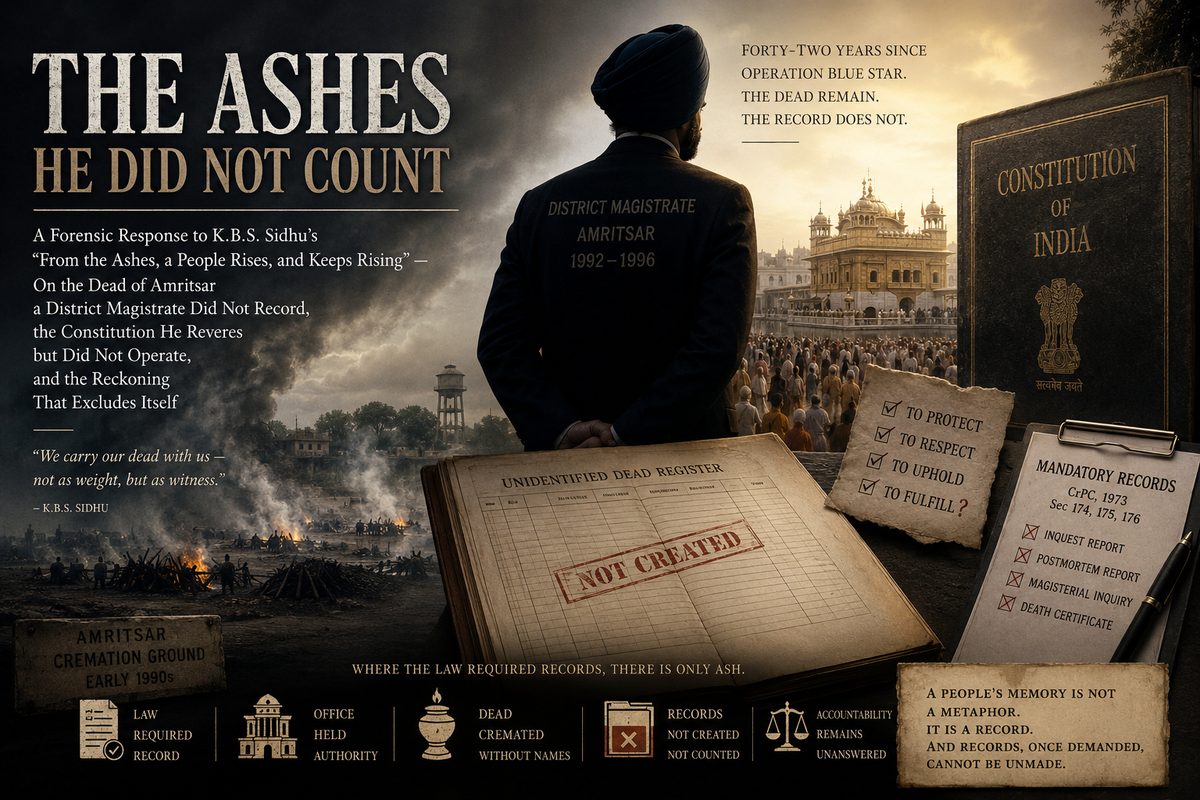
A Forensic Response to K.B.S. Sidhu’s “From the Ashes, a People Rises, and Keeps Rising” — On the Dead of Amritsar a District Magistrate Did Not Record, the Constitution He Reveres but Did Not Operate, and the Reckoning That Excludes Itself
“We carry our dead with us — not as weight, but as witness,” you wrote, on the forty-second anniversary of the assault on the Akal Takht.
But a witness must have a name, and a manner of death, and a record that he lived and was taken. The one thousand two hundred and thirty-eight unidentified dead of Amritsar carry none of these. You did not make them witnesses. The office you held made them ash without names — and then it did not count the ash.
A Note on Method and Address
This is a response to a specific essay by a specific author, and it is addressed to him directly. It applies the standing evidentiary framework of The Death Certificate Project: [PF] Proved Finding, [DA] Documented Allegation, [AI] Analytical Inference, [PM] Panthic Memory, [Q] Unanswered Public Question, and [Q-RTI] an RTI-ready record request whose production or denial is itself evidence.
It proceeds under three disciplines, and they should be stated at the outset so that nothing in what follows is mistaken for either malice or flattery. First, it is fair to the essay. Your reflection contains real truth and real feeling, and where it does, this response says so without grudging it; the case made here does not require pretending that a thoughtful essay is a worthless one. Second, it makes no claim about your interior life. It does not say what you feel, what you intend, or what you privately know; it confines itself to what you wrote, what the proved record establishes about the office you held, and the relation between the two. Third, it is grounded in law and in documents. Every load-bearing assertion rests on a published finding, a statutory text, a matter of public record, or your own published words — and your own published words, in this essay and elsewhere, are the principal instrument of what follows. You have written a great deal. This response takes you at your word, and then measures the word against the record.
A final note on what this is not. It is not a charge that you personally killed anyone; the record does not establish that, and this response does not allege it. It is not an attack on your faith, your learning, or your right to reflect publicly on the fate of your people. It is something narrower and, for that reason, harder to evade: an examination of whether a man who held the civil authority over the district of the disappeared, during the years of their disappearing, may now assume the voice of Sikh conscience, memory, and reckoning — while having never once accounted, in any of the hundreds of thousands of words he has published, for the dead who were burned without names under his own jurisdiction. That is the question. The essay raises it. This response pursues it.
I. The Essay and Its Author
Read on its own, “From the Ashes, a People Rises, and Keeps Rising” is an accomplished piece of writing. It is structured with care, moves with control from grief to resolve, and reaches for the registers of the sermon, the policy memorandum, and the civilizational essay in turn. It commemorates the forty-second anniversary of Operation Blue Star; it celebrates the resilience of the Sikh people; it defends the Constitution of India against those who would make it the enemy; it calls the Panth to an honest reckoning with its own institutional fractures; it warns against the Khalistan demand; it prescribes, on the model of the Jewish diaspora, an architecture of continuity built on education, institutions, and documentation; and it closes on a couplet of Iqbal and an affirmation that the Sikh people will not be erased. It is the work of a literate, reflective man who has thought about his people’s place in the world and wishes to be heard on it.
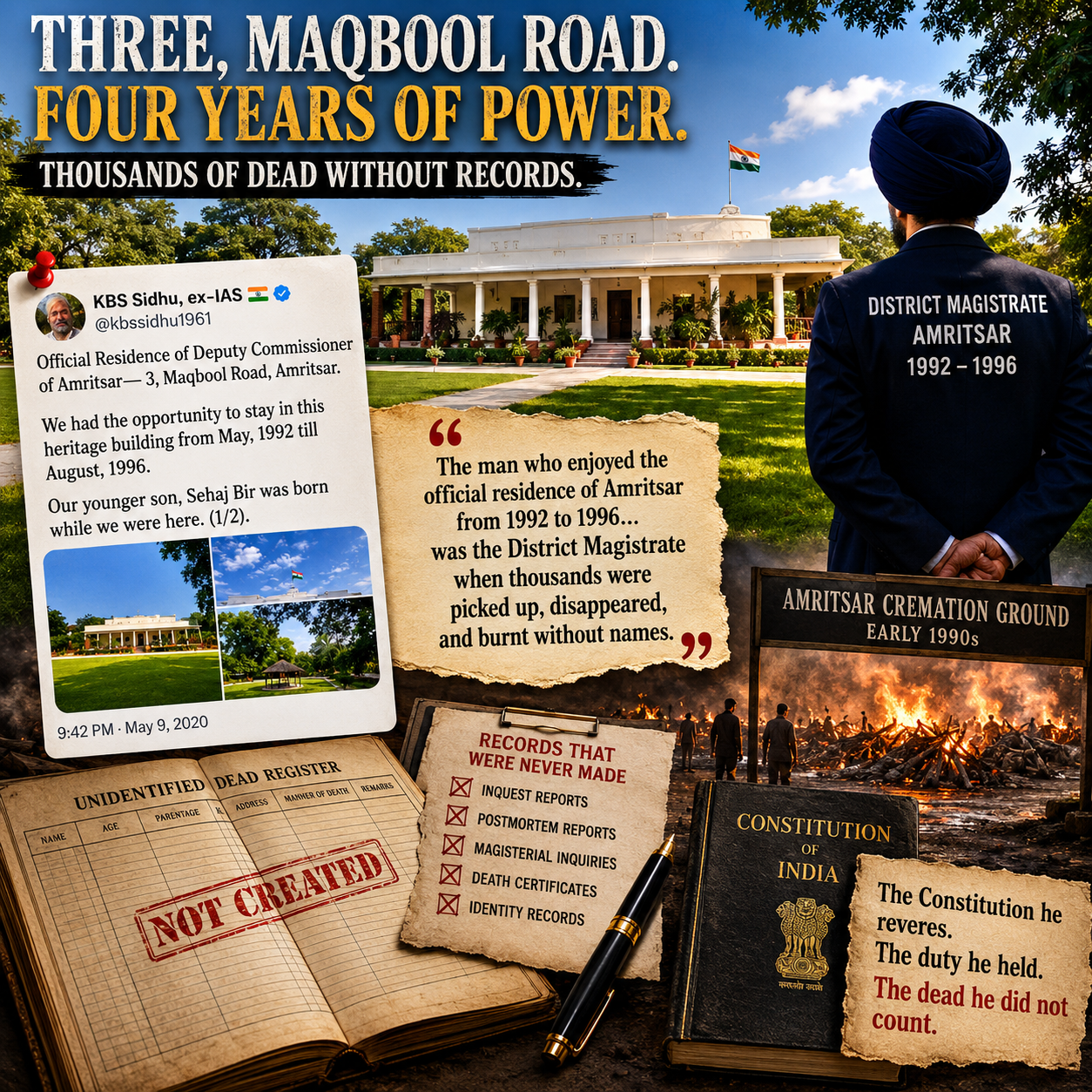
It is also, read against the record of its author, an essay that cannot survive the question of who is writing it. For the man who wrote it is not a private essayist reflecting at a safe distance from power. He is Karan Bir Singh Sidhu, retired Indian Administrative Service officer of the 1984 Punjab cadre, who served as Deputy Commissioner and District Magistrate of Amritsar from 1992 to 1996 — a fact he states in his own author’s note appended to the essay. [PF] He held, that is, the supreme civil authority over the district of Amritsar during four of the most lethal years of the Punjab counterinsurgency — the years in which, on the findings of the Central Bureau of Investigation later affirmed by the Supreme Court of India, the illegal cremation of the unidentified and unclaimed dead at the cremation grounds of his district proceeded on a mass scale. [PF] This essay, with its meditation on the dead carried as witnesses, its reverence for a Constitution that protects, its call for documentation so that memory cannot be falsified, is written by the man who held the office statutorily charged with creating the records of those very dead — and who, on the documented record, created none.
That disjunction is the subject of this response, and it must be felt in its full weight before the essay can be read honestly. There is a difference between an essay written by a survivor, a scholar, a journalist, or an ordinary member of the Panth — and the same essay written by the District Magistrate of the district where the dead were burned. From the first, a reflection on Sikh resilience and Sikh memory is an act of participation in a shared grief. From the second, the same reflection is something else: it is an act of authorship by a man with a specific, documented, official relationship to the dead he is invoking — a relationship not of fellow-mourner but of the civil officer whose duty it was to record them, and who did not. The essay never discloses that relationship. It speaks throughout in the first-person plural of the grieving Panth — we grieve, we remember, we carry our dead — and never once shifts into the first-person singular of the official who held the pen that should have recorded those dead and left it still. The “we” of the mourner is deployed to cover the “I” of the office. This response is, before all else, an insistence that the “I” be made to stand where the essay has hidden it.
For the essay’s power depends entirely on the reader not knowing, or not recalling, who wrote it. Read as the reflection of an anonymous Sikh elder, it is moving and largely unobjectionable. Read as the reflection of the District Magistrate of Amritsar, 1992 to 1996, it becomes a document of a wholly different character — a reckoning offered by a man who has never reckoned with the one thing the record places at his own door, and who now assumes the moral authority to instruct his people on memory, honesty, and the carrying of the dead, while himself having buried, in administrative silence, the dead he was bound to name. The essay asks to be read as conscience. This response asks: by what authority does this author speak of conscience, having never accounted for the 2,097?
II. The Shadow He Names and the Shadow He Cast
You open with a confession of shadow. “I joined the Indian Administrative Service in 1984 — the same year as the tragedy,” you write. “It was not a coincidence I could easily set aside. It has shadowed my entire administrative life, and it shadows this reflection.” It is a striking and deliberate opening, and it deserves to be taken seriously, because it is the one place in the essay where you gesture, however obliquely, toward the relationship between your career and the catastrophe of your people. You name a shadow. The question this response presses is which shadow you have named, and which you have left in darkness.
The shadow you name is Operation Blue Star — the assault on the Golden Temple in June 1984, the month you entered the service. It is a real shadow, and there is no dishonor in claiming it; an entire generation of Sikhs entered adulthood under it. But notice what the naming accomplishes. By locating the shadow of your administrative life in June 1984, you locate it in an event that occurred before your service began, that was ordered by a political leadership you did not belong to, and that you bore no authority to prevent. The shadow you claim is a shadow cast upon you — the shadow of a tragedy you inherited, as a young Sikh officer, at the threshold of a career. It is the shadow of victimhood, or at least of painful inheritance. It costs you nothing to name it, because it indicts no one but the Congress government of the day, which you are in any case content to name elsewhere in the essay.
The shadow you do not name is the one your own office cast. Between 1992 and 1996, you were not a young officer bearing the inherited shadow of 1984. You were the District Magistrate of Amritsar — the senior-most civil authority in the district, the executive magistrate vested with the statutory powers to inquire into suspicious deaths, to demand the production of persons confined, to order magisterial inquiries into deaths in custody, and to oversee the lawful disposal and registration of the dead. [PF] And during those four years, in the district under your authority, the apparatus of the counterinsurgency was producing the unidentified bodies that the Central Bureau of Investigation would later confirm were cremated, in their thousands, without identification, without inquest, without the records the law required. [PF] That is a shadow too — but it is not a shadow cast upon you. It is a shadow cast by the office you held, across the dead it did not record. And of that shadow, the essay says nothing at all.
This is the asymmetry that governs the entire essay, and it appears in its very first lines. You claim the shadow that makes you a figure of inherited Sikh suffering, and you are silent on the shadow that makes you a figure of administrative responsibility for Sikh suffering. You name June 1984, which indicts the politicians. You do not name the cremation grounds of 1992 to 1996, which would require examining the office you yourself held. The shadow you have selected for your opening is the one that aligns you with the victims; the shadow you have omitted is the one that would align you with the apparatus. A reflection that truly reckoned with how 1984 “shadowed” your “entire administrative life” would have to include the years in which your administrative life was the relevant power — the years in which you, not some distant government, held the authority that the dead of Amritsar needed and did not receive. That reckoning is precisely what the essay does not contain.
It is worth being exact about what is and is not being claimed here, because the distinction is the heart of this response and it will recur in every section that follows. It is not claimed that you ordered the killings; you did not, and the record does not say you did. It is not claimed that you commanded the police or the paramilitary forces; the District Magistrate did not command them operationally, and this response does not pretend otherwise. What is claimed — and what the proved record and the statutory framework together establish — is that you held an office whose distinct, independent, civil function was to stand between the armed apparatus and the population, to inquire when deaths occurred, to compel production when persons vanished, to ensure that the dead were named and recorded. The shadow your office cast is the shadow of that function unperformed: the inquiries not ordered, the productions not compelled, the dead not named. You have named the shadow of June 1984, which you did not cast. You have been silent on the shadow of 1992 to 1996, which your office did. This response exists to name the second shadow, and to ask why the man who wrote so movingly of the first has never, in all his words, written a line about the second.
III. “From the Ashes” — Whose Ashes?
Your title is the finest thing in the essay, and it is also, read against your record, its most revealing. “From the Ashes, a People Rises, and Keeps Rising.” The image is of resurrection: a people reduced to ash by the fire of 1984, rising from that ash, turbaned and unbroken, to flourish across the world. As metaphor, it is earned and moving. The Panth did rise. But you, of all authors, chose the figure of ashes — and you cannot have chosen it without knowing, somewhere, that in the district you governed, the ashes were not a metaphor. They were a daily, physical fact, accumulating at three named grounds across four years of your tenure, and they were the ashes of human beings your office did not count.
Let the literal stand beside the metaphorical for a moment, because you have invited the comparison by your choice of title. The Central Bureau of Investigation, in the inquiry the Supreme Court of India ordered and later affirmed, confirmed that 2,097 bodies were illegally cremated at the cremation grounds of Patti, Tarn Taran, and the Durgiana Mandir in Amritsar district — 585 fully identified, 274 partially identified, and 1,238 entirely unidentified. [PF] These were not the ashes of a metaphor. They were the ashes of men, and some women, and some who were neither soldiers nor militants but persons swept up and never seen again, burned at municipal grounds whose firewood accounts recorded the consumption of wood that the acknowledged deaths could not explain. [PF] And these ashes accumulated, in substantial part, during the years 1992 to 1996 — the years you were the District Magistrate of the district in which all three grounds lay. [PF]
So when you write of a people rising “from the ashes,” the question your own record forces is unavoidable: whose ashes? You mean, in the metaphor, the ashes of the Akal Takht and the dead of June 1984. But the ashes nearest to your own hand — the ashes your office was statutorily bound to account for and did not — are the ashes of the 1,238, lying unnamed in the registers of three cremation grounds in your district. The people did rise from the ashes of 1984. But the 1,238 did not rise. They have not risen. They lie where your office left them: in the ash, without names, without inquests, without the records that would let their families know they died or how. The triumphal metaphor of your title floats above a literal ash you have never acknowledged — and the contrast between the two is the contrast between the Sikh story you are content to tell and the Sikh story your own office wrote and then erased.
There is a deeper point here about the relationship between your metaphor and your silence, and it must be stated plainly. The metaphor of rising from the ashes is a metaphor of transcendence — it invites the reader to move past the ash toward the resurrection, to see in the suffering not an unfinished accounting but a completed arc that ends in triumph. It is, in this sense, a metaphor that closes. And applied to the dead of Amritsar, it closes precisely the wrong thing. The 1,238 are not an arc that ends in triumph; they are an accounting that was never opened. To fold them into a narrative of glorious rising is to do, in the register of metaphor, exactly what your office did in the register of administration: to pass over the unaccounted dead in favor of a story that does not require naming them. The people rise; the dead remain uncounted; and the rising is invoked, whether you intend it or not, in a way that lets the uncounting stand. Your title is beautiful. It is also, for the author who chose it, an evasion dressed as an elegy. [AI]
IV. The Successful Sikhs You Celebrate Now, and the Sikhs You Administered Then
The body of your essay’s first movement is a catalogue of Sikh success, and it is genuinely stirring. You summon the Punjabi farmer who feeds 1.4 billion; Dr. Manmohan Singh, the turbaned refugee boy who became Prime Minister twice; Jagmeet Singh leading a national party in Canada in a dastar; Harjit Sajjan as Defence Minister; Sikhs in both Houses of the British Parliament; the Guru’s langar feeding the homeless of London and the flood-struck of Louisiana and the earthquake survivors of Turkey. “The Panth breathes. It builds. It governs. It leads,” you write. It is a roll-call of a people’s triumph over the attempt to break it, and as a Sikh you are entitled to your pride in it.
But consider when you are saying this, and against what. You are celebrating, in 2026, in retirement, the global Sikhs who rose — the Prime Ministers and Defence Ministers and parliamentarians and physicians. And the question that your own record forces is this: where was this tender regard for the Sikh, the turbaned Sikh, the Sikh who would not hide his identity, when you held power over a district full of such Sikhs in the first half of the 1990s? For the Sikhs you administered then were not Manmohan Singh at the summit of the Republic. They were the men of the villages of Majha and the streets of Amritsar — turbaned, bearded, identifiably Sikh — who in those years were, by the operating logic of the counterinsurgency, suspects by virtue of their appearance, and many of whom were taken, and some of whom were never seen again, and 1,238 of whom were burned without names in the cremation grounds of your district. [PF/AI] You celebrate the turban now, on the heads of the successful and the safe. You held office when the turban, on the head of an ordinary young man of your district, was treated as probable cause — and the office you held did not protect those heads. It did not even count them when they were burned.
This is the contradiction the user of language must confront in you, and it is not a small one. The Sikh excellence you now celebrate — Manmohan Singh’s, the diaspora’s — was achieved elsewhere, by Sikhs beyond the reach of the apparatus you served, or in Manmohan Singh’s case by a Sikh whose station placed him above it. It is safe to celebrate. It costs you nothing in 2026 to praise Jagmeet Singh’s dastar or to mourn Manmohan Singh’s passing. But the Sikhs who were within your reach — the ordinary, expendable, turbaned young men of Amritsar district between 1992 and 1996 — were not celebrated by you, then or since. They were administered by you. And the administration they received from your office was not protection but silence: the silence of the inquest not held, the production not compelled, the death not recorded. You have a great deal of warmth, now, for the Sikhs who rose where you had no power. You had, on the record, no protective action whatever for the Sikhs who fell where you did. [AI]
Notice, too, the precise shape of the substitution your essay performs. It offers the globally successful Sikh as the representative figure of the Panth’s fate — the farmer, the Prime Minister, the parliamentarian, the diaspora professional. And in doing so it quietly replaces the other representative figure of the Panth’s fate in exactly your years and your district: the disappeared young man, the unclaimed body, the name struck from the record. Both are real. Both are part of the Sikh story of the late twentieth century. But you have built your essay entirely around the first and excluded the second — and the second is the one your own office was responsible for. The figure you have written out of the Sikh story is precisely the figure your office failed. This is not an accident of emphasis. It is the same selection that runs through your entire public archive, examined at length in the companion study The Chronicle of the Out-Published History: the consistent substitution of the Sikh triumph you may safely celebrate for the Sikh death you would have to account for. [AI]
And there is a question of solidarity beneath the question of celebration, which goes to the deepest claim your essay makes. You write in the first-person plural — we grieve, we remember, we rise — and you assume, throughout, your membership in the suffering and triumphant Panth. But solidarity is tested where it costs something, and the test of your solidarity with the Sikhs of Amritsar came not in 2026, when you wrote this essay, but in the years 1992 to 1996, when you held the power that their lives required. Solidarity, then, would have meant the inquest ordered, the production compelled, the death recorded — the use of your office’s distinct civil authority on behalf of the population the apparatus had marked. That solidarity, on the record, you did not extend. The “we” of your essay is a solidarity claimed in retirement, at no cost, with the Sikhs who rose. It was not, when it would have cost you, a solidarity extended to the Sikhs who were falling under your own jurisdiction. A man may not spend a career declining the solidarity that costs, and then, in retirement, narrate himself into the “we” of a people’s triumph as though he had always stood inside it. The Sikhs you now claim as “we” include the 1,238 — and to them, your office was not “we.” It was the silence that did not count them. [AI]
There is a further element of your first movement that must be examined, because it reveals the deeper function of the triumphal catalogue, and it is the heading under which you place it: “What History Has Decided.” You write that if Blue Star was meant to break the Sikh spirit, “history has delivered its verdict: it failed. Not partially. Completely.” This is a closure move, and it should be recognized as one. To say that history has decided is to declare the matter settled, the verdict rendered, the account closed. And applied to the Sikh experience of the late twentieth century, the declaration that history has decided — that the story ends in triumph — performs precisely the foreclosure that this response has identified at every level of your essay: it announces a completed arc in order to relieve the reader, and the author, of the unfinished accounting. But history has not decided the question of the 1,238. History has not rendered a verdict on the cremation grounds of Amritsar, because the inquiry that would let it render one was never conducted and the records that would let it judge were never made. The verdict you announce is a verdict on the Sikh spirit, which did indeed survive. It is not a verdict on the Sikh dead of your district, whose case has not been heard, let alone decided. To proclaim that history has decided, over the heads of 1,238 unaccounted dead, is to mistake the survival of the living for the settlement of the debt owed the dead. The first is real. The second has not occurred. [AI]
Observe, too, the specific theology you enlist in the service of this closure. You invoke Kirat Karo — the Guru’s commandment to labor with dignity — and you gloss it, pointedly, as labor “without complaint and without surrender.” The Punjabi farmer, you write, “has never stopped sowing… That is not stubbornness. It is theology made practical.” It is a beautiful reading of a real value, and this response does not dispute the dignity of Sikh labor. But notice the work that the phrase “without complaint” is doing in an essay that omits a mass atrocity. To valorize endurance “without complaint” as the highest Sikh response to suffering is, in a context where the suffering in question includes an unredressed mass killing, to subtly recast the demand for accountability as a failure of that stoic ideal — to suggest that the truly admirable Sikh bears the wound and keeps sowing, rather than demanding the inquest and the name. This is not what Kirat Karo means, and you would not defend the proposition if it were stated baldly. But the rhetorical effect of celebrating uncomplaining endurance, in an essay that buries the cremations, is to place the dignity of the Panth on the side of those who carry on in silence and, by implication, to leave the demand for redress looking like complaint — like the grievance you elsewhere disparage. The Gurus did not teach that the response to the murder of the innocent is uncomplaining labor. The same tradition that teaches Kirat Karo produced the shaheed, the witness who would not be silent. Your essay has chosen the half of the tradition that endures and omitted the half that demands. [AI]
This is the deepest function of “What History Has Decided,” and of the entire triumphal first movement: it offers the Panth a story in which the suffering is over, the verdict is in, the people have won, and the appropriate posture is dignified, uncomplaining, forward-facing endurance. It is a consoling story, and the consolation is not entirely false. But it is a story whose effect is to close the books — and the books cannot be closed while 1,238 of the Panth’s own lie unnamed in the ash of your district. The triumph is real; the closure it invites is premature; and the author who invites it is the very official whose office left the books open by refusing to write in them. You declare the verdict in. For the dead of Amritsar, the trial has not begun. [AI]
V. “Every Beard and Turban a Terrorist” — The Population You Were Sworn to Stand Between
To understand the weight of what your office failed to do, one must recall the conditions under which it failed — conditions you know intimately, because you administered a district at their epicenter, and conditions your essay does not mention even once. The years of your tenure in Amritsar were years in which Sikh identity itself had been, in the operating logic of law-enforcement, converted into a mark of suspicion. The turban and the unshorn beard of an ordinary young Sikh man were not, in the Punjab of the early 1990s, neutral facts of appearance. They were, in practice, treated as indicia of threat. The young, turbaned, bearded, identifiably observant Sikh man of the rural Majha belt was the paradigmatic object of the counterinsurgency’s suspicion — and it is this population, documented across the human rights literature and held in the collective memory of the Panth, that bore the overwhelming share of the detentions, the custodial interrogations, the disappearances, and the unclaimed deaths. [DA/PM]
This is the context your essay erases, and the erasure matters because it inverts the relationship between you and that population. In a period when an entire identifiable community has been collectively rendered suspect by the armed apparatus of the state, the civil magistrate’s protective function does not diminish — it intensifies. The whole constitutional purpose of vesting an independent civil authority with powers over arrest, production, inquiry, and the disposal of the dead is to provide a check precisely when the armed apparatus has begun to treat a population as an enemy. When every turbaned young man is a suspect in the eyes of the police, the District Magistrate is the one official whose duty is to insist that suspicion is not death — that a man may not be taken without a record, held without production, killed without inquest, or burned without a name, merely because of how he looks and where he lives. The collective criminalization of the Sikh young man did not relieve you of your duty toward him. It was the very condition that made your duty toward him urgent. [AI]
And here is the indictment your essay’s silence cannot escape. You were the District Magistrate of the district where this collective criminalization fell hardest, during the years it fell hardest, and the protective function that the situation made urgent was, on the documented record, not performed. The turbaned young men of your district who were taken were not, by your office, the subject of compelled production. The ones who died in custody were not, by your office, the subject of magisterial inquiry. The 1,238 who were burned without names were not, by your office, recorded, described, or accounted for. The population that the apparatus had marked by its Sikh appearance was, precisely, the population your office was constitutionally positioned to shield — and the shield was not raised. [PF/AI]
Now set this against the essay you have written. In 2026 you celebrate the turban — on the head of Manmohan Singh at the summit of the Republic, on the head of Jagmeet Singh leading a Canadian party, on the heads of the Sikhs who “did not hide.” You write with evident pride of the Sikh who would not conceal his identity. But in the years you held power, the turbaned, unconcealed Sikh of your own district was the most endangered man in Punjab — and your office, which existed to protect him, did not. There is a terrible distance between the turban you celebrate from the safety of retirement and the turban you administered from the chair of the District Magistrate. The first is a symbol of triumph you may praise at no cost. The second was a mark of mortal danger that your office was bound to answer and did not. You honor the dastar now. You did not protect the men who wore it then, when protecting them was your job and would have cost you something. [AI]
It is worth pausing on what that protection would have required, because the gap between the requirement and the performance is the measure of the failure. It would not have required you to defeat the militancy or to command the police. It would have required the ordinary, lawful, unglamorous exercise of your civil powers: insisting that arrests in your district were reported to you as the law required; issuing the search warrants the law empowered you to issue when families reported their sons taken; ordering the magisterial inquiries the law mandated when deaths in custody occurred; ensuring that the dead brought to the cremation grounds were described, photographed, and recorded before they were burned. [PF] None of this was beyond your office. All of it was your office’s defined function. And the doing of it would have created the one thing that could have stood between the turbaned young man and the anonymity of the ash: a record. That record was not created. The men were burned without it. And you now write essays in praise of the turban.
VI. “The Constitution Is Not Our Enemy” — and the Record You Did Not Create
We come now to the section of your essay in which you speak most directly in your own voice as a constitutional officer, and it is the section in which the disjunction between your words and your record is sharpest. “I joined the IAS as a Sikh who took an oath to uphold the Constitution of India,” you write. “In forty years of public service, I never found that oath in contradiction with my faith. In fact, I found the opposite.” You go on to praise the Constitution as among the few in the world that grant fundamental rights exclusively to minorities — Articles 29 and 30, the cultural and educational rights; Article 25, Explanation I, the guarantee of the Sikh’s right to the kirpan. “A Sikh who understands what the Constitution actually says,” you conclude, “will find more protection than adversity within it.”
This is a sincere and, in its terms, accurate account of the Constitution’s text. And it is the most damning thing you have written, because of what it omits about your own relationship to that Constitution. You reverence the Constitution as a charter of protection. But the Constitution does not protect anyone through reverence. It protects through machinery — through the specific, operational duties it imposes on officers like you, the discharge of which is the only form in which its guarantees become real in the life of a citizen. And the machinery of the Constitution’s most fundamental protections — the protections not of culture and education, which you cite, but of life and liberty, which you do not — runs directly through the office you held. The District Magistrate is not a spectator of the Constitution’s protections. He is one of their principal instruments. And the instrument, in your hands, did not operate. [AI]
Consider the two constitutional guarantees you conspicuously do not mention, though they are the ones that mattered most to the men of your district. Article 21 guarantees that no person shall be deprived of life or personal liberty except according to procedure established by law. Article 22 guarantees that a person arrested shall be informed of the grounds of arrest, shall have the right to counsel, and — this is the crucial one — shall be produced before the nearest magistrate within twenty-four hours of arrest. [PF] These are not abstractions. They are the constitutional architecture of the protection against exactly what happened in your district: the disappearance, the secret detention, the death in custody, the burning without a name. And the magistrate before whom the arrested were to be produced within twenty-four hours — the constitutional checkpoint between lawful arrest and enforced disappearance — was, for the district of Amritsar, your office. Article 22 made you, the District Magistrate, the living mechanism of the Constitution’s promise that no man would simply vanish into custody. [AI]
You revere the Constitution. But Article 22’s guarantee is only as real as the magistrate’s insistence on production — and the men of your district were not produced. You revere the Constitution. But Article 21’s guarantee that life shall not be taken except by procedure is only as real as the inquest that examines a suspicious death — and the suspicious deaths of your district were not inquired into. The Constitution you call a charter of protection contained, in Articles 21 and 22, the precise protections the dead of Amritsar needed; those protections were routed, by constitutional and statutory design, through the office you held; and in your hands those protections did not function. You did not find your oath in conflict with your faith, you say. Perhaps not. But you found it, on the record, in conflict with nothing at all — because to honor that oath in the Amritsar of 1992 to 1996 would have required acts of insistence against the apparatus that the record does not show you performed. An oath that is never tested against power is an oath that costs nothing to keep. The oath was tested in your district, every time a man was taken and not produced. The record does not show that you met the test. [AI]
This is the heart of the matter, and it deserves to be stated with full precision, because it is the argument that your reverence for the Constitution cannot survive. The protection of constitutional rights is not a sentiment. It is a documentary practice. The right under Article 22 to production within twenty-four hours is protected by the arrest memorandum and the production record. The right under Article 21 to not be killed except by procedure is protected by the inquest report under Section 174 and the magisterial inquiry under Section 176 of the Code of Criminal Procedure. The right of the dead to an identity, and of their families to know their fate, is protected by the post-mortem record, the photograph, the description, and the death registration under the Registration of Births and Deaths Act. [PF] Each of these constitutional and legal protections exists as a record, and is realized only through the creation of that record. Where the record is created, the right is protected. Where the record is not created, the right is not protected — it is, whatever the Constitution says on paper, defeated in fact. And the creation of these records, in the district of Amritsar, was the function of the office you held. [AI]
So here is what your reverence for the Constitution omits, and it is the omission this entire response circles: you did not create the records. The men, women, and children of your jurisdiction held constitutional rights that could only be protected through the records your office was bound to create — the arrest reports, the production records, the inquest reports, the magisterial inquiries, the death registrations — and those records, on the documented findings of the Central Bureau of Investigation, were not created. [PF] The 1,238 were burned without the records that Article 21 and Article 22 required. Their constitutional rights were not protected, because the documentary practice in which those rights consist was not performed, by the office whose function it was to perform it. You revere the Constitution as a charter of protection while having presided over the office that, by failing to create the records, left that charter’s most fundamental protections unrealized for the very people it was meant to shield. The Constitution was not their enemy, as you say. But it was not their protector either — because the protection the Constitution promised them ran through your office, and your office did not deliver it. The enemy of those Sikhs was not the Constitution. It was the silence of the officer sworn to operate it. [AI]
VII. The Machinery of the Constitution, and the Duty That Ran Through Your Chair
Because you have raised the Constitution, and because you are a man who values precision, this response will be precise about what the Constitution and the laws beneath it actually required of the office you held. The point is not pedantry. The point is that your reverence for the Constitution can be tested only against the specific duties the Constitution and its enabling statutes placed upon the District Magistrate — and when it is so tested, the reverence is revealed as detached from the duties it should have animated. Here, then, is the machinery, and here is where your chair sat within it.
Begin with the constitutional floor. Article 21 forbids the deprivation of life or liberty save by procedure established by law. Article 22(1) and 22(2) require that an arrested person be informed of the grounds of arrest, be permitted counsel, and be produced before the nearest Magistrate within twenty-four hours. [PF] These are the supreme law’s guarantees against disappearance and extrajudicial killing, and they are not self-executing; they execute through magistrates. The Magistrate before whom the arrested must appear within twenty-four hours is the constitutional hinge — the point at which the executive’s power to detain is submitted to independent scrutiny. In your district, that hinge was your office and the magistrates subordinate to it.
Beneath the Constitution, the Code of Criminal Procedure operationalizes these guarantees through a sequence of duties, several of which fall directly on the District Magistrate and the executive magistracy. Section 57 forbids police detention beyond twenty-four hours without the authority of a Magistrate — the statutory echo of Article 22. Section 167 requires that where investigation cannot be completed within twenty-four hours, the detainee be produced before a Magistrate, who alone may authorize further detention. Section 58 requires officers in charge of police stations to report to the District Magistrate or Sub-Divisional Magistrate the cases of all persons arrested without warrant — a reporting duty that exists precisely so that the civil magistracy maintains a running account of who has been taken into custody in the district. [PF] Section 97 empowers a Magistrate, on information that a person is confined under circumstances amounting to an offence, to issue a search warrant for that person’s production — the direct statutory instrument for a District Magistrate confronted with a report that a citizen has been seized and hidden. [PF]
Then the duties that attach when a body appears. Section 174 requires inquiry into and a report upon any death that is suspicious, unnatural, or occurs in circumstances raising reasonable suspicion that another has committed an offence — the inquest, conducted under the authority of the executive magistracy and police, which produces the foundational record of how a person died and what their body disclosed. Section 176 requires a magisterial inquiry into the cause of death in specified cases, including, most pointedly, deaths in police custody — a duty that, even in the form it took during your tenure and before the 2005 amendment that later assigned such inquiries to judicial magistrates, placed upon the executive magistracy the obligation to inquire independently into custodial deaths. [PF] And the duties that attach to the dead as such: the Registration of Births and Deaths Act, 1969, mandates the registration of every death, with its cause; the Punjab Police Rules govern the handling of unidentified and unclaimed bodies, requiring that descriptions and photographs be taken and identification attempted before disposal; the Identification of Prisoners Act, 1920, provides for the photographing and measurement of arrested persons. [PF] And from October 1993 — within your tenure — the newly constituted National Human Rights Commission directed that every custodial death be reported to it within twenty-four hours. [PF]
This is the machinery. Now observe a single, decisive fact about it: the District Magistrate stands inside almost every one of these protections. The twenty-four-hour production under Article 22 and Section 57 runs to the magistracy. The reporting of warrantless arrests under Section 58 runs to the District Magistrate by name. The search warrant for a confined person under Section 97 issues from a Magistrate. The inquest under Section 174 and the inquiry under Section 176 are functions of the executive magistracy. The lawful disposal and registration of the dead occur under the civil administration the District Magistrate heads. The office you held was not adjacent to the Constitution’s protections of life and liberty. It was, for the district of Amritsar, the place where those protections were supposed to live. Every one of the constitutional rights of the men, women, and children of your jurisdiction passed, for its protection, through your chair. [AI]
And every one of them, on the documented record, failed there. The Central Bureau of Investigation found that the deaths were not inquired into and the cremations not recorded; the 1,238 were burned unidentified, which means the Police Rules on unidentified bodies were not followed, the descriptions and photographs not taken, the registrations not made; the families who reported their sons taken did not, on the record, obtain the Section 97 warrants that might have produced them; the custodial deaths did not generate the Section 176 inquiries the law required. [PF] The machinery of the Constitution’s protection of life and liberty, which ran through your office, did not operate in your office. This is not an inference about your state of mind. It is a description, drawn from the proved record and the statutory text, of a constitutional machinery that was bound to function through the District Magistrate of Amritsar and that, during your tenure, did not function. You revere the Constitution. The Constitution’s life-and-liberty protections were, in your district and your years, a dead letter — and they were a dead letter at precisely the point in the machinery where you sat. [AI]
The companion studies of The Death Certificate Project — The Audit of the Silent Pen, The Unbroken Line, and the others — establish this machinery and its failure in exhaustive detail, including the crucial point that the failure was not the product of any single officer’s choices but of an institutional policy of silence transmitted across three successive District Magistrates of Amritsar, of whom you were the last. [PF] This response does not repeat that demonstration; it incorporates it. What it adds is the confrontation between that demonstrated failure and the essay you have now written — an essay that praises the Constitution as a charter of protection while never once acknowledging that the charter’s protections, in the author’s own district and tenure, went unhonored at the author’s own desk. You have written a hymn to the Constitution. The men of your district needed not a hymn but its machinery, and the machinery ran through you, and it stopped. [AI]
It is worth dwelling on one statutory development that fell squarely within your tenure, because it removes any suggestion that the duties this response describes were antique or unknown in your years. In October 1993 — when you had been District Magistrate of Amritsar for over a year, and would remain so for nearly three more — the National Human Rights Commission was constituted, and it issued directions requiring that every custodial death be reported to it within twenty-four hours. [PF] This was not an obscure provision buried in a colonial code; it was a contemporaneous, high-profile national reform, the establishment of the country’s apex human rights body, accompanied by an explicit and widely known reporting obligation directed at exactly the category of death — the death in custody — that the apparatus in your district was producing. The reform arrived in the middle of your tenure. The obligation it created ran, like the others, through the district administration you headed. And the record does not show that the custodial deaths of Amritsar were reported to the Commission as the new directions required. [PF/AI] A man cannot claim, of the years after October 1993, that the duty to account for custodial death was a faint or forgotten thing. The nation had just built an institution to enforce it, in full public view, while you held office. The duty was as fresh and as prominent as a duty could be. It was still not performed.
Add to this the older but equally pertinent Identification of Prisoners Act of 1920, which provided for the taking of photographs and measurements of arrested persons — the very records that, had they been made, would have rendered the later identification of the dead possible. [PF] The 1,238 are unidentified today in part because the identifying records that the law provided for were not created at any stage: not at arrest, under the 1920 Act and the Police Rules; not at death, under the inquest provisions; not at disposal, under the rules governing unidentified bodies; not at registration, under the 1969 Act. At every point in the sequence where the law required the creation of a record that would fix a person’s identity, the record was absent. The identification of these dead was not rendered impossible by some inherent mystery. It was rendered impossible by the cumulative non-performance, across the whole chain, of the documentary duties that ran through the civil administration. The unidentifiability of the 1,238 is not a fact of nature. It is an administrative product. [AI]
Consider, finally, a single worked example of how the machinery was meant to function and how its failure played out, because the abstraction of “the records were not made” can obscure the concreteness of the loss. Imagine a young man of a Majha village, taken from his home by police in 1994 — a turbaned, bearded young man of the kind the apparatus marked. Under Section 58, the fact of his warrantless arrest should have been reported to you, the District Magistrate; a record would exist that he had been taken. Under Article 22 and Section 57, he should have been produced before a magistrate within twenty-four hours; a record would exist that he was alive and in custody on a given date. Had his family reported him missing, under Section 97 you could have issued a warrant for his production; a record would exist of the search. Had he died in custody, under Section 176 a magisterial inquiry should have examined the death, and under the NHRC directions it should have been reported within a day; records would exist of how he died. Had his body been brought unidentified to a cremation ground, under the Police Rules it should have been described and photographed before disposal, and under the 1969 Act his death should have been registered; records would exist by which his family might later find him. At every one of these stages, the law placed a record between the young man and oblivion. And in the Amritsar of your tenure, at every stage, on the documented findings, the record was not made — so that the young man could pass from his home to the ash without a single document marking that he had been taken, held, killed, or burned. That is what it means to say the machinery did not function. It means a man could be erased, step by lawful step left undone, and the office that was meant to mark each step left the page blank at every one. That office was yours. [AI]
VIII. “An Honest Reckoning” — The One Account It Will Not Give
The moral center of your essay is its fourth movement, and it is the movement on which your authority as a truth-teller most depends. “Yet we would be dishonest — and the Gurus named dishonesty explicitly as sin — if we did not pause and look inward,” you write. You then deliver a genuinely unflinching inward critique of the Panth’s contemporary condition: the SGPC has held no general election since 2011; over seventy lakh Sehajdhari Sikhs were disenfranchised by a retrospective amendment in 2016; the drug crisis is a civilizational warning; the youth are leaving in despair; the agriculture is failing on subdivided, indebted holdings; the Panth argues ferociously on social media and organizes inadequately on the ground, producing “heat without light, passion without programme.” It is bracing, and much of it is true, and it is offered under the banner of honesty, with the Gurus’ condemnation of dishonesty as its warrant.
And it is here that the essay’s omission becomes not merely a gap but a contradiction — because you have invoked honesty as a sacred duty, cited the Gurus’ naming of dishonesty as sin, and then conducted a “reckoning” that is honest about every failure except the one the record places at your own door. Examine the catalogue of your inward critique. Every item in it is a failure of others — of the SGPC’s leadership, of the parliamentary majority that disenfranchised the Sehajdharis, of the political class that let the drug crisis fester, of the diffuse “we” that argues online and organizes poorly. Not one item in your reckoning is a failure of yours. The reckoning ranges across the institutional and political life of the Panth and arrives nowhere near the cremation grounds of Amritsar, 1992 to 1996. The “honest reckoning” reckons with everyone but its author. [AI]
This is the precise definition of the sin you have named. Dishonesty, as the Gurus named it and as you cite them naming it, is not only the assertion of what is false; it is the suppression of what is true, especially what is true and costly to oneself. A reckoning that catalogues the failures of others while suppressing the failure of the one conducting it is not an honest reckoning. It is a performance of honesty deployed to obscure a dishonesty — the dishonesty of the omitted account. You have, in the very act of summoning the Gurus’ condemnation of dishonesty, committed the dishonesty of the silence about your own record. The frame indicts the picture. By your own standard, invoked in your own words, the reckoning you offer is not honest, because it excludes the one truth that honesty would most require its author to face: that the man calling the Panth to honest self-examination has never once examined, in public, his own office’s role in the unaccounted death of 1,238 of the Panth’s own. [AI]
There is a particular structure to this kind of evasion, and it should be named because it recurs throughout the essay and throughout your public archive. It is the structure of the displaced confession. You do confess failings — but always the failings of the collective, the institution, the political class, the diffuse “we.” You permit yourself the posture of the unsparing critic precisely because the objects of the critique are never you. The confession is real; only its target is displaced. And the effect — whether designed or not — is to purchase the credibility of the honest man at no personal cost, and then to spend that credibility on an essay that never approaches the author’s own accountability. The reader, having watched you criticize the SGPC and the drug-enabling state and the heat-without-light of Sikh social media, is invited to conclude that here is a man unafraid of hard truths. But the hardest truth available to you — the truth of the silent pen in the District Magistrate’s office of Amritsar — is the one truth your honesty never touches. The displaced confession is the most sophisticated form of the evasion, because it wears the face of candor. And it is still evasion. [AI]
What would an honest reckoning, by you, actually contain? It would contain the sentence you have never written: that during your tenure as District Magistrate of Amritsar, in a district where the unidentified dead were being cremated in their thousands, the inquests were not held, the productions were not compelled, the records were not made — and that this occurred on your watch, in your office, under your authority. It would contain an accounting of what you knew and when, what your office did and did not do, and what records exist or do not exist of any action you took on behalf of the disappeared and the dead. It would contain, in short, the application to yourself of the same unsparing scrutiny you apply to the SGPC and the political class. That sentence, that accounting, that scrutiny — these are what honesty, by your own invocation of it, requires. Their absence is not an oversight. In an essay built around the duty of honest reckoning, the absence of the author’s own reckoning is the essay’s defining act, and it is, by the Gurus’ standard you have cited, the sin the essay was ostensibly written to renounce. [AI]
IX. The 1984 You Name, and the 1984 You Will Not
Twice in your essay you invoke justice for 1984, and the invocation is exact, forceful, and correct as far as it goes. “The wounds of 1984 come from Congress and its leadership — they must be named clearly, without deflection,” you write. “The anti-Sikh pogrom in Delhi in October-November 1984, following Indira Gandhi’s assassination, was organised and Congress-abetted. Justice has been delayed scandalously, denied in many cases entirely. That reckoning is not complete and must not be allowed to lapse.” And later, among your prescriptions: “Justice for 1984.” This is true. The November 1984 massacre of Sikhs in Delhi was organized, was abetted by figures of the ruling party, and has gone substantially unpunished for four decades. To name it without deflection is right. This response affirms it.
But watch the boundary you have drawn around the year, because the boundary is the evasion. You name the 1984 of Delhi — the pogrom organized by the Congress, the crime of the politicians, the atrocity whose perpetrators are your political adversaries and were never your colleagues. You do not name the other 1984 and its long aftermath: the 1984 of Punjab, of Operation Blue Star and the Army’s entry that you describe in your opening, and of the counterinsurgency that followed it through the next decade — the disappearances, the fake encounters, the custodial killings, the mass illegal cremations that ran through the very years you administered Amritsar. The pogrom in Delhi was committed by a political party. The atrocities in Punjab were committed by the security and administrative apparatus of the state — the apparatus you served, in the district where its work was bloodiest, at the height of its work. You demand justice for the first 1984. You are silent on the second. [AI]
This is not a small distinction of emphasis. It is the entire architecture of your moral position. The 1984 you name is the safe 1984 — safe because its guilt belongs to others, because naming it costs you nothing and aligns you with the victims against a party you owe no loyalty to. The 1984 you omit is the dangerous 1984 — dangerous because its guilt belongs, in part, to the apparatus you were a member of, and because naming it would require you to follow the thread of administrative responsibility into your own office. You have constructed a demand for justice that is precisely shaped to exclude the one atrocity in which your own institution, and your own office, bears documented responsibility. The Delhi pogrom you will prosecute in your essay. The Amritsar cremations you will not even mention. And the difference between the two is not their gravity — 2,097 confirmed illegal cremations is not a lesser matter than the Delhi pogrom — but their proximity to you. You name the distant crime and bury the near one. [AI]
Consider what your selective justice does to the dead it omits. The 1,238 unidentified of Amritsar are owed justice in exactly the sense you demand for the dead of Delhi — the naming of what was done, the identification of who did it, the accounting that has been “delayed scandalously, denied in many cases entirely.” Every word you write about the incompleteness of justice for Delhi applies, with equal force, to the incompleteness of justice for Amritsar. “That reckoning is not complete and must not be allowed to lapse” — yes, and neither is the reckoning for the cremation grounds, which has barely begun, and which your essay does its part to let lapse by passing over it in silence. You have a doctrine of justice for the Sikh dead. You have applied it to the dead whose killers were your adversaries and withheld it from the dead whose killers were your apparatus. A justice that operates only against one’s enemies and falls silent before one’s own institution is not justice. It is factional accounting wearing the language of justice. [AI]
And there is a further, sharper point, which your own framework supplies. You are careful, in the Khalistan section that follows, to distinguish the legitimate demands of the Punjab Sikh — “justice for 1984,” “a fair MSP,” “futures” — from the illegitimate territorial project. You place justice for 1984 firmly in the column of the legitimate, the urgent, the achievable. But the demand for an accounting of the 2,097 illegally cremated is justice for 1984 and its aftermath — it is the most concrete, document-grounded, rule-of-law justice demand in the entire Punjab story, and it sits squarely in your own column of the legitimate. By your own taxonomy, the demand for the records of Amritsar’s dead is not Khalistan, not separatism, not the politics of partition; it is exactly the kind of lawful justice you say the Sikh majority rightly wants. And yet you, who endorse that column of legitimate justice in the abstract, omit its most specific instance — the one nearest your own hand — from an essay otherwise devoted to Sikh memory and Sikh justice. You have endorsed the principle and erased the case. The case is the 2,097. The case is your district. The case is the one your own framework says is legitimate, and the one your own essay will not name. [AI]
X. “The Khalistan Question” — the Frame That Buries the Demand
Your essay’s most forceful section is its treatment of the Khalistan demand, and it is here that the stakes of your selective justice become not merely personal but political — because the frame you deploy is the very frame by which legitimate Sikh accountability is, across the world and in the courts of your own state, delegitimized. This section must be answered with care, because part of what you say is defensible and part of it is dangerous, and the two are braided together in a way that does real work.
What is defensible: you are entitled to your view that the territorial Khalistan project, as currently pursued, lacks international legitimacy, internal consensus, and strategic coherence, and that the energies it consumes might be better spent on the dignity and flourishing of Sikhs where they live. Many Sikhs hold this view in good faith. This response does not contest your right to it, and — this must be stated plainly, because it bears on everything — the work of forensic accountability for the dead of Amritsar is not the Khalistan project. The demand for the inquest registers, the death registrations, the names of the 1,238, the magisterial inquiries that were never held, is not a demand for a separate state. It is a demand for the rule of law within the existing one. It asks the Republic of India to honor its own Constitution, enforce its own Criminal Procedure Code, and produce its own records. It is the opposite of secession: it is a demand that the state be held to its own law. On this, you and the Project should, by your own stated principles, agree. [AI]
What is dangerous is the way your framing erases that distinction precisely when it matters most. You write that the Khalistan demand “delivers our adversaries a convenient narrative with which to delegitimise every legitimate Sikh grievance” — and this is acute, and true. But your own essay then performs that very delegitimization in reverse. By devoting your section on Sikh political danger entirely to Khalistan, and by consigning “the politics of partition” to “the past where it belongs,” you fold the whole question of unredressed Sikh grievance into the Khalistan frame and then dismiss it as belonging to the past. The reader is left with a binary: either you are pursuing the discredited territorial project, or you are a sensible Sikh who has left all that behind and seeks only MSP and study visas and SGPC elections. There is no room, in your binary, for the third thing — the Sikh who seeks neither a separate state nor a quiet accommodation, but the lawful accounting for a documented mass atrocity. That Sikh, and that demand, your frame renders invisible, or worse, assimilates to the “politics of partition” you have just told everyone to abandon. [AI]
This is the frame’s danger, and it is not abstract, because it is the operative frame of the state’s own suppression of accountability work — including the suppression now directed at the publication of The Death Certificate Project and its companion archive. The publication KPSGILL.COM has been made the subject of a blocking proceeding by the Government of India under Section 69A of the Information Technology Act. [PF] The mechanism by which such accountability work is targeted is precisely the conflation you have reproduced: the treatment of Sikh memory, Sikh grievance, and the documentation of state atrocity as though they were continuous with separatism and therefore matters of national security to be suppressed rather than answered. When you write that the Khalistan demand gives adversaries the narrative to delegitimize “every legitimate Sikh grievance,” you describe the exact harm — and then your essay, by burying the legitimate grievance of the 2,097 inside an essay that treats Khalistan as the only Sikh political danger and partition as a closed past, lends that harm a respected Sikh voice. The state wishes the demand for the dead of Amritsar to be heard as separatism, so that it may be blocked rather than answered. Your framing, whatever your intent, makes that wish easier to grant. [AI]
The remedy is the distinction your essay refuses to draw, and it is the distinction this response insists upon: accountability is not secession. To demand that the state produce the inquest it was bound to conduct is not to demand a flag. To insist that the 1,238 be named is not to redraw a border. To file for the records under the Right to Information Act is not to take up the politics of partition; it is to take up the Constitution you profess to revere and to ask that it be enforced. You, who served the Constitution for forty years and call it a charter of protection, of all people ought to be able to see that the demand for the records of Amritsar’s dead is a constitutional demand, not a separatist one — and to say so. Instead your essay collapses the Sikh political field into Khalistan-versus-accommodation and consigns the unfinished business of the disappeared to the past. That collapse serves the apparatus that wishes the disappeared forgotten. It does not serve the dead, or the Constitution, or the truth. And it is unworthy of a man who claims both the Constitution and the conscience of the Panth as his own. [AI]
There is a passage in this section of your essay that deserves particular scrutiny, because in it you cite, with approval, the very precedent that refutes your own counsel of forgetting. You invoke the statement made by Prime Minister Mark Carney of Canada on 23 May 2026, on the 112th anniversary of the Komagata Maru, in which he called that episode “one of the darkest chapters in our history — a moment where Canada failed to uphold our values.” You write that this acknowledgment “matters and deserves to be received with dignity.” And then you turn it to your purpose: that Canada welcomes its Sikhs as Canadians, not as proxies for a subcontinental dispute, and that the message to be heard is to “leave the politics of partition in the past where it belongs.” But look at what you have actually placed at the center of your argument. You have held up, as a thing of value, a head of government formally acknowledging a historical wrong committed by the state against Sikhs — and you have done so in the same breath as you counsel Sikhs to consign their own demand for the acknowledgment of historical wrongs to the past. [AI]
The contradiction is total, and it is instructive. The Komagata Maru injustice occurred in 1914. Carney acknowledged it in 2026 — one hundred and twelve years later. And you praise the acknowledgment, rightly, as something that matters and deserves dignity. But if the formal acknowledgment of a state’s wrong against Sikhs is valuable a hundred and twelve years after the fact — valuable enough for you to cite approvingly in an essay — then on what principle is the acknowledgment of India’s wrong against the Sikhs of Amritsar, a mere thirty years after the fact, to be left “in the past where it belongs”? Your own chosen example demolishes the central defense of your silence. The passage of time is no bar to the demand for acknowledgment; your own citation proves it, for you have praised an acknowledgment rendered after more than a century. By the standard you yourself invoke and approve, the wrong of the Amritsar cremations is not too old to be acknowledged. It is, by comparison with the Komagata Maru, fresh. It is well within the window in which, on the model you have just celebrated, a state owes its acknowledgment and a people is right to seek it. [AI]
So observe the asymmetry your essay constructs and cannot justify. When Canada acknowledges a 112-year-old wrong against Sikhs, you receive it with dignity and hold it up as a model. When the question is India’s acknowledgment of a 30-year-old wrong against Sikhs — the cremation of 1,238 unidentified dead in your own district — you do not demand it, do not mention it, and counsel that the politics of the past be left in the past. You celebrate state contrition when the contrite state is Canada and the wrong is a century old; you counsel Sikh forgetting when the state that owes contrition is India and the wrong is recent and proximate to your own office. The same act — the formal acknowledgment by a state of its historical wrong against Sikhs — is, in your essay, admirable when Canada performs it and unmentioned, even implicitly discouraged, when India owes it. There is no principle that sustains this asymmetry. There is only proximity. The Komagata Maru indicts no one you served; the Amritsar cremations indict the apparatus you were part of and the office you held. You praise the acknowledgment that costs you nothing and omit the demand for the acknowledgment that would cost you everything. [AI]
And the deepest point is this: the Komagata Maru acknowledgment is precisely the model for what The Death Certificate Project asks of India — and what an honest reflection by you would ask of India. It is the model of a state confronting, naming, and taking responsibility for a historical wrong it committed against Sikhs, however long after the fact. You have, by citing it approvingly, endorsed that model. Now apply it. If Canada’s acknowledgment of 1914 “deserves to be received with dignity,” then India’s acknowledgment of the Amritsar cremations is a thing to be demanded with seriousness — and you, who praise the one, are obligated by your own logic to demand the other. Instead you counsel the burial of the demand. You have shown the Panth a precedent of state contrition and then told it to want no such contrition from the state whose contrition is actually owed. The precedent is sound. Your conclusion betrays it. [AI]
XI. “Documentation So That Memory Cannot Be Falsified” — the Cure He Prescribes for the Disease His Office Spread
In your essay’s penultimate movement, you turn to the Jewish people for a model of civilizational continuity, and among the elements you commend, one sentence stands out with an irony so complete that it could serve as the epigraph for this entire response. You praise “the meticulous investment in historical documentation so that memory cannot be falsified.” You commend, that is, the discipline of creating and preserving the records that prevent the powerful from rewriting or erasing what was done. You hold this up to the Panth as a thing it must learn. And you do so without any apparent recognition that you are describing, with perfect precision, the discipline your own administration violated — the discipline whose violation is the central mechanism of the crime your essay refuses to name.
Understand what the falsification of memory actually consists of, in the case of the dead of Amritsar, because it is not metaphor. Memory was falsified there not primarily by the assertion of lies but by the non-creation of records. The killing of a man becomes deniable, erasable, falsifiable, the moment it is not recorded — the moment no inquest describes his body, no registration notes his death, no document names him before he is burned. The absence of the record is the falsification. It is the technology by which a death is converted into a non-event, a man into an unperson, a mass atrocity into a thing that, lacking paper, can be denied ever to have occurred. The 1,238 unidentified dead of your district are unidentified because the records that would have identified them were not made. Their memory was falsified — erased before it could be inscribed — by precisely the failure of documentation that your essay, citing the Jewish example, now exhorts the Panth to remedy. [AI]
And the office responsible for that documentation, in the district of Amritsar, was yours. The inquests under Section 174, the magisterial inquiries under Section 176, the death registrations under the Registration of Births and Deaths Act, the descriptions and photographs of unidentified bodies under the Police Rules — these were the documentary apparatus by which the memory of the dead would have been made un-falsifiable, and they were the apparatus your office was bound to operate, and they were not operated. [PF] You now prescribe, to your people, “meticulous investment in historical documentation so that memory cannot be falsified.” But you presided over the office whose meticulous non-documentation is the reason the memory of 1,238 human beings was falsified into ash. You are recommending the antidote while having administered the poison. The discipline you commend is the discipline whose absence in your own tenure produced the very erasure that makes the dead of Amritsar uncountable today. [AI]
There is a way for you to honor the principle you have invoked, and it is the only way that would convert your sentence from irony into integrity. If you believe — and you have written that you do — that meticulous documentation is the safeguard against the falsification of memory, then produce, or call for the production of, the documentation of the dead of your own district. Demand the inquest registers. Demand the death registrations. Demand the records of the unidentified bodies. Name the 1,238, or call upon the state to name them. Apply the principle to your own tenure, your own office, your own dead. That is what “documentation so that memory cannot be falsified” requires of the man who held the District Magistracy of Amritsar from 1992 to 1996. Anything less is to invoke the principle as a decoration while refusing its only application that would cost you something. The Jewish example you admire was not built by survivors who praised documentation in the abstract while suppressing the records of their own complicity. It was built by the meticulous, painful, costly insistence on the record — especially the record that implicates. You have praised the discipline. The discipline now asks you for the records of Amritsar. [AI]
XII. “We Carry Our Dead With Us — Not as Weight, but as Witness”
And so we arrive at the line with which this response opened — the line that is the most beautiful sentence in your essay and, against your record, the most terrible. In your closing movement, having quoted Iqbal on the people who cannot be erased, you write: “Forty-two years on, we remember with tears and we rise with resolve. We carry our dead with us — not as weight, but as witness.” It is an exquisite formulation. The dead are not a burden to be set down but a testimony to be carried forward — present in the living as the witnesses to what was suffered and survived. As a statement of Sikh memory, it is profound. As a statement by you, it is an indictment you have written against yourself without seeming to know it.
For a witness is not a feeling. A witness is a specific thing: one who can testify to what occurred — who has a name, an identity, a death that is known and acknowledged, a place in the record from which testimony can be given. The dead can be witnesses only if they have been kept — if their identities were preserved, their deaths recorded, their fate made known, so that they may stand, in memory and in law, as evidence of what was done to them. A dead man who has a name and a recorded death is a witness; his existence testifies. A dead man who was burned without a name, whose death was never recorded, whose identity was erased before his body was destroyed, cannot be a witness to anything — because he has been stripped of the very thing that witness requires: a known identity and an acknowledged death. He testifies to nothing, because nothing of him was kept. [AI]
This is what your office did to the 1,238. It did not merely fail to save them. It stripped them of the capacity to be witnesses. By not conducting the inquests, not making the registrations, not recording the descriptions, not preserving the identities, your office ensured that these 1,238 human beings could never become what your beautiful sentence celebrates — dead who are carried as witnesses. They were carried nowhere. They were burned, nameless, into an ash that testifies to nothing because the apparatus, through the silence of the office you held, destroyed both the bodies and the records that would have let those bodies speak. You write that “we carry our dead with us — not as weight, but as witness.” But the dead of your own district you did not carry, and could not be carried, because your office did not keep them. They are not weight and they are not witness. They are absence — the engineered absence that is the cruelest thing the state did, crueler even than the killing, because it took from the dead not only their lives but their capacity ever to testify to the taking. [AI]
Sit with the full structure of this, because it is the center of everything. The Sikh tradition you invoke holds the dead as witnesses — shaheeds, martyrs whose deaths testify, whose names are remembered, whose sacrifice is inscribed in the collective memory precisely so that it cannot be erased. To carry the dead as witness is to refuse the erasure of their testimony. But the dead of Amritsar were denied entry into that tradition by the apparatus that killed them, because to be a witness, even a martyr, one must first be known — and the 1,238 were unmade as known persons by the same silence that this entire response has documented. Your office’s failure to create the records was not only a legal dereliction. It was the theft of the dead’s standing as witnesses. It was the act that ensured these particular Sikhs could never be carried as your sentence describes, because nothing of them was preserved to carry. And now you write the sentence — we carry our dead as witness — as though you stood among those who had done the carrying, when in fact you held the office that, for 1,238 of the dead, made the carrying impossible. [AI]
There is no way to read this charitably that survives the record. Either you wrote the line without thinking of the dead of your own district — in which case the man who governed Amritsar during the cremations can compose a meditation on carrying the Sikh dead as witnesses while the 1,238 his office failed to record do not so much as cross his mind, which is its own kind of indictment. Or you wrote it knowing — in which case the line is an appropriation, the language of carrying the dead deployed by the very official whose office ensured a portion of those dead could never be carried. This response does not claim to know which. It claims only what the words and the record together establish: that the sentence “we carry our dead with us — not as weight, but as witness,” written by the District Magistrate of Amritsar of 1992 to 1996, is a sentence whose author bears documented responsibility for the fact that 1,238 of the Sikh dead are witnesses to nothing — nameless ash, kept by no one, carried by no one, because the records that would have made them witnesses were never made by the office he held. You wish to carry the dead as witnesses. Begin with the ones your own office unmade. Name them. Then the sentence will be true. [AI]
Before leaving the closing movement of your essay, the couplet you chose to crown it must be examined, because it too, against your record, turns from affirmation into indictment. You quote Muhammad Iqbal — “Kuch baat hai ke hasti mit-ti nahin hamari, / Sadiyon raha hai dushman daur-e-zamana hamara” — and render it: “There is something in us that will not be erased — / For centuries, the age itself has been our adversary.” It is a magnificent line, drawn from Iqbal’s great anthem of belonging, and you deploy it to affirm the indestructibility of the Sikh people. But read it against the 1,238, and its consolation becomes a wound. For the couplet’s claim is that we are not erased — that the collective endures the centuries of adversity. And the unbearable fact your essay omits is that while the collective endured, individuals were erased — comprehensively, deliberately, and by the apparatus you served. The 1,238 were erased. Their names were erased; their deaths were erased; their identities were erased; they were burned into an ash that retains nothing of who they were. The couplet’s “hasti mit-ti nahin” — existence is not blotted out — is true of the Panth and false, in the most absolute and literal sense, of the 1,238, whose existence as named persons was precisely what your office’s silence blotted out. [AI]
This is the characteristic move of the entire essay, performed one final time at its summit: the consolation that operates at the level of the collective in order to obscure the annihilation at the level of the individual. The Panth is not erased — true, and worth affirming. But “the Panth is not erased” is not an answer to “1,238 individuals were erased”; it is a change of subject from the individual to the collective, and it is a change of subject that benefits the author, because the individual erasures are the ones his office is responsible for and the collective endurance is the one he may safely celebrate. To stand over 1,238 erased persons and recite a poem about a people who cannot be erased is to use the survival of the whole as an anesthetic against the destruction of the parts — and the parts, in this case, were destroyed on the author’s watch, in the author’s district, through the silence of the author’s office. The couplet is true of the Panth. It is a lie told over the ash of the 1,238, whose existence was erased exactly as thoroughly as the couplet says the Panth’s cannot be. [AI]
And consider the adversary the couplet names, for here too your essay performs an abstraction that serves your evasion. Iqbal’s line locates the adversary in daur-e-zamana — the age, the turning of the times, the impersonal sweep of history. It is a grand and consoling abstraction: the enemy is Time itself, the centuries, the cosmic adversary against which the people’s endurance is heroic. But the adversary of the 1,238 was not the age. It was not an abstraction. It was the security apparatus of a particular state, in particular years, operating through the particular silence of a particular civil office — your office. To name the adversary as “the age” is to dissolve into cosmic abstraction the concrete, nameable, documented apparatus that actually did the erasing. The dead of Amritsar were not erased by the impersonal turning of the centuries. They were erased by police and paramilitary forces whose work the civil administration was bound to check and did not. The poetry permits you to gesture at a vast, faceless adversary — the age, the times — precisely so as not to name the specific, faced, official adversary that was the apparatus you served. Iqbal’s abstraction, in your mouth, becomes one more veil over the concrete thing your essay exists to avoid. [AI]
There is, finally, a quieter irony in the provenance of the line, and it bears on your larger argument. The couplet is from Iqbal’s Tarana-e-Hind — Saare Jahan Se Achha — his early hymn to the belonging of a people within Hindustan, the song of national inclusion. You quote it, fittingly, in an essay whose constitutional theme is that the Sikh belongs within the Indian Republic and that the Constitution is not the enemy. But the belonging the poem celebrates — the secure inclusion of a people within the nation — is exactly the belonging that was denied, in the most violent and absolute form, to the 1,238 of your district. They were not included; they were disappeared. They were not embraced by the Republic; they were erased by its apparatus and abandoned by its civil administration. To quote the anthem of belonging over the dead who were denied all belonging, by the state whose Constitution you praise, in the district where you held the office that should have secured their belonging and did not — this is the essay’s contradiction distilled into a single citation. The poem promises the people a place in the nation. Your office helped ensure that 1,238 of the people received, instead, a place in the unmarked ash. The couplet sings of belonging. The 1,238 were the proof of its denial. [AI]
XIII. The Belonging You Seek Now, and the Belonging You Did Not Offer Then
Step back from the individual sentences and consider what the essay, as a whole, is doing — what posture it constructs for its author. It is the posture of the Sikh elder statesman: the man of long public service and deep learning who, in the evening of his life, gathers the threads of his people’s experience and offers them wisdom, warning, and a program for the future. You celebrate the Panth’s triumphs; you defend its constitutional standing; you chasten its failings; you warn it against folly; you prescribe, on the grandest model available, an architecture of global Sikh institutional continuity — “a globally networked Sikh institution with research capacity, legal standing, diplomatic relationships.” You are, in this essay, applying to join the front rank of the Panth’s thinkers and guides, and to be received there as a wise and serious Sikh voice. This response does not begrudge the ambition. It observes only when you have chosen to pursue it: now, in retirement, and not before.
This timing is the quiet center of the user’s objection to your essay, and it is correct. The Sikh consciousness on display in this essay — the warm identification with the Panth’s fate, the concern for its institutions, the vision of its global flourishing — is a consciousness you express, publicly and at length, in your retirement. The translation of Sukhmani Sahib, the convening of a Punjab forum, the Substack devoted to Sikh and Punjab affairs, this essay on the anniversary of Blue Star: these are the works of your post-power years. They are the labors of a man building, late in life, a place of belonging and honor within the Panth. And there is nothing wrong with a retired man turning to his faith and his people — except in your specific case, where the turn invites the question the essay is designed to avoid: where was this solidarity when you held power over the Sikhs of Amritsar, and it would have cost you something to extend it? [AI]
For the solidarity you now express costs you nothing. It is costless to celebrate Manmohan Singh in 2026. It is costless to call for SGPC elections, to lament the drug crisis, to envision a global Sikh institution. None of it requires you to confront power, to risk your career, to set yourself against the apparatus. It is the safe Sikhism of the honored retiree. But the solidarity that would have counted — the solidarity the Sikhs of Amritsar actually needed — was required of you in the years 1990 to 1996, when you held office in that district and the apparatus was disappearing and burning the Panth’s own. That solidarity would have cost you. It would have meant insisting, against the security establishment, on the production of the taken and the inquest of the dead. It would have meant using your office’s powers on behalf of a population the state had marked, at a time when doing so was neither safe nor career-advancing. That solidarity, on the record, you did not extend. And so the essay presents the spectacle of a man seeking, in his honored retirement, the belonging and moral standing of a Sikh elder — a belonging he is welcome to seek — while having withheld, in his years of power, the costly solidarity that belonging, honestly earned, would have required. [AI]
There is a name for the structure of this: belonging claimed in arrears, at the safe end of a career, unpurchased by the costly acts that would have earned it when they mattered. You wish now to be received into the front rank of the Panth’s guides and thinkers. But the front rank of the Panth’s guides — the tradition you invoke — is populated by those who paid for their standing, often with everything, at the moment the payment was demanded. Jaswant Singh Khalra, whose method of recovering the records you would do well to study, paid with his life for insisting that the dead of Amritsar be counted — in the very years you held office in that district and did not. [PF] The belonging Khalra earned, he earned at the cost of his life, in the present tense of the danger. The belonging you seek, you seek in retirement, at no cost, decades after the danger, having never accounted for your own office’s part in it. You cannot have on the cheap, in the evening, the standing that others bought with their lives in the heat of the day. The Panth may, in its generosity, hear you. But it is entitled first to ask what you offered the Sikhs of Amritsar when you held the power they needed — and the honest answer, on the record, is silence. [AI]
This is why the essay’s grand prescriptions ring hollow against your record, however sound they may be in themselves. You call for a globally networked Sikh institution with “research capacity, legal standing, diplomatic relationships” and the discipline of meticulous documentation. But the most concrete act of Sikh research, legal standing, and documentation available to you, specifically, is the one you will not perform: the documentation and accounting of the dead of your own district. You prescribe for the Panth, in the abstract and at no cost, the very disciplines you decline to apply, at some cost, to your own tenure. The institution-building you envision is the work of belonging-seeking; the accounting you avoid is the work of belonging-earning. You have chosen the first and refused the second. And until the second is done — until you have applied to your own record the research, the legal seriousness, and the documentation you prescribe for everyone else — your prescriptions for the Panth’s future are the words of a man who wishes to lead the reckoning without having submitted to it. [AI]
XIV. The Question of Forgiveness
This response must now say the hardest thing it has to say, and say it directly to you, because the user who commissioned it has asked that it be said and because the record and your own invoked tradition require it. It concerns forgiveness — the forgiveness that this essay, in its posture of reconciliation and its turn toward the Panth’s embrace, implicitly seeks. And it is this: you are not, on the present record, in a position to be forgiven for the years of your authority in Amritsar — because forgiveness, in the tradition you invoke and in moral reason generally, is not available to one who has not first acknowledged the wrong.
Be clear about what is meant. This is not a refusal of the possibility of your forgiveness in principle; no man is beyond the reach of repentance, and Sikhi above most traditions holds open the door of return. It is a statement about the conditions that must be met before forgiveness can be sought, let alone granted — conditions you have not met, and that this essay, far from meeting, evades. The tradition you cite is exact about these conditions. Repentance — pashchatap — requires, at minimum: the acknowledgment of the wrong; the honest naming of what was done; genuine contrition; restitution where restitution is possible; and amendment, the turning away from the wrong toward the right. None of these is optional. And the first of them — the acknowledgment, the honest naming — is the gate through which all the others must pass. One cannot be contrite for, make restitution for, or amend a wrong one has never named. And you have never named the wrong. [AI]
This is the decisive fact, and your essay confirms it rather than curing it. In all your public words — the Substack, the interviews, the commentary, and now this essay on the anniversary of the catastrophe of your people — you have never once named the wrong of your own tenure: never acknowledged that the dead of Amritsar were not inquired into, the disappeared not produced, the 1,238 not recorded, on your watch and at your desk. You have not named it, so you have not acknowledged it; you have not acknowledged it, so you have offered no contrition; you have offered no contrition, so you have made no restitution and no amendment. You stand, with respect to the dead of your district, at a point before the gate of repentance — not having walked through it, not having approached it, not, on the evidence of your words, having acknowledged that it is there. And forgiveness cannot be extended across a gate the one seeking it has not passed. There is nothing yet to forgive, because there has been no confession of anything to be forgiven. [AI]
And this is precisely where your own essay condemns the position it implicitly seeks. You wrote — citing the Gurus — that “we would be dishonest… if we did not pause and look inward,” and that the Gurus “named dishonesty explicitly as sin.” You have thereby supplied the standard by which your own claim to the Panth’s embrace must be judged, and you have failed it. The honest inward look you demand of the Panth, you have not performed upon yourself. The dishonesty the Gurus named as sin — the suppression of the costly truth — is the dishonesty of your forty-year silence about the dead of Amritsar. By the doctrine of your own essay, a man who calls his people to honest reckoning while suppressing the one reckoning that implicates him is in the condition of sin, not of grace — and the condition of sin, unconfessed, is not the condition from which forgiveness is received. You have, in the very essay by which you seek the Panth’s acceptance, articulated the standard that denies it to you until the silence is broken. [AI]
It must also be said, with the gravity it demands, that forgiveness for the wrong done to the dead of Amritsar is not, in any case, within the gift of the living to extend on the dead’s behalf. The 1,238 cannot forgive, because they were unmade as persons before they could be named; the families of the disappeared may forgive their own grief, but no one may forgive, on behalf of a murdered and erased man, the erasure of his death. The forgiveness your essay’s posture reaches for — the Panth’s warm reabsorption of you as an honored elder, the quiet closing of the question of your record in the embrace of a shared Sikh identity — is a forgiveness no living party is competent to grant, because the only parties who could grant it were destroyed by the silence for which it would be granted. To seek that absolution from the Panth at large is to ask the living to forgive, on behalf of the dead, a wrong the dead were never allowed to survive long enough to name. The Panth may hear you. It may even, in time, find a place for you. But it cannot forgive you for the 1,238, because the 1,238 are not here to be consulted, and they are not here precisely because of the silence in question. [AI]
So this response says to you what the user has asked it to say, and it says it not in anger but in the cold clarity the matter requires: you cannot seek forgiveness for the years of your authority in Amritsar — not now, not by means of this essay, not by the route of a graceful reabsorption into Sikh memory and Sikh causes — because you have not done the one thing that must precede any seeking of forgiveness, which is to name, acknowledge, and account for the wrong. The road to whatever forgiveness may be possible for you does not run through essays on Sikh resilience, or translations of scripture, or visions of a global Sikh institution, however admirable those may be. It runs through the gate you have never approached: the public acknowledgment of what your office did and did not do in Amritsar from 1992 to 1996, the naming of the dead it failed, the demand for the records it never made. Until you stand at that gate and pass through it, the question of your forgiveness does not arise — because forgiveness presupposes confession, and you have confessed nothing. The essay seeks absolution while withholding admission. It cannot have the first without the second. No one can. [AI]
It is worth being precise about the tradition’s own architecture of repentance, because you have invoked that tradition throughout your essay, and it does not leave the matter of return vague. Sikhi is, among the world’s traditions, unusually generous in holding open the door of return: the Gurus taught that no one is beyond the reach of grace, that nadar — the divine glance of mercy — may fall upon the most fallen, and that the sincere turning of the heart is never refused. This response does not contest that door, and it does not say you are beyond it; no one is. But the same tradition is exact about the threshold of that door, and the threshold is not sentiment but surrender — the dissolution of haumai, the ego that protects the self from the truth about itself, which is the precondition of any genuine turning. [PM] And the dissolution of the ego that protects the self from the truth begins, necessarily, with the speaking of the truth the ego has been protecting. You cannot surrender the haumai that has kept your record unspoken for forty years while continuing to keep it unspoken. The turning the tradition requires is, in the first instance, the turning toward the truth one has avoided — and that turning, in your case, is the acknowledgment of what your office did and did not do in Amritsar. The door is open. The threshold is the confession you have not made. [AI]
The tradition you invoke also contains a specific institutional mechanism for exactly the situation of one who has wronged the Panth and seeks return, and it is instructive that your essay reaches for the posture of the honored elder rather than for that mechanism. When a Sikh has committed a serious wrong against the community, the path of return in the Sikh tradition runs through confession before the sangat and, in grave matters, before the Akal Takht — the temporal seat whose authority you yourself invoke in your essay — where the wrong is acknowledged openly, accountability is accepted, and a tankhah, a penance, is undertaken as the visible sign of genuine contrition. [PM] This is not a private transaction between the self and its own conscience, conducted through self-authored essays of moral instruction to others. It is a public submission — the placing of oneself, and one’s acknowledged wrong, before the community one has wronged, in humility rather than in the posture of its guide. The tradition’s own architecture of repentance is one of submission to the Panth’s judgment, not the assumption of the Panth’s pulpit. And you have chosen the pulpit. You have written an essay instructing the Panth on memory, honesty, and the carrying of the dead — assuming, that is, the posture of one who guides the community — when the tradition’s path for one in your position is the opposite posture: the submission of one’s own record to the community’s judgment, in acknowledgment of a wrong. You have reached for the role of the teacher when the tradition assigns you, until you have confessed, the role of the penitent. [AI]
This is why the forgiveness your essay’s posture seeks cannot be obtained by the route the essay takes, and why the route matters as much as the destination. One does not arrive at the Panth’s absolution by accumulating moral authority through essays and translations and forums, and then deploying that accumulated authority to occupy the front rank of Sikh thought, such that the question of one’s own record is quietly dissolved in the general esteem. That is not repentance; it is the management of reputation, the construction of a standing so elevated that accountability becomes unseemly to raise. The tradition’s path is the reverse of this — not the accumulation of authority but the surrender of it, not the ascent to the pulpit but the submission before the sangat, not the dissolving of one’s wrong in general esteem but its naming in particular humility. You have spent your retirement on the first path. The tradition you invoke prescribes the second. And until you take the second — until you stand, in whatever form, before the Panth and its institutions and name what your office did, rather than instructing the Panth from above as though your record were not in question — the door of return, though open as it is open to all, remains a door you have not approached. The generosity of Sikhi will not be the difficulty. The difficulty is that you have not knocked. [AI]
XV. The Reckoning That Excludes Itself
Gather now what the line-by-line reading has established, because the parts compose a single figure, and the figure is the thesis of this response. Your essay is a reckoning — that is its explicit, declared form. It reckons with 1984. It reckons with the Constitution. It reckons, inwardly, with the failures of the Panth’s institutions. It reckons with the folly of Khalistan. It reckons with the architecture the Panth must build. It is, from first line to last, an act of accounting, conducted by a man who presents himself as unafraid to name hard truths and to look inward in the spirit the Gurus demanded. And it is a reckoning constructed, with what must be either remarkable unconsciousness or remarkable design, to exclude the one account its author is uniquely obligated to give.
The exclusion is total and it is consistent. The shadow you name is the shadow of June 1984, which you did not cast; the shadow of 1992 to 1996, which your office did, you do not name. The ashes from which you say the Panth rises are the metaphorical ashes of the Akal Takht; the literal ashes of the 1,238 at the cremation grounds of your own district you do not name. The Sikhs you celebrate are the globally successful, beyond your power; the Sikhs you administered, within your power, you do not name. The Constitution you revere is a charter of cultural protection; the Articles 21 and 22 your office failed to operate you do not name. The justice you demand is justice for the Delhi pogrom, whose authors were your adversaries; the justice owed for the Amritsar cremations, in which your apparatus was implicated, you do not name. The documentation you prescribe is the safeguard against falsified memory; the documentary erasure your own office performed you do not name. The dead you carry as witnesses are the Panth’s martyrs in the abstract; the 1,238 your office unmade as witnesses you do not name. Across every movement of the essay, the same operation: the reckoning approaches the territory of the author’s own accountability, and, every time, turns away before reaching it. [AI]
This is what it means to say that the essay is a reckoning that excludes itself. It performs the form of accountability with real skill while excising, with perfect consistency, the single subject that accountability — for this author — most requires. And the excision is not incidental to the essay; it is the essay’s organizing principle. Remove the omission and the essay collapses, because the essay exists, structurally, to occupy the space where the author’s reckoning with his own record should be, and to fill that space with everything except that reckoning — with the Panth’s triumphs, the Constitution’s virtues, the SGPC’s failures, the Khalistanis’ folly, the Jewish example, the dead-as-witness — so that the reader’s attention is led everywhere but to the one place the record points. The essay is, in this precise sense, a structure of avoidance: a sustained and eloquent act of looking away, performed in the idiom of looking squarely. [AI]
And the cruelty of it — the thing that finally cannot be forgiven in the essay even if its author someday can be — is that it conscripts the dead into the avoidance. It is built around Sikh suffering, Sikh memory, Sikh dead. It uses the grief of the Panth as its emotional engine and the carrying of the dead as its closing image. But the dead it uses are always the dead at a safe distance — the dead of Delhi, the dead of Blue Star, the dead as abstraction and symbol — and never the dead at the author’s own door, the 1,238 whose erasure the author’s office accomplished. The essay mourns the Sikh dead in general in order to avoid the Sikh dead in particular — the particular dead who would, if named, indict the mourner. It is grief deployed as a screen. And there is no more complete inversion of the principle you invoke — we carry our dead as witness — than to summon the Sikh dead in general precisely so as not to have to carry, or even name, the specific Sikh dead your own office left in the ash. [AI]
XVI. The Anticipated Defenses, and Their Answers
A response this grave must meet the defenses that will be raised on your behalf — by you, by your admirers, by those who will say it is unjust to lay the cremations of Amritsar at the door of a man who held a civil office and commanded no troops. They are set out here in their strongest form and answered on the record, because a charge that cannot survive its rebuttals is not worth making, and this one survives them.
First, and most fundamental: the District Magistrate did not command the police or the paramilitary forces; the killings and disappearances were the work of the security apparatus, over which a civil officer had no operational control, and it is therefore wrong to hold him responsible for them. The answer is that this response does not hold you responsible for the killings; it holds you responsible for the failure of the distinct civil function that was yours. The Indian system deliberately separates the police from the executive magistracy precisely so that the latter may check the former — the inquest, the inquiry, the production order, the oversight of the dead are civil functions, vested in the District Magistrate, that exist independently of operational command over the police. [PF] You are not charged with directing the apparatus. You are charged with the non-performance of the independent civil checks that the law placed in your hands as the counterweight to the apparatus. That the police did the killing is not a defense to the civil office’s failure to inquire; it is the very situation the civil office existed to address. The separation of powers that absolves you of command is the same separation that fixes upon you the duty of the check — and the check was not performed. [AI]
Second: the District Magistrate’s powers were, in the conditions of the militancy, more theoretical than real; a civil officer who pressed the security establishment in 1994 would have been ignored, transferred, or worse, and it is unjust to demand heroism as the price of avoiding blame. The answer distinguishes what is owed. This response does not, in the first instance, demand that you have been a hero; it demands that you have created the records the law required, and the creation of records — the inquest report, the registration, the inquiry file, the entry of a search-warrant application — is not heroism but routine administration, the ordinary paperwork of the office, much of which could have been performed without any public confrontation with the security establishment at all. [AI] The 1,238 were burned without descriptions, photographs, or registrations; producing those records was a clerical and administrative duty, not an act of defiance. And to the extent that genuine protection of the disappeared would have required confronting the apparatus — yes, it would have, and that is precisely the measure of the office. But even setting the costly acts aside, the costless ones — the records — were not made either. You are not condemned here for failing to be a hero. You are asked why even the ordinary records were absent. The defense of futility explains, at most, the acts that carried risk. It does not explain the empty registers. [AI]
Third: he was one officer in a vast machine, in office for four years, and it is the machine — the policy of the state, the conduct of successive governments — that bears responsibility, not any single civil servant. The answer is that the companion study The Unbroken Line establishes exactly this institutional dimension — the failure was the policy of an office sustained across three successive District Magistrates, of whom you were one — and this response incorporates that finding rather than contradicting it. [PF] But the institutional nature of the failure does not dissolve the individual’s share in it; it locates it. You were not a bystander to the machine; you were, for four years, the machine’s civil head in the district where its work was bloodiest. An institution acts through its officers, and the officer who occupies the chair during the years of the atrocity does not escape his share by pointing to the chair’s other occupants. The machine’s responsibility and yours are not alternatives. The machine failed through you, among others, and your four years are your four years. [AI]
Fourth: he is now a private citizen, long retired, entitled like any other to reflect publicly on his faith and his people; to subject his personal essay to forensic prosecution is to deny a man the ordinary freedom of reflection. The answer is that this response defends absolutely your freedom to write, and exercises the same freedom to reply. You are free to publish; others are free to read your words against your record. But more to the point: you have not written as a private citizen reflecting privately. You have written as a public figure — a former Special Chief Secretary, a Substack author of some fifty thousand followers, a self-presented voice of Sikh conscience — making public claims about Sikh memory, Sikh justice, and the Panth’s future, and appending to the essay an author’s note that foregrounds your official career. [PF] You have entered the public square as an authority on the very subjects — memory, the dead, justice for Sikhs — on which your own record is in question. Having claimed public standing to instruct the Panth, you cannot claim private immunity from the examination of whether your record entitles you to it. The freedom of reflection is mutual. You reflected. This is the reflection in reply. [AI]
Fifth: the essay is about the Panth and its future, not about the author’s tenure; to attack it for failing to address Amritsar is to fault a piece of writing for not being a different piece of writing. The answer is that an author who writes on Sikh memory, Sikh dead, justice for 1984, and documentation against the falsification of memory — and who held the District Magistracy of Amritsar during the cremations — has chosen subjects that make his own record directly relevant, indeed unavoidable. This is not faulting the essay for failing to be about something unrelated; it is observing that the essay is about precisely the cluster of subjects to which the author’s own omitted record belongs, and that the omission within that cluster is therefore not a change of subject but a silence at the essay’s own chosen heart. One may write about gardening without addressing one’s tenure in Amritsar. One cannot write about carrying the Sikh dead as witnesses, on the anniversary of Blue Star, as the former District Magistrate of Amritsar, and have the absence of the 1,238 be a mere matter of scope. The subject summoned the dead. The author declined to name the ones he was responsible for. That is not scope. That is evasion within the chosen subject. [AI]
Sixth, and most sympathetic: whatever the failures of his tenure, he did real and valuable work — the Golden Temple Beautification, his scholarship, his decades of service — and a life should not be reduced to a single accusation. The answer concedes the premise and denies the conclusion. You may well have done valuable work; the beautification of the precincts of the Golden Temple, your translation of Sukhmani Sahib, your long administrative service may all be real contributions, and this response does not deny them. But valuable work elsewhere does not discharge the specific debt owed for a specific failure. A life is not a ledger in which the beautification of a shrine offsets the non-recording of the dead burned in its city; the two do not net against each other. The dead of Amritsar are not made whole by the beauty of the Galliara. And there is a darker irony in the juxtaposition that should not pass unremarked: that the same official who is credited with beautifying the marble around the Golden Temple presided over the district whose cremation grounds, a short distance away, received the unrecorded dead. The beauty of the precinct and the silence about the ash belong to the same tenure. The first does not absolve the second. A life is more than one accusation — but it is not less than its gravest unanswered one, and this one remains unanswered. [AI]
Seventh: this critique is politically motivated; it serves a separatist or anti-national agenda, and is itself an instance of the very Khalistan-adjacent grievance-mongering that the essay rightly warns against. The answer is the distinction this response has already drawn and now drives home. Every load-bearing fact in this critique is drawn from the state’s own institutions: the Central Bureau of Investigation’s findings, the Supreme Court of India’s characterization, the statutes of the Indian Republic, the directions of the National Human Rights Commission. [PF] The demand it makes is that the Indian Constitution be enforced, the Indian Criminal Procedure Code be honored, and the records the Indian state was bound to keep be produced. This is not the program of secession; it is the program of constitutional fidelity. To call the demand for the enforcement of India’s own law against India’s own apparatus “anti-national” is to assert that the nation’s interest lies in the non-enforcement of its Constitution and the concealment of a mass atrocity — which is the opposite of patriotism and the precise inversion this response has already exposed. The accountability of the state for the killing of its citizens is the most fundamental demand a constitutional people can make of its government, and it is the furthest thing from separatism. That the charge of “anti-national” is so readily available to deflect it is itself a symptom of the conflation your essay reproduces — the conflation by which the demand for the rule of law is recast as a threat to the nation, so that it may be suppressed rather than answered. The critique is not anti-national. It is constitutional to its core. The anti-national act is the concealment of the dead. [AI]
Eighth: it is unfair to single out one retired civil servant when the entire system failed — the political leadership that set the policy, the police who executed it, the courts that delayed, the whole apparatus; why fix upon this one man? The answer is that you are addressed not because you are uniquely guilty among the many who failed — the companion studies make clear that the failure was systemic and institutional — but because you, among the many, have uniquely stepped forward to claim the mantle of Sikh conscience, memory, and moral instruction. The system’s other failures have not, for the most part, published essays on the anniversary of Blue Star instructing the Panth on how it must carry its dead. You have. A man who assumes the public role of the Panth’s moral guide, who writes on Sikh memory and Sikh justice and the documentation of Sikh suffering, who appends to his essay an author’s note foregrounding his tenure as District Magistrate of Amritsar — that man has placed his own record squarely within the field of his public claims, and has thereby invited the examination this response provides. You are addressed because you spoke, and because what you spoke about is the very subject your own record concerns, and because the office you held and the words you have published place you at a specific, documented intersection of the atrocity and its present denial. The response does not single you out from the guilty. It answers you among the speakers — and you have spoken, at length, on the one subject your own silence most concerns. [AI]
When the defenses are answered, the charge stands, narrowed to exactly what the record supports and no more: not that you killed, not that you commanded, not that you are beyond the human possibility of return — but that you held the civil office charged with the records that protect life and liberty, in the district and the years of the mass cremations; that those records were not made; that you have never, in any of your many public words, acknowledged or accounted for this; and that you now seek, through an eloquent essay, the moral standing of a Sikh elder and the Panth’s embrace, while the account remains unopened and the 1,238 remain unnamed. That is the charge. The defenses do not dislodge it. They locate it more precisely.
XVII. What the Dead Were Owed
Let the argument descend, for a moment, from the statutes and the structure to the human fact, because the 1,238 were not a category and the duty owed them was not an abstraction. They were men, and some women, and — the record compels us to say it — some who were neither combatants nor suspects but persons swept into the machinery and never returned. They had names, before the ash took the names. They had mothers in the villages of Majha who waited at doors that did not open, fathers who went from police station to police station and were turned away, wives who did not know for years whether they were widows, children who grew up unable to say how their fathers died or where they lay. [PM] This is the human substance of the “1,238 unidentified,” and it is the substance your essay, for all its talk of the Sikh dead, never touches — because to touch it would be to touch the dead your own office failed.
What were these dead and their families owed, by the office you held? They were owed the small, decisive acts of administration that this response has named throughout, and it is worth saying what each of those acts would have meant in human terms. The arrest report under Section 58 would have meant that a mother could learn her son had been taken into custody, by whom, on what day — that he had not simply vanished from the earth. The production within twenty-four hours under Article 22 would have meant that a man taken on a Tuesday stood before a magistrate by Wednesday, his existence registered, his disappearance made impossible. The search warrant under Section 97 would have meant that a family’s report of an abduction triggered the state’s own power to find and produce the abducted. The inquest under Section 174 and the inquiry under Section 176 would have meant that a death in custody was examined, its cause recorded, its circumstances preserved. And the description, photograph, and registration of the unidentified dead would have meant that a body, even unclaimed, was made identifiable — that a family searching for years might one day match a description and learn, at last, the fate of their own. [PF/AI] These were not grand interventions. They were the ordinary mercies of a lawful administration. They were what the dead and their families were owed. And they were not given.
Consider what their absence has meant across the thirty years since, because the wound your office’s silence inflicted did not end with the cremations; it continues, daily, in the lives of those left behind. A family that never received the arrest report does not know, to this day, the day their son was taken. A family that never received an inquest does not know how he died. A family whose dead lies among the 1,238 unidentified does not know which ash, in which ground, is his — cannot perform the rites, cannot mark the grave, cannot give the death the dignity that even the poorest death is owed. The non-creation of the records did not merely fail the dead; it sentenced the living to a permanent unknowing, an open wound that cannot close because the information that would close it was never recorded and can never now be recovered. [PM/AI] This is the ongoing human cost of the silent pen — and it is the cost your essay, which speaks so movingly of carrying the dead, does not acknowledge, because the dead it does not acknowledge are the ones whose families your own office left in this permanent dark.
And so when you write, in your fine closing cadence, of carrying the dead as witnesses and of the Guru’s sovereign Word as covenant, compass, and comfort, the families of the 1,238 are entitled to ask where that covenant, that compass, that comfort was when they came to the doors of the administration you headed and found no record, no inquiry, no acknowledgment, no name. The comfort of the Word is real, and it is theirs as much as yours. But the comfort the state owed them — the comfort of the record, the inquiry, the named death, the returned body — was withheld by the office you held, and no quantity of scriptural cadence in a retirement essay can substitute for the inquest that was not held or the name that was not recorded. The dead were owed the records. The living were owed the truth. Your office gave neither. That is what the dead were owed, and that is the debt your essay, even now, declines to name. [AI]
It must be said plainly where these dead came from, because the geography is not incidental and you, of all readers, know it in your bones. The overwhelming share of the disappeared and the cremated came from the Majha — the land between the rivers, the belt of villages around Amritsar and Tarn Taran whose young men the apparatus marked most heavily. [PM] These were the villages of the Khalsa heartland, the agrarian communities whose sons filled the Army and the fields in equal measure, whose households were observant, whose young men wore the kes and the dastar as a matter of course and were, for precisely that reason, the paradigmatic objects of suspicion in the years of your tenure. The 1,238 were not an abstraction drawn from the whole of Punjab. They were, disproportionately, the sons of the Majha — the region whose memory holds this period not as a chapter of history but as a wound carried in particular families, in particular villages, to this day. [PM]
Consider the architecture of the grief your office’s silence built, because it has a specific and terrible shape, and it is a shape that Panthic memory has preserved with exactness even where the state’s records are blank. A family whose son was taken and never returned, and who never received an arrest report, was denied even the certainty that he had been taken into custody — left to the torment of not knowing whether he had been killed, had fled, had joined the militancy, or lay dead in some unmarked place. A family that received no inquest was denied the knowledge of how their son died. A family whose son lies among the 1,238 unidentified was denied the body — denied the ability to perform the antim sanskar with the rites due a Sikh, denied a place to mourn, denied even the small mercy of knowing which fire, in which ground, had consumed him. [PM/AI] This is a grief without an object — a mourning that cannot complete itself because the information required to complete it was never recorded and can never now be recovered. It is the cruelest grief there is, the grief of permanent uncertainty, and it was manufactured, in family after family of the Majha, by the non-creation of the records that your office was bound to create. The silence of the pen was not an abstraction in those households. It was the reason a mother died without knowing where her son lay.
And here is the dimension that Panthic memory insists upon and that your essay, for all its invocation of the Sikh dead, will not register: these dead are not anonymous to the Panth, even where they are unidentified in the state’s records. The families remember. The villages remember. The names that the state’s registers never recorded are held, still, in the memory of those who loved them — spoken at the gurdwara, recalled at the anniversaries, carried in the oral record of communities that refuse to let the state’s silence be the last word. [PM] This is the witness your essay celebrates in the abstract — we carry our dead with us, not as weight, but as witness — and it is being performed, in reality, not by you but by the very families your office failed. They are the ones carrying these dead as witnesses, in the only way left to them after the records were denied: in memory, in prayer, in the stubborn refusal to forget the names the state would not write. You praise the carrying of the dead. The carrying is being done — by the mothers and widows and children of the Majha, who have done it for thirty years without the help of a single record from the office you held. The Panth is carrying its dead. It has been left to do so without the documents that were owed it. And the official who owed those documents now writes essays praising the carrying, as though he were among the carriers rather than among those whose silence made the carrying so much heavier. [AI]
What the dead of the Majha were owed, then, was not poetry about their endurance. It was the record — the arrest report that would have told a mother her son was taken, the inquest that would have told a family how he died, the description and registration that would have let them find him in the ash. These were owed by your office, and they were not given, and their absence is the wound the Majha still carries. The families have done the carrying the state made impossible. The least the official who held the pen can do, at the end of his life, is stop praising the carrying from the safe distance of an essay and begin, at last, to supply the records whose absence has made that carrying a thirty-year ordeal. The dead were owed the record. The living are owed it still. That debt does not lapse, and it is not discharged by elegy. [AI]
XVIII. The Khalra Standard — Proof That It Was Possible
The defense that hovers behind every excuse for your tenure — that nothing more could have been done, that the conditions were impossible, that the demand for action is the demand for an unavailable heroism — is refuted by a single name, and it is a name you did not mention in your essay though it belongs at the center of any honest reflection on the Sikh dead of your district: Jaswant Singh Khalra. His example is the standard against which your tenure must be measured, because he did, in the same district and the same years, with none of your power, exactly what your office declined to do.
Recall who he was and what he did. Khalra was not a District Magistrate. He held no statutory powers, no executive authority, no office of the state. He was a bank employee and a human rights worker, a private citizen of Amritsar. And in the same years you sat as District Magistrate of that district, he did the thing your office was bound to do and did not: he counted the dead. [PF] Lacking any power to compel, he obtained the municipal cremation-ground records — the firewood and fuel purchase registers, the most ordinary administrative documents — and he read in them the proof of mass illegal cremation, reconstructing from the wood consumed the scale of the bodies burned. [PF] He gave the unidentified dead the beginning of an accounting. He brought the truth of the cremation grounds into the light. He did, as a private citizen with no authority, the work of documentation that your office, vested with full authority, had left undone.
And he was abducted for it, on 6 September 1995 — during your tenure, in your district — held, and killed, his last evidenced custody dating to late October 1995, some forty-nine days after he was taken. [PF] Six police officials were eventually convicted of his abduction and murder, and the Supreme Court of India upheld the life sentences in 2011. [PF] He paid for counting the dead of Amritsar with his life. And the contrast between his conduct and your office’s is the whole of the matter: in the same place, in the same years, confronting the same apparatus, a private citizen with no power did the counting that you, with all the powers of the District Magistracy, did not. The dead of Amritsar were countable. The records were obtainable. The truth was reachable. Khalra proved it, at the cost of everything. The defense that nothing could have been done is refuted by the man who did it. [AI]
This is why Khalra’s name belongs at the center of any reflection by you on the Sikh dead, and why its absence from your essay is so telling. You wrote an essay on Sikh memory, Sikh justice, Sikh dead, and the duty of documentation — and you did not name the man who, in your own district during your own tenure, gave his life to document the Sikh dead. You praised, in the abstract, “meticulous investment in historical documentation so that memory cannot be falsified,” and you did not name the martyr of exactly that cause from your own jurisdiction. The omission of Khalra from your essay is the omission of the standard you failed, personified. He is the measure of what was possible and what was owed, and he is the rebuke to every defense of your silence, and so he is the one figure your essay, devoted though it is to the Sikh dead, cannot afford to name. To name Khalra would be to summon the standard. And the standard convicts. [AI]
There is a final, unbearable symmetry here, and it must be stated. Khalra carried the dead of Amritsar as witnesses — literally, in the records he recovered and the testimony he assembled — and he did so at the cost of becoming one of the dead himself. You, who held the office that should have done the carrying, did not carry them, and you survived, and prospered, and rose to the apex of the service, and retired with honor, and now write essays about carrying the dead as witnesses. The man who actually did what your essay celebrates was murdered for it in your district on your watch. The man who did not do it — you — now writes the celebration. If you wish to honor the principle that the dead are carried as witnesses, there is a place to begin that is more demanding than any essay: take up the work Khalra died doing. Demand the records. Name the 1,238. Carry, at last, the dead your office left in the ash. That is the Khalra standard. You did not meet it when it counted. It is not too late to acknowledge that you did not — and acknowledgment, as this response has said, is the gate through which everything else must pass. [AI]
XIX. The Account You Owe
This response has been, of necessity, an indictment. But it would be incomplete, and untrue to the spirit of the tradition you and this Project both invoke, if it ended in indictment alone — because the purpose of naming a wrong is not the humiliation of the one who committed it but the opening of the road to its repair, and that road, even now, even at this distance, remains open to you. You asked, in your essay, what the Panth owes itself. This section answers the question you did not ask: what you owe the dead of Amritsar, and how, concretely, the account might begin to be given. It is offered not as a taunt but as a path, and it is a path you, more than almost anyone living, are positioned to walk.
First, the acknowledgment. The gate through which everything else must pass, as this response has said, is the public, specific, unevasive acknowledgment of what your office did and did not do. Not a general lament about the difficult years; not a diffuse regret about the tragedy of Punjab; but the specific sentence you have never written: that during your tenure as District Magistrate of Amritsar from 1992 to 1996, in a district where the unidentified dead were being cremated in their thousands, the inquests were not held, the productions were not compelled, the records were not made, and that this occurred under your authority and at your desk. The acknowledgment must be specific because the wrong was specific, and because a general regret that names no particular failure is precisely the displaced confession this response has already identified as evasion. Name the office. Name the years. Name the failure. That is the first thing you owe, and nothing that follows can be real without it. [AI]
Second, the naming, or the demand for it. You wrote of carrying the dead as witnesses; begin to carry the ones your office unmade. Use the standing you have built — your platform, your following, your access to the institutions and the press — to demand that the 1,238 be named: that the state produce, or be compelled to produce, the records by which their identities might yet be recovered, the cremation-ground registers, the descriptions and photographs that the Police Rules required, the death registrations that were never made. The companion study The Open Ledger sets out, in detail, the specific records that should exist and the means by which a citizen may demand them through the Right to Information Act. [Q-RTI] You, who prescribe documentation as the safeguard of memory, are uniquely placed to demand the documentation of the dead of your own district. Do it. Lend the cause the standing you have spent a career and a retirement accumulating. That is the second thing you owe.
Third, the answers. This Project has placed on the public record a set of specific questions that you, of all people, are positioned to answer: whether your office received the arrest reports under Section 58 that the law required; whether it issued any search warrant under Section 97 in response to the families of the disappeared; whether you ordered any magisterial inquiry under Section 176 into any of the deaths; whether you were aware, during your tenure, of the volume of cremations recorded in the municipal accounts that reported to your office; and what producible record exists of any action your office took, in either direction, concerning the disappeared and the dead. [Q] You have written hundreds of thousands of words on Punjab and the Panth. You have not answered these. Answer them. That is the third thing you owe.
Fourth, the cession of the unearned posture. Until the first three are done, the honest course is to set aside the mantle of the Sikh elder who instructs his people on memory, justice, and the carrying of the dead — because that mantle, worn by a man who has not accounted for his own office’s role in the unaccounted death of 1,238 of the Panth’s own, is not authority but its counterfeit. This is not a demand for your silence; it is a demand for a different speech — the speech of acknowledgment rather than the speech of instruction. Speak, by all means. But speak first to your own record, before you presume to guide the Panth on how it should hold its dead. The order matters. Reckoning with oneself precedes the right to call others to reckoning. You inverted the order. Restore it. That is the fourth thing you owe. [AI]
These four — the acknowledgment, the naming, the answers, the cession of the unearned posture — are the account you owe, and they are, not coincidentally, the path toward whatever forgiveness may one day be possible for you, which this response has said cannot even be sought until the wrong is named. They are demanding. They would cost you the comfortable standing your essay seeks to consolidate. They would require you to become, at the end of your life, the one thing your public career has most conspicuously avoided being: a man who tells the costly truth about his own role in the suffering of his people. But they are not impossible, and they are not foreclosed by time. The records can still be demanded. The dead can still be named, or the attempt made. The acknowledgment can still be spoken. Khalra did the work at the cost of his life; you are asked only to do, in your safe and honored retirement, the far smaller thing of acknowledging that you did not do it then, and lending your voice to its doing now. That is the account you owe. It remains open. And this Project will hold it open, in the names of the dead, for as long as it remains unpaid. [AI]
There is a dimension to this account you owe that transcends your own situation, and it should be named, because it transforms the demand from a private reckoning into a historic opportunity that is, at this moment, uniquely yours to seize. In the three decades since the cremations, not one of the senior civil officials who administered Amritsar during that period has broken the official silence — has stepped forward to acknowledge, from inside the administration, what the apparatus did and what the civil arm failed to do. The wall of administrative silence has held, unbroken, across thirty years; it is the same wall, examined in the companion study The Unbroken Line, that ran through three successive District Magistrates and has been maintained by their collective reticence ever since. You are one of the last living figures with both the direct knowledge and the public standing to crack that wall. An acknowledgment by you — by the District Magistrate of Amritsar of 1992 to 1996 — would not be one retiree’s confession. It would be the first breach in the institutional silence of the civil administration, the first time a senior officer of the period told the truth about it from the inside. It would matter, historically, in a way that almost nothing else could. [AI]
Weigh what that means against the posture your essay adopts. You have the standing of a respected former Special Chief Secretary, the platform of a substantial readership, the credibility of a man widely received as a thoughtful Sikh voice. These assets, which you have spent your retirement accumulating and which your essay deploys in the service of moral instruction, could instead be spent on the one act that would justify their accumulation: the act of breaking, from inside, the silence about the dead of Amritsar. You are positioned, as few are, to do for the cremations what the families and the activists and this archive cannot do alone — to supply the insider acknowledgment that would render the official denial untenable. That is the opportunity your standing creates. And your essay spends that standing on everything but the opportunity — on the celebration of Sikh resilience, the defense of the Constitution, the warning against Khalistan, the vision of a global institution — while declining the one act that your particular position makes uniquely possible and uniquely valuable. You have the key to a door no one else can open, and you have used it, instead, to decorate the wall. [AI]
This is the final measure of the distance between the essay you wrote and the essay your record demanded. The essay you wrote seeks to consolidate a reputation. The essay your record demanded would have risked one — would have spent the accumulated standing on the costly truth rather than the safe instruction. And the tragedy, if that word may be permitted, is that the second essay is still available to you. The acknowledgment is not foreclosed by time, as your own citation of the Komagata Maru proves; the records can still be demanded; the dead can still be named, or the naming attempted; the silence can still be broken, and broken by you, to historic effect. You stand, at the end of a long career and in the midst of an honored retirement, before a choice that few men are given so clearly: to remain the eloquent custodian of a silence, or to become the one who broke it. Your essay made the first choice. The second remains open. It will remain open until you make it, or until you can no longer make it. And this archive, in the names of the 1,238, will hold it open, and will record, against your name, which of the two you finally chose. [AI]
XX. The Ashes He Did Not Count
You titled your essay “From the Ashes, a People Rises, and Keeps Rising.” It is a true title, and a noble one, and the people did rise, and they keep rising, and nothing in this response diminishes the truth of that rising or your right to celebrate it. But there is an accounting the title evades, and this response has been, from its first line, the insistence on that accounting. The people rose from the ashes. But some of the ashes were not a metaphor. Some of the ashes were 1,238 human beings, burned without names at the cremation grounds of Patti, Tarn Taran, and Durgiana, in the district you governed, in the years you governed it — and those ashes did not rise, and have not risen, and will not rise, because the records that would have let them rise as named and acknowledged dead were never made by the office you held. The people rose from the ashes. The 1,238 are the ashes. And you did not count them.
That is the sentence this entire response reduces to, and it is the sentence your essay was constructed to avoid: you did not count them. You did not count them when you held the office charged with counting them, between 1992 and 1996. You did not count them in the decades of public commentary that followed. You did not count them in the interviews, or the Substack, or the translations, or the forums. And you did not count them in this essay — this essay on the Sikh dead, on Sikh memory, on carrying the dead as witnesses, on documentation against the falsification of memory — in which the 1,238 of your own district do not appear, are not named, are not acknowledged, do not so much as cast a shadow across the prose. You wrote an essay about carrying the Sikh dead, and you left the dead you were responsible for in the ash, uncounted, exactly where your office left them thirty years ago. The essay is the silence of the office, extended into the present, in the idiom of elegy.
The governing principle of the work to which this response belongs holds that the moral sequence demands going to the dead first — ਸ਼ਬਦ ਤੋਂ ਪਹਿਲਾਂ, ਸ਼ਮਸ਼ਾਨਘਾਟ — before the Word, the cremation ground. It means that one does not get to recite the beautiful Word — the elegy, the meditation, the scripture-laced reflection on Sikh memory and Sikh dead — before one has gone to the cremation ground and reckoned with what lies in it. You have inverted the sequence. You have recited the Word — and recited it well, with learning and grace and the cadences of real feeling — while never once going to the cremation ground of your own district, never counting the ash, never naming the dead the Word is supposedly for. You reached for the Word before, and instead of, the cremation ground. And the cremation ground — Patti, Tarn Taran, Durgiana, with its 1,238 unnamed — is still there, still uncounted, still waiting for the officer who held the pen to come, at last, and do the counting he did not do when it was his sworn duty.
So this response ends where it began, with your own line turned back toward the dead it forgot. “We carry our dead with us — not as weight, but as witness.” Then carry them. Not the dead of Delhi alone, whose killers were your adversaries; not the dead of Blue Star alone, whose tragedy preceded your power; but the dead of Amritsar, 1992 to 1996, the 1,238 your office unmade — carry them, as witnesses, by doing the one thing that can still make them witnesses: name them, demand their records, acknowledge what was done to them and what your office failed to do for them. Until you do, the sentence is not true in your mouth. Until you do, you do not carry the dead; you carry only the ones it is safe to carry, and you leave the rest in the ash. And the ash you left them in has a name now, and a number, and an archive that will not let it be forgotten, and a ledger that does not close. The people rose from the ashes. The 1,238 are still in them. You did not count them. The account is open. And it is addressed, now, to you.
Let the closing be simple, because the matter beneath all the analysis is simple. Twelve hundred and thirty-eight human beings were burned without names in the district you governed, in the years you governed it, and the records that would have given them names and deaths and the dignity of being known were never made by the office you held. You have lived, and prospered, and been honored, and have now written an essay about how the Sikh people carry their dead as witnesses. The dead you were responsible for, you have never named, never acknowledged, never counted — not in thirty years, not in this essay. What is asked of you is not punishment, not humiliation, not the surrender of the genuine goods of your life and learning. What is asked is the truth: that you say, plainly and in public, what your office did and did not do in Amritsar from 1992 to 1996; that you lend your standing to the demand that the dead of your district be named and their records produced; that you submit your own record to the reckoning you so eloquently demand of everyone else. That is all. It is also everything, because it is the one thing you have spent a lifetime not doing, and the one thing the dead are owed, and the one thing that stands between you and whatever peace a man in your position may still hope to find. [AI]
You wrote that there is something in the Sikh people that will not be erased. There was, in 1,238 of them, everything that could be erased, and your office erased it, and you have never said so. You wrote that we carry our dead as witnesses. Then carry the ones your office unmade — by naming them, by demanding their records, by breaking at last the silence you have kept. You wrote that memory must be documented so that it cannot be falsified. Then document the memory your office falsified by failing to record it. Every principle you invoked in your essay points, if you follow it honestly, to the same act you have spent your life avoiding: the accounting for the dead of Amritsar. Your own words, taken seriously, are a summons. This response has only made the summons audible. [AI]
The cremation ground is still there. The ash is still uncounted. The families still wait, as they have waited for thirty years, for the records that were never made. And the officer who held the pen — the pen that should have written the inquest, the registration, the name — is still alive, still able to write, still able, even now, to go at last to the cremation ground he never visited and do the counting he never did. Before the Word, the cremation ground. You have given the Word, many times over, beautifully. The cremation ground is still waiting for you to come. Come.
ਵਾਹਿਗੁਰੂ ਜੀ ਕਾ ਖਾਲਸਾ, ਵਾਹਿਗੁਰੂ ਜੀ ਕੀ ਫਤਿਹ — the salutation with which you closed, and which belongs to the 1,238 as fully as it belongs to you. They were the Khalsa too. They were not counted. Count them.
This is a response to a specific essay published by K.B.S. Sidhu on 4 June 2026, and it is addressed to its author. It forms part of the Punjab ‘95 Forensic Series and The Death Certificate Project. It quotes the essay as published and engages it line by line; the factual assertions concerning the cremations, the Khalra case, the Supreme Court’s proceedings, and the statutory framework are drawn from the documented public record, including the findings of the Central Bureau of Investigation, the judgments of the Supreme Court of India, the relevant statutes, and the reports of recognised human rights organisations. The author’s tenure as District Collector of Amritsar (1992–96) is stated in his own author’s note. This response makes no claim that K.B.S. Sidhu personally committed any killing or commanded any force; it examines the relationship between the civil office he held, the constitutional and statutory duties attaching to that office, the documented failure of those duties during the cremation period, and the essay he has now published. Claims are graded by evidentiary tier. Corrections supported by documentary evidence will be recorded in the Project’s public corrections register.