From the Forum to Guru Ka Chak

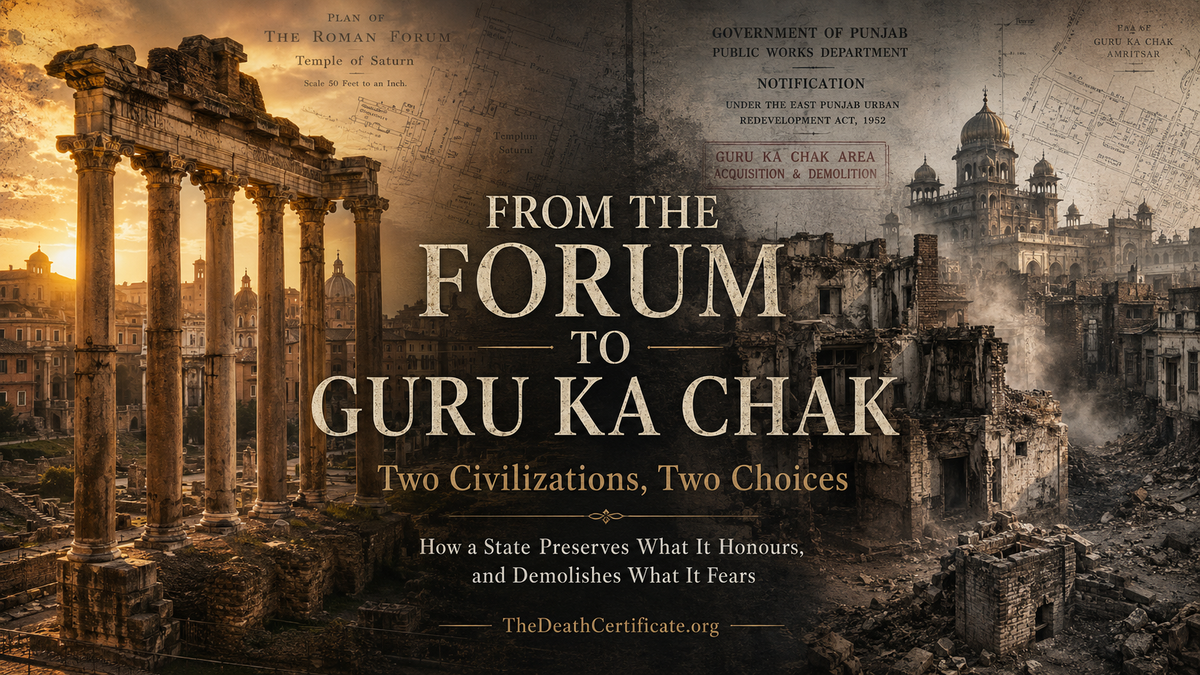
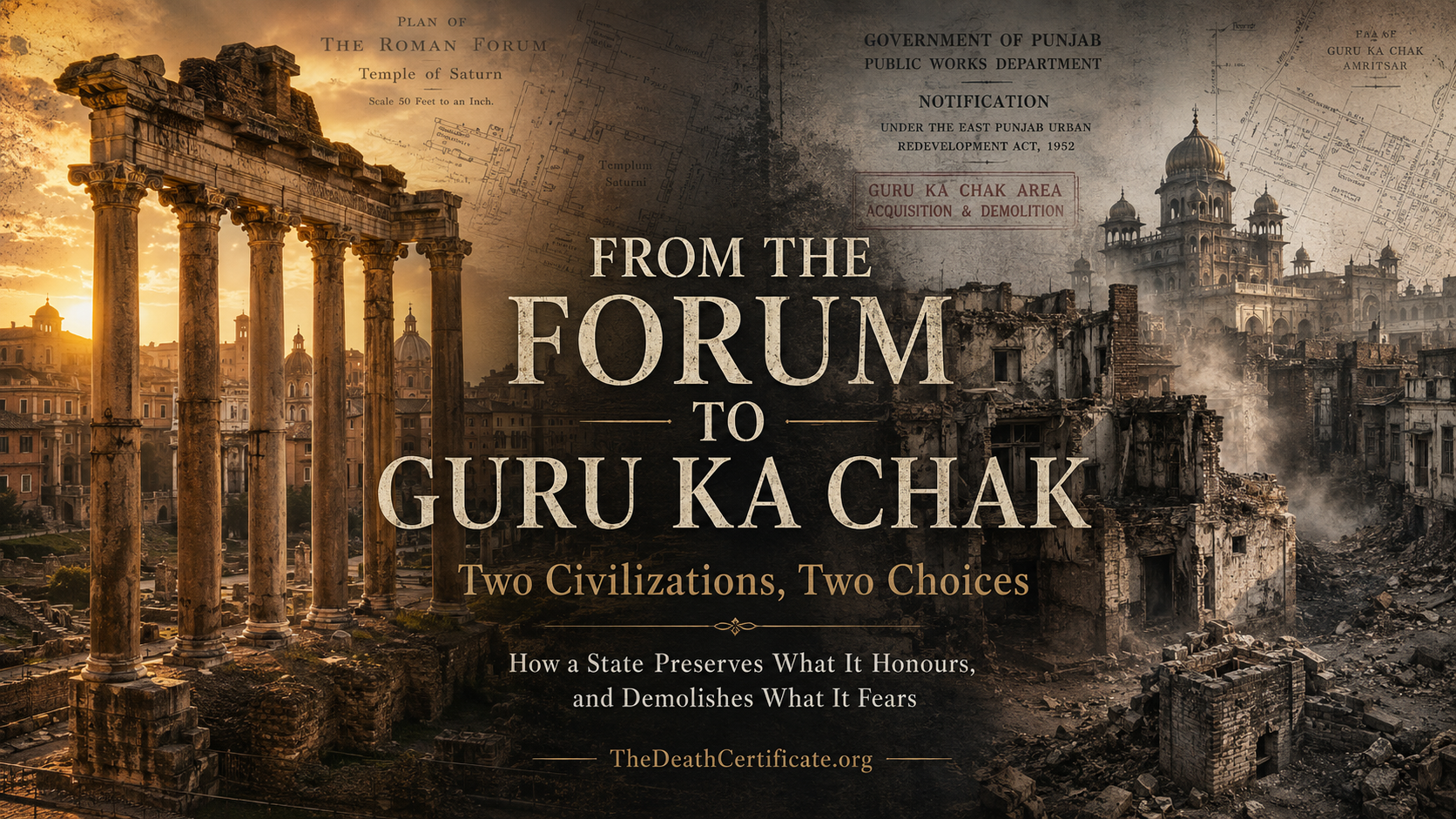
Two Civilizations, Two Choices: How a State Preserves What It Honours, and Demolishes What It Fears
A Long-Form Forensic Comparison — Italy, India, the Galliara Project, the Kar Seva Apparatus, and the Architecture of Selective Memory
kpsgill.com · Punjab ’95 Forensic Series · May 2026
Evidentiary Framework
[PF] Proved Finding — facts established by judicial record, official document, or convergent primary documentation
[DA] Documented Allegation — claims grounded in identifiable sources but not finally adjudicated
[AI] Analytical Inference — reasoned conclusions drawn from the cumulative pattern of the record
[PM] Panthic Memory — inherited community knowledge, devotional record, oral historical testimony
[PM-Direct] Direct personal witness testimony of the author
[JR] Judicial Record — specific court or tribunal finding
[SR] State Record — government administrative or legislative source
[ML] Media-Logged — contemporaneous press documentation
[UNVERIFIED / ARCHIVE TARGET] — claim requiring further documentary verification; flagged for archival research
Prologue — A Letter Begun in Rome
I am writing the first pages of this article in Italy. I arrived in Rome on the twenty-third of May, walked through the Forum on a morning when the heat had not yet settled into the stone, sat for the better part of an hour on a low wall opposite the surviving columns of the Temple of Saturn, and felt — without warning, with the dull surprise of recognition — that I had been here before. Not in Rome. In Amritsar. Not in the Forum. In a city I will not see again because the city I am remembering no longer exists. [PM-Direct]
The columns of the Temple of Saturn are older than the Christian era. Eight of them still stand. They have been struck by lightning, lived through fires, watched empires pass through and dissolve, watched popes and pilgrims walk past them, watched Mussolini bulldoze a triumphal avenue half a kilometre to the north, and they still stand. They stand because, for two millennia, no Roman bureaucrat with the authority to demolish them has done so. They stand because, for the last hundred and fifty years, the Italian state has not only refused to demolish them but has built around them an entire legal-administrative apparatus whose purpose is to keep them standing. The Soprintendenza Archeologica answers to a Ministry. The Ministry answers to a Code. The Code, in its current incarnation, dates to 2004, but its bones are older: the Bottai Law of 1939, the Rosadi Law of 1909, the deep liberal-conservative consensus that the past is not at the disposal of the present and that no individual administrative officer, however well-intentioned, however gifted, however well-connected, has the right to weigh his own aesthetic judgement against the cumulative testimony of stone.
I sat on the wall and I thought of a man who would have understood what was missing here. I thought of him because he is, in a precise and not entirely coincidental sense, the obverse of what Rome had built around me. I thought of Karan Bir Singh Sidhu, Indian Administrative Service, 1984 batch, Punjab cadre, Deputy Commissioner and District Magistrate of Amritsar from 1992 to 1996, and now — in his retirement — a public commentator on Sikh affairs, a writer of Gurbani translations, a Substack columnist with thousands of subscribers, and a man who lists, among his two principal achievements as DC Amritsar, the project he calls the Galliara: the demolition of the lanes, the houses, the shops, and the hereditary fabric of the settlement that surrounded Sri Darbar Sahib for four centuries before he arrived, and the rebranding of that demolition as a beautification project.
[AI] It is the parallel I cannot stop seeing. In Rome a state has organised an entire constitutional posture around the proposition that two thousand years of accumulated stone is not the property of the contemporary administrator. In Amritsar — in the city that took its very name from the pool of nectar built by Guru Ram Das at the centre of the land he himself purchased and consecrated in the sixteenth century — an Indian administrative officer demolished five hundred houses and eleven hundred and fifty shops belonging to eight hundred and fifty-nine families and called it civic improvement. The Italian state would have arrested him. The Indian state honoured his predecessors with the Padma Shri and now permits him to publish moral homilies on Gurbani every Thursday.
This article is the long argument for what that parallel means. It is not, in the first instance, an attack on Mr Sidhu, though it does not spare him. It is an attempt to set, side by side, the choices a civilization makes when it confronts the inherited geography of its sacred and historical past — and to ask, with the bluntness that the comparison forces, why one tradition has produced two millennia of preserved fabric and the other has produced a Deputy Commissioner who lists the demolition of Guru Ka Chak as the first of his career achievements.
[PF] The comparison this article exists to make is the comparison between a system that requires Heritage Impact Assessments, public consultation records, institutional authorisation, criminal sanctions for non-compliance, and a dedicated investigative heritage police — and a system that requires none of these. The Italian Codice dei Beni Culturali e del Paesaggio requires all of the above. The Indian Land Acquisition Act of 1894 — under which the Galliara was conducted — required none of them.
“Where, in the Italian system, a Deputy Commissioner who demolished five hundred houses around the Pantheon would face criminal investigation, in the Indian system the Deputy Commissioner who demolished five hundred houses around Sri Darbar Sahib received the project director’s title and, three decades later, the moral authority to write public homilies on Sukhmani Sahib.”
I will, in the pages that follow, draw the long line from the Forum to Guru Ka Chak, from the Soprintendenza to the Deputy Commissioner’s bungalow, from the Codice dei Beni Culturali to the absence in Indian law of any equivalent that protects Sikh heritage from its own administrators. I will compare the Galliara to Mussolini’s Via dei Fori Imperiali, which cut through medieval Rome to produce a parade route for Fascist tanks. I will compare it to Haussmann’s reconfiguration of Paris in the eighteen-fifties and eighteen-sixties. I will compare it to Robert Moses’s expressways through the Bronx and Manhattan. I will compare it to the December 1992 demolition of the Babri Masjid — an event for which it shares the year, the country, and the underlying logic, but from which it differs in one crucial respect that makes it, by an exact moral calculation, worse than the Babri Masjid demolition.
Above all I will return, at length and with documentary precision, to the cremation register that Sidhu’s polished stone cannot redeem. [PF] While the Galliara was being landscaped, two thousand and ninety-seven illegally cremated bodies — the figure is the Central Bureau of Investigation’s, not mine, confirmed to the satisfaction of the Supreme Court of India in December 1996 — were being delivered to three cremation grounds in Sidhu’s district. The Galliara is photographed. The cremation ash is not. The Galliara appears in Sidhu’s Substack as a civic achievement. The cremation ash does not appear in his archive at all.
I. The Italian Method — Two Thousand Years and the Patience to Save Them
Begin with the law, because the law tells you what kind of state you are dealing with. The Italian Republic, in the present moment, governs the protection of its cultural and landscape heritage through the Codice dei Beni Culturali e del Paesaggio — the Code of Cultural Heritage and Landscape — adopted by Legislative Decree number forty-two of two thousand and four, and amended several times since. [SR] The Code is itself the descendant of an older statute, the Bottai Law of 1939, which is the more remarkable fact when you consider that Giuseppe Bottai was a Fascist Minister of Education and that the law he sponsored has survived the regime that created it because successive Italian governments — democratic, Christian Democrat, Socialist, technocratic, Berlusconian, Meloni — have all recognised that the protection of cultural heritage is not the property of any political faction. [AI] The Bottai Law was itself the consolidation of an earlier 1909 statute associated with the jurist Rosadi. Italian heritage law, in its modern form, is more than a hundred and fifteen years old. It is older than the Indian Republic. It is older than Italian democracy.
The Codice dei Beni Culturali does several things. [SR] It identifies categories of cultural property. It distinguishes between immovable property — buildings, archaeological sites, gardens — and movable property — paintings, manuscripts, archaeological finds. It establishes the principle that cultural property of historical, artistic, archaeological, or ethnographic interest is subject to public-interest constraints regardless of who owns it. A private citizen who owns a building that has been declared culturally significant cannot demolish it. Cannot substantially alter it. Cannot even change its external colour without authorisation from the Soprintendenza, the regional cultural heritage authority that answers to the Ministry of Culture.
[SR] The Soprintendenza is the working bureaucracy of cultural protection. There is one for each region, sometimes more, divided by subject matter — Archaeological Soprintendenze, Architectural Soprintendenze, Library Soprintendenze. The Soprintendente has authority that is administrative but functionally quasi-judicial. He or she can declare a property protected. Can require the owner of a protected property to submit conservation plans for any proposed work. Can require excavations, surveys, photographic documentation, and material analyses before authorising any intervention. Can stop work in progress if undocumented heritage emerges during construction — the regular discovery of Roman foundations beneath modern Roman streets is so common that Rome’s metro system is decades behind schedule because every excavation uncovers archaeological material that the Soprintendenza must examine.
“The metro waits. The Forum does not. That sentence, by itself, summarises the difference between a civilization that has decided its past is sovereign and a civilization that has decided its past is at the disposal of whichever administrative officer happens to be sitting in the District Magistrate’s chair.”
[SR] The Code’s reach is wider than the protected-list system. Article 142 declares categories of landscape — coasts, lakes, mountains above a certain altitude, glaciers, parks, woodlands — to be protected ex lege, by operation of law, without any requirement of individual declaration. This is the vincolo paesaggistico, the landscape constraint, which subjects whole categories of territory to mandatory cultural-heritage review. Combined with the vincolo monumentale that protects declared buildings, it creates a layered constraint system in which entire historic city centres — Rome’s centro storico, Florence’s centro storico, Venice’s island — are functionally non-demolishable.
[SR] The enforcement mechanisms are real. Article 169 of the Code criminalises the destruction, deterioration, or unauthorised alteration of protected cultural property. Penalties range from fines into the tens of thousands of euros to imprisonment of up to one year for the basic offence, with aggravated forms carrying longer sentences. Article 170 criminalises unauthorised work on protected sites. The Carabinieri Tutela Patrimonio Culturale — a dedicated heritage police division established in 1969, the oldest force of its kind in the world — has, since its creation, recovered hundreds of thousands of cultural objects and pursued thousands of cases. [AI] The Italian state has decided that the protection of cultural heritage requires not only a legal framework and an administrative apparatus but also a dedicated police force. That is the measure of the seriousness.
[AI] Now apply the test that the comparison forces. If a District Magistrate of Rome, in 1993, had announced the compulsory acquisition of five hundred houses within thirty metres of the perimeter of the Pantheon — for the announced purpose of creating a tactical security perimeter, later rebranded as a beautification corridor — what would have happened? The Soprintendenza would have refused. The Italian Constitutional Court would have been seized within days. UNESCO, under whose World Heritage designation Rome’s historic centre is registered, would have issued a formal communication. The Carabinieri Tutela Patrimonio Culturale would have opened a file. The District Magistrate would have been transferred, demoted, possibly prosecuted. He would not, three decades later, be writing public homilies on religious philosophy for a civilian audience of thousands.
[AI] This is what the Italian method is. The burden of proof falls on the demolisher, not on the inheritor. The Galliara would not have happened in Italy because, in Italy, the burden of proof would have fallen on Mr Sidhu, and Mr Sidhu — by his own admission, in his own Substack column, in his own television interviews — did not have the documentation, the SGPC resolution, the Heritage Impact Assessment, the public consultation record, the conservation rationale, or the institutional partnership that the Italian system would have required as preconditions of even beginning to consider the project.
II. The Indian Counter-Method — A State That Learned to Protect Some Pasts and Erase Others
India is not without a heritage law. India has, on paper, a fairly elaborate one. [SR] The Ancient Monuments and Archaeological Sites and Remains Act of 1958 is the principal national statute. The Archaeological Survey of India, the institutional successor of the colonial-era Survey founded by Alexander Cunningham in 1861, is the operational agency. [SR] The Constitution, in the Directive Principles under Article 49, includes a state duty to protect monuments and places of national importance. India is a State Party to the UNESCO World Heritage Convention. India has ratified the Hague Convention for the Protection of Cultural Property in the Event of Armed Conflict.
[AI] What is absent is the institutional culture. What is absent is the operational protection. What is absent is the dedicated investigative police force — no Indian equivalent of the Carabinieri Tutela Patrimonio Culturale exists. What is absent, above all, is the principle that the burden of proof falls on the demolisher. In India, the burden falls on the heritage advocate, who must prove that the structure was historically significant; on the displaced family, who must prove that the compensation was inadequate; on the religious community, which must prove that the demolition violated its custodial rights. It does not fall on Mr Sidhu, who is permitted, three decades after the fact, to publish his own account of the demolition as a civic achievement.
[AI] The Ancient Monuments Act protects what is on the centrally protected list, which contains roughly 3,693 monuments — a number that has remained essentially static for decades. The list contains the obvious things: the Taj Mahal, Humayun’s Tomb, Fatehpur Sikri, the Red Fort, the Qutub Minar, the Sun Temple at Konarak, the rock-cut temples of Ellora, the painted caves of Ajanta. It contains most of the major Mughal monuments and most major Hindu temples of southern India. It contains a strikingly thin representation of Sikh historical fabric.
[DA] The documented controversy surrounding the Darshani Deori at Tarn Taran Sahib — a Guru-period structure whose renovation involved the demolition and reconstruction of elements that INTACH and independent conservation specialists identified as historically irreplaceable — illustrates the mechanism with forensic clarity. The authorisation trail for that intervention: who directed it, under what committee resolution, with what heritage-assessment input, with what conservation specialist approval, and with what archaeological oversight, does not appear in the public domain in a manner that would satisfy the standards of the Archaeological Survey of India applied to any other heritage site of equivalent antiquity.
[SR] The Indian state has constructed a constitutional posture that delegates the management of Sikh sacred spaces to the SGPC under the Sikh Gurdwaras Act of 1925 and then declines, in the name of religious autonomy, to apply to those spaces the same heritage-conservation regime it would, in principle, apply to a Mughal monument or a Chola temple. [AI] The delegation is convenient. It produces a regime in which the state can claim that it is respecting Sikh institutional autonomy while the historical fabric is being destroyed by an SGPC machinery over which the state declines to exercise supervision.
III. Guru Ka Chak — The Land Before the Bureaucrat Arrived
The town that became Amritsar was, in its original name and its founding documents, called Guru Ka Chak. [PM] The name is unceremonious and exact. Chak in Punjabi means a tract of land, often a settlement on land newly brought under habitation, often associated with a specific founder. Guru Ka Chak is the Guru’s tract — the land of the Guru. The Guru in question is Guru Ram Das, the fourth Guru of the Sikh tradition, who acquired the land in the second half of the sixteenth century and consecrated it as the future centre of Sikh religious and civic life.
[PM, ML] Guru Ram Das founded the settlement in 1577, the standard date in the Sikh historical record. He directed the construction of the Amrit Sarovar, the sacred tank that gave the town its eventual name. He directed the laying out of bazaars and the establishment of trades. He summoned merchants, artisans, scribes, doctors, and householders to establish themselves on the land. The town was, from its founding, a planned settlement — planned around a sacred geometry with the tank at the centre, the Harmandir on an island in the tank, the bazaars in concentric rings, and the lanes connecting the bazaars to the tank.
[PF] The Adi Granth was installed in the Harmandir Sahib by Guru Arjan Dev Ji in 1604. From that moment forward, the structural geometry of the town was organised around the living text. The bazaars supplied the pilgrim economy. The lanes carried the pilgrims from the bazaars to the parikrama. The dharamsalas housed the pilgrims. The houses of the hereditary custodial families — the ragis, the granthis, the seva-families, the merchants whose families had supplied goods to the Darbar Sahib for generations — clustered around the parikrama in concentric rings of decreasing density.
[PM] By the time of Maharaja Ranjit Singh, in the early nineteenth century, the city had a fully developed urban fabric. The gilding of the Harmandir Sahib’s dome under Ranjit Singh’s patronage produced the structure we now call the Golden Temple. The marble work, the inlay work, the painted murals of the early nineteenth century were superimposed on the architectural fabric of the previous two centuries. The result, by the late nineteenth and early twentieth century, was an urban ensemble that combined Guru-period planning, Misl-period architecture, Ranjit Singh-period adornment, and colonial-period accretions in a single living fabric.
[PF, ML] The numbers, where they are documentable, are these. The Galliara project, in its expanded form, displaced eight hundred and fifty-nine families. It demolished approximately five hundred houses. It demolished approximately eleven hundred and fifty shops. The cost figures, as reported in the Tribune and other contemporary accounts, ran to approximately one hundred and sixty crore rupees in the values of the early 1990s. The displacement was effected through the Land Acquisition Act of 1894, which permitted compulsory acquisition with compensation determined by administrative valuation. [AI] A shop that had been in the same family for five generations on a lane two hundred metres from the parikrama could not be replaced by a shop in a new commercial development two kilometres away, however generous the formal compensation. The hereditary value was extinguished. The custodial inheritance was severed.
“The Italian comparison is instructive here. Around the Vatican, the Borgo neighbourhood’s medieval streets are treated as heritage in their own right — their irregular geometries, the property lines of centuries of occupation. The Italian vincolo paesaggistico applies. The Soprintendenza reviews any proposed demolition, however minor. The cumulative fabric — the lane, the courtyard, the relationship between buildings — is itself cultural property requiring protection. Guru Ka Chak deserved the same standard. It received none of it.”
IV. The Galliara — A Tactical Perimeter Rebranded as Civic Beautification
[PF, ML] The Galliara has a date of origin, and the date is not the date Sidhu prefers to emphasise. The project was initiated on 9 June 1988 — exactly thirteen days after Operation Black Thunder Two, the second paramilitary operation conducted against the Golden Temple complex in the post-Blue Star period. The June 1988 announcement described the project as the creation of a thirty-metre security buffer around the perimeter of the Golden Temple complex. The language was tactical, not aesthetic. The justification was the prevention of future militant occupation. The dense urban fabric around the Darbar Sahib had, in the official analysis, complicated the army’s tactical operations during Blue Star in 1984 and during the two Black Thunder operations. [AI] The Galliara was, in its original conception, the elimination of these tactical disadvantages. It was a security project. The language was clear.
[ML] The project encountered resistance. The resistance was extensive. The Akali political parties, in their various factions, opposed the demolition on the grounds that it was an extension of the state’s military intrusion into Sikh sacred geography — an interpretation that the timing relative to Black Thunder Two made impossible to deny. The displaced families resisted the acquisition. The merchants whose shops were threatened organised. The kar seva community, in some of its branches, opposed the project on the grounds that no SGPC resolution authorising the project had been adopted.
[DA, ML] Then came the murder. In the early 1990s, a government engineer associated with the Galliara project was murdered. The killing, in the political context of the period, could not be definitively attributed to any one group. The political effect of the killing was immediate and decisive: the project was effectively suspended. The Galliara, in 1991 and 1992, was a stalled project — partially demolished, partially intact, the displaced families relocated to inadequate temporary accommodation.
[PF] This is the project that Karan Bir Singh Sidhu, IAS, inherited in 1992 when he was posted as Deputy Commissioner of Amritsar. In 1993, Sidhu was appointed Project Director of the Galliara — a title additional to his DC/DM responsibilities. The acquisitions that had stalled were completed. The demolitions that had paused were resumed. The displaced families’ temporary accommodation was made permanent.
[PF] And at this point, in Sidhu’s own narrative, the transformation occurred. The project that had been conceived as a security buffer was rebranded as a beautification corridor. The vocabulary shifted. The bare cleared zone became the landscaped plaza. The marble was laid. The lighting was installed. The vista of the Harmandir Sahib was framed. The result was, in Sidhu’s account, the Galiara that visitors to Amritsar now experience: an open plaza, clean and well-lit, with the Darbar Sahib visible across an unobstructed expanse.
“The thirty metres of demolition did not change. The geometry did not change. The displacement did not change. The destruction of four centuries of urban inheritance did not change. What changed was the name. The security buffer became the beautification corridor by an act of administrative re-description, performed not in 1988 by the army that had cleared the complex during Black Thunder, but in 1993 by the Deputy Commissioner who had completed the demolition the army had only authorised.”
[PF] The re-description is what permits Sidhu, in his retirement, to list the project as a civic achievement. The re-description is what permits the photograph — Sidhu standing in the completed plaza, the Darbar Sahib in the background, the marble polished — to function as a moral credential. The re-description is what permits Khushwant Singh’s late-edition acknowledgement of the project in A History of the Sikhs to be cited by Sidhu as historical validation.
[PF] The re-description is also, on Sidhu’s own admission in his Substack column, an act he has documented. The relevant post describes the Galliara as having been “originally conceived in security terms” and “later transformed into a beautification initiative.” The language is Sidhu’s own. [AI] The functional argument is not a speculative argument. It is an engineering argument that any military planner would make: the thirty-metre cleared strip provides clear sight lines for security forces, eliminates the dense urban fabric that complicated tactical operations in 1984, 1986, and 1988, creates a controlled and monitorable approach, and eliminates the cover that defenders had used in previous operations. The aesthetic finish does not change any of these functional properties.
V. The Auzaar Television Confession — What Sidhu Said When He Thought It Sounded Good
[PF] The most consequential document in the Galliara archive is a Punjabi-language television interview that Karan Bir Singh Sidhu, IAS (retired), gave in early 2025 — uploaded to YouTube under PRO Punjab TV’s channel (video ID: YBoBWZYl8EA), promoted through his own Substack as a “fresh perspective on Punjab’s panthic politics” — in which he set out, in his own voice, the authorisation history of the Galliara as he wished it to be remembered.
[PF] On the interview, Sidhu sets out the SGPC approval narrative in a sequence that contains, in compressed form, every flaw in the project’s authorisation chain. He states — paraphrased from the Punjabi original — that:
- He went to SGPC President Gurcharan Singh Tohra individually and explained the project
- Tohra approved verbally
- He went to SGPC General Secretary Manjit Singh Calcutta individually
- Calcutta approved verbally
- The three men — Sidhu, Tohra, and Calcutta — then met together to confirm the approval
- No SGPC resolution was adopted
- No document was signed
- Tohra died in 2004; Calcutta is deceased
[AI] The legal-institutional consequence is that the SGPC, as an institution, did not authorise the Galliara. The Sikh Gurdwaras Act of 1925 requires that the SGPC act through its executive committee in formal capacity, with resolutions recorded in minutes. The personal verbal opinions of two now-deceased office-bearers cannot substitute for the institutional record. [SR] The executive committee of the SGPC may or may not have been convened. Its minutes, if they exist, would answer the question. Their non-production is the institutional record’s gap.
[PF] Gurcharan Singh Tohra served multiple terms as SGPC President and was one of the most powerful figures in Sikh institutional politics of the twentieth century. He died on 1 April 2004. [DA] Tohra cannot confirm that he gave verbal approval. He cannot explain what he understood the project to be. He cannot say whether the SGPC executive committee was ever formally convened. The dead-corroborator problem is complete.
“The retired Sidhu writes against the practices of the active Sidhu. The Substack columnist warns the public about the bureaucrat. The bureaucrat has not heard the warning, because the bureaucrat retired, and the columnist now sits in his place, drawing the salary of moral commentary on the institution whose recorded resolutions the bureaucrat had been content to do without.”
[PF, DA] Sidhu has also stated, in the Auzaar TV interview, that he was the primary negotiator during the April 1993 hijacking at Raja Sansi International Airport and that K.P.S. Gill arrived after the resolution primarily for the photograph. [PF] K.P.S. Gill died on 26 May 2017 and cannot contest this account. The Crisis Management Group records, the National Security Guard records, the Punjab Police records, and the Ministry of Civil Aviation records of the incident, if produced, would conclusively settle the credit allocation. They have not been produced.
VI. The Bureaucrat’s Resume — Two Achievements, One Long Silence
[PF] If you ask Karan Bir Singh Sidhu what he accomplished as DC Amritsar between 1992 and 1996, he has a ready answer. Two things: the Galliara and the hijacking. The Galliara is the civic improvement around Sri Darbar Sahib. The hijacking is the April 1993 episode at Raja Sansi Airport. Two achievements. Two photographs. A career compressed into a symmetrical pair of administrative successes.
[PF] The four years that Sidhu spent as DC Amritsar between 1992 and 1996 were not four years that contained only two events. They were four years that contained, on the documentary record established by the Central Bureau of Investigation, the Supreme Court of India, the National Human Rights Commission, Human Rights Watch, Amnesty International, and the Ensaaf database:
[PF, JR] — The systematic illegal cremation of 2,097 unidentified persons in three cremation grounds within his district — the Durgiana Mandir cremation ground at Amritsar city, the Patti cremation ground, and the Tarn Taran cremation ground — which the Supreme Court in its December 1996 order described as “a flagrant violation of human rights on a massive scale.” (Writ Petition (Criminal) No. 447 of 1995, Committee for Information and Initiative on Punjab v. Union of India)
[PF, JR] — The abduction, on 6 September 1995, of Jaswant Singh Khalra, the human-rights activist who had documented the illegal cremations from the cremation-ground firewood-requisition vouchers, during Sidhu’s tenure as DC Amritsar
[PF, JR] — The killing of Khalra in police custody at the Jhabal Police Station, his body thrown into the Harike canal without last rites and never recovered, and the eventual conviction of five Punjab Police officers for that killing, upheld by the Supreme Court in 2011
[PF, JR] — The death — by alleged suicide on the railway line at Bhakharpur village on 23 May 1997 — of Senior Superintendent of Police Ajit Singh Sandhu, the main accused in the CBI chargesheet for Khalra’s murder, who died before he could be brought to trial
[PF, JR] — The systematic non-conduct, confirmed by the CBI, of the mandatory Section 176 magisterial inquiries required under the Code of Criminal Procedure before cremation of any unidentified body
[AI] None of this appears on Sidhu’s curated resume. None of this appears in his Substack column. None of this appears in the August 2025 SikhNet interview with Dr Gurnam Singh. This is the selective archive. This is what the kpsgill.com series has named the architecture of forgetting.
“The Galliara is the photograph. The two thousand and ninety-seven cremations are the negative space around the photograph. The bureaucrat is the figure in the foreground. The negative space is filled with the unidentified ash of bodies that the office in which the figure sat had a statutory duty to inquire into and did not.”
VII. December 6, 1992 — The Year He Took Office
[PF, JR] Karan Bir Singh Sidhu was posted as Deputy Commissioner of Amritsar in 1992. The year is significant for reasons that go beyond Sidhu’s personal career. On 6 December 1992, in Ayodhya in Uttar Pradesh, approximately 75,000 kar sevaks mobilised by the Vishwa Hindu Parishad and affiliated Sangh Parivar organisations breached police cordons around the Babri Masjid and, in approximately five hours, demolished the sixteenth-century mosque.
[PF, JR] The Liberhan Commission of Inquiry, established on 16 December 1992 by the central government, took seventeen years to file its final report. The report, delivered in 2009, identified by name the senior political leaders, party workers, and administrative officers held responsible for the demolition. The Commission found that the demolition had been pre-planned and organised at the highest levels of the Sangh Parivar. [PF, JR] The criminal prosecution of the principal accused resulted, in 2020, in the acquittal of all accused by a special CBI court. The acquittal was widely understood, in the Indian legal and historical community, as a political verdict rather than an evidentiary one.
[AI] This is the political-historical backdrop against which Sidhu took office in Amritsar. The Babri Masjid demolition was the dominant national event of the year of his appointment. And yet, in the same year, the Galliara demolition continued. [AI] The Babri Masjid demolition was a mob action against state property protection. The Galliara demolition was a state action against community property holding. The Babri demolition was extralegal. The Galliara demolition was procedurally legal — under the Land Acquisition Act — but substantively a demolition of religious heritage of comparable consequence.
“Babri was a mob with hammers. Galliara was a bureaucrat with files. Babri was punished by history with public memory. Galliara was rewarded by history with Khushwant Singh’s acknowledgement. The asymmetry is not a coincidence. The asymmetry is what the Indian state’s selective protection of religious heritage has produced as its consistent result.”
[PF, ML] The Babri Masjid demolition was publicly visible — photographed, televised, archived, internationally condemned. The Galliara demolition was administratively quiet — conducted through acquisition notices, possession orders, demolition contractors, and the bureaucratic machinery whose operations the press does not usually photograph. [AI] The Babri demolition produced the Liberhan Commission and a seventeen-year inquiry. The Galliara demolition produced no inquiry. The asymmetry of the institutional response tells the story of how the Indian state treats demolitions of religious heritage according to which community’s heritage is being demolished and by which mechanism.
VIII. The Roman Comparison — Three Sacred Districts, Three Civilizational Choices
[PF, SR] Rome has three sacred districts. Each is, in the present-day Italian heritage system, comprehensively protected. The Vatican is, in formal international-law terms, a sovereign state established by the Lateran Treaties of 1929 between the Holy See and the Italian state. It is also a UNESCO World Heritage Site. Any proposed alteration to Vatican structures requires authorisation from multiple bodies: the Reverend Fabbrica di San Pietro, the Vatican’s permanent conservation authority; the Office of Liturgical Celebrations; and, where the alteration affects the visible profile from Italian territory, the Italian Soprintendenza.
[PF, SR] The Forum Romanum occupies approximately five hectares between the Capitoline Hill and the Colosseum. The Italian heritage authorities have made the deliberate decision not to excavate further until conservation techniques are developed that can preserve the additional remains under conditions superior to those available at present. [AI] This is the principle of minimum intervention applied to archaeological practice — the principle that an archaeological site is best preserved where it is, in the state in which it has survived, with the minimum disturbance compatible with study and public access.
[PF, SR] The area around the Pantheon — constructed in approximately 126 CE — is one of the densest fabrics of medieval and Renaissance Rome. The vincolo paesaggistico applies. The Soprintendenza reviews any proposed demolition. The result is that the visitor to the Pantheon today walks the same lanes the visitor walked in 1595, in 1895, in 1995.
[AI] Compare this to what the Indian state did when it confronted, in the post-Blue Star period, a sacred site of equivalent religious significance to a community of equivalent demographic size. The Sikh tradition is the world’s fifth-largest religion. Its global demographic is approximately 25–30 million, depending on the count. Sri Darbar Sahib is, to the Sikh tradition, what Saint Peter’s is to the Catholic tradition. If a hypothetical Italian Deputy Commissioner had proposed, in 1993, the compulsory acquisition of the medieval Borgo neighbourhood within thirty metres of Saint Peter’s Square, the proposal would have been politically impossible within hours of its announcement. And yet, on the equivalent ground around Sri Darbar Sahib, the Galliara did proceed.
“The Italian heritage system protects what would otherwise be vulnerable. The Indian heritage system, by its selective non-application to Sikh historical fabric, exposes what would otherwise be protected. The Galliara is the architectural expression of this systematic exposure.”
IX. The Kar Seva Mirror — When the State Outsources the Demolition to Faith Itself
[PM] The word kar seva, in its proper religious meaning, refers to voluntary devotional service performed by the Sikh community at gurdwaras — service that includes cooking in the langar, sweeping the parikrama, washing the marble, polishing the brass, and all the daily acts of maintenance that the gurdwara economy has depended upon since the founding of the tradition. The proper religious meaning of kar seva is one of the most beautiful aspects of Sikh institutional life.
[AI] What the Sikh tradition has developed, in the twentieth and twenty-first centuries, is a parallel and distinct phenomenon that has appropriated the religious vocabulary of kar seva while operating as something institutionally different. The contemporary kar seva, particularly as practiced in the renovation of major historical gurdwaras under the SGPC’s authority, is not the voluntary devotional service of the historical tradition. It is a system of contracted construction work, conducted by specific babas — dera-affiliated religious figures who command the labour of devotees, control the funds donated by the sangat, and supervise the actual demolition, replacement, and reconstruction of historical fabric. [AI] The mechanism has three components: the appropriation of devotional vocabulary to describe a construction contract; the avoidance of heritage protocol through devotional framing; and the substitution of new fabric for old fabric without conservation justification.
[DA] The Darshani Deori at Tarn Taran Sahib — the gateway structure associated with Guru Arjan Dev Ji — was subjected to a renovation episode in which the original Nanakshahi brick fabric was replaced in substantial portions. INTACH and independent conservation specialists identified specific structural elements that were irreplaceably altered. The kar seva baba presiding over the work did not commission any Heritage Impact Assessment, did not consult INTACH, did not engage any conservation specialists, and did not maintain any documented record of the pre-intervention fabric. [DA] The SGPC did not require any of these procedures. The Indian state, by treating the renovation as an SGPC internal matter, did not intervene.
[PF, JR] The Akal Takht reconstruction is the most consequential case study of the kar seva mechanism’s operation in the post-Blue Star period. The Akal Takht was severely damaged in the June 1984 Indian Army assault. The reconstruction was conducted under the supervision of Buta Singh and Sant Santa Singh, at the direction of the Indian state. The reconstruction was contested. [PF, JR] Santa Singh was excommunicated by the Akal Takht in 1986 for his role in the state-supervised reconstruction — the only documented case in modern Sikh history of an excommunication of a kar seva baba for his role in a reconstruction project.
“Sidhu’s Galliara is the state’s version. The contemporary kar seva is the SGPC’s version. The Galliara is paid by the state and presented as civic. The kar seva is paid by the devotees and presented as devotional. Both demolish Sikh heritage. Both lack heritage protocol. Both substitute uniform modern surfaces for the inherited material record. The two are not separate phenomena. They are mirror images of a single mechanism, distinguished only by who pays the demolisher.”
X. The Akali Dal’s Touristy Conversion — Statues, Standardised Fonts, and the Erasure of Lane Memory
[ML, AI] The Heritage Street project — implemented during the Sukhbir Singh Badal-led government’s period in power, broadly 2012 to 2017 — produced the route now known to tourists: approximately five hundred metres of standardised facades, uniform amber lighting, the Maharaja Ranjit Singh equestrian statue at the head of the approach, and the Town Hall converted into the Partition Museum. The result is, on every contemporary tourism index, a successful pedestrian corridor. The result is also, in substance, the erasure of the visual record of four centuries of commercial and devotional life.
[AI] The statue of Maharaja Ranjit Singh is the most visible single intervention. Ranjit Singh is unambiguously a figure of central significance to Sikh political and religious memory — the founder of the Sikh Empire, the patron of the Harmandir Sahib’s gilding, the most consequential ruler of nineteenth-century Punjab. The statue the Akali Dal project produced is, in its bronze and plinth, designed to function as a photogenic backdrop for tourist photography rather than as a contemplative invocation of the historical figure it represents. It has become, in the visual economy of the Heritage Street, an Instagram point — a designed photographic node — rather than a memorial.
[AI] The standardisation of fonts and colours on the shop signage is the second-most visible intervention, and in heritage terms the more consequential one. Each previous font, each previous colour, each previous proportion was the expression of a particular family’s particular history of occupying that particular shop. The variety was the document. The standardisation erased the document. Compare this to the Italian heritage system: the lanes around the Pantheon are not standardised. The shop signage is not uniform. The Soprintendenza maintains colour charts derived from the historically documented palette of each city’s architectural tradition, preserving variety within consistency. The Heritage Street’s standardisation imposes contemporary design uniformity on a historical fabric whose accumulated variety was itself the heritage.
“The Heritage Street is the architectural culmination of what the Galliara began. The Galliara cleared the inner perimeter. The Heritage Street standardised the outer approach. Together, they have produced a single curated environment in which Sri Darbar Sahib functions as the visual climax of a tourist itinerary rather than as the sacred destination of a pilgrim’s journey.”
[AI] The institutional pattern is consistent. The Akali Dal political establishment that authorised the Heritage Street is the same establishment whose alignment with the central government produced the political space for Sidhu’s Galliara two decades earlier. The Akali Dal SGPC that presided over the contemporary kar seva apparatus is the same SGPC whose President and General Secretary gave verbal approval to Sidhu’s Galliara without an executive committee resolution. The pattern is not a series of unrelated decisions. It is the consistent expression of a single institutional posture: a political establishment that has, over four decades, accepted the conversion of Sikh sacred geography into a curated visitor experience in exchange for the political accommodations the Indian central state has been willing to offer in return.
XI. Old Parallels — Haussmann, Mussolini, Moses, and the Universal Grammar of Beautification
[AI] The administrative demolition of historical urban fabric, justified by aesthetic and circulation arguments, is one of the most extensively documented phenomena of modern urban history. The vocabulary is consistent across countries, decades, and political systems: slum clearance, urban renewal, pedestrianisation, beautification, strategic improvement, national grandeur, public health, crime prevention, traffic flow, dignity of approach. The actual operation, beneath the vocabulary, is consistent: the cleared zone is the cleared zone, the displaced families are the displaced families, the demolished fabric is the demolished fabric. The aesthetic outcome may vary. The mechanism does not.
[PF, ML] Georges-Eugène Haussmann, Baron Haussmann, served as Prefect of the Seine from 1853 to 1870 under the Second Empire of Napoleon the Third. He demolished approximately twenty thousand buildings in the medieval centre of Paris and displaced approximately three hundred and fifty thousand residents — approaching one-third of the city’s population. He destroyed the Île de la Cité’s medieval residential quarter, the medieval lanes of the Latin Quarter in significant portions. He produced, by the demolition, a property-development boom that enriched the politically connected and impoverished the displaced. The displaced constituted the urban working class whose political consciousness would express itself in the Commune of 1871.
[AI] Haussmann’s stated rationale was multiple — public health, aesthetic improvement, and the strategic defensibility of wide boulevards against barricades. [AI] The strategic rationale was, in functional effect, decisive. Note the parallel to the Galliara: multiple stated rationales, the aesthetic rationale as the publicly foregrounded justification, and the security rationale as the founding impetus — which Sidhu himself has acknowledged in the language of his own Substack column.
[PF, ML] Benito Mussolini’s regime undertook a series of administrative demolitions in Rome that are the closest twentieth-century parallel to the Galliara. The most consequential was the Via dei Fori Imperiali, the wide ceremonial avenue cut between the Piazza Venezia and the Colosseum in the early 1930s by demolishing the Quartiere Alessandrino. The aesthetic was triumphalist — the political message being the continuity between the Roman Empire and the Fascist regime. [AI] The post-war Italian state has treated the Via dei Fori Imperiali as the foundational example of what administrative demolition produces, and has organised itself never to repeat it. The Italian heritage system has, in the early twenty-first century, debated whether to pedestrianise the avenue precisely because its continuing existence is treated as an embarrassing reminder of the Fascist regime’s interventions. Mussolini’s beautification is Italy’s cautionary case study. India has not assigned the Galliara the same cautionary status. India has assigned it the status of civic achievement.
[PF, ML] Robert Moses, who held overlapping appointed positions in New York from 1930 to 1968, undertook the most extensive sequence of administrative demolitions in twentieth-century American urban history. He demolished approximately a quarter of a million units of housing and displaced more than half a million residents — overwhelmingly Black, Puerto Rican, and Italian-American working-class communities. He constructed in their place expressways — the Cross-Bronx Expressway, the Brooklyn-Queens Expressway — that produced the racial and class geography of contemporary New York. His posthumous reputation was substantially demolished by Robert Caro’s 1974 biography The Power Broker, which remains the foundational case study of administrative power exercised without accountability against the inherited fabric of the city it was supposed to serve. The Indian institutional culture has not produced a Caro equivalent for Sidhu. The kpsgill.com series is, in its modest forensic capacity, the attempt to begin that work.
“Haussmann demolished twenty thousand buildings and displaced three hundred and fifty thousand people in Paris. Mussolini demolished a medieval Roman quarter to build a parade route. Moses demolished half a million housing units to build expressways. Sidhu demolished five hundred houses and eleven hundred and fifty shops around Sri Darbar Sahib to build a plaza. The scale differs. The mechanism is identical. The erasure of the displaced community’s historical memory is identical.”
[AI] The universal grammar of beautification has five consistent elements. First, a stated aesthetic or civic rationale presented as the primary justification. Second, a security or strategic rationale that is the actual impetus but admitted only retrospectively. Third, a displaced community whose political power is inadequate to the resistance required. Fourth, an aesthetic outcome that is, in its own terms, a real visual improvement — which functions, thereafter, as the primary evidence in favour of the project. Fifth, a systematic absence of documentation of the cost. In every case — Haussmann, Mussolini, Moses, Sidhu — the fifth element is what permits the project to be presented, in retrospect, as an achievement rather than a scar.
XII. Medieval and Colonial Parallels — Selective Memory in Stone
[AI] The pattern is older than the modern administrative state. The conqueror demolishes the inherited religious architecture of the conquered. The conqueror replaces it with the religious architecture of the conquering tradition. The replacement is justified by the supremacy of the conquering tradition. The cost — the loss of the inherited architecture, the displacement of the religious community, the erasure of the historical memory — is treated as the appropriate price of supremacy.
[PF, ML] The Aztec capital of Tenochtitlan — the largest city in the Americas at the time of the Spanish conquest in 1521 — was systematically demolished by Hernán Cortés. The Templo Mayor was demolished and its stone reused in the construction of colonial Mexico City, including in the cathedral built on the site. The founding logic of Spanish colonial urbanism in the Americas is the founding logic of every subsequent administrative demolition: the inherited fabric of the conquered community is not heritage. It is rubble waiting to become construction material for the conquering tradition’s architectural ambition.
[PF, ML] The Ottoman conversion of the Hagia Sophia in 1453 is the most famous single act of heritage conversion in world history. The great domed church of the Byzantine tradition — built by Justinian in 537 CE, one of the great architectural achievements of the ancient world — was converted into a mosque within days of Mehmet the Second’s conquest. Atatürk converted it into a secular museum in 1934. Erdoğan reconverted it to a mosque in 2020, in a political move that the UNESCO World Heritage Committee condemned. The building has been, across fifteen centuries, the site of every regime change’s need to assert its architectural claim on the past.
[PF, ML] The British colonial reorganisation of Shahjahanabad — the walled Mughal city of Delhi — after the 1857 uprising involved the systematic demolition of large portions of the city to create security zones around the Red Fort and the Jama Masjid. The demolition displaced approximately one-third of Shahjahanabad’s population. The stated rationale included security and public health. The actual rationale included the colonial administration’s desire to assert physical control over the most symbolically charged urban space in the subcontinent.
[AI] Each of these historical cases — Tenochtitlan, Hagia Sophia, Shahjahanabad, and, at a much smaller scale, Guru Ka Chak — shares the same structural feature: the administrative authority of the demolishing entity is exercised against the inherited sacred or historic fabric of a community whose political power is insufficient to prevent the demolition, and the demolition is subsequently justified by an aesthetic, civic, or strategic rationale that converts the cost into a credential. The Galliara’s place in this lineage is not accidental. It is the structural consequence of the same political-administrative logic that has, across centuries and continents, produced the pattern of selective memory in stone.
XIII. The Twentieth and Twenty-First Century — From Babri to Bamiyan to Palmyra
[PF, JR] The Babri Masjid demolition of 6 December 1992 has been discussed in an earlier section. Its connection to the Galliara is the most immediate — the same year, the same country, the two demolitions operating simultaneously. The Babri demolition was publicly visible — photographed, televised, archived, internationally condemned. The Galliara demolition was administratively quiet. The Babri demolition produced the Liberhan Commission and a seventeen-year inquiry. The Galliara demolition produced no inquiry.
[PF, ML] The Taliban’s destruction of the Bamiyan Buddhas in March 2001 is the most internationally visible act of heritage destruction in the early twenty-first century. The two monumental figures carved into the sandstone cliffs of the Bamiyan Valley in Afghanistan, dating to the sixth century CE and representing the highest surviving expression of Gandharan sculptural tradition, were destroyed over two days using explosives, anti-aircraft weapons, and hand tools. The Taliban’s Mullah Omar announced the destruction as an act of Islamic iconoclasm. The UNESCO World Heritage Committee convened an emergency session. The international condemnation was immediate and universal. [PF] UNESCO lists the Bamiyan Valley as a World Heritage Site in Danger precisely because of the Taliban’s destruction.
[PF, ML] The Islamic State’s destruction of Palmyra, the ancient Syrian city whose well-preserved Roman-era ruins had been a UNESCO World Heritage Site since 1980, is the most recent case of comparable scale. The Islamic State captured Palmyra in May 2015. Over the following months, it systematically destroyed the Temple of Bel, the Temple of Baalshamin, the Tower of Elahbel, the Roman theatre, and numerous other structures. [PF] UNESCO’s documentation of the Palmyra destruction remains the authoritative record.
“The Bamiyan Buddhas are a war crime. The Galliara is a civic achievement. Both were demolished by authorities that decided the inherited fabric of a religious community was less important than their own strategic or aesthetic objectives. The difference between them, in the international moral vocabulary, is not the logic. The difference is the political location. The Buddhas were demolished in Afghanistan by the Taliban. The lanes were demolished in India by an IAS officer.”
[PF, ML] The Hagia Sophia’s reconversion to a mosque in July 2020 under Erdoğan’s decree reversed Atatürk’s 1934 museum conversion. The UNESCO World Heritage Committee issued a formal statement of concern. The European Union criticised the decision. The United States State Department expressed disappointment. The Turkish government proceeded regardless.
[AI] The Galliara is not equivalent to the Bamiyan Buddhas or Palmyra in its political framing. But the structural logic is the same: an authority with superior coercive power decided, for reasons combining strategic and aesthetic elements, to demolish the inherited sacred and historic fabric of a community that lacked the power to prevent the demolition. In each case, the demolition was subsequently justified by a rationale — religious purity, strategic security, civic improvement — that converted the cost into a credential. In each case, the community that lost the fabric has not received institutional acknowledgement of the loss.
XIV. The Bureaucratic Difference — Why an Administered Demolition Is Worse Than a Mob’s
[AI] There is an argument that a thoughtful reader might make at this point. The argument: the Babri Masjid demolition was conducted by a mob acting in defiance of court orders. The Galliara demolition was conducted through the legal machinery of the Land Acquisition Act. The Babri demolition was illegal. The Galliara demolition was legal. If the Galliara was legal, in what sense can it be compared to illegal demolitions? The argument, though it has a surface plausibility, fails on examination. And it fails in a way that makes the Galliara, in a precise moral calculation, worse than the Babri demolition rather than better.
[SR, AI] The Land Acquisition Act of 1894, under which the Galliara acquisitions were conducted, was a colonial statute whose definition of public purpose was sufficiently elastic to include what a colonial administrator decided to call a public purpose. The Act did not require a Heritage Impact Assessment. Did not require public consultation of the kind any serious contemporary heritage-protection law would require. Did not require the preparation of a documentary record of the historical fabric being demolished. Did not require the consent or even the formal institutional approval of the religious community whose sacred geography was being altered. The legality of the Galliara is the legality of a colonial statute. The legality is not an endorsement of the project’s heritage consequences.
“The Babri demolition is visible as destruction because a mob left no cover. The Galliara demolition is invisible as destruction because a bureaucrat left a paper trail. The bureaucratic paper trail is the precise mechanism by which an act of heritage destruction is converted into an administrative achievement. The bureaucrat, unlike the mob, can always say: I have the files.”
[JR, AI] The Liberhan Commission examined witnesses and produced findings. The CBI filed chargesheets. The special CBI court tried the accused. The acquittal was, in many analyses, a political verdict. But the attempt at criminal accountability was made. No equivalent accountability process has been initiated in connection with the Galliara. No inquiry has examined whether the project was conducted in accordance with heritage law. No inquiry has examined whether the compensation paid to the displaced families was adequate. No inquiry has examined whether the SGPC’s institutional approval was properly secured. No inquiry has been proposed.
[AI] This is the precise sense in which the administered demolition is worse than the mob’s. The mob’s demolition is visible. The mob’s demolition produces, eventually, an institutional accountability demand. The bureaucrat’s demolition is invisible — the paper trail converts it into an achievement. The paper trail is what the institution accepts as proof that the proper procedure was followed. The proper procedure was followed. And the proper procedure, under the 1894 Act, did not require heritage protection. Therefore the heritage was not protected. Therefore the heritage was demolished. And the demolition, having been conducted through the proper procedure, is recorded in the institutional memory not as a demolition but as an administrative achievement. The bureaucrat retires with his achievement. The achievement follows him into retirement. The retirement produces the Substack column. The Substack column produces the Gurbani commentary. The Gurbani commentary produces the moral authority. The moral authority is uncontested. Until now.
XV. The 2,097 — What Beautification Cannot Cover
There is a number in this article that has been present since the first paragraph and that must now receive its full treatment. The number is 2,097. The number is the Central Bureau of Investigation’s confirmed count — confirmed to the satisfaction of the Supreme Court of India in proceedings initiated in 1995 and reported in December 1996 — of the illegal cremations conducted in three cremation grounds in the Amritsar district during the period the CBI’s investigation covered.
[PF, JR] The Supreme Court of India, in its order in Writ Petition (Criminal) No. 447 of 1995 — filed by the Committee for Information and Initiative on Punjab (CIIP) — noted the CBI’s findings confirming the illegal cremation of approximately 2,097 unidentified persons in three cremation grounds in the Amritsar district: the Durgiana Mandir cremation ground at Amritsar city, the Patti cremation ground at Majitha, and the Tarn Taran cremation ground. The Supreme Court described the findings as revealing “a flagrant violation of human rights on a massive scale.”
[PF, JR] The National Human Rights Commission, in proceedings conducted between 1997 and 2012 arising from the same CBI investigation, held the Government of Punjab responsible for violations of the right to life under Article 21 of the Constitution of India in connection with the illegal cremations, and directed compensation payments to identified families. The NHRC’s sustained engagement with the Punjab cremation cases — documented across more than a decade of proceedings — is the most extensive institutional record of the state’s liability for the illegal cremations available in the public domain.
[SR] The Amritsar, Majitha, and Tarn Taran police districts fall within the Amritsar district administered by the Deputy Commissioner and District Magistrate. [SR] The Code of Criminal Procedure, in the version operative during 1992 to 1996 — the pre-2005 version before the amendment that introduced Section 176(1A) — required, under Section 176, that a magistrate conduct an inquiry into any death that occurred in the custody of the police or in any circumstance suggesting the use of force. [AI] The mandatory inquiry was not discretionary. It was a statutory duty. The District Magistrate, as the senior magistrate of the district, held ultimate supervisory responsibility for the conduct of these mandatory inquiries by the subordinate magistracy.
[PF, JR] The documentary specifics of the illegal cremations were, in the first instance, established not by the CBI but by Jaswant Singh Khalra and Jaspal Singh Dhillon. Khalra, then the spokesperson of the Akali Dal Amritsar faction and a human-rights activist, obtained in 1994 the firewood requisition vouchers maintained by the three cremation grounds. The vouchers recorded the quantity of firewood requisitioned from state stores for each cremation, together with police designations — body number, date, police post — rather than the names that would have been entered if the bodies had been identified and an inquest conducted. [PF, ML] At Durgiana Mandir alone, the vouchers recorded more than 482 such unidentified cremations. Khalra and Dhillon presented their findings at a press conference in Amritsar in 1994. The findings were reported in the Tribune and the Indian Express and attracted international attention — BBC and CBS News both covered them. Amnesty International and Human Rights Watch documented the cremations in their 1995 and subsequent reports.
[PF, JR] Jaswant Singh Khalra did not survive to see the CBI’s December 1996 report. On 6 September 1995 — ten days before the Supreme Court admitted the petition that would lead to the CBI investigation — Khalra was abducted from outside his residence at Kabir Park, Amritsar. The abduction was carried out by officers of the Punjab Police. Khalra was taken to the Jhabal Police Station. He was held in illegal detention for 49 days. He was killed in police custody, his body thrown into the Harike canal without last rites, without identification, without any of the magisterial procedure that he had spent the previous year documenting the absence of. His body was not recovered.
[PF, JR] The Punjab and Haryana High Court subsequently convicted five Punjab Police officers for the illegal detention and killing of Jaswant Singh Khalra. The Supreme Court upheld the convictions in 2011. [AI] The District Magistracy of Amritsar — the office whose statutory duty it was to inquire into unexplained deaths in police custody — did not, on the documentary record, initiate any magisterial inquiry into Khalra’s disappearance in the 49 days between his abduction and his death.
“Khalra documented the absence of magisterial inquiries into the deaths of others. The magisterial office then failed to inquire into the circumstances of Khalra’s own disappearance. The mechanism that Khalra had spent a year documenting was the same mechanism that erased his own trace from the administrative record.”
[PF] The 482 firewood vouchers from the Durgiana Mandir cremation ground alone — each recording a police requisition for the firewood to cremate an unidentified body, each recording the absence of a magistrate’s inquiry — constitute the single most powerful documentary exhibit in the counter-archive of Sidhu’s Amritsar tenure. 482 bodies cremated without a magistrate’s inquiry. In a single cremation ground. In a district administered by a man who lists the beautification of that district’s most sacred site as his primary achievement.
[AI] The Italian comparison, one final time in this section: in Italy, a senior civil administrator whose district produced 482 documented illegal cremations at a single cremation ground during his tenure would not, three decades later, be writing public homilies on religious philosophy for a civilian audience of thousands. In Italy, the evidentiary record of the CBI would have produced a parliamentary inquiry. A criminal referral. A prosecution. The outcome might or might not have been a conviction. But the institutional machinery of accountability would have been deployed. In India, the polished marble has been enough. Until now.
XVI. The Italian Test Applied — What Would Have Happened If the Galliara Were in Florence
[AI] Apply the Italian heritage standard, in its full operational detail, to the Galliara.
[SR] First, under the Codice dei Beni Culturali, a mandatory notification to the Soprintendenza is required for any proposed development affecting the area within five hundred metres of a protected monument. The Harmandir Sahib, had it been in Italy, would have been classified as a protected monument of the highest category — equivalent to Saint Peter’s, equivalent to the Pantheon. The thirty-metre strip around it would have triggered mandatory notification. The notification would have triggered a Heritage Impact Assessment process.
[SR] Second, a Heritage Impact Assessment conducted by independent conservation specialists appointed by or approved by the Soprintendenza. The Assessment would have required a detailed survey identifying, for each structure in the zone, its period of construction, architectural character, material composition — brick type, marble type, mortar composition — condition, and relationship to surrounding structures. The Assessment would have been a published document, available for public review and comment, with a minimum sixty-day comment period.
[SR] Third, a public inquiry before a commissioned panel. The affected families would have had legal standing to challenge both the acquisition and the heritage findings. Legal representation would have been permitted. The panel’s findings would have been binding on the DC unless overturned on appeal.
[SR] Fourth, condition-based authorisation: mandatory documentation — photographic, measured-survey, material-sample — of all existing fabric before demolition; preservation in situ of structures identified as having heritage value; the requirement that new construction respect the scale, materials, and typological character of the surviving historic fabric; and deposition of all documentation in the national heritage archive.
[SR] Fifth, criminal sanctions for non-compliance under Articles 169 and 170 of the Codice. The DC, as the responsible officer, would have faced personal criminal liability for non-compliant demolition. The Carabinieri Tutela Patrimonio Culturale would have opened an investigation file.
[AI] The Galliara would not have passed any of these tests. It had no Heritage Impact Assessment. No published pre-demolition survey. No public inquiry. No condition-based authorisation. No independent conservation specialist oversight. No post-completion condition record. It had, in place of all these, the Land Acquisition Act of 1894, the DC’s administrative authority, and the verbal approval of two SGPC functionaries now dead. The Italian test does not merely identify what the Galliara lacked. The Italian test identifies the institutional structure that was never built in India to protect its Sikh heritage from the Galliara — the structure whose absence made the demolition possible, inevitable, and formally credentialed.
XVII. The Architects of Forgetting — Three Deputy Commissioners, Two Padma Shris, One Substack
[AI] The Triad of Silence is the name that the kpsgill.com series has given to the three successive Deputy Commissioners of Amritsar across whose tenures the 2,097 illegal cremations and the Galliara demolitions were conducted:
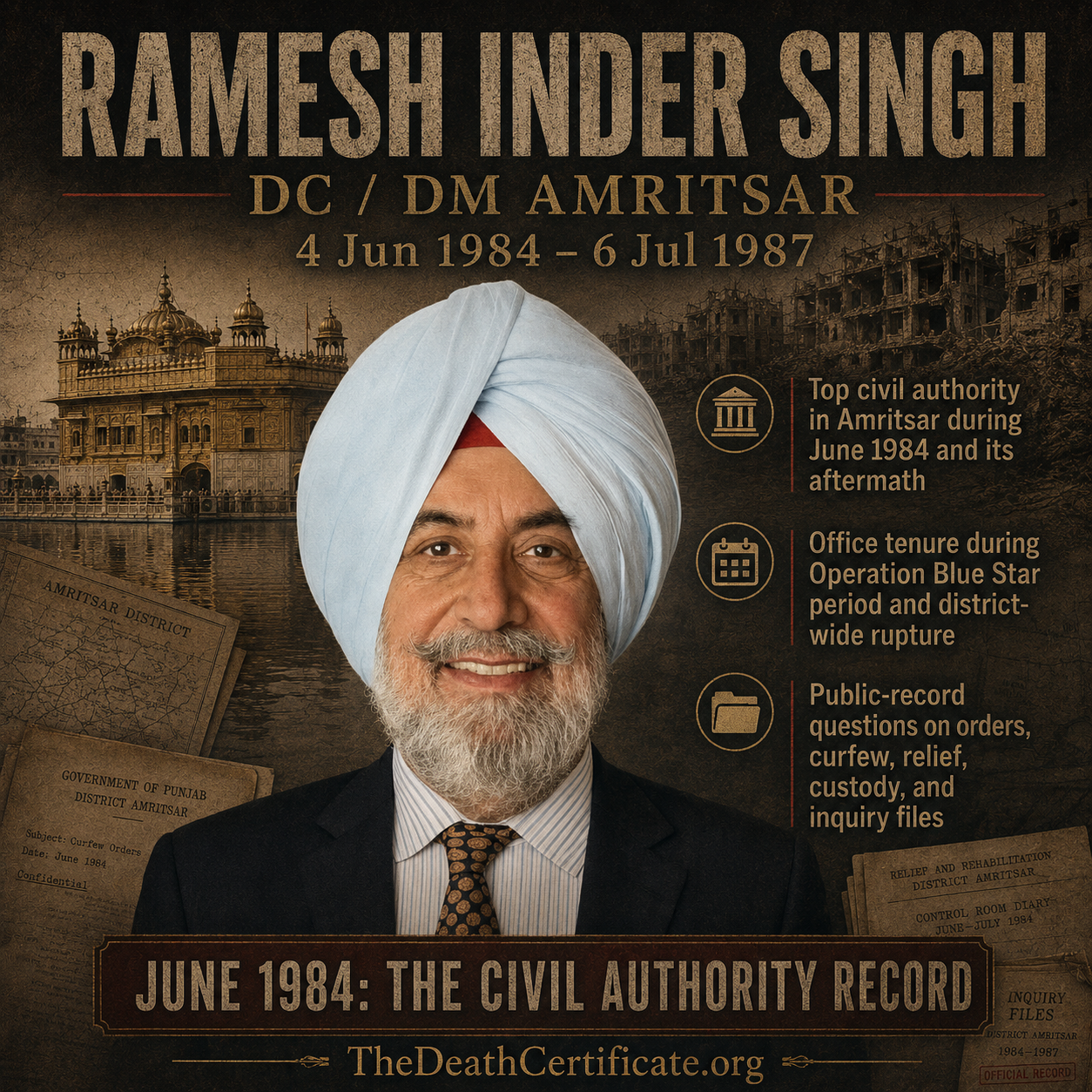
[PF] — Ramesh Inder Singh, DC Amritsar 1984–1987, serving through the period immediately following Operation Blue Star and the beginning of the illegal cremation practice. Received the Padma Shri for his services during this period.
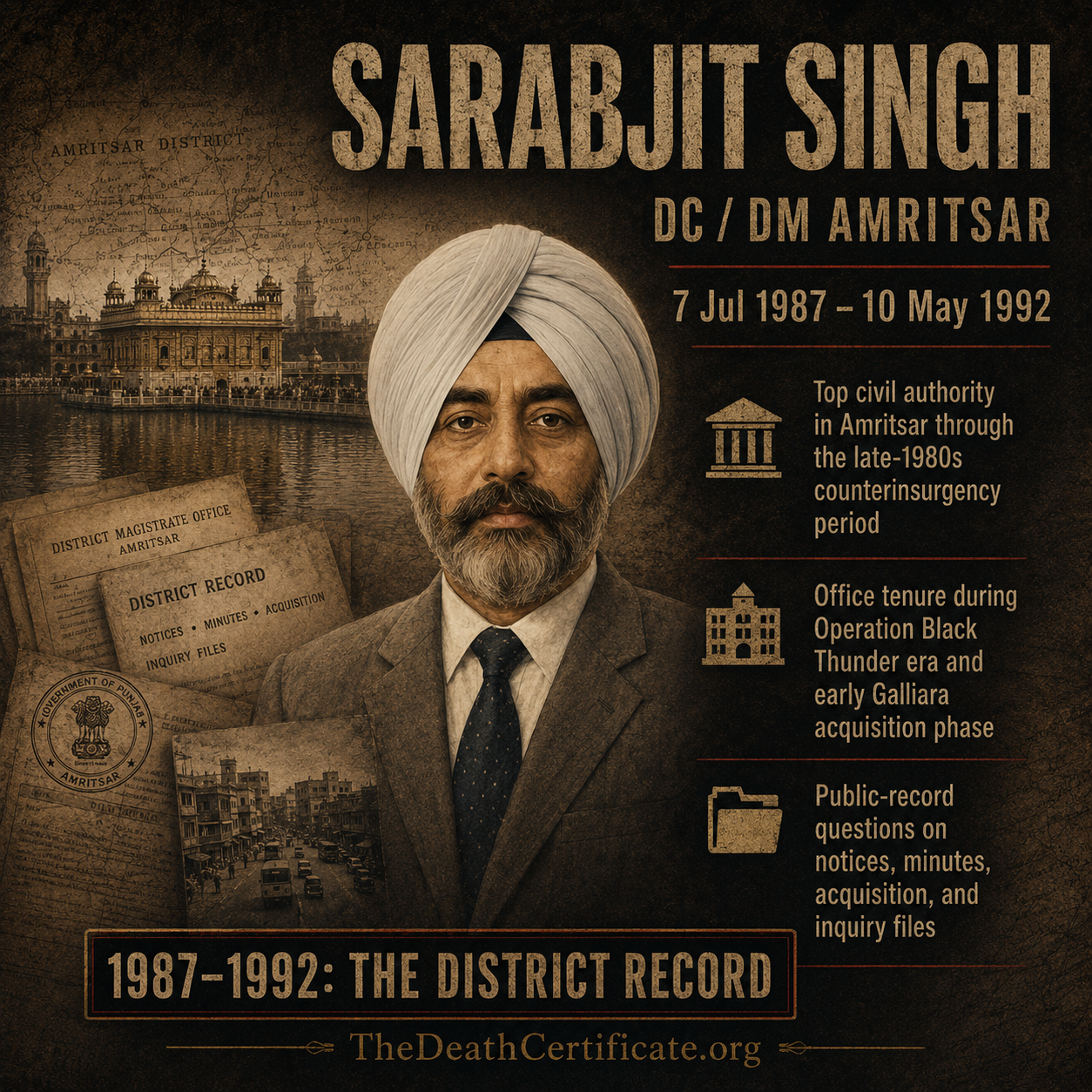
[PF] — Sarabjit Singh, DC Amritsar 1987–1992, serving through Operation Black Thunder Two and the consolidation of the illegal cremation practice. Received the Padma Shri for his services. His posthumous Tribune obituary described him as “Padma Shri Sarbjit Singh, former Deputy Commissioner of Amritsar” and noted that he had written Operation Black Thunder: An Eyewitness Account of Terrorism in Punjab.
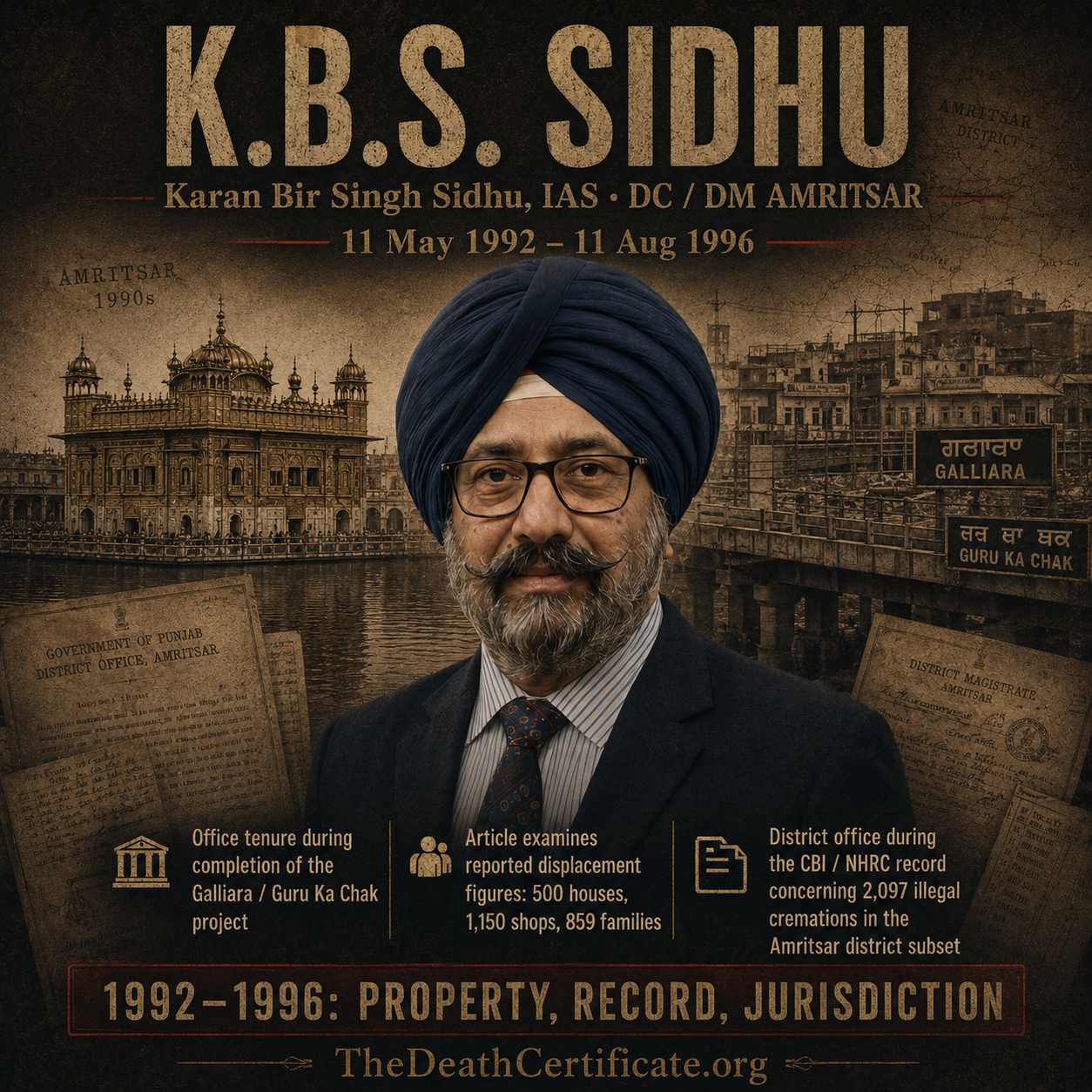
[AI] — Karan Bir Singh Sidhu, DC Amritsar 1992–1996, serving through the peak years of the illegal cremation practice, the Khalra abduction and killing, and the completion of the Galliara demolition. Did not receive the Padma Shri. Received instead, in retirement, a Substack platform, a SikhNet profile, and public positioning as a moral authority on Sikh institutional governance.
[AI] The three DCs together constitute the architecture of forgetting in its institutional form. Each administered Amritsar during the period of the illegal cremations. Each left the district without having conducted a single documented magisterial inquiry into any of the illegal cremations. Each left the district with a positive administrative record that served as the public credential of the tenure. Each left without acknowledging the illegal cremations in any public forum.
[AI] The Italian heritage system has, in its institutional design, a mechanism for preventing the architecture of forgetting: the documentation requirement. All heritage interventions — including demolitions — must be documented before, during, and after the work. The documentation requirement means that even if a future administrator wishes to convert a demolition into an achievement, the documentation of the cost is on the institutional record. The Indian administrative system permits the administrative officer to produce the documentation that serves his institutional interest and to omit the documentation that does not. The architecture of forgetting is made structurally possible by this asymmetry.
XVIII. The Statues That Mark the Erasure — Standardisation as Administrative Aesthetics
[AI] The Maharaja Ranjit Singh equestrian statue on the Heritage Street is not merely a historical tribute. It is, in its placement at the entrance to the approach that replaced the inherited urban fabric, the statue that converts the erasure into a celebration. The statue of Maharaja Ranjit Singh — the ruler who patronised the Harmandir Sahib, who funded the gilding, who maintained the Sikh Empire’s relationship with the Darbar Sahib as the centre of his realm’s sacred geography — is placed at the entrance to the corridor that demolished what he built. The irony is complete. The irony is visible. The irony is, in the contemporary tourism economy of Amritsar, unmarked.
[AI] In Italian heritage zones — the centro storico of Rome, the centro storico of Florence, the centro storico of Venice — the Soprintendenza maintains colour charts derived from the historically documented palette of each city’s architectural tradition. The ochre of Florentine building facades, the terracotta of Roman apartment blocks, the muted red-orange of Venetian canal-side structures — these are documented historical colours, preserved by a conservation bureaucracy that has understood that the colour of a building is as much a part of its heritage as its structural form. The Italian colour chart preserves variety within consistency — the consistency of a historically documented palette. The Heritage Street colour standardisation imposes contemporary design uniformity — a single palette selected by a contemporary designer on a commission from the Akali Dal government — on a historical fabric that had, over four centuries, developed its own inherited variety.
[AI] The Soviet parallel is instructive. The Soviet state’s approach to urban aesthetics — the standardised Khrushchevka apartment blocks, the standardised public squares, the standardised street furniture — produced, across the cities of the Warsaw Pact countries, a visual environment of total uniformity. The uniformity was the aesthetic of administrative power — the assertion that a single decision-making authority had imposed a single aesthetic standard on the entire built environment. The Heritage Street’s standardised facades are not ideologically equivalent to the Khrushchevka. But the aesthetic mechanism is the same: a single administrative authority imposes a single aesthetic standard on a built environment that had previously been characterised by accumulated variety, and the accumulated variety is erased by the administrative standard.
[AI] The concept of Disneyfication, in the cultural geography and urban studies literature, refers to the conversion of authentic historic or cultural environments into themed commercial experiences that simulate the authenticity they have replaced. The Heritage Street, with its standardised facades, uniform lighting, equestrian statue, pedestrianised corridor, and commercial infrastructure of hotels and souvenir shops, is, in the technical sense of the concept, a Disneyfied sacred approach. The tourist who has come to Amritsar for the Golden Temple gets a clean, well-managed approach. The pilgrim who seeks in the approach the accumulated testimony of four centuries of Sikh devotional life encounters a simulated authenticity. The accumulated testimony is not there. It has been replaced by the simulation.
XIX. The Verbal Approval of Dead Men — Tohra, Calcutta, and the Manufactured Mandate
[PF] Sidhu’s own television interview establishes the dead-corroborator problem in terms so exact that the analysis requires only to repeat what he said and identify what it means. He said: he met Tohra individually. Tohra approved verbally. He met Calcutta individually. Calcutta approved verbally. The three met together. No SGPC resolution was adopted. No document was signed.
[PF] Gurcharan Singh Tohra died on 1 April 2004. He served multiple terms as SGPC President and was one of the most powerful figures in twentieth-century Sikh institutional politics. Tohra cannot confirm that he gave verbal approval. Cannot explain what he understood the project to be. Cannot say whether the SGPC executive committee was ever formally convened. Cannot say whether his personal views — if verbal approval was indeed given — represented the institutional position of the SGPC or merely a private conversation between two officials.
[AI] The legal-institutional consequence is that the SGPC, as an institution, did not authorise the Galliara. The Sikh Gurdwaras Act of 1925 — the statute that governs the SGPC’s institutional authority — requires institutional acts to be taken by the body’s executive committee in formal capacity. The personal verbal opinions of two now-deceased office-bearers cannot substitute for the institutional record. [SR] The Land Acquisition Act of 1894 did not require SGPC approval. The SGPC’s approval was not a legal precondition of the project — it was a political precondition. Without it, the project was the state’s unilateral intervention in the environment of Sikhism’s holiest site. With verbal approval from two dead men, the project could be presented as collaborative civic improvement.
“The verbal approval of two dead men is the political legitimacy that the project required and that the project lacks as an institutional record. It rests on the absence of a record. It rests on the dead.”
[AI] The Italian comparison makes the point with characteristic force. The Vatican’s approval of any alteration to the Borgo adjacent to Saint Peter’s Square is given in writing, on Vatican letterhead, by the Reverend Fabbrica di San Pietro, after a formal review process. The writing is dated. It is archived. It is produced when required. The Italian heritage system would not accept oral approval from three men, two of whom died before the project’s completion, as the institutional authorisation of a project of the Galliara’s scale. The Italian heritage system would require the institutional record. The SGPC’s recorded institutional voice is silent on the most consequential alteration of the environment of Sri Darbar Sahib in the modern period.
XX. The Hijacking Achievement — A Crisis of Hours, an Obligation of Years
[PF, DA] The second of Sidhu’s two listed achievements is the April 1993 hijacking episode at Raja Sansi International Airport. He has narrated it across multiple platforms — Substack, Auzaar TV, SikhNet, Medium. He has claimed, in the Auzaar TV interview, that he was the primary negotiator and that K.P.S. Gill arrived after the resolution primarily for the photograph. [PF] K.P.S. Gill died on 26 May 2017 and cannot contest this account. The Crisis Management Group records, the NSG records, and the Punjab Police records of the incident, if produced, would conclusively settle the credit allocation. They have not been produced.
[AI] The forensic point about the hijacking is not the credit allocation. The forensic point is the scale disproportion. The hijacking was a crisis that lasted hours. The statutory obligation to conduct magisterial inquiries into unexplained deaths in police custody lasted four years. The hijacking produced hostages who were released alive. The failure to conduct magisterial inquiries produced 2,097 bodies cremated without inquiry. The hijacking required crisis-management skill across two days. The magisterial inquiry obligation required institutional discipline across four years. The hijacking is on Sidhu’s resume. The magisterial inquiry obligation is not on his resume.
“The hijacking was a crisis of hours. The obligation was a duty of years. The achievement lasted hours. The failure lasted four years. Sidhu listed the hours. Sidhu did not list the years.”
[AI] There is also the matter of the firewood requisition vouchers. The firewood was requisitioned by the Punjab Police from state government stores. The state government stores from which the firewood was requisitioned are within the administrative domain of the District Magistracy. The firewood vouchers record the police designation for each cremation — the body number, the date, the police post that delivered the body. The firewood was state property, requisitioned for the cremation of bodies that had not been through the mandatory magisterial inquiry. The District Magistracy was, in the administrative chain of custody of the firewood, institutionally connected to the cremations through the non-exercise of its supervisory duty. [AI] This is not a proved finding of personal criminal liability. It is an analytical inference of institutional connection — the connection that the Section 176 mandatory inquiry was designed to sever by ensuring that the District Magistracy’s oversight was exercised before the cremation, not after.
XXI. The Conservation Standard — What Italy Made Law and India Refused to Build
[SR] The Codice dei Beni Culturali e del Paesaggio, Legislative Decree 42/2004, establishes four key principles directly applicable to the Galliara comparison.
[SR] First, the public interest principle: cultural property of historical, artistic, archaeological, or ethnographic interest is subject to public-interest constraints regardless of who owns it. The owner may not demolish, substantially alter, or transfer cultural property without authorisation. This means that, in Italy, the question of whether a private family’s house has heritage value is decided by the Soprintendenza, not the family. The owner’s preference is relevant. It is not determinative.
[SR] Second, the minimum intervention principle: heritage property may be altered or restored only to the extent strictly necessary to preserve the property, without substituting new fabric for old without documented conservation justification. This is the heritage-law expression of primum non nocere — first, do no harm. Every element of a proposed intervention must be justified in documented terms, reviewed by the Soprintendenza, and made part of the heritage record.
[SR] Third, the anastylosis principle: where original material from a heritage site is available, it should be restored to its original location rather than replaced with new material. The Parthenon marble restoration programme — relocating original marble fragments to their original positions rather than replacing them with new marble of identical dimensions — is the most famous contemporary example. The original material is irreplaceable. The new material, however well-made, is not the original. [AI] Applied to the Galliara: the Nanakshahi brick and original marble of the demolished structures, had the anastylosis principle applied, would have been documented, inventoried, and — wherever structurally feasible — retained. None of this occurred.
[SR] Fourth, the documentation principle: all heritage interventions, including demolitions, must be documented before, during, and after the work. The documentation must include photographic recording, measured survey, material-sample analysis, and architectural drawings, all deposited in the national and regional heritage archives. This means that even where a heritage structure is legitimately demolished, the demolition leaves an institutional record. [AI] The Galliara demolished without documenting. The demolished fabric is gone. There is no institutional record of what was there before. The future has been denied the minimum that the Italian heritage regime would have required.
[AI] None of these four principles applied to the Galliara. The absence of each principle is not accidental. It is the accumulated consequence of a century of Indian administrative practice that treated Sikh heritage as a sub-jurisdiction of a broader religious-minority management framework rather than as a civilizational inheritance requiring systematic conservation. The refusal produced the institutional vacuum. The institutional vacuum permitted the Galliara. The Galliara is the visible architectural consequence of the refusal.
XXII. Pompeii and the Akal Takht — What Civilizations Owe the Past
[PF, SR] Pompeii was buried by the eruption of Vesuvius on 24 August 79 CE. Systematic excavation began under the Bourbon Kingdom of Naples in the mid-eighteenth century. The subsequent century and a half of Italian archaeological work has produced the most comprehensively documented Roman city in the world. [SR] The Grande Progetto Pompei — a €35 million European Union-funded conservation programme initiated in 2012 — has addressed more than forty separate deterioration problems across the site. Its approach is conservative: where possible, preserve the original material; where consolidation is required, use materials that are reversible — that can be removed by future conservators without damaging the original fabric; document everything before, during, and after. The programme’s budget is €35 million for a single archaeological site. The Italian state has committed that budget not to active infrastructure, but to a city buried since 79 CE.
[PF, JR] The Akal Takht — the seat of Khalsa temporal authority, the institution from which hukamnamas are issued, the building whose history is inseparable from the political-theological history of the Sikh tradition since its construction by Guru Hargobind Ji in 1606 — was severely damaged in the June 1984 Indian Army assault. The reconstruction was conducted under the supervision of Buta Singh and Sant Santa Singh, at the direction of the Indian state. [PF, JR] Santa Singh was excommunicated by the Akal Takht in 1986 for his role in the state-supervised reconstruction.
[AI] The Italian heritage answer to the question — what do you do with what remains after the destruction of an irreplaceable historic structure? — would have been: document what survives; stabilise the surviving structure; plan a reconstruction that preserves what survives in situ; produce a comprehensive conservation rationale for every element; involve independent conservation specialists at every stage; produce a full documentary record; and acknowledge, in the final result, that what you have produced is a reconstruction, not the original. The Italian heritage principle is that authenticity requires honesty: where original fabric has been lost, the reconstruction should not pretend to be the original.
[AI] The Akal Takht reconstruction did not follow this protocol. The reconstruction was completed without independent conservation specialist oversight. It did not produce a documented conservation rationale. It did not preserve surviving original fabric in situ according to an anastylosis-based protocol. It produced a new Akal Takht whose architectural relationship to the original is a matter of ongoing scholarly and devotional debate. [PM] The Sikh community’s response — the excommunication of Santa Singh, the subsequent political and devotional controversy — is the Sikh community’s instinctive expression of the principle that the Italian heritage system has codified: authenticity requires honesty, and the reconstruction that does not acknowledge its reconstructed character has, in its very completeness, committed a second act of violence against the original.
[AI] Pompeii is preserved as a ruin because the Italian heritage system has understood that a ruin, properly maintained, is a more honest historical record than a reconstruction, however beautiful. The Akal Takht has been reconstructed, twice — first under state supervision in 1984 and subsequently under SGPC supervision — in a way that has produced architectural controversy without producing institutional honesty. The Sikh community’s sacred inheritance deserves the honesty that the Italian heritage system has built into its conservation protocol.
XXIII. The Photograph and the Plinth — What Beautification Buys Forever
[AI] Karan Bir Singh Sidhu has a photograph. The photograph shows him in the completed plaza — the polished marble, the open vista to the Harmandir Sahib, the clean and well-lit approach. The photograph shows the administrative achievement. The photograph does not show the demolished lanes. Does not show the 859 displaced families. Does not show the 1,150 demolished shops. Does not show the firewood vouchers. Does not show Jaswant Singh Khalra. Does not show the Harike canal.
[AI] Khushwant Singh’s acknowledgement — in the last edition of A History of the Sikhs — is the verbal equivalent of the photograph. Khushwant Singh was a historian of the Sikh tradition. His History of the Sikhs is the most widely read single-volume history of the tradition in the English language. His acknowledgement of the Galliara project as a civic improvement carried, in the Sikh public discourse, the weight of historical authority. The acknowledgement does not discuss the demolished lanes. Does not discuss the displaced families. Does not discuss the security-buffer origin of the project. It discusses the aesthetic improvement, which is real.
“What beautification buys, in the long run, is the conversion of a demolition into an achievement. The conversion is not a conspiracy. It is a consequence of the way that time works in the absence of a documentary record. The demolished lanes are not visible. The polished plaza is visible. The families that remember the demolished lanes grow older. The tourists who photograph the polished plaza are young. The photograph is of the present. The memory of the demolished lanes is of the past. The past recedes. The present persists. Until someone does the forensic work of making the demolition visible again. The kpsgill.com series is that forensic work. This article is that forensic work.”
XXIV. The Counter-Archive — What the Displaced Families Remember
[PM] There is a counter-archive to the Galliara’s official record. The counter-archive is not in government files. It is in the memory of the 859 families who were displaced by the acquisition and demolition. It is in the memory of the merchants whose families had occupied the lanes of Guru Ka Chak for three, four, five generations. It is in the memory of the custodial families — the ragis, the granthis, the families of hereditary seva-workers — who had lived within walking distance of the parikrama because their occupational identity required it. It is in the memory of the artisans — the goldsmiths, the marble-workers, the embroiderers — whose work had been the material economy of the Darbar Sahib’s daily functioning for as long as the families could remember.
[ML] The counter-archive is also in the legal record, however thin. The displacement of 859 families through the Land Acquisition Act produced compensation proceedings in which the displaced families challenged the adequacy of the compensation. The legal proceedings, conducted under the land-acquisition reference provisions, are in the court record of the Amritsar district. The court record has not been analysed, to the present writing, in any published account of the Galliara project. It is the counter-archive’s closest institutional expression, and it awaits the researcher who will retrieve it.
[ML] The counter-archive includes the Tribune’s contemporaneous reporting of the 1988 demolitions, including accounts of the displaced families printed in the weeks after the acquisition notices were served. It includes the accounts of the political opposition — the Akali Dal factions, the panthic organisations, the dera-aligned groups — that contested the project on the grounds that no SGPC resolution had authorised it. It includes the architectural-history literature of Punjabi urbanism, which documents the heritage value of what was demolished.
[PM, AI] The counter-archive is, in its cumulative form, the evidence against the official record. The official record says: the Galliara was a civic beautification project endorsed by the SGPC and acknowledged by Khushwant Singh. The counter-archive says: the Galliara was a state demolition of four centuries of Sikh urban inheritance, conducted through the Land Acquisition Act with the verbal approval of two SGPC functionaries who are now dead, producing the displacement of 859 families who were not adequately compensated for the loss of their generational connection to the lanes of Guru Ka Chak. Both records exist. The official record is more accessible and more widely cited. The counter-archive is less accessible. The kpsgill.com series is the institutional effort to make the counter-archive as accessible and as widely cited as the official record.
XXV. The Verdict in Five Tiers — What This Record Establishes
Proved Findings [PF]
[PF] The Galliara project was, in its own administrative documentation and in Sidhu’s own public statements, originally conceived as a security buffer around Sri Darbar Sahib following Operation Black Thunder Two of May 1988, and was subsequently rebranded as a beautification corridor during Sidhu’s tenure as DC Amritsar from 1992 to 1996.
[PF] The project displaced approximately 859 families, demolished approximately 500 houses and 1,150 shops in the area of Guru Ka Chak — the historical settlement founded by Guru Ram Das Ji in the sixteenth century — at a project cost of approximately ₹160 crore in period values, as reported in Tribune contemporaneous coverage.
[PF] No SGPC executive committee resolution authorising the project has been produced in any public forum. Sidhu’s own television interview acknowledges that the SGPC approval was verbal, given by two office-bearers — Gurcharan Singh Tohra (died 1 April 2004) and Manjit Singh Calcutta (deceased) — both of whom are now deceased and cannot confirm, deny, nuance, or contextualise their alleged approval.
[PF, JR] The CBI, acting on Supreme Court orders in Writ Petition (Criminal) No. 447 of 1995, confirmed in its December 1996 report to the Supreme Court that approximately 2,097 unidentified persons had been illegally cremated in three cremation grounds in the Amritsar district — Durgiana Mandir at Amritsar city, Patti at Majitha, and Tarn Taran — across the tenures of three successive Deputy Commissioners including Karan Bir Singh Sidhu (1992–1996).
[PF, JR] Jaswant Singh Khalra was abducted on 6 September 1995 from outside his residence in Kabir Park, Amritsar, during Sidhu’s tenure as DC/DM. He was held in illegal detention at the Jhabal Police Station for 49 days and killed in custody. His body was thrown into the Harike canal without last rites and was never recovered. Five Punjab Police officers were convicted by the Punjab and Haryana High Court for the illegal detention and killing, and the convictions were upheld by the Supreme Court in 2011.
[PF, JR] The mandatory Section 176 CrPC magisterial inquiry — required to be conducted before the cremation of any unidentified body — was not conducted in connection with any of the 2,097 confirmed illegal cremations, on the CBI’s own documented finding. The National Human Rights Commission held the Government of Punjab responsible for violations of Article 21 of the Constitution and directed compensation payments to identified families.
Documented Allegations [DA]
[DA] The Galliara’s aesthetic rebranding was politically motivated rather than organically derived from a change in the project’s strategic conception. The security function of the cleared thirty-metre perimeter around Sri Darbar Sahib is identical whether the surface is a bare acquisition zone or a polished marble plaza, and the transformation served primarily to convert political liability into political credit.
[DA] The compensation awarded to the 859 displaced families was inadequate to the actual cost of the displacement, which included not only the market value of the acquired properties but the generational inheritance of commercial and devotional location that no monetary compensation under the Land Acquisition Act of 1894 was designed to address.
[DA] Sidhu’s claim, in the Auzaar TV / PRO Punjab TV interview, that he was the primary negotiator during the April 1993 hijacking and that K.P.S. Gill arrived primarily for the photograph, cannot be verified because the Crisis Management Group records have not been made publicly available and K.P.S. Gill is dead.
Analytical Inferences [AI]
[AI] The pattern of the Galliara project — appropriating civic-improvement vocabulary to describe a state demolition with a security-belt origin, using verbal approvals from deceased functionaries to substitute for the institutional record of community consent, the absence of a Heritage Impact Assessment, and the retrospective construction of the project as a civic achievement — is structurally consistent with the pattern that comparative urban historians have identified in administrative demolitions conducted under the cover of beautification, including Haussmann’s Paris, Mussolini’s Via dei Fori Imperiali, and Robert Moses’s New York.
[AI] The contemporary Akali Dal Heritage Street project — the standardisation of shop facades, the installation of the Maharaja Ranjit Singh equestrian statue, the uniform lighting and paving — is the third phase of a single connected pattern of administrative-aesthetic intervention in the inherited urban environment of Guru Ka Chak, following the Galliara demolitions of 1988–1995 and the SGPC kar seva fabric replacements of the same period. The three phases together have converted the sacred geography’s character from an inherited living document of Sikh civilizational development to a designed tourist destination.
[AI] The SGPC’s management of Sikh historical fabric — through the kar seva mechanism’s contractorised demolition and replacement of Guru-period and Misl-period fabric, the absence of heritage protocols for renovation works at major gurdwaras, and the institutional alignment with SGPC-controlling political factions — is functionally equivalent to the Sidhu mechanism in its outcome: both produce the systematic destruction of Sikh historical fabric without documentation, without conservation rationale, and without accountability.
Panthic Memory [PM]
[PM] The lanes of Guru Ka Chak carried, in the living memory of the Sikh community, the accumulated history of four hundred years of devotional, commercial, and custodial life organised around Sri Darbar Sahib. The demolition of those lanes was not the demolition of anonymous urban fabric. It was the demolition of the material record of how the Khalsa lived, worked, prayed, and sustained the sacred centre of its tradition. The loss is not recoverable. It is the kind of loss that is felt across generations as an absence — the absence of the lane, the absence of the family shop, the absence of the inherited place — and that produces, in the Panthic consciousness, the understanding that the Indian administrative state has treated the material inheritance of the Sikh tradition as something less than worthy of the protection it offers to its own preferred heritage.
[PM] The memory of the families displaced by the Galliara is the living counter-archive to the official administrative record. The family whose shop has been in the same lane for five generations does not experience the compensation award under the Land Acquisition Act as an adequate substitute for the lane. The Panthic memory of the Galliara is the memory of displacement, of inadequate compensation, of the systematic destruction of a generational inheritance, and of the conversion of that destruction into an administrative credential by the officer who conducted it.
Personal Direct Knowledge [PM-Direct]
[PM-Direct] I write this article from Italy, where I have, since 23 May 2026, walked the lanes around the Pantheon, stood before the Forum’s columns, traced the pavements of Florence’s historic centre, and felt, at each turn, the difference between a state that has organised itself around the preservation of inherited fabric and a state that has organised itself around the discretion of the officer who decides what stays and what goes. The difference is not subtle. The difference is the Forum. The difference is the Temple of Saturn’s eight columns. The difference is that these things are still standing. The difference is that the equivalent things around Sri Darbar Sahib are not.
XXVI. ਸ਼ਬਦ ਤੋਂ ਪਹਿਲਾਂ, ਸ਼ਮਸ਼ਾਨਘਾਟ — The Journey from the Forum to Guru Ka Chak
ਸ਼ਬਦ ਤੋਂ ਪਹਿਲਾਂ, ਸ਼ਮਸ਼ਾਨਘਾਟ
Before the Hymn, the Cremation Ground
I began this article on a wall across from the Temple of Saturn, in the Forum Romanum, on a morning when the Roman light was still cool and the stone still held the memory of the night’s chill. I am ending it in a different register — not in Rome, not in the Forum, not in the company of two-thousand-year-old columns, but in the documentary register of a publication that has been, since its founding, committed to the proposition that the record of the dead must precede the commentary of the living. The Punjabi formulation — ਸ਼ਬਦ ਤੋਂ ਪਹਿਲਾਂ, ਸ਼ਮਸ਼ਾਨਘਾਟ — is the governing editorial principle of this series. Before the Word, the cremation ground. Before the Gurbani commentary, the record of the 2,097. Before the moral authority, the moral accounting.
The article has made a long argument. Let me compress it here into the sequence it requires.
[PF, SR] Italy has preserved, for two millennia, the stone inheritance of its sacred and civic past, through a legal apparatus — the Bottai Law, the Codice, the Soprintendenza, the Carabinieri Tutela — whose underlying premise is that no individual administrative officer has the authority to weigh his aesthetic judgement against the cumulative testimony of stone. The formula produces the Forum. Produces the lanes around the Pantheon unchanged across centuries. Produces a country that can say, to any proposed demolition: show me the documentation. Show me the Heritage Impact Assessment. Show me the public consultation record. Show me the institutional authorisation. The burden is on the demolisher.
[AI] India has not built this formula for its Sikh heritage. India has built an administrative apparatus that protects what the central administrative culture has decided is worth protecting — Mughal heritage, Hindu temple heritage, colonial-period heritage — and has left Sikh heritage, through the selective non-application of the heritage-protection regime, available for administrative demolition by whoever holds the DC’s title at the relevant moment. The formula produces the Galliara. Produces the kar seva fabric-replacement without documentation. Produces the Heritage Street’s standardised facades. Produces the SGPC’s admission that it has no protocol for heritage remains discovered during renovation. The burden is not on the demolisher. The burden is on the inheritor.
Karan Bir Singh Sidhu took office in Amritsar in 1992. He demolished 500 houses and 1,150 shops in Guru Ka Chak. He obtained no SGPC resolution. He produced no Heritage Impact Assessment. He documented nothing of what he demolished. He listed it as his first administrative achievement. He has cited it, in retirement, as the example of his commitment to the public good and to the beautification of the holiest site in the Sikh tradition. He has not, in three decades of public commentary, addressed the 2,097. He has not addressed Khalra. He has not addressed Section 176. He has not addressed the firewood vouchers. He has not addressed the dead-corroborator problem in the Galliara’s SGPC approval. He has written Gurbani commentary instead. He has built a Substack platform. He has been profiled, sympathetically, by SikhNet.
This is not adequate. It was not adequate when the lanes were demolished. It was not adequate when the firewood vouchers were signed. It was not adequate when Khalra was abducted from Kabir Park. It was not adequate when the bodies were delivered to the cremation grounds without inquiry. It is not adequate now. The moral vocabulary of the Substack column does not redeem the administrative silence of the DC’s bungalow. The Gurbani translation does not cover the 2,097. The polished marble does not cover the ash.
The comparison with Italy is, in its final form, a comparison of civilizational seriousness. The Italian state has had its own Sidhu — in the form of Mussolini’s Piacentini, cutting the Via dei Fori Imperiali through the Quartiere Alessandrino — and then organised itself, after the catastrophe, never to permit the architectural ambitions of a single officer to override the inherited claim of the community. India has not yet had its Galliara moment — its moment of institutional reckoning with what the administrative demolition of Sikh heritage has produced.
The moment must occur. Not because the polished plaza must be demolished. The polished plaza cannot and should not be demolished. The moment must occur because the record of what the polished plaza cost must be made visible in the institutional discourse. The displaced families must receive institutional acknowledgement of what they lost. The documentary record of what was demolished must be produced — however incompletely, from whatever sources the archival investigation can retrieve — so that the future inheritors of Guru Ka Chak’s sacred geography have the institutional record that the Italian heritage system guarantees as a minimum.
And the moment must occur because of the 2,097. The plaza does not redeem them. The polished marble does not cover them. The Gurbani commentary does not account for them. The hijacking does not weigh against them. The 482 firewood vouchers from Durgiana Mandir alone speak — in the bureaucratic notation of date, body number, and police post — a language that is clearer than any Substack prose. The notation records the absence of the mandatory inquiry. The notation records the delivery of an unidentified body to a cremation ground without a magistrate’s oversight. The notation records everything the Section 176 inquiry was designed to produce and did not produce because the inquiry was not conducted. 482 notations. In a single cremation ground. In a district administered by a man who lists the beautification of that district’s most sacred site as his primary achievement.
ਸ਼ਬਦ ਤੋਂ ਪਹਿਲਾਂ, ਸ਼ਮਸ਼ਾਨਘਾਟ
Before the Gurbani translation, the CBI report.
Before the Substack commentary, the Section 176 inquiry that was never held.
Before the moral authority of the retired officer, the institutional accounting of the active officer’s statutory duty.
Before the photograph of the polished plaza, the record of the demolished lanes.
Before the verbal approval of the dead, the written resolution of the living institution.
Before the Heritage Street’s standardised fonts, the inherited Gurmukhi hand-lettering of the family shops that the standardisation replaced.
Before the equestrian statue at the entrance to the corridor, the question: whose lanes did we demolish to build the corridor that the statue now decorates?
The Forum is still standing. The Temple of Saturn’s eight columns still stand in Rome. They have stood through empires, through invasions, through fires, through two millennia of administrative succession in which every new power that settled in Rome faced the same choice: demolish the past to assert the present, or preserve the past and let it speak for itself. Rome chose preservation, imperfectly, incompletely, with the Mussolini interlude that the post-war Italian state made the lesson of its constitutional commitment.
Amritsar faced the same choice in 1988, and again in 1993. Amritsar chose demolition. The officer who made the choice is now writing Gurbani commentary for thousands of subscribers. The subscribers deserve to read the commentary in the full light of the record. The record is here. The record is what this article has produced.
The Roman wall on which I sat to begin this article is still there. The columns of the Temple of Saturn are still there. In Amritsar, the lanes of Guru Ka Chak are gone. The families that held those lanes for five generations have been relocated to peripheral colonies. The inherited Gurmukhi hand-lettering of their shops is gone. The Nanakshahi brick of the demolished houses is gone. The irregular geometry of the lanes that Guru Ram Das’s planning laid out in the sixteenth century is gone. What remains is the polished marble of the plaza and the published text of a Gurbani translation.
The polished marble is visible. The Gurbani translation is eloquent. The demolished lanes are invisible. The firewood vouchers are in the CBI’s sealed report. The Harike canal keeps its silence.
ਸ਼ਬਦ ਤੋਂ ਪਹਿਲਾਂ, ਸ਼ਮਸ਼ਾਨਘਾਟ
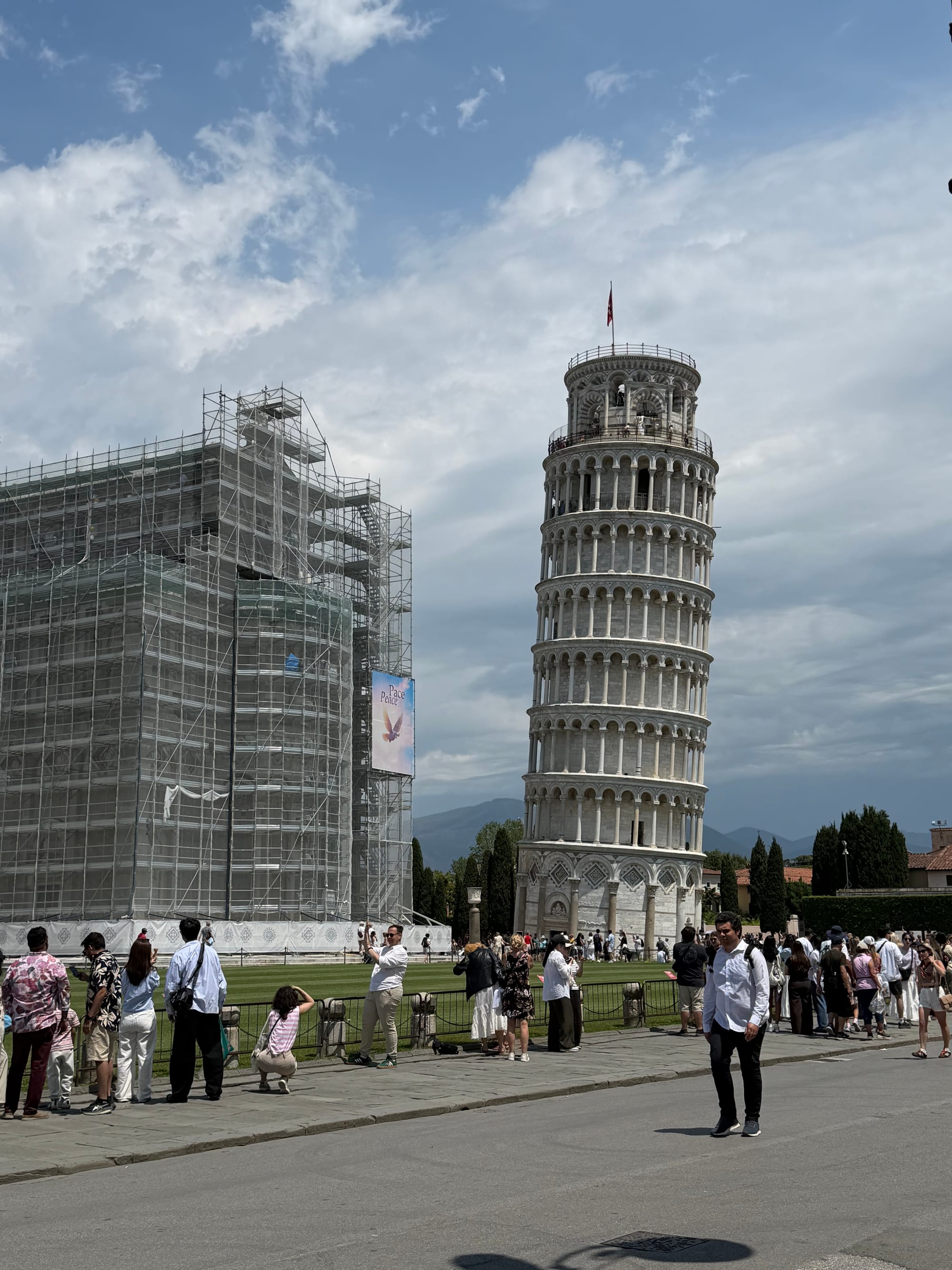
Source and Evidentiary Notes
Principal Judicial Records
- Writ Petition (Criminal) No. 447 of 1995 — Committee for Information and Initiative on Punjab v. Union of India — Supreme Court of India (CBI illegal cremations investigation)
- Punjab and Haryana High Court and Supreme Court — Khalra murder convictions
- NHRC Punjab cremation cases proceedings — 1997–2012
Principal State Records
- Ancient Monuments and Archaeological Sites and Remains Act 1958
- Land Acquisition Act 1894
- Sikh Gurdwaras Act 1925
- Code of Criminal Procedure 1973 — Section 176
- Codice dei Beni Culturali e del Paesaggio — Legislative Decree 42/2004
- Bottai Law 1939
- Constitution of India — Article 21 (Right to Life)
- Constitution of India — Article 49 (Directive Principle — Monuments Protection)
- Padma Awards — Ministry of Home Affairs
Principal Human Rights Documentation
- Ensaaf — Punjab disappearances database and Khalra documentation
- Human Rights Watch — India/Punjab reports
- Amnesty International — India reports
- NHRC Punjab proceedings
Principal Heritage and Conservation Records
- Archaeological Survey of India — centrally protected monuments list
- INTACH — Indian National Trust for Art and Cultural Heritage
- UNESCO World Heritage — Rome Historic Centre
- UNESCO World Heritage — Venice and Lagoon
- UNESCO World Heritage — Historic Centre of Florence
- UNESCO World Heritage — Bamiyan Valley
- UNESCO World Heritage — Palmyra
- UNESCO — Hagia Sophia 2020 statement
- Grande Progetto Pompei
- Carabinieri Tutela Patrimonio Culturale
- Italian Soprintendenza system
- Italian Ministry of Culture
- Vatican Fabbrica di San Pietro
- Parthenon Restoration Programme (YSMA)
Principal Self-Published Sources
Principal Reference Works Cited
- Khushwant Singh, A History of the Sikhs (Princeton University Press) — Wikipedia entry
- Robert Caro, The Power Broker: Robert Moses and the Fall of New York (1974) — Wikipedia entry
- Haussmann’s renovation of Paris
- Via dei Fori Imperiali — Wikipedia
- Operation Blue Star — Wikipedia
- Operation Black Thunder — Wikipedia
- Demolition of the Babri Masjid — Wikipedia
- Liberhan Commission — Wikipedia
- Destruction of cultural heritage by ISIL — Wikipedia
This article is part of the Punjab ‘95 Forensic Series at kpsgill.com. The Series applies the four-tier evidentiary framework — Proved Finding [PF], Documented Allegation [DA], Analytical Inference [AI], Panthic Memory [PM], Personal Direct Knowledge [PM-Direct], Judicial Record [JR], State Record [SR], and Media-Logged [ML] — to the administrative and institutional record of the Punjab counterinsurgency period and its consequences. All factual assertions in this article are grounded in sources identified within the text or in the kpsgill.com archive. The Series is published under the First Amendment protections applicable to the publication’s United States jurisdiction. The publisher’s contact for all correspondence related to this article is kpsgill@kpsgill.com.
© kpsgill.com, May 2026. Dr. Kanwar Partap Singh Gill, M.D., Publisher and Editorial Director.
Waheguru Ji Ka Khalsa, Waheguru Ji Ki Fateh
ਸ਼ਬਦ ਤੋਂ ਪਹਿਲਾਂ, ਸ਼ਮਸ਼ਾਨਘਾਟ