Delhi Sent Him. Delhi Decorated Him. Punjab Counted the Dead.

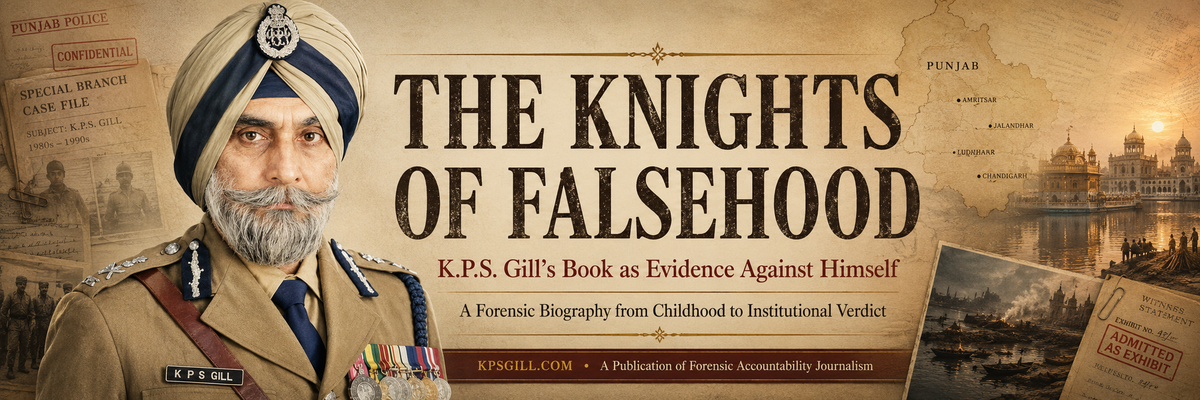
K.P.S. Gill Was Not Punjab Police. He Was a UPSC Examination Selectee of the Indian Police Service — Allocated to Assam Cadre, Deployed to Punjab as the Centre’s Counterinsurgency Instrument, and Returned to Honours by the Capital That Awarded Him the Padma Shri. The Families of 2,097 Men Cremated as “Unidentified Persons” in Amritsar District Received ₹1.75 Lakh Each. This Is the Record of That Accounting.
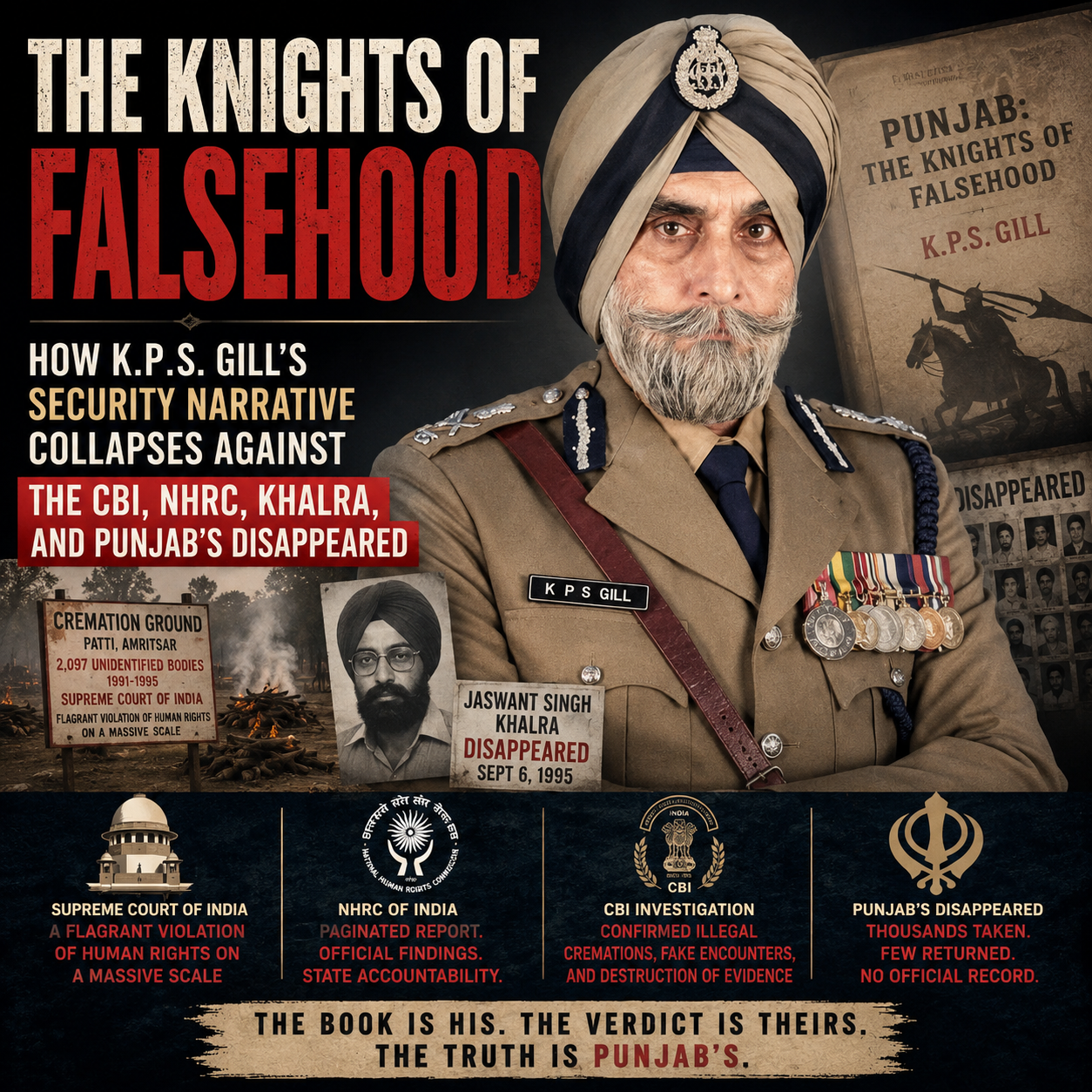
This is the record that Punjab: The Knights of Falsehood was written to prevent from being read. K.P.S. Gill, Director General of Police of Punjab from 1988 to 1990 and again from 1991 to 1995, titled his post-retirement account of the Punjab counterinsurgency The Knights of Falsehood and assigned the designation of falsehood to the community whose members his institution cremated as unidentified persons in the municipal grounds of Amritsar, Tarn Taran, and Majitha. India’s own Central Bureau of Investigation confirmed 2,097 such cremations in one district alone. India’s own Supreme Court characterized what those cremations represent as a* “flagrant violation of human rights on a mass scale.” *India’s own National Human Rights Commission paid ₹27.94 crore in compensation to 1,513 families — formal liability acknowledged, if not named. The man who built the institutional apparatus that produced this record was awarded the Padma Shri, made president of a national sporting federation, and permitted to die with the state’s full embrace and the mainstream press’s unanimous obituary of celebration. This publication is the reply the Indian state never compelled him to give: the hundred-year history he omitted, the institutional record he suppressed, and the name of the man murdered by his institution for the offence of counting the dead — and for whose murder he was never required to answer before any court of the Republic of India.
KPSGILL.COM · A First Amendment forensic accountability publication · Published from the United States of America under the protections of the First Amendment to the United States Constitution
Author’s Disambiguation Note: This article is written by Dr. Kanwar Partap Singh Gill, M.D. — a board-certified family medicine physician, born in Amritsar, Punjab in 1977, practicing in the United States, and publisher of KPSGILL.COM. The author shares a surname with the subject of this forensic analysis but bears no familial, professional, institutional, or political relationship to Kanwar Pal Singh Gill (29 December 1934 – 26 May 2017), the former Director General of Police, Punjab. The coincidence of surname is, in this context, the occasion for a specific kind of precision: this author came to Amritsar the year the Indian Army destroyed the Akal Takht, and he knows the difference between the man who held the office and the institution that survived him. Readers who arrive here searching for Gill’s book Punjab: The Knights of Falsehood are precisely where they should be — this is the institutional record his book was constructed to replace.
Currently subject to a Government of India Section 69A content-blocking proceeding (Request ID 69A/2026/MIT/11078), to which a formal written submission has been filed.
a flagrant violation of human rights on a mass scale
— Supreme Court of India — on the Amritsar cremation grounds
the terrorists…sang paeans of murder…all the evil they did was in the name of God
— K.P.S. Gill, Punjab: The Knights of Falsehood
They took him away and nobody came back to tell us where he was, what happened to him, whether he was alive or dead.
— Testimony of Paramjit Kaur Khalra — widow of Jaswant Singh Khalra
Book One — The Hundred-Year Indictment
The Long Record of Promise, Betrayal, and Erasure That Produced the Punjab of 1984–1996
A Note on This Book and the One That Follows
This work is published in two books bound as one. Book One is a self-contained history of the Sikh struggle across the century preceding the events at the center of this archive — the period from the Gurdwara Reform Movement of the 1920s through the end of the Punjab counterinsurgency in 1996, with sustained focus on the years 1978 through 1996. Book Two is the forensic biography of Kanwar Pal Singh Gill, the police officer who became the emblem of that counterinsurgency’s final and most lethal phase, examined against the institutional record of India’s own Supreme Court, National Human Rights Commission, and Central Bureau of Investigation — and against the book Gill himself wrote, Punjab: The Knights of Falsehood, which this archive reads as the prosecution’s primary exhibit.
The two books are inseparable. The man cannot be understood without the century, and the century, by 1996, had produced the man. The governing editorial concept of this publication — expressed in Punjabi as ਸ਼ਬਦ ਤੋਂ ਪਹਿਲਾਂ, ਸ਼ਮਸ਼ਾਨਘਾਟ, go to the cremation grounds before reciting Gurbani — applies to the history as much as to the biography. Before one recites the official scripture of the “saved state” and the “Super Cop” who saved it, one must first go and look at what the salvation cost, and at the hundred years of broken undertakings that made the killing fields possible. Book One is that prior looking.
The evidentiary framework is the same throughout: [PF] Proved Finding, [DA] Documented Allegation, [AI] Analytical Inference, [PM] Panthic Memory. Sources are hyperlinked inline throughout and consolidated in the Bibliography and References at the close.
Chapter One — The Promise and the Word That Bound It (1929–1947)
Every cremation ground has a history that precedes it. The 2,097 bodies processed through the municipal cremation registers of Amritsar district as ‘unidentified persons’ — the bodies the Central Bureau of Investigation confirmed in December 1996, the bodies whose existence K.P.S. Gill’s book does not acknowledge — did not arrive at those registers without a genealogy. That genealogy runs not from 1984, when the Indian Army destroyed the Akal Takht, nor from 1978, when thirteen Sikhs were killed at Baisakhi and their killers were acquitted by a court in Karnal, nor even from 1947, when the community that had been promised the glow of freedom was given, instead, a truncated state, a contested capital, and rivers that would shortly be redirected to non-riparian neighbors. It runs from 1929, when the Indian National Congress made a promise in Lahore, before God and before history, that it would not keep — and when it made that promise to a community that had no way of knowing, in the heady atmosphere of the independence movement, that the word of the Congress would prove to be the first entry in a ledger whose final accounting would be made in the cremation grounds of Amritsar district sixty-seven years later.
At the Lahore session of the Indian National Congress in December 1929 — the session at which the Congress adopted the demand for Purna Swaraj, complete independence — the Congress leadership gave the Sikh community a specific and recorded assurance. As later reconstructed in the parliamentary record by Sikh members of the Lok Sabha and documented in Sirdar Kapur Singh’s Betrayal of the Sikhs, the resolution and its surrounding undertakings held that the Congress would accept no constitutional settlement that did not satisfy the Sikhs. [PF — the 1929 Congress assurance is documented across multiple independent sources.] The language Jawaharlal Nehru used shortly afterward, in a statement carried in the Lahore press in early 1930, was unambiguous in its warmth and its scope: the brave Sikhs of Punjab were “entitled to special consideration,” and Nehru saw “nothing wrong in an area set up in the North of India wherein the Sikhs can also experience the glow of freedom.” [PF — the statement is reproduced in multiple historical compilations.]
The promise was not made once. It was repeated, in varying forms, across the eighteen years between Lahore and Partition. Mahatma Gandhi, addressing a Sikh congregation at Gurdwara Sis Ganj in Delhi in March 1931, asked the Sikhs to accept his word and the word of the Congress that it would not betray them, invoking God as the witness to the bond between the Congress and the Sikh people. [DA — the Sis Ganj assurance is recorded in Sikh historical accounts and parliamentary speeches; the precise wording varies across sources.] Sardar Vallabhbhai Patel, on 5 April 1946, reaffirmed the 1929 resolution and stated that the question of a Sikh homeland would be considered in the Constituent Assembly after the transfer of power. In the summer of 1946, at the time of the Cabinet Mission’s deliberations, a communication was conveyed to the Sikhs through Sardar Baldev Singh — the Sikh representative who would become independent India’s first Defence Minister — to the effect that the British Parliament was prepared to frame the Independence Act so that no constitution would be imposed upon the Sikh homeland that did not have the concurrence of the Sikhs. [DA — recorded by Kapur Singh and reproduced in the parliamentary record; the offer and its rejection are historically attested, though their precise legal character is debated.]
These were not casual gestures. They were the inducements by which a community that had been offered, by the departing British, the theoretical possibility of pressing its own territorial claim was persuaded instead to cast its lot with India. The Sikhs had paid for their political standing in a currency the colonial state understood: during the Quit India movement, Sikhs constituted a disproportionate share of those arrested, and Sikhs formed a substantial fraction of the Indian National Army. They had been the colonial army’s favored “martial race” and the Independence movement’s overrepresented foot soldiers. When Partition came in 1947, the community paid again, and more terribly: the Sikh heartland lay precisely along the line of severance, and the community suffered proportional losses in life, land, and displacement that exceeded almost any other. [PF — the demographic catastrophe of Partition for the Sikh community is extensively documented.]
And then the promise was broken. When the Constitution of India was finalized in 1949 and adopted in 1950, it contained none of the safeguards, none of the autonomy, and none of the recognition that the pre-Independence assurances had led the community to expect. Two Akali/Sikh representatives in the Constituent Assembly, Sardar Hukam Singh and Sardar Bhupinder Singh Mann, declined to append their signatures to the Constitution, recording instead that the Sikhs did not accept it. [DA — the refusal to sign is recorded in Sikh historical accounts and is a foundational element of Sikh constitutional memory; its precise procedural form is the subject of historical discussion.] The grievance was sharpened by Article 25 of the Constitution, whose Explanation II classified Sikhs — along with Buddhists and Jains — under the broad Hindu category for the purposes of certain personal-law provisions, an aggregation the community experienced, and continues to experience, as a denial of its distinct religious identity. [PF — the text of Article 25 is a primary legal source; the community’s objection to it is long-documented.]
When Sikh leaders later pressed Nehru on the assurances of 1929 and 1946, his recorded response — preserved in the community’s memory and in the accounts of the leaders who heard it — was that “the circumstances have now changed.” [PM — the “circumstances have changed” rebuff is a fixture of Panthic memory and is reported across Sikh historical sources; it stands as the community’s shorthand for the entire pattern of promise and abandonment.] To take a solemn oath, before God and before a community that had been induced to bind its fate to yours, and then to set the oath aside when it became inconvenient — this is the foundational act of the relationship between the Indian state and the Sikh people. Everything that follows in this history is, in a sense, the working-out of that original breach. The militants of the 1980s did not invent the Sikh grievance. They inherited it, in radicalized form, from a community that had been promised the glow of freedom and given Article 25 instead.
Chapter Two — The Language of Erasure: Punjabi Suba and Its Mutilation (1947–1966)
The first sustained post-Independence expression of the Sikh political demand was not a demand for a separate country. It was a demand for a state within India in which the Punjabi language — and, by demographic consequence, the Sikh community — would have constitutional expression. This was the Punjabi Suba movement, and its history is the second layer of the hundred-year indictment.
The demand was, on its face, entirely consistent with the principle the Indian state had already adopted for the rest of the country. In the 1950s, India reorganized its internal boundaries along linguistic lines: Andhra Pradesh for Telugu speakers, the consolidation of Tamil, Kannada, Marathi, and Gujarati territories. The States Reorganisation Commission of 1955 redrew the map of India on the explicit principle that language was a legitimate basis for statehood. [PF — the linguistic reorganization of India is a documented constitutional fact.] Every major linguistic community in India received a state organized around its language — every one except Punjabi. When the Akali Dal demanded a Punjabi-speaking state, the demand was refused, on grounds that the Commission itself struggled to articulate without exposing the obvious: that the objection to a Punjabi Suba was not linguistic but communal — a reluctance to create a state in which Sikhs would form a majority. [AI — the communal character of the objection is the analytical consensus of historians of the period; the official rationale shifted repeatedly, which is itself evidence.]
The refusal was sustained for nearly two decades, at real human cost. At least forty-three people died and more than fifty-seven thousand Sikhs were arrested in the agitations for Punjabi Suba, according to Akali Dal records. The veteran Akali leader Darshan Singh Pheruman died in 1969 after a fast unto death over the question of Chandigarh and the boundaries of the reorganized state. [DA — Pheruman’s death fast is documented in historical accounts.] The Hindu nationalist organizations of Punjab, and the Hindi press — led by figures such as Lala Jagat Narain of the Punjab Kesari group — actively campaigned for Punjabi Hindus to disown their own mother tongue, declaring Hindi rather than Punjabi as their language in the census in order to defeat the demographic case for a Punjabi state. The spectacle of a community being urged to deny its own language in order to deny another community its statehood is one of the more remarkable episodes in the history of Indian linguistic politics, and it left a residue of communal bitterness that the subsequent decades would inflame. [PF — the census campaign is documented; PM — its meaning for the Sikh community is part of Panthic memory.]
When the Punjabi Suba was finally conceded in 1966 — in the aftermath of the 1965 war, and partly as a reward for Sikh military service in it — the concession was deliberately mutilated. The state of Punjab that emerged on 1 November 1966 was stripped of Chandigarh, which was made a shared Union Territory capital; stripped of Punjabi-speaking territories that were absorbed into the newly created state of Haryana and into Himachal Pradesh; and — most consequentially for the violence to come — left with its river waters subject to a control regime that violated the ordinary riparian principle observed everywhere else in India and the world. The truncated Punjab was a state whose capital it did not fully control, whose boundaries were contested, and whose most vital economic resource — the water of its own rivers — was administered in a manner designed to transfer it to non-riparian neighbors. The reorganization that was supposed to satisfy the Sikh demand instead created the specific grievances — Chandigarh, the territories, the river waters — that the Anandpur Sahib Resolution would crystallize seven years later and that would dominate Sikh politics until the catastrophe of 1984.
Chapter Three — The Anandpur Sahib Resolution: A Federal Demand Recast as Sedition (1973)
In 1973, the Shiromani Akali Dal adopted at Anandpur Sahib a resolution that the Indian state, the security establishment, and eventually K.P.S. Gill’s own book would characterize as a charter of secession — the foundational document of the “despicable fiction” of Khalistan. This characterization is false, and its falsity is demonstrable from the text of the resolution itself.
The Anandpur Sahib Resolution was a document of constitutional federalism. Its core demands were for the devolution of powers from the central government to the states — a demand for genuine federalism of exactly the kind that regional parties across India, from Tamil Nadu to West Bengal, were articulating in the same period; for the return of Chandigarh to Punjab; for the resolution of the river-waters dispute on riparian principles; for the transfer of Punjabi-speaking areas left out of the 1966 reorganization; and for enhanced protection of Sikh religious and cultural institutions. [PF — the substance of the Anandpur Sahib Resolution’s demands is documented in the historical record; its character as a federalist rather than secessionist document is the assessment of most serious scholars of the period.] The resolution explicitly affirmed the Sikh community’s place within India. It did not demand a separate state. It demanded that the federal promise of the Indian Constitution — the promise that India would be a union of states with meaningful autonomy, not a centralized unitary state administering subordinate provinces — be honored in Punjab as the community believed it had been honored elsewhere.
The resolution’s specific condemnation of the proposed diversion of Punjab’s river waters — including the canal that would later become the Sutlej-Yamuna Link — was recorded in the 1973 document itself. [PF.] This was not an abstract grievance. It was a defense of the economic foundation of an agricultural state against a water-transfer regime that violated the principle, observed in every other inter-state river dispute in India, that the waters of a river belong first to the basin states through which it flows.
The Indian state’s response to the Anandpur Sahib Resolution was not to engage its federalist demands on their merits — many of which were shared by non-Sikh regional movements and several of which were arguably consistent with the constitutional design. The response was to characterize the resolution as secessionist, to treat the demand for autonomy as a demand for separation, and thereby to foreclose the political process by which the grievances might have been addressed. [AI — the mischaracterization of the Anandpur Sahib Resolution is a central analytical claim of this history; it is supported by the gap between the resolution’s text and the official characterization of it.] This was the same analytical move that Gill’s book would later perfect at the level of counterinsurgency doctrine: the collapse of the distinction between political demand and existential threat, between the federalist and the separatist, between the community and its most radical fringe. The collapse was not an error of analysis. It was a strategy of governance — one that converted a soluble political problem into an insoluble security problem, with consequences that the cremation grounds of Amritsar would eventually measure.
Chapter Four — The Emergency and the Akali Resistance (1975–1977)
There is an irony in the history of the Punjab conflict that the official narrative has worked hard to suppress: that the Sikh political leadership, so soon to be cast as the enemy of Indian democracy, was in fact among the most steadfast defenders of that democracy at the moment of its gravest internal peril.
In June 1975, Prime Minister Indira Gandhi, facing an adverse court judgment and mounting political opposition, declared a state of national Emergency, suspended fundamental rights, censored the press, and imprisoned tens of thousands of political opponents without trial. [PF — the Emergency of 1975–1977 is one of the most extensively documented episodes in independent India’s history.] The Emergency was, by any measure, the most serious assault on constitutional democracy in independent India’s history — a period of authoritarian rule conducted by the same Congress establishment that had broken the Sikh constitutional promise three decades earlier.
The Akali Dal launched a sustained campaign of civil disobedience against the Emergency — the Save Democracy morcha — and Sikh volunteers courted arrest in numbers that made the Akali resistance the single most organized and persistent campaign of opposition to Indira Gandhi’s authoritarian rule. [DA — the scale and significance of the Akali Emergency resistance is documented in historical accounts of the period.] The community that would, within a decade, be branded as terrorists and anti-nationals had filled the jails in defense of the very constitutional order that the Congress was suspending. This is not a minor historical footnote. It is direct evidence against the central premise of the counterinsurgency narrative — the premise that the Sikh political movement was constitutionally disloyal, externally manufactured, and hostile to Indian democracy. The historical record shows the opposite: at the decisive test of 1975–1977, it was the Sikh political leadership that defended Indian democracy and the Congress establishment that assaulted it. [AI — the inference from the Emergency resistance to the disloyalty premise’s falsity is a central analytical claim.]
Chapter Five — Baisakhi 1978: The Massacre and the Acquittal (1978–1980)
If a single date marks the beginning of the descent that would end in the cremation grounds, it is 13 April 1978 — Baisakhi, the founding festival of the Khalsa.
On that day in Amritsar, members of the Akhand Kirtani Jatha and the Damdami Taksal, led by Bhai Fauja Singh, marched in protest toward a convention of the Sant Nirankari Mission — a heterodox sect whose leader, Gurbachan Singh, had been making pronouncements that orthodox Sikhs regarded as direct insults to the Guru Granth Sahib and the Sikh Gurus. In the clash that followed, sixteen people were killed: thirteen Sikhs and three Nirankaris. [PF — the casualty figures are documented across multiple sources.] The thirteen slain Sikhs — among them members of the Akhand Kirtani Jatha and the Damdami Taksal — were cremated together on 15 April 1978 before a congregation estimated at twenty-five to thirty thousand, with the young preacher Jarnail Singh Bhindranwale in attendance. [DA — the cremation and Bhindranwale’s attendance are documented.]
The legal aftermath of the Baisakhi massacre is the second layer of the 1978 indictment, and it is where the conduct of the state — and of the Akali government then in power in Punjab — comes directly into question. The case against the Nirankaris was transferred out of Punjab to Karnal, in Haryana — a transfer the Sikh community regarded as engineered to favor the accused. In January 1980, the Karnal court [acquitted all of the accused, including the Nirankari chief Gurbachan Singh, on the ground that they had acted in self-defense](https://theprint.in/politics/rivalry-between-sikhs-nirankaris-is-almost-a-century-old/151853/). [PF — the acquittal is documented across multiple sources.] The acquittal was, in the community’s memory and in the assessment of contemporary observers, a miscarriage. As the Sikh lawyer Puran Singh Hundal later recounted, the investigating officer’s conduct undermined the prosecution; the Nirankari chief sat on a chair in the courtroom while the Sikh witnesses sat on floor mats; and Lala Jagat Narain, founder of the Punjab Kesari press group, testified in defense of the Nirankaris. [DA — Hundal’s account of the trial irregularities is a documented first-person legal recollection.]
It is here that the conduct of the Akali government of Parkash Singh Badal — in power in Punjab from 1977 to 1980 — enters the indictment. The community’s enduring grievance is twofold: that the Badal government failed to prevent the transfer of the case to Karnal and failed to mount the kind of determined prosecutorial and appellate effort that the murder of thirteen Sikhs demanded; and that after the acquittal, the state did not pursue the appeals with the vigor the community expected of a Sikh-led government. [DA/PM — the criticism of the Badal government’s handling of the Nirankari prosecution is a sustained element of Panthic memory and Sikh political discourse; the specific administrative decisions and their attribution require the kind of archival reconstruction this publication flags for further documentation. This archive presents the criticism as a documented grievance and analytical question, not as an established finding of deliberate sabotage.] What is not in dispute is the outcome: thirteen Sikhs were killed at the founding festival of the Khalsa, and no one was ever held legally accountable for their deaths. The lesson the community drew — that the Indian legal system would not deliver justice for murdered Sikhs — was the lesson that the cremation-grounds decade would confirm on a scale a thousandfold greater.
The Baisakhi massacre had two further consequences that shaped everything after. The first was the birth, in August 1978, of the Dal Khalsa and the radicalization of a generation of Sikh youth who concluded that the state’s legal channels were closed to them. The second was the rise of Jarnail Singh Bhindranwale, whose moral authority in the community was built in significant part on his identification with the martyrs of Baisakhi 1978 and his insistence that their deaths be avenged and remembered. The man who would become the central figure of the road to 1984 was made, in part, by the state’s failure to deliver justice for the thirteen.
Chapter Six — The Manufacture and the Descent (1978–1983)
The conventional narrative — the narrative of Gill’s book and of the security establishment — presents Bhindranwale as an external malignancy, a fanatic who emerged from nowhere to poison a peaceful state. The documentary record tells a more uncomfortable story, one in which the Congress establishment itself played a documented role in elevating Bhindranwale as a counterweight to the Akali Dal.
It is a matter of considerable historical documentation that elements of the Congress party — seeking to split the Akali vote and undermine the Akali Dal’s hold on the Sikh electorate — cultivated and promoted Bhindranwale in his early career as a religious figure who could be used against the Akali political leadership. [DA — the Congress cultivation of Bhindranwale as a counterweight to the Akalis is documented in numerous journalistic and scholarly accounts of the period, including the recollections of Congress figures themselves; the precise extent of the sponsorship remains a subject of historical debate.] The strategy, if it was one, was catastrophically miscalculated: the figure cultivated to divide the Akalis became, in the conditions created by the state’s broader failures, a force the state could no longer control.
The descent from 1978 to 1983 was a cycle of violence — assassinations, including the 1981 killing of Lala Jagat Narain; the proliferation of armed groups; the hardening of the security response; and the steady narrowing of the political space in which the Akali Dal’s federalist demands might have been negotiated. [PF — the violence of the 1981–1983 period is documented.] Throughout this period, the central government had repeated opportunities to address the Anandpur Sahib Resolution’s substantive demands through political negotiation, and repeated opportunities to arrest Bhindranwale through ordinary legal process. It did neither. The negotiations with the Akali leadership were conducted in bad faith and repeatedly abandoned at the point of settlement; and Bhindranwale, who moved his headquarters into the Golden Temple complex in 1982 and into the Akal Takht itself by December 1983, was permitted to operate openly for years when ordinary law-enforcement action could have removed him before the situation reached the point of military confrontation. [AI — the avoidability of the 1984 catastrophe through earlier political settlement or ordinary arrest is a central analytical claim, supported by the documented record of abandoned negotiations and unexercised arrest options.]
Chapter Seven — The Water and the Land: SYL and the Looting of a Riparian State
No account of the Punjab grievance is complete without the river waters, because the river waters are the clearest demonstration that the Sikh complaint was not theological fanaticism but a defense of material rights that any state would defend.
The Sutlej-Yamuna Link (SYL) Canal was conceived to carry the waters of Punjab’s rivers — the Sutlej and its tributaries — to non-riparian Haryana. [PF — the canal’s purpose is documented.] Under the riparian principle observed in inter-state water disputes in India and internationally, the waters of a river belong first to the basin states through which it flows. Punjab is a riparian state of the Sutlej, Ravi, and Beas; Haryana, in the relevant respect, is not. The SYL project, and the water-allocation regime behind it, required Punjab to surrender a share of its river waters to a non-riparian neighbor — a transfer that violated the principle applied everywhere else and that threatened the economic foundation of an agricultural state. [AI — the riparian critique is the analytical core of the Punjab water grievance; the riparian principle itself is well-established in water law.]
The foundation stone of the SYL canal was laid by Prime Minister Indira Gandhi on 8 April 1982 at Kapoori village in Patiala district. [PF.] The Rajiv-Longowal Accord of 24 July 1985 — the Punjab Settlement signed between Prime Minister Rajiv Gandhi and Akali Dal chief Sant Harchand Singh Longowal — committed to completing the canal by August 1986 and referred the water-sharing question to a tribunal under Supreme Court Justice V. Balakrishna Eradi. [PF.] Longowal was assassinated less than a month after signing the accord, and the Eradi Tribunal’s 1987 recommendations were rejected by Punjab as a further erosion of its rights. [PF.]
It is here that the record again implicates Parkash Singh Badal — and the implication is documented, not merely alleged. The Akali Dal’s own Anandpur Sahib Resolution had condemned the canal. Yet, as the Deccan Herald has documented, it was Badal who, as Chief Minister in 1978, “issued orders for acquiring the land” for the very canal that his party’s foundational resolution opposed and that the community regarded as the theft of Punjab’s water. [PF — the 1978 land-acquisition order under Badal is documented.] Decades later, in opposition and in subsequent terms, Badal positioned himself as the canal’s fiercest opponent, moving resolutions to denotify the acquired land. [PF.] The contradiction is the documented fact; the characterization of it — whether as opportunism, as the sale of Punjab’s rights to Haryana, or as the ordinary inconstancy of a long political career — is the reader’s to draw. [AI — this archive presents the documented 1978 acquisition and the later reversal, and notes that the community’s charge that Badal facilitated the looting of Punjab’s water rests on this documented record.] What is not contestable is that the man who led the Akali Dal for half a century presided, at the outset of his career, over the acquisition of land for a project his own party had declared a violation of Punjab’s rights — a fact that complicates every subsequent claim of the Akali leadership to have defended those rights.
Chapter Eight — June 1984: The Avoidable Catastrophe
Operation Blue Star — the Indian Army’s assault on the Golden Temple complex in the first week of June 1984 — is the hinge of modern Sikh history. This archive’s claim about it is precise and twofold: that it was avoidable, and that the manner of its conduct constituted the use of the Indian Army against the Indian state’s own citizens at their holiest site, on one of their holiest days, with consequences the state’s own subsequent conduct would compound rather than redress.
The avoidability is documented. Bhindranwale and his armed followers had fortified the Akal Takht over a period of months that the state observed in real time. The former Vice Chief of the Indian Army, Lieutenant General S.K. Sinha, had advised against a military assault, counseling instead a siege or other measures short of storming the complex. [DA — Sinha’s opposition to the operation is documented.] Members of Parliament had demanded Bhindranwale’s arrest; he had moved into the Akal Takht precisely to make ordinary arrest difficult, a move the state permitted rather than preempted. [PF.] A patient siege — cutting off supplies, isolating the complex — was available and was the course recommended by experienced military judgment. The decision to storm the complex with infantry, armored vehicles, and ultimately tank fire from Vijayanta tanks was a choice, not a necessity. [AI — the avoidability of the assault is the analytical claim, grounded in the documented availability of alternatives and the documented military advice against the assault.]
The manner of the assault compounded the choice. The operation was launched in the first week of June 1984, coinciding with the martyrdom anniversary of Guru Arjan Dev on 3 June — one of the most significant days in the Sikh calendar, when the complex was filled with thousands of pilgrims who had come for the observance. [PF — the timing relative to the Guru Arjan martyrdom anniversary and the presence of pilgrims is documented.] The result was heavy civilian casualties among pilgrims who had no connection to Bhindranwale’s militancy. The Akal Takht — the highest temporal seat of Sikh authority — was reduced to rubble by tank fire, and the Sikh Reference Library, an irreplaceable archive of manuscripts and historical artifacts, was burned. [PF — the destruction of the Akal Takht is documented; the burning of the Reference Library is widely documented, with the circumstances of its loss the subject of continuing inquiry.] The assault on the Golden Temple was accompanied by simultaneous military operations against more than forty other gurdwaras across Punjab, under a state-wide curfew with communications and transportation severed. [PF.]
The strategic catastrophe was total. The operation that was meant to end the militancy instead transformed it: it converted Bhindranwale from a factional preacher into a martyr, alienated the vast majority of Sikhs who had no sympathy for his methods but experienced the assault on the Akal Takht as an attack on their faith itself, and guaranteed the decade of insurgency that followed. The use of the national army against the population’s holiest shrine — an act with few parallels in the conduct of a democratic state toward its own citizens — was the act that made everything after it possible. The cremation grounds of Amritsar are unimaginable without the rubble of the Akal Takht. [AI.]
Chapter Nine — November 1984: The Pogrom and the Template of Impunity
On 31 October 1984, Prime Minister Indira Gandhi was assassinated by two of her Sikh bodyguards, in what the assassins and much of the community understood as retribution for Operation Blue Star. [PF.] What followed was not spontaneous grief but organized mass murder.
Across Delhi and other Indian cities, over three days in early November 1984, Sikh men were dragged from their homes, their trains, and their workplaces and killed — often by being burned alive with kerosene and tires — while organized mobs, frequently led by Congress party figures and supplied with voter lists to identify Sikh households, moved through the streets and the police stood down or actively assisted. [PF — the organized character of the November 1984 pogroms, the involvement of Congress figures, and the complicity of the Delhi Police are documented in multiple official inquiries and in the work of human rights organizations, including Ensaaf’s report Twenty Years of Impunity: The November 1984 Pogroms of Sikhs in India.] Estimates of the dead range from the official figures of around three thousand to independent estimates several times higher. [PF — the death toll is documented within this range; the precise figure remains contested, with the lower bound established by judicial findings.]
The prime ministerial gloss on the massacre — Rajiv Gandhi’s observation that “when a big tree falls, the earth shakes” — has entered the historical record as the establishment’s epitaph for three thousand murdered citizens. [PF — the statement is part of the documented historical record.] The decades since have produced a handful of convictions and a great deal of impunity: the organizers of the pogrom, with rare exceptions secured only after thirty years of litigation, were protected by the same state machinery that had failed to prevent the killing. [PF — the pattern of delayed and largely failed accountability for November 1984 is documented in the SIT and judicial record.]
November 1984 established the template that the Punjab counterinsurgency would follow: mass violence against Sikhs, organized or tolerated by the state, followed by an accountability process that reached, at most, a few low-level perpetrators while protecting the architects. The pogrom and the counterinsurgency are not separate stories. They are the same story — the story of a state that had decided, after the constitutional betrayal, the linguistic erasure, the Nirankari acquittal, and the assault on the Akal Takht, that Sikh lives could be taken without consequence. The cremation grounds were the institutionalization, in Punjab, of the impunity that Delhi had demonstrated in November 1984.
Chapter Ten — The Decade of Disappearance (1984–1995)
The decade that followed Operation Blue Star is the immediate subject of Book Two, but its character must be established here, because it is the culmination of the hundred-year arc and the context in which K.P.S. Gill operated.
Between 1984 and 1995, the Punjab Police and allied security forces conducted a counterinsurgency that the documentary record — the record produced by India’s own institutions and by the human rights organizations whose findings those institutions confirmed — establishes as a campaign of systematic enforced disappearance, extrajudicial execution, custodial torture, and the secret disposal of bodies. The legal architecture was the Terrorist and Disruptive Activities (Prevention) Act (TADA), which authorized extended detention, admitted confessions to police officers as evidence, and created special courts — a framework that, in practice, functioned as the legal scaffolding for mass detention and the encounter-killing system. [PF — TADA’s provisions are a statutory primary source; its operational effect is documented by Amnesty International, Human Rights Watch, and others.]
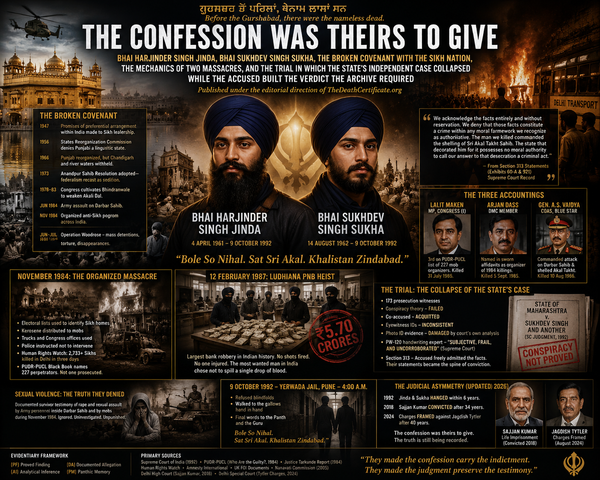
The scale is established by convergent documentation. Jaswant Singh Khalra’s investigation of the municipal cremation grounds of Amritsar district — Amritsar, Tarn Taran, and Majitha — uncovered a pattern of bodies delivered from police custody and cremated as “unidentified,” and Khalra — and his collaborator Jaspal Singh Dhillon — estimated over six thousand such cremations in Amritsar district alone, with statewide figures he placed far higher. The Central Bureau of Investigation confirmed 2,097 illegal cremations at three Amritsar-district cremation grounds in its December 1996 report — a figure the CBI itself acknowledged as limited to a single district. [PF.] The 2,097 is not the count of Punjab’s disappeared. It is the count the State could no longer deny once Khalra forced one district’s cremation registers into the Supreme Court record. HRW and Ensaaf explicitly criticized the NHRC for narrowing its inquiry to three crematoria in one district, rejecting cases from other districts, and refusing to identify responsible officials — describing the result as a “near total failure” to provide justice even for what the process formally acknowledged. The Commission stated, in its own formal language, that it was expressly “not expressing any opinion on culpability” in the mass cremations proceedings — a declaration that simultaneously acknowledged the factual record of 2,097 illegal cremations and formally exempted the state’s officers from any institutional accountability finding. [PF — the NHRC’s own language, documented in HRW/Ensaaf Protecting the Killers (2007) and Ensaaf’s case summary.] To acknowledge 2,097 illegal cremations while simultaneously declining to express any opinion on who was culpable for them is not a judicial finding. It is an institutional abdication dressed in the language of due process. The number hierarchy this publication applies: 2,097 [PF — CBI-confirmed Amritsar floor]; 5,316+ [DA — Ensaaf mapped victim profiles, statewide]; 6,733 [DA — PDAP documented statewide cases, 2019 SC petition]; “thousands / tens of thousands” [PF/DA — HRW/Ensaaf human-rights framing, statewide counterinsurgency]. This publication does not concede these numbers downward. A further institutional datum: of the 2,097 Amritsar cremations the CBI confirmed, the CBI registered only thirty regular cases for investigation — a fraction of its own acknowledged floor. [PF — documented in HRW/Ensaaf reporting of the Protecting the Killers record.] Thirty prosecutions out of 2,097 confirmed cremations, in one district, is not an accountability mechanism. It is a documentation of its own absence. [PF.] The Punjab Documentation and Advocacy Project (PDAP), which began its investigations in 2008 and visited over 1,600 villages, documented cases across the 1978–1996 period and, in a 2019 petition to the Supreme Court, sought justice for 6,732 deceased victims of encounter killings, custodial deaths, and illegal cremations across 26 districts of Punjab. [PF.] Ensaaf and the Human Rights Data Analysis Group, in their 2009 statistical study, concluded that the intensification of the counterinsurgency was accompanied by a shift to systematic enforced disappearances and extrajudicial executions amounting, in their assessment, to crimes against humanity under international law. [PF — the Ensaaf/HRDAG findings are documented in their published report.]
The counterinsurgency’s violence against women must be named specifically, because the official narrative has been most successful in erasing it. The pattern of custodial sexual violence — the rape of women in detention, and the rape of female relatives of suspected militants as a tool of interrogation, intimidation, and collective punishment — is documented by Amnesty International across multiple reports, including India: Torture, Rape and Deaths in Custody (1992) and Human Rights Violations in Punjab: Use and Abuse of the Law (1991), and by Human Rights Watch in [Dead Silence: The Legacy of Abuses in Punjab (1994)](https://www.hrw.org/reports/India0594.pdf). [PF — the pattern of custodial sexual violence is documented across these reports.] Among the individually documented cases is that of Amandeep Kaur, the twenty-year-old sister of a suspected militant, who was tortured, raped, and killed by the Punjab Police — a case recorded, among others, in the documentation of Punjab’s human rights organizations. [DA — the Amandeep Kaur case is documented by Sikh human rights organizations and reproduced in advocacy sources; this archive flags individual custodial-rape cases for the evidentiary care they require, while noting that the pattern of custodial sexual violence is established at the [PF] level by Amnesty International and Human Rights Watch.] The use of sexual violence as an instrument of counterinsurgency governance was not incidental. It was, as the human rights documentation establishes, a systematic feature of how the security apparatus operated against the community — and it is among the most thoroughly erased elements of the official record.
Chapter Eleven — The Architecture of Impunity: Why the Officers Walked
There is a principle in the theory of institutions that might be called the gradient of accountability: in organizations that commit systematic violations, accountability, when it arrives at all, moves against the gradient of command — downward rather than upward, against the operators rather than the architects, against the hands rather than the mind that directed them. The Punjab counterinsurgency offers one of the most thoroughly documented instances of this principle in operation. At the gradient’s lowest point: five constables and sub-inspectors, convicted and serving life sentences for the murder of Jaswant Singh Khalra. At its highest: the Director General of Police, who received the Padma Shri in 1989, the hockey federation presidency in retirement, and the ‘Super Cop’ headline as his epitaph. Between those two points lies everything this publication calls the architecture of impunity.
The Jaswant Singh Khalra case is the template. Khalra was abducted, tortured, and murdered by the Punjab Police for documenting the cremation grounds. After a decade of litigation sustained by his widow, Paramjit Kaur Khalra, and her legal team, six police officials were convicted in 2005; the Punjab and Haryana High Court upheld five convictions and enhanced the sentences to life imprisonment in 2007; and the Supreme Court of India upheld the convictions in 2011 (Prithipal Singh v. State of Punjab, judgment dated 4 November 2011, reported as (2012) 1 SCC 10). [PF.] But the men convicted were field-level officers — a DSP and several sub-inspectors and a head constable. [PF — the ranks of the convicted officers are documented.] Despite the sworn testimony of Special Police Officer Kuldip Singh that he had witnessed K.P.S. Gill personally interrogate Khalra in the days before the murder, and that Khalra had been tortured, no senior officer was charged, and Gill — then Director General of Police, the head of the institution that committed the murder — was never charged or even summoned for examination. [PF/DA.]
Also in 2006, Paramjit Kaur Khalra filed a petition before the Punjab and Haryana High Court seeking action against Gill for his role in her husband’s abduction, torture, and murder — a petition that, like the CBI call, was not acted upon to produce charges against him. [PF — petition documented in HRW/Ensaaf Protecting the Killers.] In 2006, Ensaaf, in partnership with Human Rights Watch, REDRESS, and the Center for Human Rights and Global Justice at NYU, issued a formal call for the CBI to investigate and prosecute Gill for his role in Khalra’s torture and murder. [PF.] The call was not acted upon. The pattern it exposed is the pattern of the entire counterinsurgency: the IPS officers who held the senior commands, and the IAS officers who held the district magistracies that provided the civilian-administrative cover, were systematically protected from prosecution, while the occasional accountability that the system produced was confined to the field level — the sub-inspectors and constables who could be convicted without implicating the command structure or the doctrine it served. [AI — the structural protection of the command level is a central analytical claim of this archive, established by the consistent pattern across the documented accountability proceedings.]
This is the architecture into which K.P.S. Gill fits — not as an aberration but as its most decorated exemplar. The man who commanded the apparatus that produced 2,097 confirmed illegal cremations in one district, that murdered the witness documenting them, and that the Supreme Court of India would characterize as having committed “a flagrant violation of human rights on a mass scale,” was never prosecuted, never investigated at the command level, and never required to answer for the institutional record his tenure produced. He was, instead, awarded the Padma Shri, made president of a national sporting federation, consulted as a counterinsurgency authority, and permitted to write the official history of his own war. That book — Punjab: The Knights of Falsehood — is the subject of Book Two, which reads it not as history but as the confession the state never compelled.
The hundred-year arc ends here, at the threshold of the man — and at the threshold of the question that the arc makes unavoidable: when a state breaks every promise it makes to a community, denies its language, amputates its state, diverts its rivers, destroys its holiest shrine, massacres its members in the capital on live television, and then deploys a Punjabi-born, Assam-cadre police officer to finish the work in the cremation grounds of Amritsar, Tarn Taran, and Majitha — what does accountability look like? The Indian state’s answer, so far, is: five constables, ₹27.94 crore, and a Padma Shri for the man who commanded the apparatus. This publication’s answer is the book that follows. The promise of 1929, the erasure of the language, the mutilation of the state, the federal demand recast as sedition, the resistance to the Emergency, the massacre at Baisakhi and the acquittal that followed it, the manufacture and the descent, the looting of the rivers, the rubble of the Akal Takht, the pogrom of November, the cremation grounds, and the architecture of impunity that protected the men who filled them — all of it converges on the figure who became the emblem of the counterinsurgency’s final phase, and on the book in which he told the world that the falsehood belonged to his victims. The cremation grounds say otherwise. The Supreme Court said otherwise. Book Two is the reckoning of what the record actually establishes.
ਸ਼ਬਦ ਤੋਂ ਪਹਿਲਾਂ, ਸ਼ਮਸ਼ਾਨਘਾਟ. Go to the cremation grounds before reciting Gurbani.
Book Two — The Man and the Confession
A Forensic Biography of Kanwar Pal Singh Gill, Director General of Police of Punjab, Read Against the Institutional Record of the State He Served — and Against the Book He Wrote
Editorial Preface and Evidentiary Framework
This article is the most forensically unusual in the ongoing accountability series published by KPSGILL.COM, and it is potentially the most effective — because its primary exhibit is not a Supreme Court judgment, not an NHRC press release, not a CBI report, but the defendant’s own book. Punjab: The Knights of Falsehood, published by K.P.S. Gill through the Institute for Conflict Management and distributed through the South Asia Terrorism Portal that Gill himself co-founded, contains specific factual assertions, statistical claims, moral characterizations, and institutional judgments — all attributed to the man who served as Director General of Police of Punjab during the period in question. Each major assertion in that book can be placed alongside the institutional record produced by India’s own judiciary, India’s own statutory human-rights body, and India’s own premier investigative agency. The comparison is not favorable to Gill.
The evidentiary architecture of this article rests on a principle that Gill himself, as a career police officer, would have recognized: the best witness against a suspect is often the suspect. Not because the suspect confesses — Gill never confessed to anything — but because the assertions he made in print created a documented record against which the institutional findings of the Indian state can be applied, systematically and without remainder. When India’s Supreme Court finds ‘a flagrant violation of human rights on a mass scale’ in the same territory that Gill’s book describes as a legally disciplined, humanely conducted counterinsurgency operation, the distance between those two positions is not a matter of perspective. It is a matter of documented, adjudicated fact.
Every factual claim in this article is graded on the publication’s four-tier evidentiary framework. A [PF] designation — Proved Finding — indicates a fact established by judicial determination, statutory commission findings, official government records, or convergent documentary evidence of the highest reliability. A [DA] designation — Documented Allegation — indicates a claim that is serious, sourced, and significant but not yet adjudicated to the standard of proved fact. An [AI] designation — Analytical Inference — indicates a reasoned conclusion drawn from established facts, documented patterns, institutional behavior, or the cumulative logic of the record; it is analytical argument, not established fact, and is offered as such. A [PM] designation — Panthic Memory / Civilizational Memory — indicates testimony, inherited understanding, or collective remembrance preserved in Sikh community memory, given independent evidentiary weight as a category of historical record that official documentation alone cannot capture.
Readers unfamiliar with this evidentiary framework may notice that it imposes a discipline that is relatively rare in journalism — and entirely absent from Gill’s own book, which presents allegations as facts, inferences as established findings, and Gill’s own authority as a substitute for documentation. The contrast is deliberate. The forensic standard applied here is higher than the standard Gill applied to himself, and correspondingly higher than the standard the Indian establishment applied to him during his lifetime. The institutional findings of the Supreme Court, the NHRC, and the CBI do not require supplementary advocacy from this publication. They require only careful presentation, accurate citation, and honest juxtaposition with the claims Gill made in print.
The governing editorial concept of KPSGILL.COM — expressed in Punjabi as ਸ਼ਬਦ ਤੋਂ ਪਹਿਲਾਂ, ਸ਼ਮਸ਼ਾਨਘਾਟ — translates into English as ‘go to the cremation grounds before reciting Gurbani.’ It is a moral sequence demand: before you speak of sacred things, before you offer the consolations of institutional narrative, before you pronounce on history, you must first go and look at what actually happened. The Gurbani, in this context, is not a religious text but a metaphor for the official narrative of Punjab’s counterinsurgency: the scripture of the ‘saved state,’ the recitation of Gill’s achievement, the celebratory institutional memory of Operation Black Thunder and the ‘return to normalcy.’ The cremation grounds — Amritsar, Tarn Taran, Majitha in Amritsar district alone — are the prior reality. Two thousand and ninety-seven bodies. Cremated. Unidentified. Outside any lawful authority. The Supreme Court of India said so. The NHRC of India paid for it. The CBI of India confirmed it.
This article also concerns the biography of a man — the life Kanwar Pal Singh Gill led from his birth on December 29, 1934 to his death on May 26, 2017 — because the institutional record cannot be fully understood without understanding the person it was produced through. The 2,097 illegal cremations did not happen by administrative accident. They happened within an apparatus of command, oversight, authorization, and institutional culture that had a name at the top of its hierarchy. Understanding that man — his formation, his doctrine, his character, his ambitions, his impunities, and his post-retirement management of his own legacy — is not a distraction from the institutional record. It is the institutional record made human and specific.
A note on language. Gill himself, in The Knights of Falsehood, uses the word ‘terrorism’ as a universal solvent — applied freely to armed militants, political agitators, community advocates, human-rights investigators, and diaspora activists alike. This article does not adopt that usage. Where Sikh political demands are referenced, they are described as political demands. Where armed violence is documented, it is described as armed violence. The distinction matters because the systematic conflation of political identity with terrorist threat is itself one of the subjects of this analysis — not a premise to be accepted from Gill’s framing and then applied throughout.
This publication operates under the full protections of the United States First Amendment and publishes from the United States of America. It is currently subject to a Section 69A content-blocking proceeding initiated by India’s Ministry of Electronics and Information Technology (Request ID 69A/2026/MIT/11078), a proceeding to which a formal written submission has been filed. The existence of that proceeding does not modify the publication’s editorial independence or its commitment to documented, evidentiary journalism. If anything, it confirms the significance of the record this publication is building.
This Publication in the Existing Literature
Punjab: The Knights of Falsehood (Har-Anand, 1997) is the primary text this work interrogates — cited throughout, its claims tested against India’s institutional record. Mark Tully and Satish Jacob’s Amritsar: Mrs. Gandhi’s Last Battle (1985) provides the authoritative journalistic account of the lead-up to Operation Blue Star but predates the counterinsurgency’s most lethal phase. Kuldip Nayar’s Beyond the Lines is the most candid mainstream journalistic treatment of Punjab politics, though state-centric on the security response. Protecting the Killers (HRW/Ensaaf, 2007) is the most authoritative institutional human rights analysis of the counterinsurgency and is this publication’s most important external source. Ram Narayan Kumar, with Georg Burg, Jaskaran Kaur, and Navkiran Singh — Reduced to Ashes: The Insurgency and Human Rights in Punjab (South Asia Forum for Human Rights, Kathmandu, 2003) — remains the most comprehensive ground-level documentation of the disappearances and is the foundational text of the accountability literature. Against the Gill-institutional narrative dominant in Indian security-studies discourse, this publication’s argument is that the judicial findings of India’s own Supreme Court, NHRC, and CBI constitute the definitive counter-record — and that they have never been engaged by the discourse that treats Gill’s book as authoritative history.
Part One
Gill’s Preface Claim: Professional Formation Within the Law | Counter-record: the Assam Cadre Service Record, the Bajaj Criminal Conviction, and the Colonial Institutional Inheritance
| The Man Before the Myth: Origins, Formation, and the Making of an Indian Police Officer |
|---|
Chapter One: The World He Was Born Into
Kanwar Pal Singh Gill was born on December 29, 1934, into a Punjab that still existed whole — a single administrative province of British India stretching from the Indus River in the northwest to the Yamuna in the southeast, from the Himalayan foothills in the northeast to the edge of the Rajputana desert in the south. [PF — date of birth confirmed in public records.] It was a Punjab of five rivers, of the Mughal road and the Grand Trunk highway, of canal colonies and cantonment towns, of gurudwaras ancient enough to predate the Mughal empire and colonial administrative bungalows built not two generations earlier. It was a Punjab that had been, for two and a half centuries, the crucible of Sikh civilization — the geographic and spiritual homeland of the Guru lineage, the theater of Ranjit Singh’s empire, and the province that had resisted British conquest longer and more fiercely than any other.
The Punjab into which Gill was born was already being administered by a particular kind of institution. The Indian Civil Service — the ICS, the ‘steel frame’ of British India — and the Imperial Police Service (IPS), its enforcement arm, had been built over the preceding century as instruments of colonial governance whose fundamental purpose was the maintenance of order in an occupied territory. The distinction between ‘order’ as a value and ‘justice’ as a value was not merely theoretical in colonial administration: it was structural. The ICS and the Imperial Police were designed to prevent disruption to British authority, to suppress political organizing, to manage ‘native’ populations through a combination of administrative discretion, intelligence networks, and the ever-present threat of force. The officers who ran this system were not, in the main, sadists. They were professional administrators who had internalized a doctrine in which the legitimacy of the state was taken as axiomatic, and any challenge to that legitimacy was categorized as disorder requiring suppression.
This was the institutional world that would shape, decades later, the IPS into which Gill was inducted. India inherited the colonial police structure at Independence in 1947 largely intact. The Police Act of 1861 — drafted in the aftermath of the 1857 uprising specifically to give colonial administrators maximum control over the police apparatus — remained operative in most Indian states well beyond Independence. The Indian Police Service, successor to the Imperial Police, retained its colonial organizational culture: hierarchical, generalist, oriented toward the maintenance of order rather than the service of individual rights, and deeply reluctant to subject itself to civilian oversight that might constrain its operational discretion. This was not a defect in design. It was, from the perspective of the colonial architects who built the system, a feature. And India, in the urgencies of postcolonial state-building, decided to live with that feature rather than redesign it.
The specific circumstances of Gill’s birth and early childhood within this Punjab — the exact district, the family’s economic position, the schools he attended, the social milieu of his first formation — require archival sourcing beyond what is readily available in the open public record. [AI — standard biographical research required; this article presents established facts and historical context rather than specific unverified personal details.] What can be stated with confidence is that he was born into a Sikh family in a province where Sikh identity was simultaneously a matter of deep cultural inheritance and active political contestation. [PF — Sikh identity is established in reliable biographical accounts.] The Sikh community in the 1930s was engaged in the aftermath of the Gurdwara Reform Movement — which had, through the Sikh Gurdwaras Act of 1925, transferred control of the historical gurdwaras from hereditary mahants to an elected body — and the beginnings of what would become, at Independence, the demand for a Punjabi-speaking state.
Gill would have been twelve years old in 1946 — the year before the catastrophe. In 1947, the Punjab that had existed as a single entity for the entire span of his childhood was severed along the Radcliffe Line into two new nations: the western portion became Pakistani Punjab; the eastern portion became Indian Punjab. The violence of Partition, concentrated with particular ferocity in the very province being divided, killed between 200,000 and two million people — historians dispute the figure, but its lower bound alone represents one of the largest episodes of mass killing in the twentieth century — and displaced ten to fifteen million more. Entire communities were annihilated. Villages were burned. Women were abducted and assaulted in numbers that neither government chose to document with care. The Punjab that Gill had been born into simply ceased to exist. The Punjab he would spend his career policing was a truncated, traumatized remnant of that world — Indian Punjab, East Punjab — carrying within its administrative geography the accumulated grief, dispossession, and communal fury of one of history’s most violent partitions.
The formative psychological significance of this experience for a twelve-year-old boy who would later build a career in state violence — the experience of witnessing, or at minimum inheriting as immediate family memory, the collapse of an entire civilization in a season — is a question that cannot be answered from the available record but cannot be entirely avoided as an analytical matter. [AI — biographical inference; the specific impact on Gill personally is not documented.] What can be said is that every Indian official of Gill’s generation who served in Punjab carried the Partition as biographical and institutional context: the consciousness that this province had the capacity for total communal violence, that its internal tensions between communities were not merely political but existential, and that the maintenance of ‘order’ in Punjab was therefore a project of extraordinary and permanent urgency. Whether Partition produced in Gill a protective impulse toward the communities that had suffered, or a generalized fear of the communal violence that territory was capable of producing, or a professional orientation in which the prevention of such violence justified almost any institutional measure — that remains, absent a documented biographical record, in the domain of inference rather than fact.
What is documented is the trajectory. The boy born into undivided Punjab in 1934 would become, by the late 1950s, an officer of the Indian Police Service. [PF — confirmed.] He would be allocated not to the Punjab cadre but to Assam — appointed to the Indian Police Service on 4 February 1958 after the 1956 competitive examination, with 1957 as his official year of allotment, and trained first at the Central Police Training College, Mount Abu, before early postings at Dergaon and Lakhimpur in Assam. [PF — the official 1960 History of Services of Indian Police Service places Gill in the Assam allocation with these specifics.] This biographical point is sharper than the surface detail suggests: Gill was Punjabi by birth but professionally formed in Assam and the Northeast, operating for approximately twenty-eight years in a counterinsurgency environment entirely different from Punjab, before being brought into Punjab during its crisis. He was not a Punjab-cadre officer organically rooted in the province’s civil-police structure. He was a Punjabi-born, Assam-cadre counterinsurgency specialist parachuted in — a distinction the command-responsibility analysis only hardens. The world he was born into had been destroyed and rebuilt before he was fifteen years old. The institution he would join had been colonial before it was Indian, and it remained more colonial than it was willing to acknowledge. These two facts — personal formation in catastrophe, professional formation in a colonial institutional inheritance — are the biographical foundations on which everything that followed was constructed.
The Punjab into which Gill was born in 1934 also harbored a specific constitutional and religious tension that would prove historically significant. The Sikh community — approximately fifteen percent of undivided Punjab Province in the 1941 census — a much smaller fraction of British India as a whole — yet disproportionately represented in the colonial army and police forces — had been the single largest casualty community of Partition in proportional terms, losing access to their sacred sites, their agricultural heartland, and their ancestral communities in what became Pakistani Punjab. At Independence, they found themselves in an Indian state whose constitutional architecture offered individual protections but whose political structure was dominated by communities that did not share their language, their scriptural tradition, or their institutional history. The demand for Punjabi Suba — a reorganized Punjab state with Punjabi as its official language and a Sikh majority population — would occupy the community’s political energy for nearly two decades before being partially resolved by the 1966 reorganization of Punjab. That reorganization itself created a truncated Punjab with contested boundaries — Chandigarh shared as a capital, Haryana carved out, Hindi-speaking districts absorbed by neighboring states — that left the community’s political claims formally acknowledged but substantively contested. This was the Punjabi political atmosphere that Gill would eventually be tasked with managing. Its essential character — a community whose political demands the Indian state recognized as partially legitimate but refused to fully accommodate — was not a product of terrorism or external subversion. It predated the militancy by decades.
Chapter Two: The IPS and the Formation of a Police Philosophy
The Indian Police Service is, in its structural DNA, a colonial institution. This is not a polemical observation; it is a constitutional and administrative fact. The Police Act under which most Indian states operated through the twentieth century was the Police Act of 1861 — enacted by the British colonial administration eighteen months after the suppression of the 1857 uprising, specifically to concentrate police authority in administrative officers accountable to the colonial government rather than to local communities or elected bodies. The Act’s fundamental philosophy was straightforward: the police existed to maintain order on behalf of the state, not to serve individual citizens or protect community rights. The relationship between the police and the public was not conceived as a service relationship. It was conceived as a governance relationship — with the state on top and the ‘public’ as the administered population.
The Indian Police Service that Gill joined in the late 1950s had inherited this architecture with minimal modification. [PF — IPS succession to Imperial Police Service is a documented institutional fact.] The institutional training infrastructure for IPS officers evolved over the decades — the later Sardar Vallabhbhai Patel National Police Academy at Hyderabad became the senior formation institution for subsequent generations; for Gill’s 1957–1958 cohort, the record places initial training at the Central Police Training College, Mount Abu, followed by field postings rather than Hyderabad. The more significant formation was in any case informal: the apprenticeship of a new IPS officer under senior officers whose own training had been conducted in the colonial system or under its immediate successors. The values transmitted through this informal apprenticeship — deference to hierarchy, cultivation of intelligence networks, operational discretion over procedural compliance, the management of ‘difficult’ populations through a combination of surveillance and exemplary force — were not taught in any classroom. They were absorbed through institutional culture.
The IPS officer’s role in the Indian administrative hierarchy is distinctive. Unlike state police — who are recruited locally and serve in a single state — the IPS is a central service: officers are recruited nationally through competitive examination, trained centrally, and then allocated to state cadres, where they serve in senior positions. The system was designed, at Independence, to create a corps of senior officers whose ultimate loyalty was to the central government rather than to state politics, and who could therefore be trusted to enforce central policy even when state governments might prefer otherwise. In practice, this meant that IPS officers developed two loyalties simultaneously: to the state they were posted in, whose senior political figures controlled their day-to-day postings and prospects, and to the central government, which controlled their ultimate career trajectory.
The Punjab cadre allocation — the assignment that would, decades later, define Gill’s career — placed him in the administrative geography of his own biographical formation. [PF — cadre allocation confirmed.] This is not unusual in the IPS: many officers served in their home states. But it did mean that Gill’s professional relationship to Punjab was not that of an outside administrator coming fresh to an unfamiliar territory. He arrived in Punjab as a native — someone who understood the province’s languages, communities, and political dynamics from the inside — which made him both more effective and, from the perspective of the communities he would eventually police, more implicating. He could not claim, as an outside administrator might, that he did not understand what he was doing or to whom he was doing it.
The specific doctrinal content of the counterinsurgency philosophy that Gill would later deploy in Punjab was not invented in Punjab. It had a longer genealogy — traceable through British counterinsurgency doctrine (the Palestine Mandate, the Malayan Emergency, the Cyprus operation), through the institutional culture of the IPS, and through India’s own post-Independence experience of managing territorial insurgencies in its northeastern states. The core elements of this doctrine were consistent across these theaters: first, the belief that a committed insurgency could not be suppressed by conventional law enforcement and required emergency legal powers that suspended ordinary protections; second, the use of intelligence-driven targeted operations to eliminate leadership rather than address grievances; third, the cultivation of ‘turned’ insurgents — former militants recruited as counter-insurgent auxiliaries — whose local knowledge made them operationally valuable and whose operations could be conducted at a degree of removal from the formal state apparatus that provided deniability; and fourth, the management of civilian populations through a combination of surveillance, collective accountability measures, and periodic exemplary force.
This doctrine was not a secret. It was not something that needed to be concealed from the public or from the courts because its implementation remained below the threshold of what the courts were monitoring. In the Northeast — particularly under the Armed Forces Special Powers Act of 1958, which granted security forces essentially unlimited authority to detain, search, and use lethal force in ‘disturbed areas’ — the doctrine operated in conditions of minimal legal oversight. The fundamental premise of this doctrine — that the rights of citizens in an insurgency-affected area were legitimately subordinate to the operational needs of the state’s counterinsurgency — was embedded in the law itself. [PF — AFSPA text is a statutory primary source.]
Gill absorbed this doctrine across the span of a career that traversed multiple insurgency theaters before arriving at the Punjab assignment that would make his name. He was not an improviser or a theorist. He was a practitioner — someone who had watched the doctrine deployed in various contexts, drawn conclusions about what worked and what did not, and arrived at Punjab with a toolkit refined through operational experience. Understanding what that toolkit contained, and why it produced the results the institutional record shows it produced, is the essential analytical task of this biography.
There is a specific feature of IPS institutional culture, documented by scholars of Indian policing, that deserves attention here: the culture of ‘encounter.’ The term ‘encounter’ in Indian police usage refers to what is formally described as an armed confrontation between police and a suspect in which the suspect is killed. In practice — and this is not a claim made by human rights organizations alone but by the National Human Rights Commission itself, by multiple High Courts, and by the Supreme Court in various proceedings — many ‘encounters’ in Indian policing are what their critics term ‘fake encounters’: deliberate extra-judicial executions staged to look like armed confrontations. [PF — NHRC and judicial findings on fake encounters are documented in multiple proceedings.] This practice was not unique to Punjab or to Gill’s tenure. It was widespread across India. But in Punjab, under the cover of TADA and the operational urgency of the counterinsurgency, it became systematized at a scale and with an administrative sophistication — the cremation grounds, the ‘unidentified body’ classification, the suppression of FIRs — that was, in the Supreme Court’s eventual assessment, categorically unprecedented.
Chapter Three: The Counterinsurgency Apprenticeship — Assam, Manipur, and the Northeast
Before K.P.S. Gill arrived at the Punjab assignment that would make him, in the Indian security establishment’s vocabulary, ‘Super Cop,’ he had served in India’s Northeast — a theater of insurgency that functioned, in the decades following Independence, as the testing ground for every counterinsurgency doctrine the Indian state would subsequently deploy elsewhere. The specific postings, precise dates, and operational details of Gill’s northeastern service are documented in the internal records of the Government of India rather than in accessible public sources; this article presents what is reliably reported in journalistic and institutional accounts while acknowledging that a complete picture requires archival access. [AI — characterization of northeastern service based on widely reported accounts; specific operational details flagged as needing archival verification.] What is clear from the available record is that Gill served in senior positions in the Northeast, including as a Director General of Police, and that this experience shaped the operational philosophy he would bring to Punjab.
The Northeast’s relationship to the Indian state has been, since Independence, a relationship of asymmetric power and contested legitimacy. The states of Assam, Manipur, Nagaland, Meghalaya, Tripura, and Arunachal Pradesh contain dozens of distinct ethnic, linguistic, and cultural communities whose connection to the Indian national project was established less through democratic consent than through the geographic logic of Partition and the British colonial boundary-drawing that preceded it. Multiple insurgencies emerged in this region beginning in the 1950s — the Naga independence movement, the Mizo uprising, the Assam insurgency led eventually by the United Liberation Front of Asom (ULFA), and the Manipur insurgency — each with its specific grievances, its specific character, and its specific relationship to the central government.
The Indian state’s response to northeastern insurgencies was governed, from 1958 onward, by the Armed Forces Special Powers Act — a piece of legislation whose constitutionality has been challenged repeatedly and whose application has been condemned by the United Nations, by the Supreme Court’s own committees, and by every serious human-rights organization that has examined it. [PF — AFSPA text, UN documentation, and Supreme Court proceedings are all primary sources.] Under AFSPA, the northeastern states were designated ‘disturbed areas,’ and security forces operating within them were granted the power to arrest without warrant, search without warrant, destroy property, and use lethal force against any person who was ‘acting in contravention’ of a law or order — with near-complete immunity from civilian prosecution. Officers could be prosecuted only with the prior sanction of the central government, a sanction that, in the decades of AFSPA’s operation in the Northeast, was granted with what human-rights advocates have described as systemic rarity. [PF — documented absence of prosecutions in the public record.]
The operational culture that developed within AFSPA’s framework was a culture of impunity. It was not individual impunity — the rogue officer acting without authorization — but systemic impunity: a structure in which the legal framework itself provided cover for actions that would, in any ordinary legal context, constitute criminal offenses. Detentions without record. Deaths in custody described as combat. Bodies unaccounted for. Families who received no information and had no legal mechanism to obtain any. The Northeast’s communities, like Punjab’s communities a generation later, have been carrying this history for decades. The continuity between the two theaters is not accidental. It reflects the deployment of the same doctrine, refined in the Northeast, to the new emergency in Punjab.
What Gill learned in the Northeast was not merely tactical. It was philosophical: that a territorial insurgency engaged by a committed state apparatus, operating under extraordinary legal cover and with disciplined operational focus, could be suppressed — not solved, not addressed at its roots, but suppressed to the point where its operational capacity was eliminated and its political demands, however substantive, could be managed through administrative channels rather than conceded through political negotiation. The lesson was that force, systematically and intelligently applied, worked. The subsidiary lesson — which the NHRC findings, the Supreme Court’s language, and the Ensaaf database would eventually make explicit — was that the force that ‘worked’ in this operational sense produced consequences in human rights, institutional legitimacy, and long-term political grievance that the tactical victories did not resolve and that the commanders who achieved those victories consistently refused to acknowledge.
The northeastern theater also gave Gill a specific operational tool that he would deploy in Punjab: the use of ‘turned’ or counter-insurgent auxiliaries. In Assam and elsewhere in the Northeast, the security apparatus cultivated former insurgents — men who, through capture, inducement, or disillusionment, had shifted their allegiance — as intelligence sources and operational actors whose knowledge of insurgent networks, safe houses, and leadership made them invaluable. The counterinsurgency literature calls this the ‘Kitson model,’ after the British general whose doctrine on counterinsurgency in the Malayan Emergency and Northern Ireland formalized the use of ‘pseudo-gangs’ — counter-insurgent units operating with the methods, appearance, and sometimes the identity of insurgents. In Punjab, this doctrine manifested as what became known as the ‘Black Cats’ network: counter-militant operatives, some of them former Sikh militants, who conducted operations against active insurgents under the Punjab Police’s operational direction and with a degree of legal accountability that the record suggests was minimal to nonexistent. [DA — existence of counter-militant auxiliaries documented; specific operational details and accountability structures remain incompletely documented in the public record.]
Gill arrived at the Punjab assignment, in the first instance in the mid-1980s and in decisive form in 1988, as someone who had seen counterinsurgency done — who had a doctrine, a toolkit, a professional confidence in his own methods, and an institutional relationship to the state that provided both operational freedom and personal protection. He was not a cautious administrator tentatively trying to find the right balance between security and rights. He was a committed operator with a clear philosophy and the political backing to implement it. Understanding this is essential to understanding what followed — and why the institutional record that Punjab produced is not, in any meaningful sense, a record of aberration.
The Canal Colonies, the Partition Ecology, and the Making of Punjab’s Administrative State
Extended Chapter One-A: Punjab’s Economic Geography and the Formation of Administrative Authority
The Punjab into which K.P.S. Gill was born in 1934 was not merely a political unit. It was a specific agricultural and economic geography whose character had been fundamentally transformed, in the preceding fifty years, by one of the largest colonial engineering projects in the history of the Indian subcontinent: the canal colony system. Beginning in the 1880s and accelerating through the first decades of the twentieth century, the British colonial administration in Punjab had constructed an extensive network of irrigation canals from the five rivers that gave the province its name — the Sutlej, the Ravi, the Beas, the Chenab, and the Jhelum — converting millions of acres of previously semi-arid ‘bar’ lands into productive agricultural territory. The canal colonies created a new class of agrarian settlers — predominantly Sikh and Hindu Jat peasants from the central Punjab districts — who received land grants on the condition of settlement and cultivation in the new territories. This transformation produced, within a generation, an agricultural economy of extraordinary productivity and an agrarian society whose relationship to the land was simultaneously intensely personal and mediated by the colonial administrative apparatus that had granted, and could therefore potentially withdraw, the land grants that made the colonies possible.
The canal colony system also produced a specific relationship between Punjab’s agricultural communities and the British colonial state that was different from the relationship that prevailed in most other Indian provinces. The settlers were dependent on the state for water — the irrigation system required maintenance, allocation decisions, and investment that only the colonial administration could provide — and they were therefore structurally less likely to organize against the state than agrarian communities in rain-fed agricultural areas whose relationship to the land did not flow through government infrastructure. The political compliance of Punjab’s canal colony settlers was purchased, in part, through the specific economic dependency that the irrigation system created. The Punjab soldier — the ‘martial race’ mythology that the British deployed to justify the disproportionate recruitment of Sikh and Punjabi men into the colonial army — was in part a product of this economic structure: men who had land they valued, land that the state had given them, and who therefore had a specific material interest in the stability of the system that had produced that land.
The Sikh community’s specific relationship to this colonial economic structure was complex in ways that bear on the later political history. The canal colony settlers who were Sikh — predominantly from the Jat caste, the same community from which the Sikh military tradition had historically drawn its fighting strength — became, through the land grants, a prosperous agrarian middle class whose political interests were intertwined with the agricultural economy of the newly irrigated territories. These territories were disproportionately located in western Punjab — the portion that would, at Partition, become Pakistani Punjab. The Partition’s economic catastrophe for the Sikh community was not merely political displacement from sacred sites and ancestral communities. It was the physical loss of the land grants that had made the community economically secure. The families that crossed the Radcliffe Line in 1947 left behind not merely homes and memories but the specific productive land — the canal colony grants — that had been the material foundation of their economic standing for two generations.
This economic dimension of Partition’s impact on the Sikh community is relevant to the biography of K.P.S. Gill because it shaped the specific character of East Punjab — the truncated, refugee-receiving rump of the divided province — in the years of his early adulthood and early career. East Punjab in the late 1940s and early 1950s was a province absorbing millions of refugees who had lost everything west of the Radcliffe Line, struggling to resettle them on land that was simultaneously being redistributed from the Muslim families who had gone the other way, and managing an agricultural transition from the pre-Partition canal system — whose western infrastructure was now in Pakistan — to a different and initially less productive irrigational arrangement. The administrative challenge was enormous; the human suffering was acute; and the political atmosphere — of communities that had survived mass violence, lost their homes, and were dependent on a state apparatus for resettlement and rehabilitation — was one in which the state’s administrative power was both indispensable and intensely contested.
The Indian state’s management of the Sikh refugee community’s resettlement in East Punjab in the post-Partition years established a specific pattern in the relationship between the Sikh community and the Government of India that would resonate in subsequent political history. The resettlement was substantial — millions of Sikh and Hindu Punjabi refugees were allocated land, granted rehabilitative assistance, and assisted in reestablishing agricultural production in East Punjab — but it was managed through a process that the community experienced as imperfect, inadequate, and subject to the administrative priorities of a state apparatus that did not always give the Sikh community’s specific needs the priority those needs deserved. The Punjabi Suba demand — for a reorganized Punjab state with a Punjabi-speaking majority and a Sikh cultural character — drew energy not merely from linguistic politics but from the specific experience of a community that had suffered the most severe losses of Partition and that felt its political representation in the post-Independence state did not reflect the severity of what it had lost. [AI — analytical inference from documented historical patterns; specific political psychology is contextual characterization.]
The administrative apparatus that governed post-Partition East Punjab was the inherited colonial apparatus, now staffed by Indian ICS and IPS officers, operating under the same basic institutional framework — the Police Act of 1861, the Code of Criminal Procedure, the colonial district administration model — that the British had established. The IPS officers who served in Punjab in the 1950s and 1960s, including the young Kanwar Pal Singh Gill in his early career postings, were operating within a district administration structure whose purpose and methods had been continuous from the colonial period. The ‘steel frame’ was intact; only the nationality of the people sitting within it had changed. The institutional culture — hierarchical, oriented toward order maintenance rather than rights protection, deeply uncomfortable with political organizing that challenged state authority — was transmitted intact from the colonial to the post-colonial period. Gill entered and was shaped by this culture in a Punjab that was still processing the wounds of Partition and the inadequacies of its resettlement.
Extended Chapter Two-A: The Colonial Police Philosophy and Its Indian Inheritance
The specific intellectual content of the colonial policing philosophy that India inherited at Independence has been analyzed by several generations of scholars, but its practical implications for the counterinsurgency that Gill would eventually command require careful restatement here. The colonial police philosophy was not merely a set of operational procedures. It was a theory of order: the theory that social and political order is the primary value that state institutions exist to maintain, that challenges to that order — regardless of their democratic or rights-based character — are threats requiring suppression, and that the officials responsible for maintaining order are entitled to a degree of discretion in their methods that the ordinary law does not extend to private individuals. This theory, embedded in the Police Act of 1861 and transmitted through a century of institutional culture, did not die with the Raj. It survived in the IPS, in the district administration, in the relationship between political executives and police officials, and — most consequentially — in the fundamental orientation of the Indian state toward political movements that challenged its authority in inconvenient or persistent ways.
The colonial police’s relationship to ‘disturbing the peace’ — the conceptual framework through which political organizing, religious gatherings, labor action, and community protests were assessed — was that such activities were presumptively suspect unless specifically permitted by the administrative authority. The colonial policeman was trained to see his role as the preservation of a social equilibrium that the colonial order had established and that legitimate authority — the District Magistrate, the Commissioner, the colonial government — had a right to maintain. Political activity that threatened that equilibrium was not, in the colonial framework, an exercise of democratic rights; it was an administrative inconvenience that the police were entitled to manage through deterrence, surveillance, and if necessary force. The ‘sedition’ prosecutions of the colonial period — from Bal Gangadhar Tilak to Mohandas Gandhi — were the extreme manifestation of this philosophy, but the philosophy itself operated at every level of the administrative hierarchy, shaping how the police interacted with communities, how they assessed political organizing, and how they justified their interventions against groups and individuals who challenged the colonial order.
India inherited this philosophy intact because the people who administered the post-Independence state had been trained in, and in many cases had built their careers within, the colonial administrative apparatus. The IPS officers who served India in the 1950s and 1960s were not ideological continuists with the Raj; many of them were committed nationalists who had participated, in various ways, in the Independence movement. But the institutional culture they inhabited was colonial: its procedures, its hierarchy, its relationship to political authority, its assessment of ‘order’ as the primary value, and its operational repertoire — the arrest, the detention, the curfew, the Section 144 prohibitory order — were all instruments of a system whose fundamental logic was the management of populations for the benefit of those at the top of the authority hierarchy. When the people at the top of the authority hierarchy changed from British colonial officials to Indian elected politicians and civil servants, the institutional logic did not change. ‘Order’ was still the primary value. The methods of maintaining it were still the inherited ones. And the political organizing that threatened it — whether by Communist labour activists in the 1950s, by Naxalite insurgents in the 1960s, or by Sikh political mobilization in the 1980s — was assessed through the same colonial lens: as disorder requiring suppression rather than grievance requiring address.
The specific training that the Sardar Vallabhbhai Patel National Police Academy provided to new IPS officers — the curriculum of law, criminology, administration, and emergency management — did not escape this inheritance. The Academy was established in the period when India’s post-Independence institutional architecture was being built, and its curriculum reflected the priorities of that moment: creating a corps of senior police officers who could manage the complex security challenges of a newly independent, territorially large, ethnically and linguistically diverse nation. The Emergency Management component of the training — the procedures for managing public order emergencies, crowd control, riot situations, and eventually internal security operations — drew explicitly on the operational experience of the colonial period, including the handling of political unrest in the late colonial years. The institutional memory of how the Punjab police had managed the 1919 Jallianwala Bagh situation — which the colonial administration classified at the time as a public order emergency requiring firm management and which subsequent history has classified as a massacre — was not fully reckoned with in the Academy’s curriculum. The operational framework survived even if the specific incident was condemned.
Gill’s specific pathway through the Academy and his early postings in Punjab would have exposed him to this institutional culture at its formative most intensive. The junior IPS officer’s experience of the first five to ten years of service — learning the practical mechanics of district administration, of crime investigation, of public order management, of intelligence collection, and of the political relationships between the police, the district magistracy, and the state’s political executive — is the period of professional character formation that determines the officer’s fundamental orientation for the rest of his career. The values absorbed in this period are not primarily the values of the classroom curriculum but the values transmitted through the operational culture of the officers who supervise the junior officer’s early work: what they reward, what they tolerate, what they condemn, and what they instruct the junior officer to do when the textbook answer is unavailable or inconvenient. In the Punjab IPS of the late 1950s and early 1960s, the operational culture was shaped by officers whose own formation had been in the late colonial period. The transmission of institutional values across this generational chain is, analytically, among the most important factors in understanding the counterinsurgency doctrine that Gill would eventually deploy.
Forensic Legal Commentary: Part One — Formation, Institutional Charter, and the First Criminal Conviction
Gill’s Book Claim (the hub): The preface to Punjab: The Knights of Falsehood (Har-Anand Publications, 1997) presents Gill as a professional who operated, throughout his career, within the norms of institutional law enforcement. The book’s authority rests on its author’s claim to have been a lawful public servant whose actions were authorized, measured, and effective. Every analytic spoke in The Knights of Falsehood depends on the integrity of that hub.
Spoke One — The IPS Charter and Its Obligations: An officer of the Indian Police Service does not hold merely an administrative appointment. The IPS Cadre Rules 1954 and the All India Services (Conduct) Rules 1968 impose affirmative statutory obligations: the obligation to uphold the law, to prevent illegal arrests, to ensure detainees are produced before magistrates within prescribed time limits, and to report deaths and injuries that occur under police authority. [PF — these Rules are statutory primary sources.] These obligations do not suspend during counterinsurgency. The Supreme Court has repeatedly held that the emergency powers available to the state during internal security operations do not authorize the suspension of Article 21 (right to life and personal liberty) or Article 22 (protection against arbitrary detention). A.K. Gopalan v. State of Madras, AIR 1950 SC 27, and the subsequent refinements through Maneka Gandhi v. Union of India, (1978) 1 SCC 248, established that any procedure affecting life or liberty must be just, fair, and reasonable. A DGP who presides over a system in which persons are detained, killed, and secretly cremated as “unidentified” is presiding over a system that violates each of those standards in the most literal possible way. [AI — the systemic analysis; the specific findings are [PF].]
Spoke Two — IPC §§ 166, 167, and 34: The Indian Penal Code provides the specific language: Section 166 (“public servant disobeying law, with intent to cause injury to any person”) and Section 167 (“public servant framing an incorrect document with intent to cause injury”). The “unidentified person” cremation classification — the administrative device by which 2,097 bodies were processed through Amritsar district’s cremation grounds and disposed of without record, identity, or notice to families — is, as a matter of IPC analysis, a document framed with intent to prevent identification of the cause and manner of death. [AI — the IPC analysis of the classification practice, supported by the [PF] finding of the CBI.] The officers who implemented this practice were, on the [PF] record, operating within an institutional system whose senior command is the subject of command responsibility analysis in Part Three.
Spoke Three — The Bajaj Conviction as Formation Evidence: The conviction of K.P.S. Gill under IPC §§ 354 and 509 — assault to outrage modesty and words or gestures to insult modesty — is not merely a footnote to his biography. It is formation evidence for the accountability analysis. Gill was DGP Punjab at the time of the incident. He committed a criminal act against a senior IAS officer, in a public setting, in the presence of witnesses. He then used his institutional authority and the resources of the counterinsurgency establishment to contest the case for seventeen years. The Supreme Court’s 2005 judgment upholding the conviction (K.P.S. Gill v. Rupan Deol Bajaj, (2005) 6 SCC 161) is a finding that India’s apex court made against the sitting counterinsurgency commander — a commander who had, two years after the Bajaj incident, received the Padma Shri. The state’s simultaneous condemnation (via the courts) and celebration (via the national awards system) of the same individual is itself a forensic exhibit: it demonstrates the structure of accountability and immunity that this article’s argument identifies. [PF — the conviction and the Padma Shri are both established facts; [AI] — the concurrent condemnation/celebration as institutional evidence.]
Forensic Verdict on Part One: The biographical record of Gill’s formation — Assam cadre, not Punjab; Central Police Training College Mount Abu; twenty-eight years in the Northeast’s counterinsurgency environment before Punjab — establishes not professional remoteness from institutional violence but professional intimacy with it. The Bajaj conviction establishes that the claim of lawful professional conduct, the foundation of the book’s authority, is falsified at the level of Gill’s own judicial record before the first argument of The Knights of Falsehood is reached.
Part Two
Gill’s Black Thunder Claim: Clean, Economical, Near-Bloodless | Counter-record: TADA’s Legal Architecture, the Post-Surrender Accountability Shadow, and the Bajaj Sequence
| The Punjab Assignment: Operation Black Thunder, the Rupan Deol Bajaj Case, and the Architecture of Impunity |
|---|
Chapter Four: First Arrival — Punjab After Blue Star
When K.P.S. Gill first arrived in Punjab in a senior capacity in the mid-1980s, the province was in a condition of acute crisis — the direct and foreseeable consequence of decisions made by the Government of India that had turned a political dispute into an armed confrontation with catastrophic and self-sustaining momentum. [PF — the historical sequence of events is extensively documented.] Operation Blue Star, the military assault on the Golden Temple complex in Amritsar in June 1984, had ended the period of Sikh militant occupation of the complex — but at a cost that, in terms of its consequences for the Indian state’s relationship with the Sikh community, was incalculable. The operation, ordered by Prime Minister Indira Gandhi and conducted by the Indian Army under General Arun Sridhar Vaidya, killed hundreds of pilgrims and militants along with Jarnail Singh Bhindranwale himself. It also damaged and partially destroyed structures within the Harmandir Sahib complex, including the Akal Takht, that are among the most sacred in the Sikh tradition. [PF — documented in official Indian army accounts, journalistic records, and subsequent government commissions.]
The Sikh community’s response to Operation Blue Star was not uniform, and this non-uniformity is important for an honest understanding of what followed. A significant portion of the community condemned the militancy that had preceded the operation, had no sympathy for Bhindranwale or his political positions, and rejected the demand for Khalistan as unrepresentative of Sikh aspirations. But the vast majority of that same community — including those who rejected Bhindranwale — experienced Operation Blue Star as a profound violation of their religious dignity: the assault, by the Indian Army, of the holiest site in the Sikh world. The political distinction between rejecting Bhindranwale’s methods and endorsing the military invasion of the Golden Temple was a distinction that the Indian state, in its framing of the events, repeatedly collapsed. This collapse — the equation of Sikh grief over Blue Star with sympathy for Sikh militancy — is one of the roots of the misclassification that Gill’s book would later systematize at the level of counter-terrorism doctrine.
Four months after Operation Blue Star, on October 31, 1984, Prime Minister Indira Gandhi was assassinated by two of her Sikh bodyguards — an act of violence whose moral complexity the Indian state has never fully reckoned with, and whose context the official narrative has consistently simplified to the point of falsification. The assassination triggered the pogrom of November 1984: organized mob violence against Sikh communities across India, concentrated in Delhi, in which somewhere between three thousand and eight thousand Sikh men were killed over three days while the Delhi Police stood down. [PF — figures are from official and independent investigations, including the Nanavati Commission; the precise figure remains disputed but the minimum is established by judicial findings.] The pogroms were not spontaneous. They were organized: evidence of Congress Party leadership involvement in coordinating the violence has been documented in multiple judicial and investigative proceedings. The state’s failure to prevent, prosecute, or adequately reckon with the November 1984 killings is itself a documented institutional failure with which the Indian judicial system continues to grapple decades later. [PF — Supreme Court proceedings, SIT findings, and convictions of Congress figures are all documented.]
The effect of these two events — Blue Star and the November pogroms — on Punjab’s political trajectory was to produce exactly what any serious analyst would have predicted: a dramatic radicalization of Sikh political anger, a surge in recruitment to militant organizations, a collapse of the moderate Sikh political leadership’s ability to offer a credible alternative, and a sustained armed insurgency whose character was shaped not by ideological abstraction but by the lived experience of communities that had watched the state assault their holiest site and then murder their community members in the streets of India’s capital city while the police looked away. The insurgency that Punjab police would spend the next decade suppressing was not a conspiracy hatched in Pakistan alone — though Pakistani support to various militant factions is documented [DA — documented in multiple intelligence assessments, though the full scope remains contested] — but a product of the Indian state’s own decisions, which had made political accommodation impossible and armed resistance seem, to a significant portion of the Sikh community, both rational and necessary.
Gill entered this environment in the mid-1980s as one of several senior IPS officers managing a deteriorating security situation. The Terrorist and Disruptive Activities (Prevention) Act — TADA — had been enacted in 1985, giving Punjab police sweeping additional powers: the power to detain suspects for up to one year without bail under special TADA courts, modified evidentiary standards under which confessions to police officers were admissible, and a presumption of guilt in certain categories of case that reversed the ordinary burden of proof. [PF — TADA text is a statutory primary source.] The legislation was presented as a measured emergency response to an extraordinary security situation. In practice, as multiple judicial findings would subsequently establish, it functioned as a mechanism of mass preventive detention of Sikh men — a legislative architecture of impunity that gave Punjab police the legal cover to detain, interrogate, and in a systematic pattern that the CBI investigation would confirm, kill without accountability.
The specific operational structure that developed during this period — the encounter killing system, the Black Cats auxiliary network, the informer apparatus, the administrative management of disappearances through the cremation ground system — was not the invention of any single moment or any single officer. It developed over the second half of the 1980s through the accumulated operational decisions of a system whose upper echelons were consistently protected from accountability and whose field-level operators were consistently given to understand that results mattered more than methods. Gill did not build this system from scratch. But he inherited it, consolidated it, systematized it, and operated it at scale during the period — 1988 to 1995 — when its most documented consequences were produced.
What distinguished Gill from his predecessors in the DGP’s chair was not the existence of the operational apparatus. It was his particular combination of operational intelligence, administrative energy, political backing from both state and central government, and personal confidence in his own methods that drove the counterinsurgency to its final phase with a ferocity and administrative thoroughness that the period’s human-rights record reflects. He was not passive in the face of a system he had inherited. He was its most energetic and effective director.
Chapter Five: Operation Black Thunder — The Tactical Victory and Its Shadow
On May 9, 1988, Punjab Police under K.P.S. Gill’s command began what would become Operation Black Thunder — a siege operation aimed at clearing the Golden Temple complex in Amritsar of Sikh militants who had again occupied the premises following the aftermath of Blue Star. [PF — date and basic facts confirmed in multiple official and journalistic accounts.] The operation, which lasted approximately ten days and concluded with the surrender of the militants on May 18, 1988, was conducted as a police operation rather than a military one — a deliberate contrast with the Army’s 1984 assault — and was notable for its specific feature of media access: journalists were permitted to observe and report from positions adjacent to the operation, and television cameras recorded the surrender of the militants and their subsequent identification.
Gill has consistently, across his book and numerous subsequent interviews, cited Operation Black Thunder as the definitive demonstration of his doctrine. The comparison to Blue Star was always available and always attractive: where the 1984 military operation had produced hundreds of casualties, massive structural damage, and a political catastrophe that fueled a decade of insurgency, Black Thunder produced a tactical resolution with fewer deaths, less structural damage, and the public spectacle of militants surrendering to police authority rather than dying in combat. The transparency of the media access — allowing the entire country to watch the outcome on television — was presented as evidence that the operation had been conducted within legal and ethical parameters: if it were otherwise, why would the government have permitted cameras?
The argument is not without merit as a tactical comparison. Black Thunder was, by the narrow criteria of immediate tactical success, a better operation than Blue Star — better planned, better executed, and better managed in terms of its immediate political consequences. Gill deserves credit, on the evidence, for the specific operational achievement the siege represented. The question this article presses is a different one: what was happening in the rest of Punjab during and after Operation Black Thunder, and does the tactical achievement at the Golden Temple complex modify in any way the institutional record of what Gill’s apparatus was doing in the province as a whole?
The answer is that it does not. Operation Black Thunder was a nine-day event in one complex in one city in May 1988. The counterinsurgency in Punjab, under Gill’s command, was a years-long operation across the entire province. The cremation grounds at Amritsar, Tarn Taran, and Majitha in Amritsar district were receiving bodies from Punjab Police custody throughout the entire period of Gill’s DGP tenure — not only during Black Thunder, not only in Amritsar, and not only in connection with actual combat operations. The institutional record of 2,097 illegal cremations in Amritsar district alone [PF — NHRC findings] covers the full span of the counterinsurgency and reflects a systematic practice of disposal that was operational before Black Thunder and continued long after it. The cameras that documented the surrender of militants at the Golden Temple were not present at Tarn Taran or Majitha. The transparency Gill cited as evidence of his operation’s legitimacy was a selected transparency — available to journalists at the Golden Temple complex, invisible to the families of men being cremated as ‘unidentified persons’ forty miles away.
The media strategy behind Black Thunder deserves specific analysis because it is central to how Gill managed, throughout his career, the public presentation of his counterinsurgency. Gill understood, with a sophistication rare among Indian police officers of his generation, that the perception of an operation was as important as its outcome — that legitimacy was a resource that needed to be cultivated, not simply assumed. The Black Thunder media access was not naive openness; it was an exercise in managed transparency, designed to create an image of controlled, disciplined, accountable counterinsurgency that could be contrasted against the uncontrolled brutality of the militants. This is precisely what the book The Knights of Falsehood subsequently attempts to do in written form: create a narrative frame in which the counterinsurgency’s legitimacy is established by Gill’s own authority, the militants’ violence provides the moral contrast, and the institutional record of the state’s own conduct is either ignored or characterized as biased advocacy.
Operation Black Thunder succeeded as a tactical operation. It also succeeded, for a time, as a public-relations operation. What it did not do — and could not do, given the nature of what was simultaneously happening in the rest of Punjab — was establish that Gill’s counterinsurgency operated within the legal and humanitarian parameters he claimed. The cameras at the Golden Temple proved only that Gill was willing to be photographed at the Golden Temple. They said nothing about what was happening at the cremation grounds. The Supreme Court, the NHRC, and the CBI would eventually establish what was happening there.
The cameras at the Golden Temple proved only that Gill was willing to be photographed at the Golden Temple. They said nothing about what was happening at the cremation grounds.
1988 was also the year of the Rupan Deol Bajaj incident — a fact that, while appearing in a different documentary register from the tactical history of Black Thunder, belongs in close biographical proximity to it. The same man who commanded the Golden Temple siege in May 1988 committed, in the same year and at the height of his operational authority, the criminal act that a seventeen-year judicial process would eventually establish: the sexual assault of a senior IAS officer at a dinner party in Chandigarh. The juxtaposition is not offered for sensational effect. It is offered because it illuminates, with unusual clarity, the specific character of the impunity that surrounded Gill at the peak of his power — an impunity so thoroughgoing that the DGP of Punjab felt free to assault a fellow senior official of the Government of India at a social gathering, in front of witnesses, without any apparent concern that institutional consequences would follow.
Chapter Six: The Rupan Deol Bajaj Case — Criminal Conviction as Biographical Data
The Rupan Deol Bajaj case is not peripheral to the story of K.P.S. Gill. It is central to it — not because sexual assault is the same category of wrong as extrajudicial killing (it is not), but because the case is the only domain in which Gill’s personal criminal conduct was directly adjudicated by a court of law, and the judicial findings it produced illuminate the broader architecture of institutional impunity within which Gill operated. The case is entirely documented in the judicial record. Its facts are not in dispute. They have been established by courts at multiple levels, including the Supreme Court of India. The article’s account of the case rests entirely on that judicial record, not on allegations, hearsay, or advocacy sources. [PF — entire account based on judicially established findings.]
Rupan Deol Bajaj was, at the time of the incident, a senior IAS officer of the Punjab cadre — a member of the highest civil service of the Government of India, a woman of considerable institutional standing and professional authority, and the wife of another senior official. At a dinner party in Chandigarh hosted by a senior Punjab government officer in 1988, K.P.S. Gill touched her on her posterior in a manner she experienced as a deliberate sexual assault. She subsequently filed a criminal complaint — an act that, given the power differential between the complainant and the accused, required a degree of courage that deserves acknowledgment even in a forensic account that does not trade in sentiment. [PF — the filing of the complaint is documented in judicial proceedings.]
The case wound through the courts for approximately seventeen years — a duration that is itself a documented institutional fact requiring analysis. Gill contested the complaint at every stage. The Punjab and Haryana High Court ultimately convicted him under Section 354 of the Indian Penal Code (assault or criminal force to a woman with intent to outrage her modesty) and Section 509 of the Indian Penal Code (word, gesture, or act intended to insult the modesty of a woman). [PF — High Court conviction documented.] The Supreme Court of India subsequently upheld the conviction. [PF — Supreme Court affirmation documented; precise citation year requires archival verification of the specific judgment year, believed to be the early 2000s. VERIFY.] The penalty imposed was nominal — a fine whose quantum, measured against the dignity of the offense and the institutional stature of the complainant, was an institutional statement about how the Indian state calibrated justice when the accused was a decorated DGP who had been called the savior of Punjab. [PF — penalty of nominal fine is documented; AI — characterization of the institutional significance.]
The judicial findings are precisely stated. The Supreme Court of India found that K.P.S. Gill had outrageously assaulted the modesty of Rupan Deol Bajaj. This is a judicial determination, not an allegation. It is a finding of criminal fact by the apex court of the Republic of India. It is included in this biography not to belabor a personal humiliation but to establish the following analytical point: the man who wrote The Knights of Falsehood — the book that claims his counterinsurgency was conducted within legal parameters, with institutional discipline, under appropriate oversight, and with respect for the dignity of those the state’s authority encountered — was himself convicted by India’s Supreme Court of criminal conduct that his own institutional authority could not suppress.
The structural significance of the case is threefold. First, it establishes that Gill’s relationship to legal parameters was instrumental rather than principled: he invoked legal authority when it served his purposes and disregarded it when it did not. Second, it demonstrates the specific quality of his impunity at the height of his power: the confidence with which a man behaves in a given situation reflects his assessment of the consequences he faces. A man who assaults a senior IAS officer in front of witnesses at a government social gathering is a man who does not believe that consequences will follow — and for seventeen years, in the career sense, he was correct. Third, and most importantly for the forensic argument of this article: if this — the assault of a woman of the highest civil service rank, with witnesses, in a social setting with a paper trail — required seventeen years of litigation before producing a conviction whose sentence was a fine, what was the prospect for accountability for the unnamed men whose bodies were delivered to Punjab’s cremation grounds by vehicles from police custody? The Rupan Deol Bajaj case is the illuminating lower bound of the accountability architecture within which Gill operated.
Paramjit Kaur, the widow of Jaswant Singh Khalra — a name this article will return to at length — waited years for justice of a kind that was, even when finally delivered, partial and unsatisfying. The five police officers convicted for her husband’s murder received life sentences that the system’s various review mechanisms might modify. The command structure that authorized or permitted or failed to prevent her husband’s abduction and murder was never prosecuted. If the Rupan Deol Bajaj case — with its named complainant, its identified accused, its social setting, its witnesses, its immediately filed complaint — took seventeen years to produce a nominal fine as a judicial outcome, the mathematics of accountability for 2,097 illegal cremations in an Amritsar district where the victims were ‘unidentified persons’ from police custody require no further elaboration.
The Rupan Deol Bajaj case closed in the courts. The Punjab cremation grounds case has not closed. The NHRC’s compensation awards acknowledge the families’ losses but not the command’s responsibility. The Supreme Court’s language — ‘flagrant violation of human rights on a mass scale’ — identifies the violation without prosecuting the violators. The CBI’s confirmation of the pattern is a finding that produced institutional acknowledgment but not institutional accountability. The pattern is consistent across both the personal case (Rupan Deol Bajaj) and the institutional case (the cremation grounds): acknowledgment without accountability, judicial finding without meaningful consequence for those who designed, authorized, and supervised the conduct in question.
Operation Black Thunder in Detail — The Tactical Anatomy and the Strategic Contradiction
Extended Chapter Five-A: The Full Anatomy of Black Thunder and Why the Tactical Record Alone Is Insufficient
Operation Black Thunder has been described, celebrated, and analyzed in dozens of journalistic accounts, security studies, and policy papers over the three decades since its conduct. The operation’s specific tactical character — the encirclement of the Golden Temple complex, the negotiated surrender framework that was simultaneously operational and propagandistic, the careful management of media access, the eventual identification of the surrendered militants — has been thoroughly documented in these sources, and this publication has no quarrel with the basic tactical narrative. What the tactical narrative invariably omits, because it is a tactical narrative rather than a command accountability analysis, is the relationship between the specific operations within the Golden Temple complex in May 1988 and the simultaneous and ongoing operations across the rest of Punjab during the same period and the same command tenure.
The temporal overlap is the key analytical point. Operation Black Thunder ran from May 9 to May 18, 1988. During those same ten days — and indeed throughout the entire span of Gill’s DGP tenure — the Punjab Police’s encounter killing apparatus was functioning in every district of the state. The cremation grounds at Amritsar, Tarn Taran, and Majitha in Amritsar district were receiving bodies. TADA detentions were being processed through the special courts. FIRs were being refused for reported disappearances. The ‘unidentified person’ cremation classification was being applied. The operational machinery whose cumulative product the NHRC would eventually acknowledge as 2,097 illegal cremations in Amritsar district alone was operating with full institutional continuity throughout the same period that Operation Black Thunder was being conducted and celebrated.
Gill was the DGP of Punjab during both of these simultaneously occurring processes. He is credited — and gives himself credit in his book — with the tactical management of Black Thunder. He has never acknowledged — and could not acknowledge without contradicting his book’s central claims — that the same institutional authority he deployed to manage Black Thunder was simultaneously presiding over the encounter killing and cremation ground apparatus that the Supreme Court subsequently condemned. The tactical transparency of Black Thunder — the cameras, the press conferences, the identification of surrendered militants — was not accompanied by transparency regarding the simultaneous operations elsewhere in the province. The DGP who permitted cameras at the Golden Temple did not permit examination of what was happening at Tarn Taran and Majitha during the same operational period.
The specific operational logic of this selective transparency deserves careful analysis. Gill was not naive about institutional reputation management. His book demonstrates that he understood the importance of public perception to the legitimacy of counterinsurgency operations — the book is itself a sustained exercise in reputation management, attempting to establish the legitimacy of the Punjab operations in the public record for future generations. The transparency of Black Thunder was not an expression of principled openness about all aspects of the counterinsurgency. It was a specific, carefully managed public relations operation designed to establish a particular image: of a disciplined, legally accountable, professionally conducted operation that demonstrated Indian democracy’s ability to manage an internal security emergency without the kind of military excess that Operation Blue Star had produced. That image was real, in the specific context of the Golden Temple complex operations. It was not generalizable to the broader counterinsurgency, whose conduct in the rest of Punjab during the same period was producing the documented record of illegal cremations and encounter killings that the institutional record subsequently established. [AI — characterization of the tactical transparency as selective, based on the documented contrast between what was made transparent and what was not; the inference is supported by the factual record.]
The critical historiographical problem that Operation Black Thunder poses for accounts of Gill’s career is the substitution effect: the vivid, televised, clearly documented tactical success of the Golden Temple siege becomes the metonymic representation of the entire counterinsurgency, displacing the less photographed and less televised reality of the encounter killings and cremation grounds. The cameras at the Golden Temple substituted, in public memory, for the cameras that were not at Tarn Taran and Majitha. The identifications of surrendered militants substituted for the identification of the 2,097 whose bodies were cremated as ‘unidentified persons.’ Gill’s book amplifies this substitution: Black Thunder is described at length; the cremation grounds are not mentioned. The book’s account is not merely incomplete. It is structured to produce incompleteness — to foreground the documented transparency and background the documented suppression, in a narrative architecture that makes the selective transparency appear to represent the whole.
The contrast between what Operation Black Thunder made public and what the broader counterinsurgency concealed is, in microcosm, the contradiction that runs through the entire institutional record of the Punjab period: the public performance of legal accountability masking the private practice of illegal conduct. This contradiction was not unique to Punjab or to Gill. It is the standard architecture of modern counterinsurgency: the managed public image designed to maintain domestic and international legitimacy, and the unmanaged operational reality that produces the casualties, the disappearances, and the institutional human-rights record that formal accountability mechanisms eventually reach. Gill was not uniquely hypocritical in managing this contradiction. He was exceptionally skilled at it.
Extended Chapter Six-A: The Impunity Architecture — From Bajaj to the Cremation Grounds
The Rupan Deol Bajaj case, when read alongside the cremation ground evidence, reveals a specific feature of the impunity architecture within which Gill operated: the impunity was calibrated not merely by the seniority of the accused but by the institutional embarrassment that accountability would produce. Rupan Deol Bajaj was an IAS officer — the highest civil service, more senior in the national hierarchy than the IPS — and her complaint against Gill was an institutional embarrassment of the first order: the DGP of Punjab, the man being celebrated for saving the province from terrorism, was being accused by a senior civil servant of criminal conduct at a government dinner party. The institutional response — the seventeen-year delay in producing a conviction, the nominal penalty when conviction was finally achieved — was calibrated to minimize that embarrassment while formally acknowledging the obligation to prosecute.
The families of the disappeared in Punjab’s cremation grounds had no equivalent institutional standing. They were not IAS officers. They were not senior civil servants. They were in most cases rural and semi-urban Punjabi Sikh families whose family members had been taken by police vehicles and who had no institutional platform from which to complain, no professional network through which to access justice, and no documentation of what had happened because the institution responsible for the disappearance had been simultaneously responsible for preventing the documentation of it. If an IAS officer with full institutional standing and professional network required seventeen years and a Supreme Court proceeding to produce a nominal-fine conviction for criminal conduct committed in front of witnesses, what was the realistic prospect of meaningful accountability for families who had no documentation, no witnesses willing to testify, no FIR, and no institutional standing?
The structural comparison between the Bajaj case and the cremation ground cases is not merely rhetorical. It is a forensic measurement of the accountability architecture. The Bajaj case established the floor — the minimum level of accountability available in the system to a complainant with maximum institutional standing. The cremation ground cases established the ceiling of non-accountability available to families with minimal institutional standing, in circumstances where the institution responsible for the wrong was simultaneously responsible for the absence of documentation. The gap between these two data points — seventeen years for a nominal fine at the floor, and zero prosecutions at the ceiling — is the measured width of the impunity architecture within which Gill’s counterinsurgency operated.
The IPC sections under which Gill was convicted at trial in the Bajaj case — Section 354 (assault or criminal force to outrage modesty) and Section 509 (word, gesture, or act intended to insult modesty), a conviction the Supreme Court upheld in 2005 while modifying the sentence from imprisonment to probation with a fine of ₹2,00,000 (K.P.S. Gill v. Rupan Deol Bajaj, (2005) 6 SCC 161) — are significant as legal data. They are not TADA provisions. They are not emergency security legislation. They are ordinary provisions of the Indian Penal Code applicable to all citizens under ordinary criminal law. Gill was convicted under ordinary criminal law — the same law that was simultaneously being suspended, in practical effect, by the TADA regime that governed his counterinsurgency operations. The ordinary law could convict him for what he did at a dinner party in Chandigarh. The ordinary law — and even the extraordinary TADA law — could not be brought to bear, in any effective way, on what his institution was doing at the cremation grounds of Amritsar district. The one domain where he faced ordinary accountability produced a seventeen-year litigation and a nominal fine. The domain where his institution committed the most severe violations produced no accountability at the command level at all. The institutional logic is consistent.
Forensic Legal Commentary: Part Two — Operation Black Thunder, the Use of Force, and the Accountability Shadow
Gill’s Book Claim (the hub): Gill presents Operation Black Thunder as the defining proof of his lawful-conduct thesis: a “clean, economical, near-bloodless” operation executed “under the fullest glare of the media,” in explicit contrast to the Army’s 1984 Blue Star. In Gill’s framing, Black Thunder’s success demonstrates that the counterinsurgency he commanded operated within legal parameters because its most visible set-piece did so.
Spoke One — The Legal Architecture of Black Thunder: Black Thunder operated under the Terrorist and Disruptive Activities (Prevention) Act (TADA), 1987, which granted the Punjab Police extraordinary powers: extended detention without magistrate production (up to thirty days under § 20(4)); reversal of the burden of proof for certain offences; and admissibility of police-recorded confessions as evidence (§ 15), reversing the protection of CrPC § 164 which requires confession to a magistrate. [PF — TADA’s provisions are statutory primary sources.] The “clean” character of Black Thunder’s public face — the media access, the surrender-not-firefight optics — cannot be evaluated without knowing what happened to the several hundred individuals who surrendered or were detained after the operation’s conclusion. The media access ended at the perimeter. What TADA permitted inside that perimeter — extended detention, confession-by-recording, modified evidentiary standards — is precisely where the accountability gap opens. [AI — the accounting for post-surrender detainees is an open question; TADA’s applicable standards are [PF].]
Spoke Two — The Rupan Deol Bajaj Case and Black Thunder’s Year: Operation Black Thunder concluded on 18 May 1988. The Rupan Deol Bajaj incident occurred on 18 July 1988 — two months later, at the height of Gill’s post-Black Thunder institutional authority. The DGP who had just received national acclaim for his “clean” operation at the Golden Temple was, eight weeks later, criminally assaulting a senior civil servant at a private gathering in Chandigarh. The proximity of these dates is not a coincidence of scheduling. It is evidence of the specific institutional culture that counterinsurgency command generates: the assumption, grounded in extraordinary-powers legislation and the absence of accountability for extraordinary-powers conduct, that the laws that apply to others do not apply to the officer who commands the apparatus. [AI — the cultural inference from the sequence; the dates are [PF].]
Spoke Three — The** “Decisive Victory” **Claim and What the Numbers Required: Gill’s “endgame” article in Faultlines (1999) presents the 1988-1993 period as the period of the counterinsurgency’s decisive success, citing 21,469 total lives lost as the cost. [PF — the statistic is from Gill’s own published record.] This figure — unverified against any independent institutional source and unbroken down by category (security force, civilian, militant) in a manner that survives scrutiny — is the foundation of the “minimized casualties” argument that Part Three and Part Four address. What is documented independently is that the period 1988-1993 is precisely the period during which the cremation-ground practice reached its peak: the CBI’s 2,097 confirmed Amritsar-district cremations are substantially concentrated in this period. [PF — the CBI’s December 1996 findings; the concentration in this period is consistent with the documented timeline.]
Forensic Verdict on Part Two: Black Thunder’s “clean” public face was a real tactical achievement with a real media strategy behind it. The accountability argument does not contest the operation’s tactical character. It contests the extrapolation from Black Thunder’s public face to the conduct of the apparatus across the full counterinsurgency period — an extrapolation that the cremation-ground record, the Khalra murder, and the Bajaj conviction collectively prohibit. A commander who can operate cleanly when the cameras are present and conducts his institution’s operations as the CBI-confirmed record shows when they are not has not established a lawful-conduct record. He has established a media-management record. [AI — the distinction between public-face conduct and institutional conduct; supported by the [PF] record of both.]
Part Three
Gill’s Book Omission: The Human Rights Record That The Knights of Falsehood Does Not Address | Counter-record: IPC S.302, Custodial Rape Documentation, and the Khalra Murder
| The Years of Maximum Darkness: TADA, Encounters, the Cremation Grounds, and the Witness Who Was Silenced |
|---|
Chapter Seven: The Operational Machinery — How Bodies Disappeared
Between 1984 and 1995, Punjab was governed under an extraordinary legal regime that suspended, in practice if not always in formal text, the ordinary protections that Indian constitutional law extended to citizens. The central instrument of this regime was TADA — the Terrorist and Disruptive Activities (Prevention) Act — first enacted in 1985 and subsequently renewed, under which Punjab police were granted powers of preventive detention, extended custody, modified evidentiary rules, and special courts that operated outside the ordinary criminal justice framework. [PF — TADA text is a primary statutory source.] The operational consequences of this regime are documented in what has become one of the most extensive and institutional human-rights records in Indian history: not the record produced by advocacy organizations, though they contributed substantially to its documentation, but the record produced by India’s own courts, commissions, and investigative agencies.
The encounter killing was the operational heart of the counterinsurgency. The term, as noted earlier, describes what was officially classified as an armed confrontation between police and suspects, but which the institutional record shows was in a substantial number of cases a staged execution. The mechanics of the encounter killing, as reconstructed from available court records, HRW documentation, CBI findings, and Ensaaf database entries, were consistent: a person suspected of militant involvement — or accused by an informer, or simply known to the police for political organizing, or in some documented cases a person of no particular significance whose death could be explained by a manufactured encounter — would be detained, often without documentation or FIR. The detention was the operational moment: once a person was in police custody without a formal arrest record, the trajectory toward an undocumented death was determined by operational decision rather than legal process. [AI — reconstruction from established evidentiary pattern; specific incidents have varied documentation levels.]
The Amritsar district cremation grounds — Amritsar, Tarn Taran, and Majitha — are the primary evidentiary sites of what happened next. These were not secret facilities. They were public cremation grounds, used in the ordinary course by Amritsar’s Hindu community for the cremation of its dead. Beginning at some point in the mid-to-late 1980s, they began also to receive bodies from Punjab Police custody — bodies described in the official cremation register entries as ‘unidentified persons’ or ‘unclaimed bodies,’ transported by police vehicles, cremated typically within hours of delivery, with no family notification, no independent medical examination, and no FIR or death record linked to any identifiable named individual. [PF — CBI investigation confirmed this pattern; Supreme Court’s summary of CBI findings is documentary primary source.] The people who worked at these cremation grounds were not police officers. They were ordinary functionaries of public municipal facilities. Some of them — the evidence suggests — were deeply uncomfortable with what they were being asked to do. None of them, in a system where the police held all institutional power and the legal framework provided no protection for witnesses who caused inconvenience, was in a position to refuse.
The administrative sophistication of this system deserves specific attention, because Gill’s book and its defenders have sometimes characterized the deaths in Punjab as the inevitable, if unfortunate, product of combat operations against armed insurgents — the tragic but essentially uncontrollable consequence of a genuine armed conflict. The cremation ground evidence destroys this characterization at the evidentiary level. Bodies delivered to cremation grounds as ‘unidentified persons’ from police custody are not the bodies of people who died in armed confrontations with security forces. People killed in genuine combat operations have identities. They have weapons. Their deaths are documented in FIRs. Their bodies are presented to families or retained for forensic examination. The entire administrative apparatus of the ‘unidentified body’ cremation — the classification, the transport, the rapid cremation, the absence of any FIR connecting the body to any named individual — is the administrative apparatus of deliberate identity erasure. It is the documentary residue of what, in the language of international human rights law, is called enforced disappearance. [AI — legal characterization based on established definitions; PF — the factual pattern established by CBI and confirmed by Supreme Court.]
Two thousand and ninety-seven such cremations were confirmed in Amritsar district alone. [PF — NHRC acknowledged all 2,097 cremations.] Amritsar is one of many districts in Punjab. The state-wide figure of extra-judicial killings and enforced disappearances, documented by the Ensaaf Project through cross-referencing of official records, family testimony, and investigative sources, stands at a minimum of 5,316 confirmed cases. [PF — Ensaaf Victim Database.] The relationship between the Amritsar figure and the Ensaaf state-wide figure suggests, without establishing definitively, that the cremation ground practice may have been substantially more widespread than the Amritsar district investigation, which was the focus of the Supreme Court’s CBI referral, was able to document. The Supreme Court’s language — ‘flagrant violation of human rights on a mass scale’ — applies specifically to the Amritsar district findings. The ‘mass scale’ may itself be an understatement of the state-wide reality.
The Black Cats network — the counter-militant auxiliary force cultivated by Punjab Police under Gill’s command — contributed to the encounter killing pattern in ways that the institutional record has only partially documented. [DA — existence and general character of Black Cats documented in HRW, journalistic accounts, and some judicial proceedings; full operational details remain incompletely established.] The fundamental operational purpose of the Black Cats was to provide a layer of operational removal between the Punjab Police command structure and the most extrajudicial aspects of the counterinsurgency: operations that were too sensitive, too legally problematic, or too potentially controversial to be conducted under ordinary police authority. The ‘turned’ insurgents who formed the core of the network were operationally invaluable — their knowledge of militant networks, safe houses, communication methods, and personnel was intelligence that no amount of conventional police work could replicate — and operationally convenient in the specific sense that their actions, when things went wrong, could be attributed to the inherent dangerousness of the men involved rather than to command decisions.
The TADA regime also produced a specific documentary effect that is analytically significant: the suppression of FIRs. In ordinary Indian criminal procedure, a First Information Report must be filed for any cognizable offense — it is the documentary initiating act of the criminal justice process. In Punjab under TADA, families of the disappeared report — and this is consistent across HRW documentation, Ensaaf entries, and the findings of the Supreme Court’s proceedings — that when they attempted to file FIRs for the disappearances of family members, police refused to register the complaints or registered them in ways that bore no relationship to what the families reported. The result was a documented system in which the crime of enforced disappearance generated essentially no documentary record at the police level, making subsequent investigation and accountability structurally nearly impossible. This was not an accident of poor record-keeping. It was the operational logic of a system that understood that its survival in any subsequent accountability proceeding depended on the absence of documentation.
The counter-argument sometimes offered by Gill’s defenders is that the militants were themselves engaged in documented atrocities — bombings, targeted assassinations of officials and civilians, sectarian killings — and that the counterinsurgency was responding to genuine and severe armed violence. This is true as far as it goes. Sikh militant organizations did commit serious atrocities during the 1984–1995 period. Civilians were killed, officials were assassinated, bomb blasts caused mass casualties, and communities were subjected to violence by armed factions whose methods were not constrained by any legal framework or humanitarian norm. Gill’s book documents these atrocities at length, and the documentation is, in many cases, accurate. [PF — Gill’s statistical record of militant violence is drawn from sources including government and police records; the underlying violence was real.] But the documented atrocities of the Sikh militant organizations do not — cannot — serve as a legal or moral justification for the documented atrocities of the Punjab Police. The Supreme Court of India did not decline to find a ‘flagrant violation of human rights on a mass scale’ because the militants had also committed atrocities. The NHRC did not decline to award ₹27.94 crore in compensation because the insurgency was real. The institutional record of what Punjab Police did is established on its own evidentiary foundation, not relativized by comparison to what the militants did.
Chapter Eight: Jaswant Singh Khalra — The Witness Who Was Silenced
Jaswant Singh Khalra was a man who read the official record against the official narrative. This is, in the forensic vocabulary of this publication, a description of exactly what this article does. Khalra did it with paper registers and cremation logs; this article does it with judicial judgments and NHRC press releases. The difference in method is minimal. The difference in personal consequence was absolute: Khalra was abducted and murdered. This article exists to honor that difference while insisting that the record he built — the record that got him killed — not be buried with him.
Jaswant Singh Khalra was the joint secretary of the Akali Dal’s Human Rights Wing, an organization that had developed in response to the systematic violations of the counterinsurgency period. [PF — organizational role documented.] He was not, by any description in the available record, a militant, a Khalistan advocate, or a supporter of the armed insurgency. He was a human rights investigator whose specific methodology was the reading of official documentary records against each other — the kind of cross-referencing that produces not advocacy claims but documentary findings. Beginning in the early 1990s, he turned his attention to the cremation grounds of Amritsar district: Amritsar, Tarn Taran, and Majitha. [PF — methodology documented in published accounts and in proceedings before the Supreme Court.]
Khalra’s approach was methodologically straightforward and forensically devastating. He obtained and compared two categories of official records: the cremation ground registers, which documented the cremation of bodies identified as ‘unidentified persons’ or ‘unclaimed bodies,’ and the police transfer records and cremation authorization documents that accompanied those bodies from police custody. By cross-referencing these records with the Amritsar district police’s own documentation of persons in custody, Khalra was able to establish a pattern of systematic discrepancy: men whose families reported them as having been taken into police custody were subsequently appearing in cremation ground registers as ‘unidentified persons’ cremated within hours of delivery. The families had not been notified. No FIRs had been filed. No death certificates had been issued in any identifiable name. The bodies were gone — ash — before anyone who cared about the person could ask where he was. [PF — documentary methodology established in published accounts and court proceedings.]
Khalra presented his preliminary findings publicly and brought them to the attention of international human-rights organizations including Amnesty International in 1994 and 1995. He held press conferences. He testified before various bodies. He filed petitions. The evidence he had compiled — not allegations, not community testimony, but official government documents cross-referenced against each other — demonstrated that Punjab Police had been systematically cremating persons taken into custody without legal authority, without family notification, without FIR, and without any of the procedural protections that Indian law required. He was documenting, in documentary form, what Gill’s book would subsequently deny with assertions.
On September 6, 1995, at approximately nine in the morning, Jaswant Singh Khalra was abducted from outside his home in Kabir Park, Amritsar (near Guru Nanak Dev University). [PF — date and location confirmed in judicial proceedings.] He had been washing his car. Police vehicles arrived. He was taken. His wife, Paramjit Kaur Khalra, watched. She tried to intervene. The officers did not respond. They took him, and the vehicles drove away. Jaswant Singh Khalra was never seen alive again by his family. [PF — established in multiple judicial proceedings.]
What happened to him after the abduction was reconstructed only years later, and from inside the police apparatus itself. In 1998, a Special Police Officer named Kuldip Singh — who had served as a gunman attached to the operation — made a voluntary statement to the Central Bureau of Investigation that he had been a witness to events from the moment Khalra was brought to the Jhabal police station until his death, and that Khalra’s body had been thrown into the canal near Harike around the time of Diwali in 1995 (Prithipal Singh v. State of Punjab, judgment dated 4 November 2011, reported as (2012) 1 SCC 10). During the trial, Kuldip Singh testified that he had personally witnessed K.P.S. Gill interrogate Khalra in the days before his murder, and that Khalra had been tortured. [DA — sworn trial testimony.] Despite this testimony, no officer was ever charged with Khalra’s torture, and Gill was never charged or summoned for examination in the case. The distinction the article maintains throughout applies here with full force: that Gill personally interrogated the man his force would shortly murder is documented trial testimony [DA]; whether that interrogation constituted direction of the murder is an inference [AI] the criminal court was never asked to adjudicate, because the prosecution of the command level was never permitted to begin.
The abduction of Jaswant Singh Khalra occurred during K.P.S. Gill’s tenure as Director General of Police, Punjab. [PF — Gill’s DGP tenure and the date of Khalra’s abduction are both documented.] The deliberate juxtaposition of this fact — stated flatly, without supplementary argument — is the most forensically efficient sentence in this chapter. The DGP of Punjab is the head of the Punjab Police. Khalra was abducted by Punjab Police vehicles. Khalra was subsequently killed in Punjab Police custody. These are facts established by the Supreme Court of India in proceedings that resulted in the conviction of five Punjab Police officers for Khalra’s murder and kidnapping. [PF — judicial record.]
Among those initially implicated in Khalra’s abduction and murder was SSP Ajit Singh Sandhu of Tarn Taran — a senior Punjab Police officer whose name appears in the investigative record and who occupied a rank significantly above the five officers ultimately convicted. Sandhu died in 1997, before the trial could conclude, under disputed circumstances: the official finding was suicide; the Sikh community and civil society organizations have long characterized the death as suspicious, raising the possibility that the death eliminated a witness as well as an accused at the most inconvenient moment for the prosecution. [DA — Sandhu’s death and its characterization as suicide vs. suspicious circumstances are documented in journalistic and advocacy sources; the circumstances remain disputed.] The five officers ultimately convicted — all of sub-inspector and DSP rank — were the lowest tier of command among those formally charged. The gradient runs: SSP Sandhu (dead before trial), DSP Jaspal Singh (convicted, life sentence), and above both of them, the Director General of Police K.P.S. Gill — never charged, never summoned, never required to answer.
This finding — judicial, institutional, unimpeachable within the Indian legal system — is the most forensically significant single fact in the accountability history of Punjab’s counterinsurgency. It establishes three things simultaneously. First, that the crimes Khalra was documenting were real — because otherwise there would have been no purpose in silencing him. A man is not murdered for documenting false allegations. He is murdered for documenting true ones. Second, that the Punjab Police apparatus, as an institutional body, was willing and able to commit murder against a citizen in order to prevent the documentation of its own conduct. Third — and this is the finding that the command responsibility analysis of Chapter Ten must address — that this institutional willingness to murder a witness existed within an apparatus whose head was Kanwar Pal Singh Gill. The judicial record does not establish Gill’s personal direction of or personal knowledge of the specific operational decision to abduct and murder Khalra. The article is therefore precise: it does not claim that Gill ordered Khalra’s murder. It claims, on the basis of the judicial record, that his apparatus did it, and that the relationship between the apparatus and its head is a question the institutional record leaves open rather than resolves.
Paramjit Kaur Khalra pursued justice for her husband through courts at every level of the Indian judicial system for years. She did not receive anything that most families would describe as justice — the institutional currency of five life sentences for field-level officers, in a case where the command structure was never examined, is a specific and limited form of reckoning that leaves intact the fundamental question of how an operation of this kind could have been authorized, tolerated, or simply not known about by the people who led the institution that conducted it. She has continued to speak, to advocate, and to represent her husband’s legacy in the public record. Paramjit Kaur Khalra, and what she stands for, is the human being that every institutional finding in this article represents behind its official language.
A man is not murdered for documenting false allegations. He is murdered for documenting true ones.
Chapter Nine: The Families Left Unnamed — The Human Cost Behind the Numbers
The National Human Rights Commission’s acknowledgment of 2,097 illegal cremations in Amritsar district and its award of ₹27.94 crore in compensation to 1,513 families of victims is, in the formal documentary record, a set of numbers. [PF — NHRC press release.] This article insists, as a matter of both historical responsibility and forensic honesty, that those numbers are not abstractions. Each of the 1,513 families that received NHRC compensation is a family in which someone — a son, a husband, a brother, a father — was taken by Punjab Police, killed outside any lawful authority, cremated without identity or record, and then officially nonexistent for years or decades before the NHRC’s proceedings established, as a matter of Indian state acknowledgment, that they had existed, that they had been killed, and that the killing was illegal. The compensation did not restore anyone. It acknowledged them.
The gap between 2,097 cremations acknowledged and 1,513 compensated families is itself a documented number: 584 families whose family members were identified as having been illegally cremated by the NHRC proceedings but who, for various administrative reasons, did not receive the compensation awards. Some could not be located. Some had incomplete documentation. Some had been displaced. Some were simply unreachable by the machinery of a commission whose resources were not infinite and whose operating procedures were designed for the bureaucratic norm rather than for the specific tragedy of families that had been systematically prevented from creating the documentation that would ordinarily establish their claim. [AI — characterization of the gap between 2,097 and 1,513 based on general knowledge of the NHRC proceedings and the administrative challenges of compensating families of disappeared persons; specific documentation of the gap requires archival verification.]
The Ensaaf Victim Database, which documents a minimum of 5,316 enforced disappearances and extrajudicial killings in Punjab across the counterinsurgency period, is a compilation produced through years of research, cross-referencing of official documents, family interviews, and journalistic investigation. [PF — Ensaaf database and methodology documented on the Ensaaf Project website.] The 5,316 figure covers the entire state of Punjab and represents the current state of documentation rather than the full universe of cases — Ensaaf has consistently noted that the actual number of victims is likely substantially higher than what has been documented, given the systematic suppression of FIRs, the destruction or non-creation of records, and the administrative invisibility that the ‘unidentified body’ classification was designed to produce. If the figure of 2,097 in Amritsar district alone represents the confirmed minimum in one district, the state-wide figure must be substantially higher than 5,316 — a calculation that the institutional record cannot definitively answer but that the available evidence strongly suggests.
What do the names behind the numbers look like? The Human Rights Watch report Dead Silence: The Legacy of Abuses in Punjab, published in 1994 while the counterinsurgency was still in progress, documented specific cases of disappearances, torture, and extrajudicial killing with the names of victims, dates of detention, locations, and witness accounts. [PF — HRW Dead Silence report is a primary documentary source.] Many of the men documented in that report were young — in their twenties and thirties — taken from their homes, their fields, or public spaces, detained without warrant, held without FIR, and either found dead in circumstances classified as ‘encounter’ or simply never found at all. Their families — wives, mothers, fathers — spent years in the bureaucratic labyrinth of a system that had been designed, at the operational level, to produce exactly the opacity that made tracing their loved ones impossible.
The Sikh community’s collective memory of this period — preserved in the testimonies of survivors, in the cultural production of a diaspora that has documented what the state sought to erase, in the religious commemoration practices of communities on both sides of the border — is what this publication designates [PM]: Panthic Memory. [PM — designation reflects the category of collective community testimony and cultural record.] This memory is not a substitute for the documentary record, and this article does not treat it as such. But it exists alongside the documentary record as a form of historical testimony that has its own epistemic weight: the convergent remembrance of a community that was systematically subject to the practices the documentary record confirms. The families of the disappeared did not need the NHRC to tell them their sons were dead. They knew. The NHRC told the Indian state that it was responsible.
The ‘sons of Punjab’ — the phrase deserves to be used, because it is the phrase that the Punjab Police used about itself in the era of Gill’s command, the claim that the men who conducted the counterinsurgency were themselves Punjabis, Sikhs in many cases, who were protecting their community from the violence of a militant minority — must be understood in light of the fact that the 2,097 men cremated at Amritsar, Tarn Taran, and Majitha were also sons of Punjab. They were also, in the majority of documented cases, Sikh. They were also Punjabis. The counterinsurgency did not protect a community from violence from outside. It visited violence on a community from within its own administrative structures. The record the courts established — the same courts that validated the constitutional system Gill claimed to serve — says exactly this.
Chapter Ten: The Command Responsibility Question
Command responsibility is a doctrine of international law that has been codified in the Rome Statute of the International Criminal Court, Article 28, and that reflects a principle traceable through the Nuremberg Tribunal, the Tokyo Tribunal, and every major international criminal law proceeding since: that a military or police commander who knew or should have known that forces under his effective control were committing crimes, and who failed to take all necessary and reasonable measures to prevent or punish those crimes, bears legal responsibility for those crimes — not merely moral responsibility, not merely political accountability, but criminal legal responsibility. [PF — Rome Statute text, Article 28, is a primary legal source.] This doctrine exists precisely because institutional atrocities — unlike individual criminal acts — are typically committed by people who did not personally pull the trigger, carry the body, or enter the name in the cremation register. They are committed by systems. And systems have heads.
This article does not claim — and the available record does not establish — that K.P.S. Gill was ever charged with, prosecuted for, or convicted of command responsibility for any crime. [PF — documented absence; no such prosecution occurred.] The article is precise about this because precision matters in a forensic account that distinguishes between proved findings and analytical inferences. The argument offered here is not that Gill was legally found guilty of command responsibility. The argument is that the factual predicates for command responsibility doctrine — effective control over the forces in question, and the knowledge or reasonable knowledge of crimes being committed — appear to be satisfied by the established facts, and that the non-prosecution of Gill under this doctrine is a documented fact about the limits of institutional accountability rather than a finding about his innocence.
Effective control: K.P.S. Gill served as Director General of Police of Punjab during the period in which the 2,097 illegal cremations in Amritsar district occurred, in which the five convicted officers committed the murder of Jaswant Singh Khalra, and in which the Ensaaf database’s documented cases accumulated. [PF — Gill’s DGP tenure is documented; the temporal overlap is established.] The Director General of Police is the head of the state police force. Effective control is not a contested issue in this record. It is a documented institutional fact.
Knowledge or reasonable knowledge: This is the analytically contested element, because Gill never admitted knowledge of illegal cremations, never acknowledged awareness of systematic encounter killings beyond what he described as lawful operations, and never acknowledged any aspect of the pattern that the courts subsequently found. [PF — Gill’s public positions are documented in his book and interviews.] The analytical question — what did Gill know and when did he know it — cannot be answered from the documentary record with the precision that a criminal prosecution would require. What can be said, on the basis of established facts, is this: Gill was the head of an institution that was delivering 2,097 bodies to cremation grounds in one district over a period of years; those deliveries were documented in official cremation ground registers; those registers were accessible to the administrative apparatus of the district; and Gill, as DGP, had a formal responsibility for the conduct of the institution he commanded that included, in law and administrative practice, the monitoring of exactly the kind of irregular disposal of persons in custody that the records document. [AI — inference about what DGP-level oversight should have captured, based on established facts about institutional structure and the scale of the documented practice.]
Gill’s defenders will argue — and have argued — that a DGP cannot monitor every action of every subordinate officer in a force of tens of thousands, and that the responsibility for specific field-level actions lies with the field-level officers who carried them out. This argument has a degree of structural validity: direct command responsibility for every individual encounter killing is not a reasonable attribution for any senior commander in any counterinsurgency. But the argument fails when applied to the specific documented pattern in Punjab for two reasons. First, the scale of 2,097 illegal cremations in one district alone is not the scale of occasional aberration or rogue officer behavior. It is the scale of systematic, institutionalized practice — a practice that, to be maintained over years across multiple cremation grounds with consistent administrative methodology, required institutional authorization or institutional tolerance at a level above the individual officer. [AI — inference about institutional authorization based on scale and consistency of documented pattern.] Second, the murder of Jaswant Singh Khalra — a man who had publicly presented his findings about exactly these cremation grounds and who was abducted by Punjab Police vehicles in broad daylight — is not an act that can be characterized as an individual officer’s aberration. It is an institutional act with an institutional logic: the logic of silencing the man who was documenting what the institution was doing.
Human Rights Watch, in its documentation of the Punjab period, specifically called for an investigation of Gill’s role in the systematic violations and, according to the user’s source documents, made a specific appeal for Gill’s prosecution. [PF — per source documents cited in the evidentiary note above.] That appeal was not acted upon. The NHRC’s proceedings — which established the violation and awarded compensation — did not result in any prosecution of command-level officers. The Supreme Court’s findings — which used language as strong as any Indian court has ever used about human rights violations — did not result in any prosecution beyond the five field-level officers for Khalra’s murder. The command accountability gap is not a minor oversight in the institutional record. It is the most significant institutional fact the Punjab record produces — the documented demonstration that India’s counterinsurgency doctrine, even when judicially condemned, produces no accountability for those who designed, authorized, and supervised it.
The Khalra Methodology as Forensic Journalism — Reading Official Records Against Themselves
Extended Chapter Eight-A: The Documentary Method That Got a Man Killed
Jaswant Singh Khalra’s specific contribution to the human rights documentation of the Punjab period was methodological as much as substantive. He did not discover the illegal cremations by interviewing witnesses — though witness testimony was part of his work. He discovered them by reading official documents. The cremation ground registers — the official records maintained at Amritsar, Tarn Taran, and Majitha — were government documents. They were public records. They were maintained by municipal or district-level officials in the ordinary course of their administrative duties. They documented, in the mundane language of official record-keeping, the cremation of bodies delivered to the facility: the date of cremation, the stated identity of the deceased (or the statement that the deceased was ‘unidentified’), the authority under which the cremation was conducted, and in many cases the official who had authorized or accompanied the delivery.
By cross-referencing these official cremation records with police custody records — also official documents, also maintained in the ordinary course of governmental administration — Khalra was able to establish a documentary pattern: persons whose families reported them as having been taken into police custody were subsequently appearing in cremation ground registers as ‘unidentified persons,’ cremated within hours of delivery. The cross-reference was the forensic method. The government documents were speaking against the government’s official account. Khalra was not making allegations. He was reading the state’s own records against the state’s own other records and finding that they told a story the state’s official narrative was designed to prevent.
This methodological observation is of direct relevance to this publication. KPSGILL.COM has adopted, as its fundamental editorial approach, the same basic method that Khalra pioneered: reading official records against official narratives, using the state’s own documentary production to establish what the state’s official account denies or conceals. The Supreme Court records, the NHRC press releases, the CBI findings, the conviction records from the Khalra murder case — these are all official documents, all products of Indian state institutions, all part of the state’s own documentary record. This publication compiles them, cross-references them, and presents them against the official narrative that Gill’s book represents. The method is Khalra’s. The implementation is digital and transnational. The essential intellectual operation — reading the state’s records against themselves — is identical.
The institutional response to Khalra’s method was the institutional response of a state that cannot answer documentary evidence with counter-documentation: it murdered him. This is the most intellectually honest explanation for the sequence of events. Khalra’s documentation was not false — if it had been false, the appropriate institutional response would have been to produce the documentary counter-evidence showing that the cremation records had been misread, that the police custody records did not match what Khalra claimed, that the families who reported disappearances were mistaken or lying. None of this counter-documentation was produced. Instead, the institution whose records Khalra was reading against themselves sent police vehicles to his home and took him away. The documentary method that found the truth was answered with the extrajudicial method that eliminated the documentarian. The gap between those two responses — documentation and murder — is the institutional admission of the documentation’s accuracy.
The significance of the September 6, 1995 date deserves specific attention. Khalra was abducted on that date — during K.P.S. Gill’s DGP tenure, by officers of the Punjab Police, in broad daylight, in a residential area of Amritsar. [PF — established facts.] The temporal proximity to the anticipated completion of Khalra’s documentary project is analytically relevant. By 1995, Khalra had already presented his preliminary findings publicly and internationally. He was in the process of compiling a more comprehensive documentation that would have expanded the evidentiary base beyond the preliminary findings he had already made public. The abduction occurred at the moment of maximum danger to the institutional record of the counterinsurgency apparatus: when the documentation was becoming more comprehensive, more international in its reach, and more institutionally damaging in its implications. The timing supports — but does not conclusively establish — the inference that the abduction was motivated specifically by the documentary project’s advancing completion. [AI — inference from documented timeline; the motivation for the specific timing of the abduction is not established in the judicial record.]
Three decades later, this publication continues Khalra’s documentary project through legal instruments not available to him in 1995: the ability to publish from the United States, under the full protections of the First Amendment of the Constitution of the United States, to a global audience, with the institutional legitimacy of a named, accountable publication whose editor is identified by name and profession. The Government of India has responded to this publication’s continuation of the documentary project with a Section 69A blocking proceeding — a digital-era administrative mechanism that is the institutional descendant of the physical abduction: the attempt to prevent the documentation from circulating. The Section 69A proceeding does not kill the documentarian. It tries to make the documentation invisible. The First Amendment of the United States Constitution prevents the invisibility from being achieved in the territory where this publication operates. [PF — Section 69A proceeding documented; legal analysis based on First Amendment doctrine.]
The continuity between Khalra’s 1995 documentary project and KPSGILL.COM’s current publication is not merely thematic. It is evidentiary: the records Khalra compiled — the cremation ground register cross-references, the pattern of ‘unidentified person’ classifications, the family testimonies — are the same evidentiary foundation that the Supreme Court used to reach its ‘flagrant violation’ finding, that the NHRC used to calculate its 2,097 figure and ₹27.94 crore compensation, and that the CBI used to confirm the pattern of secret executions. The documentation Khalra produced with his own hands, under the institutional risk that eventually got him killed, is the documentary DNA of every institutional finding that has since established the Punjab counterinsurgency’s human rights record. The publication that continues his work is the continuation of a forensic project whose accuracy has been vindicated, posthumously, by the same state whose instrument murdered its originator.
Extended Chapter Nine-A: The 584 — The Families the Compensation Did Not Reach
The gap between 2,097 acknowledged cremations and 1,513 compensated families deserves a full chapter of its own — not because the 584-family gap is the most dramatic number in the Punjab accountability record, but because the mechanisms that produced it are forensically illuminating in ways that the headline figures do not capture.
When the NHRC conducted its proceedings to identify the families of the 2,097 illegally cremated men and award them compensation, it was working against the very documentation gap that the Punjab Police’s administrative apparatus had been designed to create. The families who could not be identified or contacted for compensation purposes were, in most cases, families in exactly the situation the Punjab counterinsurgency’s operational machinery had produced: no FIR for the disappearance (refused or discouraged by police), no official record of detention (because the detention had been off the books), no official record of death (because the death had occurred in unofficial custody and been processed through the ‘unidentified person’ cremation classification), and therefore no paper trail connecting the family to the institutional record that the NHRC was trying to use to reach them. The administrative machine that had prevented documentation of the disappearance was simultaneously preventing the family from accessing the remedy for it.
Some of the 584 uncompensated families were simply unreachable: displaced by the violence of the counterinsurgency period itself, having emigrated to Canada, the United Kingdom, or the United States as refugees from the specific terror of the disappearance regime, or having simply moved from rural Punjab to urban areas in the decades following the counterinsurgency’s end. The diaspora dimension of the 584 gap is analytically significant: the families of the Punjab disappeared are disproportionately represented in exactly the Sikh diaspora communities that Gill’s book and the SATP taxonomy characterize as terrorist sympathizers and Khalistan advocates. The men and women who fled Punjab because their family members had been murdered by the Punjab Police are, in the SATP’s characterization, security threats. Their political anger about what happened to their families is, in Gill’s framing, evidence of their sympathy for militancy rather than evidence of their experience of state violence. This characterization — applied to the specific families who were prevented from accessing NHRC compensation by the same administrative suppression that killed their family members — is among the most analytically obscene features of the institutional narrative that Gill’s post-retirement apparatus produced.
The 584 uncompensated families are a documented number in a system that systematically prevented their documentation from being created in the first place. They represent, in miniature, the broader epistemological challenge of the Punjab accountability record: the scale of the violations is documented at the lower bound (2,097 in Amritsar district, 5,316 in the Ensaaf state-wide database) but the upper bound is necessarily unknown, because the operational machinery of the violations was designed to prevent the upper bound from being established. The institutional findings of the NHRC, the CBI, and the Supreme Court are not the full truth of what happened in Punjab. They are as much of the truth as the state’s institutional accountability mechanisms were able to recover from a record that the state’s operational machinery had been systematically designed to suppress.
Extended Chapter Ten-A: What Effective Control Actually Means in Police Command Structures
The concept of effective control, which is central to command responsibility doctrine, has been analyzed extensively in the international criminal law literature following the ICTY, ICTR, and ICC proceedings of the 1990s and 2000s. [PF — international criminal law doctrine is established in the Rome Statute, the Tadić case, and subsequent ICC proceedings.] Its application to the specific context of a state police force — as opposed to a military command structure, which is the more common context for command responsibility analysis — requires careful articulation, because the institutional architecture of a police force and a military force differ in ways that affect the application of the doctrine.
In a military force, the command chain is formal and hierarchical in a way that makes effective control relatively easy to establish: the commander’s orders flow down through a documented chain of command, and the subordinates’ reports flow up through the same chain. The effective control of a military commander over his subordinates is presumptive from the documentary existence of the command chain. In a police force, the operational chain of command is similarly hierarchical in its formal structure, but police forces — particularly in the context of counterinsurgency operations — develop informal and off-the-books operational channels that operate parallel to the formal command chain. The encounter killing, as an institutional practice, is precisely an example of such an informal channel: it does not appear in formal operational orders, because issuing formal orders for extra-judicial killing would create the very documentation that accountability proceedings would use. Instead, it operates through institutional understanding — the culture of tolerance, the implicit authorization, the absence of investigation when officers produce results in the encounter-killing format — that is transmitted through the informal channel of operational culture rather than through formal documentation.
The DGP’s effective control over the Punjab Police must be assessed against this institutional architecture. Formal effective control — the legal authority to direct, promote, discipline, and dismiss officers of the force — is uncontested. [PF — DGP’s formal authority is established in the Punjab Police Act.] The DGP is at the top of the formal command chain and has comprehensive formal authority over all officers in the force. The more nuanced question for command responsibility purposes is whether the DGP had, or should have had, awareness of the informal operational channels through which the encounter killing and cremation ground practices were conducted. This is the analytically contested element, and the article’s labeling of the inference as [AI] is appropriate: the article does not claim, and the record does not establish, that Gill issued formal orders for illegal cremations or for the murder of Jaswant Singh Khalra. What the article infers, from established facts about the scale of the practice and the operational structure of the force, is that the maintenance of a practice producing 2,097 illegal cremations in one district alone required, at minimum, institutional tolerance at a level above the individual officer — and that the DGP’s formal authority over the institutional culture that produced this tolerance creates the preconditions for command responsibility analysis.
The Rome Statute’s Article 28 formulation — ‘knew, or owing to the circumstances at the time, should have known’ — is precisely designed to address the informal channel problem. A commander cannot escape command responsibility by constructing institutional arrangements that prevent formal documentation of the crimes being committed while still maintaining effective operational control over the units committing them. The ‘should have known’ standard captures exactly the situation where the crimes are occurring at sufficient scale and with sufficient systemic consistency that the commander who claims not to have known is making an affirmative claim about his failure to exercise the oversight responsibilities his position required. [PF — Article 28 doctrine; AI — application to Gill’s specific situation.] Whether the specific facts of Gill’s tenure satisfy the ‘should have known’ standard in the formal legal sense is a question that only a prosecution or inquiry could definitively answer. The article’s [AI] inference — that the preconditions appear to be satisfied — is offered as an analytical proposition for the accountability debate, not as a finding of criminal liability.
The HRW call for an investigation of Gill’s command responsibility — documented in the available source materials — is the appropriate institutional response to the factual record as described above. An investigation — not a conviction, but an investigation — is what the preconditions established by the factual record warrant. The absence of any such investigation during Gill’s lifetime, and the ongoing absence of any institutional mechanism through which such an investigation might be conducted posthumously, is itself a forensically significant fact about India’s relationship to the accountability of its counterinsurgency apparatus. The command level has never been investigated. The command level has been celebrated. The institutional message of this choice is the most consequential element of the Punjab accountability record for the future conduct of Indian counterinsurgency.
Forensic Legal Commentary: Part Three — The Human Rights Record, IPC § 302, and the Architecture of the Disappeared
Gill’s Book Claim (the hub): Punjab: The Knights of Falsehood contains no substantive engagement with the human rights record of the counterinsurgency Gill commanded. The book does not mention Jaswant Singh Khalra. It does not mention the 2,097 cremations. It does not mention the Supreme Court’s “flagrant violation of human rights on a mass scale” finding. It does not mention the custodial sexual violence documented by Amnesty International and Human Rights Watch. The silence is the claim: by not addressing the record, the book implies the record does not exist, or does not matter.
Spoke One — IPC § 302 and the Inquest Obligations Under CrPC §§ 174–176: The murder of a person in police custody is, under the Indian Penal Code, an offence under § 302 (murder) read with § 34 (common intention) and § 149 (unlawful assembly). [PF — the statutory text is a primary source.] The Code of Criminal Procedure imposes mandatory procedures precisely for this situation: § 174 requires that when any person dies suddenly or under suspicious circumstances, the officer-in-charge of the police station shall immediately give intimation to the nearest executive magistrate empowered to hold inquest; § 176(1) requires a magistrate to hold an inquiry into the cause of death. The “unidentified person” cremation classification was the administrative device by which these mandatory procedures were systematically bypassed: if the person has no identity, no FIR can be filed, no inquest can be ordered, and no magistrate need be informed. The CBI’s confirmation of 2,097 such cremations — 2,097 cases in which the mandatory CrPC §§ 174-176 procedures were bypassed — is a confirmation that 2,097 separate violations of mandatory law occurred, each one concealing what may have been a separate § 302 offence. [PF — the CBI confirmation; [AI] — the IPC § 302 analysis of each unrecorded death.]
Spoke Two — The Custodial Rape Record and IPC §§ 375–376: Amnesty International’s 1992 documentation of the pattern of custodial sexual violence — the rape of women in detention and the rape of female relatives of suspected militants — establishes, at the [PF] level, that sexual violence was a systematic feature of the counterinsurgency’s interrogation and intimidation apparatus. The case of Amandeep Kaur — tortured, raped, and killed — is one documented instance. Under IPC §§ 375-376 (rape, as they stood in the relevant period) and IPC § 354 (assault to outrage modesty), and under the absolute prohibition of torture under Article 21 of the Constitution as interpreted since D.K. Basu v. State of West Bengal, (1997) 1 SCC 416, which established mandatory procedural safeguards for custody, these acts constitute criminal offences. [PF — the statutory standards; [DA] — the pattern as documented by Amnesty.] Not a single security officer was prosecuted for custodial sexual violence during the counterinsurgency period. [PF — from HRW/Ensaaf Protecting the Killers (2007).]
Spoke Three — The Khalra Investigation and IPC §§ 364A, 302, 120B: The abduction of Jaswant Singh Khalra from outside House No. 8, Kabir Park, Amritsar on 6 September 1995 was not a random criminal act. It was an operation targeting a specific individual for a specific institutional reason: Khalra was documenting the cremation-ground records that would, in November 1995, form the basis of the Supreme Court’s ordering of a CBI investigation. His abduction, torture, and murder — confirmed by Prithipal Singh v. State of Punjab, judgment dated 4 November 2011, (2012) 1 SCC 10 — constitutes the clearest evidence that the counterinsurgency apparatus understood its own documentary vulnerability and acted to eliminate the documentation and the documentarian simultaneously. Under IPC § 364A (kidnapping) read with IPC § 302 (murder) and § 120B (criminal conspiracy), the Khalra case is established as institutional murder in the judicial record. The question the record does not answer — because the command level was never prosecuted — is who gave the order and at what level the institutional decision was made. [PF — the convictions; [AI] — the institutional decision analysis.]
Forensic Verdict on Part Three: The silence of The Knights of Falsehood is not a failure of research. It is the document’s most important forensic feature, because it is structurally impossible to attribute it to oversight. Gill was the Director General of Police of Punjab during the years in which Jaswant Singh Khalra cross-referenced the cremation registers of Amritsar district and brought the results to the Supreme Court of India. He knew of Khalra. His officers abducted Khalra from outside his home in Kabir Park, Amritsar, on 6 September 1995. His officer’s gunman testified, under oath, that he had seen Gill personally interrogate Khalra in the days before Khalra’s murder. Gill’s book, published two years after the abduction and one year after the Supreme Court ordered a CBI investigation into the cremation grounds, does not mention any of this. A book that purports to be the definitive, comprehensive, first-person account of the Punjab counterinsurgency, written by the man who commanded it, and published into a public record that already contained the beginnings of the judicial proceedings that would culminate in the ‘flagrant violation of human rights on a mass scale’ finding — a book that omits all of this without explanation — is not history. It is the author’s formal declaration that the record he produced does not exist, addressed to a readership he assumed would never look at the record. This publication is the reader he did not anticipate. [AI — the structural impossibility of innocent oversight; [PF] — the specific facts omitted are judicially established.]
Part Four
Gill’s Claim: Objective History | Counter-record: Evidentiary Standards, Institutional Conflicts of Interest, and the Falsified Core Claims
| The Book: Punjab: The Knights of Falsehood as Forensic Exhibit |
|---|
Chapter Eleven: What the Book Claims to Be — and What It Is
Punjab: The Knights of Falsehood was published by Gill through the Institute for Conflict Management — the organization he co-founded with Ajai Sahni after his retirement from the Punjab Police. [PF — publication provenance documented.] It is distributed through the South Asia Terrorism Portal, which Gill and Sahni also established, and which serves as the primary digital platform for ICM’s analytical output. [PF — SATP institutional provenance documented.] The book is presented as a historical and analytical account of the Punjab insurgency — an insider’s assessment of what happened, why the insurgency arose, how it was managed, and what its consequences for India’s security architecture were. It is presented, in other words, as the authoritative account: the account of the man who was there, who commanded the operation, and who therefore has the most comprehensive knowledge of what actually occurred.
The specific epistemological problem this self-presentation creates is the same problem that makes the book a forensic exhibit rather than merely a historical source: its author has an enormous personal and professional interest in a particular version of the record. The historian who has committed no crimes can write the history of criminals with relative dispassion. The commander who designed, authorized, and supervised an operation that the Supreme Court subsequently found to have constituted ‘a flagrant violation of human rights on a mass scale’ is not in a position to write the history of that operation with dispassion. He can write only advocacy — advocacy for a version of events in which his own role is legitimate, his methods are defensible, and his critics are wrong. This is what The Knights of Falsehood is. It is institutional self-defense dressed in the garments of historical scholarship.
The institutional loop through which the book is distributed amplifies this problem. The South Asia Terrorism Portal presents itself as an independent research organization providing objective analysis of terrorism and insurgency across South Asia. [PF — SATP’s self-description is on its own website.] But SATP was founded by the person whose counterinsurgency record is the primary subject of historical controversy in the region SATP analyzes. Its taxonomy — the classification of political movements, religious organizations, diaspora groups, and community advocates as terrorist organizations or their sympathizers — was developed by the person whose professional legacy those classifications serve to protect. The research institution and its founder’s book are not independent sources corroborating each other. They are the same voice speaking in two different registers: the voice of a man whose counterinsurgency record was subsequently condemned by Indian courts, constructing an institutional platform through which that record can be defended and the people who challenge it can be reclassified as enemies of the state. [AI — characterization of the institutional relationship; PF for the factual elements of the relationship.]
The title itself is a forensic exhibit — which is why this article has adopted it as its own title and inverted its referent. In Gill’s framing, the ‘Knights of Falsehood’ are the Sikh militants and their supporters, the people who constructed and maintained what he describes as the ‘despicable fiction’ of Khalistan. [PF — title usage and Gill’s characterization of Khalistan confirmed in text per source documents.] The title carries within it a specific rhetorical assumption: that Gill’s account is the truth, and that those who challenge it are trafficking in falsehood. The forensic question this article presses is whether the title’s referent — ‘falsehood’ — has been correctly assigned. The Supreme Court of India did not assign ‘falsehood’ to Jaswant Singh Khalra’s documentation. It assigned it, in effect, to the official narrative that Khalra was documenting against. The NHRC did not find that the families of 2,097 illegally cremated men were perpetuating a falsehood. It found that the Government of Punjab was financially liable for the illegal cremations those families described. The book’s title, read against the institutional record it ignores, is one of the more elaborate inadvertent ironies in the history of Indian counterinsurgency literature.
There is a specific and important clarification that must be made before proceeding to the claim-by-claim analysis. The Punjab insurgency was real. Sikh militant organizations killed civilians, police officers, political figures, journalists, and community leaders. The violence was documented, widespread, and serious. [PF — confirmed in official records, journalistic documentation, and Gill’s own statistical account.] The recognition of this violence is not a concession to Gill’s framing; it is an accurate historical acknowledgment. But the reality of militant violence does not establish the claims Gill makes in his book about the counterinsurgency’s legal conduct, its civilian casualty record, its accountability mechanisms, or its treatment of human rights organizations. These are separate analytical questions. The militant atrocities are a matter of historical record. The state’s atrocities are also a matter of historical record — established in the same institutional system, by the same institutional authorities, that Gill claimed to serve. Both sets of facts belong in the record. Neither cancels the other.
The book’s central analytical framework is a classic of counterinsurgency advocacy literature: the binary in which the security forces and the state they represent are positioned on the side of order, civilization, constitutional legality, and the protection of all citizens against a minority of violent extremists who are destroying a peaceful society. This binary is not unique to Gill — it appears in virtually every official account of every counterinsurgency conducted by every state that has ever fought an insurgency. Its analytical power lies in what it excludes: the question of how the state’s conduct within the binary is assessed; the question of whether the ‘protection’ offered to ‘peaceful citizens’ was consistent with the rights of those citizens; and the question of whether the characterization of the entire political community whose grievances the militants claimed to represent as somehow responsible for or complicit in the violence is accurate. These are the questions that the book steadily avoids, and they are precisely the questions that the institutional record has answered.
Chapter Twelve: The Claim of Legal Parameters — Falsified by India’s Own Courts
The first major claim of The Knights of Falsehood — present throughout the text, in multiple formulations — is that the Punjab counterinsurgency was conducted within legal parameters. Gill presents TADA as a legitimate legislative response to a genuine security emergency, encounter operations as lawful uses of force against armed insurgents, and the Punjab Police’s overall conduct as professionally disciplined and constitutionally accountable. [PF — characterization of Gill’s claims based on text as described in source documents; specific page and section references will be inserted upon full text acquisition.] This claim is the foundational premise of the book’s self-defense: if the counterinsurgency was legal, then the human rights criticism of it is either misinformed or malicious, and Gill’s role in it is not merely defensible but commendable.
the flagrant-violation finding
— Supreme Court of India — on the Amritsar Cremation Grounds Findings
The counter-evidence to this claim does not come from human rights organizations, diaspora publications, or foreign governments. It comes from the Supreme Court of India. The Court’s finding — in the proceedings examining the CBI’s investigation of Amritsar district’s cremation grounds — that the evidence disclosed ‘the flagrant-violation finding’ [PF — Supreme Court finding per source documents; full case citation: Paramjit Kaur v. State of Punjab, (1999) 2 SCC 131 and associated writ-sequence orders, is not a qualified or hedged judicial observation. It is the apex court of a constitutional democracy characterizing the conduct of a state institution in the strongest language of condemnation available in India’s judicial vocabulary. ‘Flagrant.’ ‘Massive scale.’ These are not the words of a court noting a procedural irregularity or expressing mild concern about oversight gaps. These are the words of a court that examined an evidentiary record and found that what had happened was a systematic and severe violation of the fundamental rights of persons who were in the custody of the state.
The legal parameters within which Gill claims his counterinsurgency operated do not include the illegal cremation of 2,097 bodies in one district. TADA, whatever its expansive provisions, did not authorize the detention of persons without record, the killing of those persons outside any lawful use-of-force framework, the delivery of their bodies to public cremation grounds as ‘unidentified persons,’ and the systematic suppression of FIRs when families attempted to report disappearances. None of these practices is authorized by any provision of TADA, by any provision of the Code of Criminal Procedure, by any provision of the Indian Penal Code, by any provision of the Indian constitution, or by any principle of international humanitarian law applicable to internal armed conflicts. [PF — legal analysis based on the statutory texts and applicable principles; the specific authorization gap is the evidentiary foundation of the Supreme Court’s finding.] The claim that the counterinsurgency operated within legal parameters is not a matter of contested legal interpretation. It is a claim that has been directly and authoritatively rejected by India’s own judicial institutions.
The NHRC’s compensation award amplifies the Supreme Court’s language with the specific currency of financial liability. When a government body — the National Human Rights Commission, established by the Protection of Human Rights Act of 1993, mandated by India’s Parliament to investigate and remedy human rights violations — awards ₹27.94 crore in compensation to 1,513 families for illegal cremations by Punjab Police, it is making a de jure finding of illegal conduct. [PF — NHRC compensation documented in press release per source documents.] A government does not compensate families for illegal cremations that were, in fact, legal. The compensation award is the institutional admission — made in the formal currency of the Indian state — that the practice it is compensating for was illegal. It is the Government of India paying money because the Government of Punjab violated the law. No formulation of ‘legal parameters’ that Gill offers in his book is consistent with this finding.
The claim of legal parameters also fails specifically and definitively in the Khalra case. The murder of Jaswant Singh Khalra — established by the Supreme Court’s upholding of the convictions of five Punjab Police officers — was not a lawful use of force. It was not an encounter killing in any meaningful sense: Khalra was a human rights investigator, not a militant. He had no weapons. He was taken from outside his home at nine in the morning while washing his car. He was held in custody and killed. Five of the men who did this were convicted. The institution they belonged to — the Punjab Police — was the institution whose DGP was K.P.S. Gill. The murder of a human rights investigator by police officers of an institution whose head wrote a book claiming his institution operated within legal parameters is not a marginal inconsistency in the book’s account. It is a direct and specific falsification of the book’s central claim, established by the institution’s own judicial system.
The CBI’s investigation — conducted under Supreme Court supervision, the gold standard of Indian investigative independence — confirmed what Khalra had documented: the pattern of illegal cremations in Amritsar district. [PF — CBI findings per source documents.] The CBI is not a foreign-funded organization. It is not a Khalistani advocacy body. It is the Central Bureau of Investigation of the Government of India, India’s premier investigative agency, conducting an investigation under the direct oversight of India’s Supreme Court. When the CBI confirmed the pattern of illegal cremations and when the Supreme Court summarized those findings as establishing ‘the flagrant-violation finding,’ the claim that Punjab’s counterinsurgency operated within legal parameters was not merely challenged. It was institutionally demolished by the instruments of the same state that Gill claimed to serve.
[PF] — Supreme Court finding:* ‘flagrant violation of human rights on a mass scale’ *| [PF] — NHRC: 2,097 cremations, ₹27.94 crore to 1,513 families | [PF] — CBI investigation confirmed pattern under Supreme Court supervision | [AI] — Connection to Gill’s specific command responsibility
Chapter Thirteen: The Claim of Minimized Civilian Casualties — Falsified by the Numbers Gill Cannot Control
Gill’s book presents a specific set of casualty statistics for the Punjab insurgency: approximately 11,694 persons killed in total during the period, with approximately 61 percent of those being Sikh victims. [PF — Gill’s statistics as described in source documents; exact figures drawn from text.] His framing of these statistics carries a clear analytical implication: the majority of people killed were Sikhs, and Sikhs were primarily killed by Sikh militants — the ‘terrorists’ of his account — rather than by security forces. This framing is designed to establish that the counterinsurgency was protective of the Sikh civilian population rather than predatory toward it, and that the human cost of the period was primarily the product of militant violence rather than state violence. The statistics are Gill’s, and the framing is Gill’s. Neither the statistics nor the framing survive contact with the institutional record.
There are three specific evidentiary problems with Gill’s casualty framing. The first is the denominator problem. Gill’s 11,694 figure is drawn from sources — official records, police reports, government statistics — that were generated within the same institutional apparatus that was systematically suppressing the documentation of state-caused deaths. A figure derived from official sources that systematically excluded the illegal cremation category — 2,097 in Amritsar district alone, with no official death record in any identifiable name — is not a figure that accurately represents total fatalities. It is a figure that accurately represents officially documented fatalities, which is a different and substantially smaller universe. [AI — logical inference from established documentary facts about the suppression of records; the inference follows necessarily from the established fact of systematic non-documentation.] The 2,097 Amritsar district cremations are not included in Gill’s figure because they were designed not to be included in any figure: the entire administrative purpose of the ‘unidentified person’ classification was to produce deaths that would not appear in any official count.
The second evidentiary problem is the attribution problem. Gill’s framing implies that Sikh deaths were primarily caused by Sikh militants. The Ensaaf Victim Database — which documents a minimum of 5,316 confirmed disappearances and extrajudicial killings in Punjab — documents cases of Sikh victims killed by security forces, not by militants. [PF — Ensaaf database per source documents.] Khalra’s own documentation — confirmed by the CBI — establishes that bodies delivered to Amritsar district cremation grounds as ‘unidentified persons’ from police custody were overwhelmingly Sikh men. The cremation grounds were not receiving bodies of people killed by militants; they were receiving bodies of people killed in police custody. The Sikh victims of the counterinsurgency period, in the categories confirmed by India’s own institutional record, were predominantly victims of state violence, not militant violence. Gill’s casualty attribution — which he presents as evidence of the state’s protection of the Sikh community — is a selective reading of figures that excludes the largest documented category of Sikh deaths from state action.
The third evidentiary problem is the ‘minimization’ claim itself. Minimizing civilian casualties, in the vocabulary of counterinsurgency doctrine, implies that some civilian casualties were accepted as operationally inevitable and that efforts were made to reduce them below what they would otherwise have been. The institutional record does not show minimization. It shows systematic concealment. Bodies cremated as ‘unidentified persons,’ FIRs suppressed when families tried to report disappearances, death records non-existent in any identifiable name — this is not the administrative residue of a counterinsurgency that minimized civilian casualties. This is the administrative residue of a counterinsurgency that managed the documentation of civilian casualties so as to prevent them from appearing in the official record at all. The distinction is fundamental: minimization is an operational outcome; concealment is an institutional strategy. The NHRC’s findings established concealment, not minimization.
The specific comparative claim that Gill makes — that his counterinsurgency produced fewer casualties than other comparable operations — is the kind of argument that any institution can make if it controls the definition of ‘comparable’ and the documentation of its own conduct. Compared to the worst-documented counterinsurgencies in global history, Punjab’s death toll may appear relatively contained. But the appropriate comparator is not the worst atrocity ever committed anywhere; the appropriate comparator is the legal standard applicable to Indian governance in Indian territory — the fundamental rights guarantees of the Indian Constitution, the statutory protections of TADA itself, the prohibitions of the IPC, and the principles of international humanitarian law. Against that comparator, the record of 2,097 illegal cremations in one district, the murder of Jaswant Singh Khalra, and the Supreme Court’s finding of ‘flagrant violation’ is not minimized. It is catastrophic.
Chapter Fourteen: The ‘Masquerading Organizations’ Claim — Falsified by India’s Own Statutory Institutions
The third major claim of The Knights of Falsehood — and in some respects the most analytically vulnerable — is Gill’s characterization of human-rights organizations that documented Punjab state violence as ‘masquerading’ entities: organizations that presented themselves as human-rights bodies but functioned, in Gill’s account, as information and propaganda wings of Sikh militant organizations. [PF — Gill’s ‘masquerading’ characterization confirmed in text per source documents.] This characterization was not merely rhetorical. It served a specific operational purpose: by discrediting the organizations that documented state violence as covertly militant, Gill sought to render their documentation inadmissible in the court of public opinion — not by engaging with the evidence they had compiled, but by impugning the institutional character of those who had compiled it.
The claim fails at exactly the point where Gill would most want it to succeed: in the domain of institutional validation. The organizations that documented Punjab’s human rights violations — Amnesty International, Human Rights Watch, domestic civil society bodies, and above all Jaswant Singh Khalra’s own documentation project — compiled evidence that was subsequently validated by the very institutions of the Indian state that Gill claimed to serve. The NHRC — India’s statutory national human rights body, established by the Indian Parliament, accountable to the Indian government — instituted its proceedings on the basis of exactly the evidence that these organizations and Khalra had compiled. [PF — NHRC proceedings and their evidentiary basis documented.] The NHRC is not a foreign-funded organization. It is not a Khalistani body. It is a statutory institution of the Indian state.
The Supreme Court of India’s direction to the CBI to investigate the cremation grounds — the investigation that produced the findings the Court subsequently characterized as ‘the flagrant-violation finding’ — was responsive to petitions that began with civil society and human rights organizations’ documentation. [PF — Supreme Court proceedings and their evidentiary basis are in the judicial record.] The Court did not dismiss that documentation as militant propaganda. It ordered India’s premier investigative agency to investigate the substance of the claims, and the CBI confirmed the substance. The institutional validation of the human rights documentation is complete, multi-layered, and attributable to Indian institutions at the highest level.
The case of Jaswant Singh Khalra is the definitive refutation of the ‘masquerading organization’ claim. Khalra was not a militant. He was a human-rights investigator whose specific methodology was the cross-referencing of official documents. His ‘organization’ was not a front for anything: it was a one-man or small-team documentary research project that used cremation registers and police transfer records to establish a factual pattern. His murder by Punjab Police — established by the Supreme Court — is the strongest possible institutional statement about the accuracy and significance of his documentation. Institutions do not murder people who are documenting false allegations. The murder of Khalra is itself institutional confirmation that what he was documenting was true and that those who commanded the institution he was documenting understood it to be true. The ‘masquerading organization’ claim, applied retroactively to the man whose murder Punjab Police committed, is not merely false. It is obscene — and the Supreme Court’s upholding of the murder convictions makes its obscenity a matter of institutional record.
There is a deeper analytical problem with the ‘masquerading’ claim that deserves attention: it is structurally unfalsifiable in the framing Gill deploys. Any organization that documents state human rights violations is, in this framing, either a legitimate organization that is wrong (its evidence is false) or an illegitimate organization that is a militant front (its evidence, whatever its apparent validity, is tainted by its institutional character). This binary forecloses the possibility that an organization can be both independent and accurate — that it can document state conduct faithfully without being an arm of the state’s enemies. But this is precisely the category that Khalra, the NHRC, and the Supreme Court together establish: independent documentation, conducted by persons with no militant affiliation, producing findings that India’s own institutional apparatus subsequently confirmed. The ‘masquerading’ framework cannot accommodate this category, which is why the institutional validation of the documentation destroys the framework entirely.
Institutions do not murder people who are documenting false allegations.
[PF] — NHRC validated same evidence Gill characterized as* ‘masquerading’ *organizations’ output | [PF] — Supreme Court CBI referral validated civil society documentation | [PF] — Khalra murder by Punjab Police established by Supreme Court | [AI] — Logical inference that murder confirms accuracy of documentation
The Book’s Rhetorical Architecture — How Institutional Self-Defense Masquerades as Historical Scholarship
Extended Chapter Eleven-A: The Institutional Self-Defense as Genre
The Knights of Falsehood belongs to a specific literary genre that has no formal name in the academic catalogue but that recurs with remarkable consistency across modern counterinsurgency history: the commander’s memoir that presents itself as history. This genre has specific and consistent features. The author is a senior security official whose career was defined by a major counterinsurgency operation. The book is written after retirement, when the tactical outcome of the operation is established (usually favorable to the state) but before — or in denial of — the full institutional accounting of the operation’s human costs. The book presents the author’s personal authority and operational knowledge as the primary source of historical understanding, positioning the author’s account as more reliable than the accounts of those who opposed the operation, questioned its methods, or documented its casualties. The book’s organizational logic is adversarial rather than investigative: its categories are the forces of order (the counterinsurgency apparatus) versus the forces of disorder (the insurgents and their sympathizers), and its evidentiary standard is applied asymmetrically — rigorously to claims made by critics of the operation, permissively to claims made in its defense.
The genre’s most intellectually dishonest feature is its relationship to documentation. These books typically contain extensive documentation of the atrocities committed by the insurgency — incident reports, casualty statistics, named victims, specific attacks — while providing essentially no primary-source documentation of the state’s conduct beyond official characterizations. Gill’s book is a particularly accomplished example of this asymmetry: the militant violence is documented in detail, with the authority of official records; the state’s violations are either denied, characterized as lawful conduct, or, where acknowledgment is unavoidable, attributed to isolated rogue actors rather than institutional practice. The documentary rigor that the book applies to the record of militant atrocities is precisely the rigor whose application to the state’s conduct would require the book to engage with the Supreme Court’s findings, the NHRC’s compensation awards, and the CBI’s confirmation of the cremation ground pattern. Those findings are not in the book.
The specific linguistic strategies by which Gill’s book manages this asymmetry deserve close reading. Militant killings are described in active voice with named perpetrators: the militants did this. State killings — to the limited extent they are acknowledged — are described in passive voice without institutional attribution: the suspected militant was killed in an encounter. The rhetorical grammar of active/passive voice does an enormous amount of accountability work in these texts: active voice assigns agency and therefore responsibility; passive voice removes agency and therefore removes responsibility. A militant ‘bomb blast killed eleven civilians’ (active, agency assigned to militants); a ‘suspected militant was killed in a police encounter’ (passive, no agency assigned to police). The grammar of the counterinsurgency memoir does not accidentally produce this asymmetry. It is a systematic rhetorical choice that reflects the fundamental purpose of the genre: to establish the legitimacy of the state’s violence while denying the legitimacy of any challenge to it.
Gill’s characterization of Khalistan as a ‘despicable fiction’ is a specific example of the rhetorical asymmetry. The claim implies that the political demand for Sikh self-determination has no legitimate historical, political, or communal foundation — that it is not merely a demand the Indian state cannot accommodate, but a demand whose foundational premise is false. This characterization does enormous rhetorical work: it eliminates the political grievance as a category of legitimate political claim and reframes the entire Punjab conflict as a contest between legitimate authority (India) and irrational violence (Khalistan). But the characterization requires suppressing a substantial historical record — the post-Partition reconstruction of the Sikh community, the 1966 reorganization of Punjab and its incomplete resolution of Sikh political demands, the Anandpur Sahib Resolution’s articulation of Sikh constitutional claims, the Indian government’s own negotiations with Sikh political leaders across decades — that is inconsistent with the ‘despicable fiction’ framing. The historical record of Sikh political grievance is not a fiction, despicable or otherwise. It is a documented political history that the Indian state’s own records acknowledge at multiple points. The ‘despicable fiction’ characterization is itself a specific exercise in the kind of historical revisionism that Gill’s genre requires.
The book’s statistical work — the 11,694 figure, the 61 percent Sikh victim percentage — is presented with a precision that implies documentary rigor. The figures are attributed to official sources without specifying which official sources or how they were compiled. The evidentiary transparency that would allow a reader to assess the methodology — which records were consulted, how the categories were defined, what was excluded from the count — is absent. The figures are offered with the authority of the commander who oversaw the data-collection apparatus, without the documentation that would allow independent verification. This is the rhetorical structure of assertion rather than evidence: the figure is presented, the author’s authority is invoked, and the reader is asked to accept the figure on the basis of the author’s credibility. The counterpoint — the denominator problem, the attribution problem, the systematic exclusion of ‘unidentified person’ cremations from official counts — requires exactly the kind of documentary engagement that Gill’s book systematically avoids.
Extended Chapter Twelve-A: The Legal Parameters Claim — A Deeper Analysis of the Falsification
The claim that the Punjab counterinsurgency operated within legal parameters requires analysis at three distinct levels: the formal level of statutory authorization, the procedural level of compliance with that authorization’s own requirements, and the constitutional level of consistency with the fundamental rights guarantees of the Indian constitution. Gill’s book operates primarily at the formal level — TADA was enacted by Parliament; the special courts were established by statute; the encounter killing was framed in encounter FIRs; the institutions were formally sanctioned. At this formal level, there is a degree of truth: many aspects of the counterinsurgency were formally authorized by emergency legislation. But the formal authorization of an institution does not authorize everything that institution subsequently does, and the formal authorization of TADA did not authorize the specific practices that the Supreme Court, NHRC, and CBI subsequently found to constitute ‘the flagrant-violation finding.’
At the procedural level — compliance with the requirements of TADA itself — the counterinsurgency record is significantly worse than the formal level suggests. TADA authorized extended detention but required periodic review procedures and minimum documentation standards. The practice of detaining persons without FIR — without any formal record of arrest or detention — was not authorized by TADA; it was a violation of TADA’s own procedural requirements. The encounter killing system — in its specific implementation as documented by the CBI and confirmed by the Supreme Court — was not authorized by any provision of TADA or any other statute: the delivery of bodies to cremation grounds as ‘unidentified persons’ from police custody, without FIR, without inquest, without official death record, was illegal under the Code of Criminal Procedure regardless of the security context. The ‘legal parameters’ claim fails even when measured against the extraordinary legal framework that the counterinsurgency itself operated under.
At the constitutional level — the fundamental rights guarantees of Articles 14, 19, 20, and 21 of the Indian Constitution — the counterinsurgency’s record is catastrophic. Article 21 — the right to life and personal liberty, which the Supreme Court has interpreted as one of the most fundamental of all constitutional guarantees — is not suspended even during declared emergencies unless the emergency declaration procedure itself specifies that suspension. The period of Punjab’s counterinsurgency did not involve a formal constitutional emergency declaration under Article 352 of the constitution. The counterinsurgency operated under statutory emergency legislation (TADA) rather than constitutional emergency powers. The fundamental rights of detainees — including the right not to be killed outside any lawful use-of-force framework, the right to have one’s death investigated and recorded, and the right of one’s family to receive notification of detention and death — were not suspended by TADA. Their systematic violation in the cremation ground apparatus was therefore not merely a procedural irregularity. It was a constitutional violation of the most fundamental kind: the killing of citizens outside any lawful authority, in a territory where the constitution’s fundamental rights protections were formally in force.
The Supreme Court’s ‘flagrant violation of human rights on a mass scale’ finding reflects exactly this constitutional analysis. The court was not finding that TADA had been exceeded at the margins. It was finding that the conduct documented by the CBI was inconsistent with the constitutional framework within which the Indian state operates — that it represented a violation not merely of statutory procedure but of the fundamental rights that the constitution guarantees to every person within Indian territory. This is the highest possible level of legal condemnation available within the Indian system: a finding by the apex court that the conduct violated the constitutional rights of the people subjected to it. No claim of ‘legal parameters’ survives a Supreme Court finding at this level.
The comparative dimension of the legal parameters claim — the implied argument that Punjab’s counterinsurgency was more legally disciplined than other comparable operations — deserves specific examination in light of what ‘comparable operations’ the claim implies. If the comparison is to the worst-documented counterinsurgencies in modern history — Algeria, Guatemala, Argentina’s dirty war — then Punjab’s documented record might appear relatively contained. But this comparison is morally and legally meaningless: the Indian constitution’s fundamental rights protections do not permit ‘we killed fewer people than the Argentinian junta’ as a defense to the charge that people were killed outside any lawful authority. The relevant comparison is to the Indian constitution’s own requirements — the standard that the Indian state set for itself in 1950 when it enacted the constitution that Gill claimed to serve. Against that standard, the record is not ‘more legally disciplined than comparable operations.’ It is a flagrant violation.
Forensic Legal Commentary: Part Four — The Book as Legal Instrument and Its Evidentiary Failure
Gill’s Book Claim (the hub): Punjab: The Knights of Falsehood presents itself as objective historical analysis: the first Chapter is titled “Doctrines of Deceit” — implying that Gill’s account stands in the register of truth against a field of falsehood. The book positions its author as a dispassionate analyst of a historical episode he understands better than his critics because he commanded it.
Spoke One — What the Book Is as an Evidentiary Matter: Stripped of its institutional authority and read against the applicable legal standards, The Knights of Falsehood is a post-hoc, self-published, self-exculpatory narrative authored by the primary subject of the accountability inquiry it purports to address. In any judicial proceeding — criminal, civil, or commission-of-inquiry — a self-serving statement by the party whose conduct is under examination is treated with the lowest evidentiary weight: it is admissible as part of the record but cannot substitute for independent evidence and is subject to cross-examination that, in this case, Gill’s retirement and subsequent death have permanently foreclosed. [AI — the evidentiary analysis applies the framework of judicial evidence standards to an extra-judicial document.] The contrast with the institutional record is sharp: the Supreme Court’s “flagrant violation” finding (Paramjit Kaur v. State of Punjab, (1999) 2 SCC 131 and associated orders) is a judicial determination after adversarial proceedings; Gill’s book is a unilateral claim. The two are not of comparable evidentiary weight.
Spoke Two — The** “Legal Parameters” **Claim — Falsified by India’s Own Apex Court: Gill’s central claim — that the counterinsurgency he commanded operated within legal parameters — is directly falsified by India’s own Supreme Court’s finding that the counterinsurgency produced “the flagrant-violation finding.” [PF — the SC finding.] A “flagrant violation of human rights on a mass scale” is, by definition, a finding that the operations were conducted outside legal parameters. The modifier “flagrant” — not “incidental,” not “regrettable,” not “limited” — is the Court’s own word. Its selection by the court reflects the factual record the CBI investigation produced: systematic, repeated, administratively organized violations that were not exceptional but institutional. [PF — the SC’s word choice is from the judgment record; [AI] — the inference from “flagrant” to the institutional character of the violations.] Gill’s legal-parameters claim and the Supreme Court’s flagrant-violation finding cannot both be true. Only one of them is a finding of the Republic of India’s highest court.
Spoke Three — The** “Minimized Casualties” **Claim — Falsified by the Denominator: Gill cites in Punjab: The Knights of Falsehood and in the associated Faultlines article casualty figures that present the counterinsurgency’s human cost as both quantified and proportionate. The forensic problem with these figures is structural: they exclude from the denominator the 2,097 CBI-confirmed cremations in Amritsar district alone; they exclude the 5,316 profiles in Ensaaf’s victim database; they exclude the 6,733 cases documented by PDAP; and they exclude what HRW and Ensaaf characterize as the killing, disappearing, and torturing of thousands of Sikhs statewide. A proportionality analysis built on an incomplete denominator is not a proportionality analysis. It is the mathematical performance of proportionality while the actual proportionality calculation is concealed. [PF — the specific excluded figures; [AI] — the structural analysis of the denominator problem.]
Spoke Four — The** “Khalistan as Fiction” **Claim — Falsified by the Constitutional Record: Gill’s characterization of Khalistan as a “despicable fiction” — his Chapter I’s “Doctrines of Deceit” framing — is contested at the foundational level by the constitutional record this article’s Book One establishes: the 1929 Congress promise, the 1946 Cabinet Mission assurance, the Constituent Assembly’s Article 25 classification, the denial of Punjabi Suba for nineteen years, and the 1966 reorganization that denied Chandigarh and the river waters. A demand that emerged from this sequence of documented failures of constitutional accommodation is not a “despicable fiction.” It is a predictable political consequence of a state’s failure to honor its constitutional commitments to a minority community. The analytical move by which Gill converts a constitutional grievance into a manufactured deceit is the same move this article traces in the wider institutional narrative: the pre-emptive classification of the political demand as illegitimate in order to foreclose accountability for the state’s response to it. [AI — the constitutional-record analysis; [PF] — the specific documented failures are established.]
Forensic Verdict on Part Four: Punjab: The Knights of Falsehood is not history. It is institutional self-defense in literary form — written by the subject of the inquiry, published through an institution the subject controls, and cited in the security-studies literature as objective research without disclosure of the fundamental conflict of interest. As a legal document, it fails on every prong: its central claims are falsified by India’s own judicial record; its omissions are not incidental but systematic; and its authority rests on the institutional credibility of its author’s office rather than on the independent weight of its evidence.
Part Five
The Institutional Verdict: What India’s Own Supreme Court, NHRC, CBI, and Murder-Conviction Record Actually Established | Counter-record: the Accountability Gap They Left Open
| The Institutional Verdict: Supreme Court, NHRC, CBI, and the Evidence That Cannot Be Dismissed |
|---|
Chapter Fifteen: The Supreme Court — ‘A Flagrant Violation of Human Rights on a Massive Scale’
The Supreme Court of India is the apex court of a constitutional democracy of more than one billion people. It is not an advisory body. It is not a consultative commission. Its findings are binding constitutional determinations, enforceable throughout the territory of India, carrying the full weight of the sovereign constitutional authority that the Indian state exercises over all matters within its jurisdiction. When the Supreme Court of India characterizes a factual situation in its judgment, that characterization is not an opinion that can be contextually modified or politically relativized. It is the Indian state speaking through its highest institutional authority about what the evidence established and what that evidence means. [PF — characterization of the Supreme Court’s constitutional role and the binding nature of its findings.]
The Supreme Court’s findings in the proceedings examining Punjab’s cremation grounds — the case that the documentary record identifies as Paramjit Kaur v. State of Punjab, in which the Supreme Court ordered a CBI inquiry in November 1995 and issued its finding in December 1996, in which the Court examined a CBI investigation conducted under its own supervision and summarized its findings — produced the phrase that now anchors every honest account of the Punjab counterinsurgency period: ‘the flagrant-violation finding.’ [PF — Supreme Court finding per source documents; precise case citation and judgment date: Paramjit Kaur v. State of Punjab (CBI inquiry ordered November 1995; finding December 1996) — exact citation requires archival verification of the specific volume, page, and bench composition. VERIFY.] No qualifying language surrounds this phrase in the judgment. There is no ‘while acknowledging the security challenges,’ no ‘despite the genuine difficulties of the counterinsurgency environment,’ no ‘balanced against the state’s legitimate security interests.’ There is the finding. It stands alone. ‘Flagrant violation.’ ‘Human rights.’ ‘Massive scale.’
Each word in this formulation carries specific legal weight. ‘Flagrant’ is not the language a court uses to describe a procedural oversight or an operational mistake. It is the language a court uses when the violation is conscious, deliberate, and egregious — when the breach of legal standard is so obvious that it cannot be attributed to confusion about what the law requires. ‘Violation of human rights’ is not the language a court uses when it is describing a policy disagreement about counterinsurgency doctrine. It is the language a court uses when it finds that the fundamental rights of human beings — recognized in India’s constitution, in international human rights conventions, in the most basic principles of human dignity recognized by civilized legal systems everywhere — have been contravened. ‘Massive scale’ is not a rhetorical intensifier. It is a factual descriptor: the violation was not isolated, not exceptional, not the product of a few rogue actors. It was systematic, widespread, and enormous in its human impact. [AI — legal interpretation of judicial language, based on the standard legal usage of these terms in Indian judicial proceedings and international human rights jurisprudence.]
The Supreme Court’s procedural pathway to this finding is itself a forensically significant document. The Court did not make this finding on the basis of an advocacy petition presented by a foreign-funded organization. It made it on the basis of a CBI investigation that it had ordered and supervised — an investigation by India’s own premier agency, reporting to the Court under the Court’s direct institutional oversight. This is the most rigorous investigative framework available in the Indian legal system: a Supreme Court-supervised CBI investigation produces findings that the Court then reviews and characterizes. The result was ‘flagrant violation of human rights on a mass scale.’ The procedural legitimacy of this finding is unimpeachable, even by the standards of Gill’s own institutional world.
The Court’s direction of the matter to the National Human Rights Commission — following its own findings — represents a specific institutional acknowledgment: that the scale and character of the violation required a dedicated statutory mechanism, not merely judicial orders, for the provision of remedy. The Supreme Court chose to route the compensation and remediation process through the NHRC precisely because the NHRC — a statutory body created by Parliament specifically to address systematic human rights violations — was the appropriate institutional instrument for the magnitude of what had been found. This routing is itself a measure of the Supreme Court’s assessment of the scale: when the nation’s highest court decides that a matter is too large for ordinary judicial remediation and requires the intervention of a dedicated statutory commission, it is communicating something specific about the dimension of the violation.
The significance of this finding to the evaluation of Gill’s book cannot be overstated. The Knights of Falsehood claims that the Punjab counterinsurgency was conducted within legal parameters. The Supreme Court of India found that it produced ‘the flagrant-violation finding.’ These two propositions cannot both be true. One of them is false. The Supreme Court’s finding is a judicial determination of the Republic of India’s highest court. Gill’s claim is an assertion in a book published by a man with an institutional interest in the claim’s acceptance. The evidentiary weighting of these two positions — in any framework that claims to apply forensic standards — is not in serious dispute.
The Supreme Court’s finding also carries a specific implication for the accountability architecture of the Punjab period. The Court found that the violations were of ‘mass scale.’ This scale — 2,097 illegal cremations in one district, confirmed by the CBI — is not the scale of individual criminal conduct. It is the scale of institutional practice. Institutional practices of this scale are not maintained by individual actors operating independently of command structures. They are maintained by command cultures, institutional tolerances, and authorization frameworks — formal or informal — that exist at levels above the individual officer. The Supreme Court did not explicitly identify those command levels in its judgment. But the scale of what it found necessarily implies their existence. [AI — inference from scale to institutional command culture; the logical necessity of this inference is grounded in the established facts about organizational behavior and the specific scale of the documented practice.]
Chapter Sixteen: The NHRC — India’s State Acknowledges Its Debt to the Dead
The National Human Rights Commission of India is a statutory body established under the Protection of Human Rights Act, 1993 — an Act of the Indian Parliament — with the mandate to inquire into complaints of violations of human rights, to review the safeguards for the protection of human rights, and to recommend remedial measures to governments and other bodies. [PF — NHRC’s statutory mandate is established in the Protection of Human Rights Act, 1993.] It is chaired by a former Chief Justice of India and its members include former justices of the Supreme Court and High Courts. It is, in short, as institutionally senior and as institutionally independent as a statutory commission of the Indian state can be. When the NHRC makes a finding and awards compensation, it does so as an institution of the Indian Parliament, under the authority of an Act enacted by the Parliament, with the standing of a body whose members have served at the apex of India’s judicial hierarchy.
The NHRC’s findings in the Punjab cremation grounds proceedings — acknowledging all 2,097 illegal cremations and awarding ₹27.94 crore in compensation to 1,513 victims’ families — are, in the formal vocabulary of the Indian state, an admission of government liability for illegal conduct. [PF — NHRC press release per source documents.] The Government of Punjab did not dispute the NHRC’s jurisdiction or its findings in terms that resulted in a court overturning the compensation awards. The compensation was paid. The payment is documented. The payment is the Indian state acknowledging, in the most concrete institutional currency available — money, transferred from government accounts to surviving family members — that its police force killed 2,097 men illegally and cremated them without legal authority, family notification, or official identity.
The specific language of the NHRC’s press release, as described in the documentary sources available to this article, explicitly links the compensation relief to ‘cases of unidentified 2,097 bodies from Punjab.’ [PF — NHRC press release per source documents.] This language is precise and deliberate. ‘Unidentified bodies’ is the classification that Punjab Police used in the cremation ground registers — the classification that Khalra had identified as the administrative instrument of disappearance, and that the CBI confirmed as the mechanism of systematic illegal disposal. The NHRC’s use of this language — the same language that appeared in the registers — in the context of awarding compensation for illegal killings is the institutional closing of the evidentiary loop: the state using the state’s own documentation to acknowledge the state’s own liability for the state’s own crimes.
The gap between 2,097 cremations acknowledged and 1,513 families compensated — 584 families whose family members were acknowledged as illegally cremated but who did not receive compensation — represents a further dimension of the tragedy. These 584 families are not families whose family members were not killed. They are families whose family members were killed and acknowledged as having been illegally cremated, but who were unable, for administrative reasons, to access the compensation mechanism. The reasons for this gap — family displacement, inability to produce documentation, administrative inaccessibility, or simply the impossibility of being found by a commission working with incomplete records in a community systematically prevented from creating records — are themselves a consequence of the same administrative suppression that the compensation is meant to remedy. The machine that made documentation impossible is being asked to compensate the people who couldn’t document, and it is finding that it cannot reach all of them. The irony is not subtle.
The NHRC compensation award creates a specific and uncomfortable problem for Gill’s defenders, and it is worth stating clearly. If the Punjab Police’s conduct was, as Gill’s book claims, within legal parameters and professionally accountable, what exactly is the Government of India paying ₹27.94 crore for? Governments do not pay compensation for legal conduct. Governments pay compensation when they have been found liable for illegal conduct and when the institutional mechanisms available to the affected parties have established that liability. The NHRC’s compensation award is the institutional finding that the Government of Punjab was liable. The payment is the institutional admission. No framing of Gill’s account that accepts both the NHRC compensation payment and the claim that the counterinsurgency was legally conducted is logically coherent.
The NHRC findings and compensation awards were made during Gill’s lifetime. He died on May 26, 2017 — approximately five years after the 2012 NHRC press release that publicly acknowledged the 2,097 cremations and the ₹27.94 crore compensation. [PF — NHRC 2012 press release timing and Gill’s death date.] In those five years, Gill gave interviews. He wrote opinion pieces. He was celebrated by the Indian security establishment. He was quoted as an authority on counterinsurgency doctrine and Sikh political militancy. His book remained in circulation on the SATP platform. In none of the available record of that five-year period did Gill publicly engage with the NHRC’s findings, reconcile his book’s claims with the NHRC’s compensation awards, or acknowledge any tension between his account and what India’s statutory human rights commission had officially established. The silence is itself a document.
Chapter Seventeen: The CBI — India’s Own Investigative Agency Confirms the Pattern
The Central Bureau of Investigation of the Government of India is India’s premier investigative agency, functioning under the Delhi Special Police Establishment Act, housed in the Ministry of Personnel, Public Grievances and Pensions, and directed by a Director who is appointed by a high-powered committee that includes the Prime Minister, the Leader of the Opposition in the Lok Sabha, and the Chief Justice of India. [PF — CBI’s institutional structure is established in its enabling statute and organizational history.] The CBI is not an independent body in the formal sense of the NHRC — it is accountable to the executive branch — but it is institutionally the most credible investigative agency available in India for major cases, and its investigations conducted under Supreme Court supervision carry the additional guarantee of judicial oversight that removes the executive branch’s direct control over the investigation’s direction and findings.
The CBI investigation into the Amritsar district cremation grounds was conducted specifically under Supreme Court supervision, which means that its direction, progress, and findings were accountable to the Court rather than to the political executive. [PF — institutional character of Supreme Court-supervised CBI investigations is established in Indian constitutional law.] This supervision is the critical feature: it removes from the executive government the ability to direct the investigation away from politically inconvenient findings, and it places the investigation’s reporting within the formal record of the Court’s proceedings. A CBI investigation ordered and supervised by the Supreme Court is the most rigorous investigative mechanism available in the Indian legal system for matters of this kind.
The CBI’s findings confirmed the pattern of secret executions and unrecorded burnings in Amritsar district — the pattern that Khalra had documented from cremation ground registers and that civil society organizations had reported to the Supreme Court. [PF — CBI findings per source documents; the specific documentary location of the CBI report is in the Supreme Court’s proceedings.] The confirmation by the CBI is forensically significant in a way that deserves specific articulation: this is not a case in which an outside investigator contradicted the official record. This is a case in which an inside investigator — India’s own premier agency — examined the official record and found that it documented exactly what the critics had said it documented. The cremation registers were real. The ‘unidentified body’ classifications were real. The pattern of delivery from police custody was real. The systematic absence of FIRs was real. The CBI found all of it to be exactly as described — and reported its findings to the Supreme Court, which characterized them as ‘the flagrant-violation finding.’
The CBI confirmation is the forensic closing argument against Gill’s book’s central claim. The ‘masquerading organizations’ that Gill dismissed as militant fronts were not, it turns out, fabricating the cremation ground evidence. They were accurately reporting a pattern that the CBI subsequently confirmed. The ‘legal parameters’ within which Gill claimed the counterinsurgency operated did not extend to the practices the CBI confirmed. The ‘minimized civilian casualties’ of Gill’s statistical account did not include the 2,097 illegal cremations the CBI’s investigation established. On every significant factual question on which The Knights of Falsehood makes a claim that can be tested against the CBI’s findings, the CBI’s findings contradict the claim. Not an outside body. Not a foreign organization. Not a Khalistani advocacy group. The CBI of the Government of India.
There is one additional dimension of the CBI’s institutional role in this history that deserves acknowledgment: the CBI was asked to investigate because the civil society documentation — the documentation Gill characterized as ‘masquerading organization’ output — was credible enough, and the Supreme Court found the petition serious enough, to order the full investigative resources of India’s premier agency to examine it. The decision to order a CBI investigation is itself a judicial evaluation of the credibility of the allegations being investigated. Courts do not order CBI investigations into allegations they consider frivolous. The Supreme Court’s order for a CBI investigation was, procedurally, a judicial finding that the allegations were serious enough to warrant the most rigorous investigation available. The CBI’s subsequent confirmation of the allegations is the substantive finding. Together, they constitute a complete institutional arc: from civil society documentation, through judicial evaluation, through independent investigation, through Supreme Court finding, through NHRC remedy. Each step in that arc is an Indian institution. Gill cannot dismiss any of them as external to the system he served.
Chapter Eighteen: Khalra’s Vindication — What the Murder Convictions Prove
The Supreme Court of India upheld the convictions of five Punjab Police officers for the abduction and murder of Jaswant Singh Khalra — a finding reported in 2011 by the Indian Express and by other Indian news organizations, and documented in the judicial record of the case. [PF — Supreme Court affirmation of convictions documented in reporting; precise case citation and judgment requires archival verification. VERIFY.] The convicted officers received life sentences. The institutional finding is not in dispute: Punjab Police officers kidnapped and murdered a human rights investigator who was documenting illegal cremations by Punjab Police.
The implications of this finding for the evaluation of Gill’s book are several, and they deserve to be stated with the precision of the record. First and most directly: the finding establishes that Khalra’s documentation of illegal cremations was accurate enough that the Punjab Police apparatus murdered him to prevent it from becoming more widely known. This is the logical inference that the chronological and causal record compels. [AI — logical inference from established facts: the murder occurred after the documentation, not before; the murder occurred by the same institution being documented; the murder occurred at the moment of maximum public exposure of the documentation.] If the documentation had been false — if the cremation ground evidence Khalra had compiled was fabricated or mistaken — there would have been no reason for the institution being ‘falsely’ accused to murder the person making the ‘false’ accusation. The murder, paradoxically, is the Punjab Police’s inadvertent authentication of Khalra’s findings.
Second: the finding establishes that the Punjab Police apparatus, as an institutional body, was willing and capable of committing murder against a citizen for the purpose of suppressing documentation of its own conduct. This is a finding not about individual criminal psychology but about institutional culture. Five officers conspired to abduct, detain, and murder a named civilian human rights investigator. Five officers operating within a formal command structure, using police vehicles, carrying out an operation in broad daylight outside Khalra’s home in a residential area of Amritsar. This is not the conduct of five individuals acting outside the institution’s awareness and against its values. This is the conduct of five individuals who believed — based on the institutional culture within which they operated — that this action was either authorized, or tolerated, or at minimum would not result in meaningful accountability. For seventeen years of litigation, including years during which Gill was alive and publicly celebrated, they were correct. It was only the Supreme Court’s ultimate affirmation that changed the institutional accounting, and even then, it changed only the accounting for the five field-level officers.
Third — and this is the finding that must be stated with the maximum care and the maximum precision available in this publication’s evidentiary framework — the convictions of five Punjab Police officers establish what happened to Khalra. They do not establish what Gill specifically knew, ordered, or authorized. [PF — the judicial record establishes the convictions; the judicial record does not include a finding about Gill’s specific knowledge or direction of the operation. VERIFY that no such finding exists in the full judgment.] The article is explicit about this distinction because the distinction is fundamental to the forensic standard it applies. Command responsibility, as analyzed in Chapter Ten, operates through a different evidentiary framework — the ‘knew or should have known’ standard — and that analysis, labeled [AI], is the appropriate vehicle for the inference about command-level knowledge and responsibility. What the criminal convictions establish as [PF] is: Punjab Police murdered Khalra. What the article infers as [AI] is: the institutional culture within which this murder occurred, and the command structure above the convicted officers, are matters the institutional record leaves open but does not exculpate.
The Human Rights Watch documentation of the Punjab period specifically referenced what its sources described as Gill’s direct involvement in counterinsurgency operations that included extrajudicial killing, and called for his prosecution. [PF — HRW advocacy documented per source documents; specific HRW report and its precise claims require archival verification for full citation. VERIFY.] That call was not acted upon. The accountability architecture of the Punjab counterinsurgency protected the command level from the proceedings that reached the field level. This is not an anomaly in the Indian legal system’s treatment of counterinsurgency accountability: it is the consistent pattern across every major internal-security operation India has conducted. Field officers are occasionally prosecuted, as in the Khalra case. Command officers are celebrated, as in Gill’s case. The institutional message delivered by this pattern — to every officer who will conduct the next counterinsurgency — is not subtle.
Paramjit Kaur Khalra, her husband’s memory now partially vindicated by the Supreme Court’s upholding of the convictions, has continued to speak publicly about the incompleteness of the accountability. In interviews and public statements, she has consistently noted that the five convicted officers were the instruments of a decision that was made at a level above them, and that the people who made that decision have never faced legal accountability. [PF — Paramjit Kaur’s public statements are documented in reporting; specific quotations require source verification. VERIFY.] Her account of her husband’s legacy — the man who read official records against official narratives and paid with his life for the accuracy of what he found — is the human history that the institutional record of the Khalra murder convictions encodes in its formal language.
Chapter Nineteen: The Ensaaf Database and the International Record — What Remained When the Official Figures Were Corrected
The Ensaaf Project — a human rights organization specifically dedicated to documenting violations against Sikhs in Punjab and to pursuing accountability for those violations — has produced, through years of cross-referencing official records, family interviews, journalistic sources, and legal proceedings, a Victim Database that currently documents a minimum of 5,316 confirmed enforced disappearances and extrajudicial killings in Punjab across the counterinsurgency period. [PF — Ensaaf Victim Database and methodology documented on the Ensaaf Project website per source documents.] The database is not advocacy: it is a documentary compilation of cases with specific sourcing for each entry. Its methodology has been reviewed by human rights scholars and legal practitioners. Its findings have been cited in international forums. It represents the most comprehensive systematic documentation of individual cases of state violence in the Punjab counterinsurgency available in any accessible public source.
The 5,316 figure must be understood as a minimum rather than a ceiling. Ensaaf has been explicit, in its own documentation of its methodology, that the database represents cases where evidence has been compiled and verified — not the full universe of cases that occurred. The systematic suppression of FIRs, the administrative erasure of records through the ‘unidentified body’ classification, and the displacement and intimidation of families who might otherwise have reported disappearances have together produced a documentary landscape in which the confirmed cases are necessarily a fraction of the actual cases. The Amritsar district figure alone — 2,097 confirmed illegal cremations in one district — suggests that the state-wide documented figure of 5,316 may be substantially below the actual total of state-caused deaths and disappearances in Punjab during the counterinsurgency period.
Human Rights Watch’s report Dead Silence: The Legacy of Abuses in Punjab, published in 1994 while the counterinsurgency was still in progress, documented specific cases of torture, disappearance, and extrajudicial killing with enough individual detail to establish, at the time of its publication, that the patterns civil society organizations were reporting were not speculative or ideologically motivated. [PF — HRW Dead Silence report is a primary documentary source.] The report’s case documentation — naming victims, dates, locations, methods, and in many cases the officers or units responsible — was compiled through field research in Punjab at a moment when the counterinsurgency’s operational mechanisms were still active and the administrative erasure of records was still in progress. The report was dismissed by the Indian government of the time as biased and inaccurate. The NHRC’s findings, the CBI’s confirmation, and the Supreme Court’s characterization — all produced by Indian institutions in the decade and a half following HRW’s report — validated its central findings in their entirety.
Amnesty International, in its documentation of the Punjab period, similarly reported a pattern of torture, disappearances, and extrajudicial killing that was subsequently validated by the institutional proceedings described in this article. [PF — Amnesty International documentation of Punjab period exists; specific reports require citation verification. VERIFY.] International human rights bodies — including the United Nations Human Rights Committee, which reviewed India’s compliance with the International Covenant on Civil and Political Rights — expressed concerns about the Punjab situation in terms consistent with the findings of the domestic Indian institutions that subsequently examined the same record.
The cumulative international record — HRW, Amnesty International, UN bodies, diaspora documentation, legal advocacy — was exactly what Gill characterized in The Knights of Falsehood as ‘masquerading organization’ output: foreign-funded, Khalistani-aligned, biased against the Indian security forces, and therefore inadmissible as credible evidence of anything other than the political agenda of those who produced it. The institutional response of India’s own Supreme Court, NHRC, and CBI to the same evidentiary record constitutes the definitive evaluation of this characterization. The international organizations were not fabricating. The Indian institutions confirmed what the international organizations had documented. The ‘masquerading’ charge was the mechanism by which Gill attempted to foreclose accountability for what the international organizations accurately described. The Indian institutional record demonstrates that the attempt failed at the factual level, even if it succeeded — during Gill’s lifetime and in the mainstream Indian media’s obituaries — at the reputational level.
What the Institutional Verdict Means — Legal Analysis of* ‘Flagrant Violation’ *and the NHRC’s De Jure Admission
Extended Chapter Fifteen-A: The Language of the Supreme Court — A Word-by-Word Forensic Reading
The phrase ‘the flagrant-violation finding’ is not the product of judicial imprecision or rhetorical excess. It is the product of a deliberate judicial choice about how to characterize a specific evidentiary record in the formal language of the highest court of a constitutional democracy. Each element of this formulation has a specific legal meaning within the tradition of Indian constitutional jurisprudence and within the broader tradition of international human rights law that the Supreme Court of India has increasingly incorporated into its fundamental rights jurisprudence. A close reading of each element illuminates why the Court chose these specific words and what their choice means for the evaluation of Gill’s claims.
‘Flagrant’: The word flagrant, derived from the Latin flagrare (to burn), carries in its legal usage a connotation of conspicuousness — of a violation so obvious that it is essentially undeniable, so clear that it cannot be attributed to uncertainty about what the law required. Courts use ‘flagrant’ when they want to communicate not merely that a violation occurred but that the violation was conscious and deliberate — that those who committed it knew they were violating the applicable standard and proceeded regardless. In the context of the Punjab cremation grounds, ‘flagrant’ is the Supreme Court’s characterization of a violation that was not inadvertent, not the product of confusion about legal requirements, but systematic and administratively sophisticated. The ‘unidentified person’ classification, the rapid cremation procedure, the systematic suppression of FIRs — these are not the administrative residue of confusion about legal requirements. They are the administrative architecture of a deliberate system designed to produce exactly the result the Court found: the disposal of human bodies outside any lawful authority, without identity, without record, without family notification.
‘Violation of human rights’: The Court’s choice of ‘human rights’ rather than ‘constitutional rights’ or ‘statutory rights’ is significant. Human rights, in Indian constitutional jurisprudence, are understood as rights inherent in the human person — not granted by the constitution but recognized by it — and therefore not subject to governmental modification or emergency suspension in the way that purely statutory rights might be. By characterizing the Punjab cremation ground practice as a violation of ‘human rights’ rather than merely of constitutional procedure, the Court was placing the finding in the broadest possible legal register: the violation was not merely a breach of Indian law but a breach of the fundamental entitlements of human beings as human beings. This framing connects the Punjab finding to the international human rights framework — the Universal Declaration of Human Rights, the International Covenant on Civil and Political Rights, the Convention Against Torture — and positions it as a violation of the global standard of human dignity rather than merely the Indian legal standard.
‘On a mass scale’: The qualification of scale is the most operationally significant element of the Court’s formulation. It communicates that the Court was not finding an isolated incident, a rogue officer’s aberration, or a limited institutional failure in a specific operational context. It was finding that the violations were systemic, widespread, and enormous in their human scope. ‘Massive’ implies numbers — the 2,097 Amritsar district figure that the NHRC subsequently acknowledged, and the larger state-wide figures that the Ensaaf database established. It also implies institutional character: something that is ‘massive’ in scale is necessarily maintained by institutional structures rather than individual actors. Individual officers can commit isolated atrocities; only institutional practices — supported by command culture, operational authorization or tolerance, and administrative mechanisms of concealment — can produce violations ‘on a mass scale.’ The Court’s choice of this qualification was a finding about institutional character, not merely about the individual conduct of specific officers.
Together, these three elements — ‘flagrant,’ ‘human rights,’ ‘mass scale’ — constitute a judicial characterization of the Punjab cremation ground practice that is, in the vocabulary of Indian constitutional jurisprudence, as severe as characterizations come. The Supreme Court of India has, in its long history, used strong language in various contexts. But ‘flagrant violation of human rights on a mass scale’ is not the language of mild institutional concern or procedural critique. It is the language of finding, in a matter of constitutional record, that a state institution — the Punjab Police, operating within the territory and authority of the Indian Union — committed systematic, deliberate, and large-scale violations of the fundamental entitlements of human beings. This is the Indian state’s own apex court speaking. The finding is binding. It is constitutional record. It cannot be relativized, contextualized, or modified by any subsequent statement of any official of the Indian government, including the Padma Shri awards committee.
Extended Chapter Sixteen-A: The NHRC Compensation as De Jure Admission — The Legal Mechanics of Governmental Liability
The legal mechanics of the NHRC’s compensation award deserve specific analysis, because the significance of the award as a legal document — as a de jure admission of governmental liability — is often underappreciated in accounts that treat it as a humanitarian gesture rather than a legal finding.
The Protection of Human Rights Act, 1993 — the statute under which the NHRC was established and operates — grants the NHRC the authority to investigate complaints of violations of human rights by the state or its instrumentalities, to recommend remedial measures including monetary compensation, and to approach the Supreme Court or High Court for such reliefs as it deems necessary. [PF — statutory text is the primary source.] The NHRC’s compensation recommendations in the Punjab cases were made on the basis of its investigation of the specific cases of illegal cremations in Amritsar district — an investigation that included examining the same evidentiary record that the CBI had investigated and that the Supreme Court had characterized as establishing a ‘flagrant violation.’
HRW and Ensaaf, in Protecting the Killers (2007), documented a near total institutional failure: the NHRC failed to independently investigate a single case in the mass cremations proceedings, refused to identify the responsible officials by name, and limited its remedial mandate to Amritsar district despite the statewide evidence before it. The compensation awarded — ₹1.75 lakh per family — was characterized by advocates not as justice but as the minimum the state was prepared to provide to foreclose further accountability proceedings. [PF/DA — sourced to HRW/Ensaaf Protecting the Killers (2007): https://www.hrw.org/report/2007/10/17/protecting-killers/policy-impunity-punjab-india]
The payment of the NHRC-recommended compensation by the Government of Punjab — which is the state government that was liable for the Punjab Police’s conduct — is, in the legal vocabulary of governmental liability, an admission. When a government pays compensation under a judicial or quasi-judicial finding of liability, it is formally acknowledging two things: first, that the event for which compensation is paid occurred as alleged; and second, that the government was legally responsible for the event. The payment does not admit every element of every allegation, and it is not equivalent to a criminal conviction. But it is a legal acknowledgment of civil liability for the events that produced the compensation claim. [AI — legal analysis of the de jure significance of compensation payment; the general principle is established in civil liability doctrine, and its application to the NHRC compensation is the specific analytical point.]
The specific amount — ₹27.94 crore distributed to 1,513 families — represents a specific calculation of compensable harm: a monetary figure assigned to the illegal killing and cremation of 1,513 individuals, based on the NHRC’s assessment of the appropriate quantum of compensation for this category of governmental wrong. The figure is not ‘blood money’ in the informal sense — it is not a payment by the killers to the families to buy silence or settle a dispute. It is an institutional calculation of legal liability, made by a statutory body established by Parliament, based on its finding that the Punjab Police’s conduct created the compensable harm for which the government was liable. The institution that paid this compensation is the same institution that operated the police force whose conduct created the liability. The payment is the institutional acknowledgment that the conduct and the liability are factually established.
The relationship between the NHRC’s de jure admission of liability and Gill’s book’s claims creates a specific logical contradiction that no amount of contextual framing can dissolve. Gill’s book claims that the counterinsurgency operated within legal parameters. The Government of Punjab paid ₹27.94 crore in compensation for illegal killings by its police force. These two propositions are logically incompatible. If the operation was within legal parameters, the government has no liability and should not pay compensation. If the government pays compensation for illegal killings, the operation was outside legal parameters. The NHRC compensation payment — the government’s own institutional act, performed by the government’s own statutory human rights body — is the government’s own institutional statement that the operation was not within legal parameters, expressed in the most concrete and irreversible currency available: money paid to the families of the dead. Gill’s book cannot survive the NHRC compensation payment without internal logical contradiction.
Extended Chapter Eighteen-A: The Command Structure That Was Never Prosecuted
The five Punjab Police officers convicted for the abduction and murder of Jaswant Singh Khalra represent the full extent of the criminal accountability that the Indian judicial system produced for the Punjab counterinsurgency’s most documented atrocity. They are field-level officers — not senior commanders, not DIG-level officers, not DGP-level officers. [PF — the convicted officers’ ranks and positions are established in the judicial record; the characterization of their level relative to the command hierarchy is based on standard IPS rank structure.] Their convictions establish criminal accountability at the operational level of the institution. The command level — the level at which the operational culture that produced the murder of Khalra was shaped, sustained, and protected — has never been subjected to any criminal accountability proceeding.
The structural logic of this limited accountability is consistent with the general pattern of how institutional atrocities are processed by accountability mechanisms that are themselves embedded within the institution being held accountable. The criminal justice system that convicted the five officers is the same criminal justice system that operates within a state apparatus that included, at the time of the conviction, the ongoing celebration of the DGP whose institutional authority the five convicted officers served under. The system was capable of prosecuting the operators of an atrocity that had become too well-documented and too publicly visible to ignore entirely. It was not capable of prosecuting the commanders whose institutional culture produced the atrocity and whose continued celebration by the political establishment made prosecution politically impossible.
The international criminal law literature on selective accountability — the prosecution of field-level perpetrators while command-level architects escape accountability — identifies this pattern as among the most damaging outcomes of transitional justice proceedings. [PF — transitional justice literature is extensively documented; the specific analytical point is standard in the field.] The specific damage is twofold. First, the impunity of command-level architects sends a clear institutional message to the next generation of commanders: that the design and oversight of systematic atrocities can be managed without personal legal risk, as long as the field-level operators absorb the accountability that the system eventually produces. Second, the limited accountability of field-level prosecution, without command-level prosecution, implicitly misattributes the character of the atrocity: by prosecuting individuals rather than prosecuting the institutional architecture that enabled and sustained their conduct, the judicial process treats the atrocity as the product of individual bad actors rather than institutional failure, leaving the institutional failure intact to produce the next generation of atrocities.
The Punjab counterinsurgency’s accountability record is a specific instance of this pattern. The five officers convicted for Khalra’s murder served institutional sentences — individual accountability for an institutionally authorized operation. The DGP who commanded the institution that murdered Khalra served hockey federation terms, received a Padma award, published a book through his own institution, and died celebrated. The institutional architecture that produced both the murder and the celebration has not been fundamentally reformed. The doctrines of TADA, the encounter killing system, the cremation ground administrative methodology — each has been reformed at the margins without the fundamental accountability proceedings that would establish, in binding institutional record, what those doctrines produced and why they must not be reproduced. The institutional message of the Punjab counterinsurgency’s accountability record — for the next DGP who faces the next counterinsurgency, in the next Indian state, in the next decade — is precisely the message that the command level’s impunity delivers: the tactical achievements will be celebrated, the institutional violations will be partially compensated, and the commanders will be honored.
Forensic Legal Commentary: Part Five — The Institutional Verdict and the Accountability Gap It Exposes
Gill’s Book Claim (the hub): The Knights of Falsehood was published in 1997 — before Paramjit Kaur’s 1999 SCC reporting, before the Khalra murder convictions, before the NHRC’s 2012 compensation award. Gill’s post-retirement institutional apparatus — the ICM, SATP, the Faultlines journal — continued to publish without acknowledging any of these findings. The institutional silence about the Supreme Court’s finding is, in this sense, the continuation of the book’s silence about the human rights record. The hub claim — lawful parameters, minimized casualties, legitimate counterinsurgency — was maintained by the institutional architecture Gill built precisely against the institutional findings his own state was producing.
Spoke One — What** Paramjit Kaur **(1999) 2 SCC 131 Actually Held: The Supreme Court in the Paramjit Kaur proceedings did not conduct a trial. It exercised its writ jurisdiction under Article 32 of the Constitution, received a CBI report into the Amritsar cremation grounds under Supreme Court supervision, and issued findings that: (a) the CBI investigation confirmed 2,097 illegal cremations of persons who were in police custody or were killed by security forces; (b) this constituted “the flagrant-violation finding”; (c) the matter should be referred to the NHRC with direction to determine compensation and further action. [PF — the Supreme Court’s orders and findings are documented in HRW/Ensaaf Protecting the Killers (2007) and in the NHRC’s subsequent proceedings.] What Paramjit Kaur did NOT do, and what the NHRC subsequently did NOT do, is what this Spoke establishes as the accountability gap: the Court did not name or prosecute command-level officers; the NHRC did not independently investigate a single case; the CBI registered only thirty regular cases out of 2,097 confirmed cremations. The institutional verdict is both the strongest possible confirmation of the human rights violation and the clearest possible demonstration of the limits of the accountability mechanism.
Spoke Two — The NHRC Act 1993 and the Compensation-as-Floor Problem: The NHRC Act 1993, § 18 authorizes the Commission to recommend compensation for human rights violations. The NHRC’s April 2012 award of ₹27.94 crore to 1,513 families — ₹1.75 lakh per family — represents the state’s formal acceptance of civil liability for the illegal cremations in the Amritsar subset. [PF.] As a legal matter, this compensation operates as an acknowledgment of liability but not as a criminal conviction; it establishes no individual criminal responsibility and does not transfer to the state’s prosecution obligation under IPC § 302. HRW and Ensaaf criticized the NHRC process for limiting the compensation to 1,513 of the 2,097 confirmed cases (leaving 532 families of unidentified victims uncompensated) and for failing to identify the responsible officials or recommend criminal prosecution. [PF — the HRW/Ensaaf critique is documented in Protecting the Killers (2007).] The compensation is, in legal terms, not justice. It is the minimum the state was prepared to provide to limit the scope of further proceedings. [AI — the characterization of the compensation as litigation-management.]
The Gradient of Accountability — Made Visible
The following table presents the accountability outcome for each level of the command structure implicated in Jaswant Singh Khalra’s abduction and murder. It is the most concise forensic exhibit this article can offer for the “architecture of impunity” argument.
| Officer | Rank | Accountability Outcome |
|---|---|---|
| SSP Ajit Singh Sandhu | Senior Superintendent of Police, Tarn Taran (field commander level) | Died in 1997 before trial concluded, under disputed circumstances; officially ruled suicide |
| DSP Jaspal Singh | Deputy Superintendent of Police (field-level command) | Convicted 2005; life sentence upheld by Punjab & Haryana High Court 2007 and Supreme Court 2011 (Prithipal Singh v. State of Punjab, (2012) 1 SCC 10) |
| Constables / Sub-Inspectors (3 others) | Constable / Sub-Inspector (field-operator level) | Convicted 2005; sentences upheld through Supreme Court 2011 |
| K.P.S. Gill | Director General of Police — Punjab (command level, state-wide) | Never charged; never summoned for examination; Padma Shri 1989; died 2017 |
The accountability process descended as far as the DSP. It did not ascend one rank further. This is not a failure of the judicial system’s capacity; it is a demonstration of its institutional ceiling when the command level is protected by the state that controls prosecution decisions. [AI — the institutional analysis; [PF] — the specific outcomes in each row are documented.]
Spoke Three —** Prithipal Singh **(2012) 1 SCC 10 and the Command-Level Gap: The Supreme Court’s November 4, 2011 judgment in Prithipal Singh upheld the convictions of five Punjab Police officers for Khalra’s murder and sustained their life sentences. [PF.] The officers convicted — a DSP and several sub-inspectors and a head constable — are the field-level operators of the institutional act. No officer above the rank of DSP was prosecuted. Despite the sworn trial testimony of SPO Kuldip Singh (PW.16) that he witnessed K.P.S. Gill personally interrogate Khalra in the days before his murder, and despite the 2006 joint call by Ensaaf, HRW, REDRESS, and the Center for Human Rights and Global Justice at NYU for the CBI to investigate and prosecute Gill, no charge was brought against any senior officer. This is the accountability gap the Prithipal Singh judgment simultaneously illuminates and leaves open: the judicial system convicted the hands but not the mind. [PF — the trial testimony and the international call for prosecution; [AI] — the “hands but not the mind” characterization of the accountability gap.]
Forensic Verdict on Part Five: The institutional verdict of the Indian state against its own counterinsurgency is, measured by the standards of what full accountability requires, both remarkable and radically insufficient — and both of those things simultaneously, without contradiction. It is remarkable because the state’s own apex court, on the petition of the widow of a murdered human rights investigator, ordered the state’s own investigative agency to exhume the cremation registers of the state’s own police, and found what was found: a “flagrant violation of human rights on a mass scale.” It is remarkable because the state’s own courts convicted five of the state’s own police officers for murdering the man who brought those registers to the court’s attention. Measured against the full documentary record — the 2,097 confirmed in one district, the 5,316 in Ensaaf’s database, the 6,733 in PDAP’s filing, the thousands documented by Amnesty International and Human Rights Watch across the full counterinsurgency period — what the institutional verdict produced is not justice. It is the portion of the truth the state was prepared to process under judicial compulsion, stripped of command-level accountability and quarantined within the administrative boundaries of Amritsar district, at a compensation rate of ₹1.75 lakh per life. The man whose office commanded the apparatus that produced every one of those deaths received the Padma Shri. This is not a paradox. It is a policy. The accountability gap — field-level conviction, command-level immunity — is not a failure of the institutional verdict. It is the institutional verdict’s design. [AI — the structural analysis; [PF] — the specific findings are judicially established.] The standard is not this publication’s standard. It is the standard of the UN Principles on Impunity (Orentlicher Principles, 2005), which require states to prosecute those bearing greatest responsibility, not merely the field operators through whom policy is executed.
Part Six
The Post-Retirement Architecture: How the ICM, SATP, and Section 69A Continue the Counterinsurgency’s Information Operations in a New Format
| The Post-Retirement Architecture: SATP, the Hockey Field, and the Managed Legacy |
|---|
Chapter Twenty: The Institute for Conflict Management and the SATP — Legacy Management as Institutional Project
The Institute for Conflict Management was established by K.P.S. Gill and Ajai Sahni in the period following Gill’s retirement from the Punjab Police. [PF — ICM founding documented; precise founding year requires verification. VERIFY.] The South Asia Terrorism Portal — SATP — is ICM’s primary public-facing platform: a website that presents itself as a research archive providing objective analysis of terrorism and insurgency across South Asia, with extensive databases of incident data, profiles of insurgent organizations, and policy analysis. [PF — SATP’s self-description and content are on the public website.] SATP is widely cited in Indian security discourse, referenced by government officials, quoted in news media, and treated in many journalistic and policy contexts as an authoritative source of data on terrorism and political violence in South Asia.
The institutional arrangement between ICM, SATP, and The Knights of Falsehood creates a specific problem that the forensic record requires naming. The book’s primary distributor — SATP — is an institution co-founded and co-directed by the book’s author. The book’s claims about the legitimacy of Punjab’s counterinsurgency are advanced by the same institutional platform that provides counterterrorism data used to classify and characterize Sikh political organizations. The platform that presents Sikh political demands, cultural organizations, diaspora advocacy groups, and historical memory projects as nodes in a terrorism network was designed and operated by the person whose counterinsurgency record produced the findings the institutional record condemns. [AI — characterization of the institutional arrangement’s analytical significance; PF for the factual elements of the relationship.]
The analytical consequence is a system in which the authority of the institutional platform — SATP’s database, its incident records, its organizational profiles — is deployed to sustain the narrative framework of the commander whose record the platform’s existence is organized to protect. When SATP classifies a diaspora advocacy organization as a terrorist front, it is not a neutral academic institution making an evidence-based finding. It is an institution founded by the person whose counterinsurgency record those organizations are criticizing, applying a classification system designed by that person, and reaching a conclusion that serves that person’s institutional interest. The classification launders an advocacy position as research. [AI — characterization of the institutional dynamic; PF for the factual elements of ICM/SATP’s founding and operation.]
The SATP taxonomy of Sikh political organizing — the systematic reclassification of Sikh political claims, religious organizations, cultural advocacy, and historical memory projects under terrorism and extremism rubrics — is the logical extension of the framing Gill deploys in The Knights of Falsehood. In the book, Khalistan is a ‘despicable fiction’ and its advocates are either deluded or militants. In SATP’s database, the same equivalence is operationalized: organizations that advocate for Sikh political interests, memorialize the victims of Punjab’s counterinsurgency, or challenge the Indian government’s account of the 1984 period are profiled as terrorist or terrorist-adjacent entities. The continuity between the book’s framing and SATP’s taxonomy is not coincidental. They reflect the same institutional perspective, expressed in different registers: one as historical argument, the other as purportedly objective data.
Ajai Sahni’s role in the ICM/SATP project deserves specific acknowledgment. Sahni is not a former police officer; he is an intellectual and writer who co-founded ICM with Gill and has been the organization’s operational intellectual director. His writing — on terrorism, on the Sikh political movement, on counterinsurgency doctrine — consistently reflects the analytical framework Gill advanced in his book: the framework in which Sikh political demands are primarily understood as security threats, in which the documentation of state violence is primarily understood as militant propaganda, and in which the counterinsurgency’s conduct is primarily understood through the lens of its tactical achievements rather than its institutional accountability. Sahni has produced this analysis in his own name and through SATP, creating an intellectual ecosystem that sustains Gill’s narrative through the institutional apparatus that outlasted Gill himself. [AI — characterization of Sahni’s analytical framework based on available published writing; PF for the documented institutional relationship.]
The specific significance of ICM/SATP to the forensic analysis of The Knights of Falsehood is that it reveals what the book is doing institutionally. Books come and go; institutional platforms persist. The book’s distribution through SATP is not merely a marketing decision. It is the integration of the book’s claims into an institutional framework that will continue to advance those claims after the book’s author is gone, through the authority of what presents itself as a research archive rather than advocacy, through the citation patterns of officials and journalists who treat SATP as a neutral source, and through the cumulative effect of a taxonomy that classifies Sikh challenges to Gill’s narrative as evidence of the very extremism that the narrative claims to be opposing. The institutional architecture is sophisticated. It is designed to survive scrutiny by not appearing to be what it is.
This publication — KPSGILL.COM — has produced a specific forensic audit of the SATP, examining its institutional relationship to ICM, its taxonomic methodology, and the mechanisms by which it has reclassified Sikh constitutional demands as terrorism. [PF — SATP forensic audit produced by KPSGILL.COM.] The analysis in that audit, and the institutional findings it documents, are incorporated by reference into this article’s assessment of the ICM/SATP project. The SATP audit establishes, at the level of documented institutional analysis, the specific mechanisms by which the post-retirement architecture serves the legacy-management function this chapter describes.
Chapter Twenty-One: The Hockey Administrator — Reinvention and the Indian Establishment’s Continued Embrace
K.P.S. Gill served as the president of the Indian Hockey Federation for a period following his retirement from the Punjab Police. [PF — Gill’s hockey federation presidency is documented in sports journalism; precise dates require verification. VERIFY.] Hockey — field hockey, the sport India dominated for most of the twentieth century, winning multiple Olympic gold medals and producing some of the most celebrated athletes in Indian sporting history — held a specific place in the national imagination that was different from cricket’s commercial dominance and more intimate with the postcolonial nationalist project. The hockey federation presidency was not a minor ceremonial position. It was a major platform of national visibility and institutional authority.
Gill’s appointment to lead Indian hockey was the Indian establishment’s statement — made through the currency of institutional platform rather than formal honor — that his career was one to be rewarded rather than investigated. In the years during which the NHRC was still processing compensation claims for the families of 2,097 illegally cremated men, the man who had commanded the apparatus that produced those cremations was managing one of India’s most beloved national sporting institutions. The two processes ran in parallel. The institutional machinery of compensation and the institutional machinery of celebration operated simultaneously, in the same country, administered by the same state, without apparent awareness of — or concern about — the contradiction between them.
The hockey federation presidency also gave Gill a specific kind of public visibility that the security establishment could not have provided in the same form: the visibility of a sporting administrator, engaged with national athletic achievement, photographed in contexts of celebration rather than counterinsurgency, appearing in media coverage oriented toward sporting success rather than security accountability. The reinvention was not total — Gill remained a commentator on security matters, continued to be cited on counterinsurgency doctrine, and was not shy about his Punjab record — but the hockey role softened the profile, added dimensions to the public persona, and contributed to the establishment of a legacy that could be celebrated in multiple institutional registers.
The Indian establishment’s continued embrace of Gill through the hockey federation and through the ongoing citation of his security expertise reflects a specific feature of how the Indian state processes the accountability implications of its counterinsurgency operations. The Supreme Court had condemned ‘the flagrant-violation finding.’ The NHRC had paid ₹27.94 crore to 1,513 families. The CBI had confirmed the pattern of illegal cremations. Five Punjab Police officers had been convicted of murdering Jaswant Singh Khalra. And throughout all of this — not before it, but during and after it — the Indian establishment that presided over the Punjab counterinsurgency was celebrating, platforming, and institutionally rewarding the man who had commanded the apparatus in question. The co-existence of institutional condemnation and institutional celebration is not a paradox in India’s relationship to its counterinsurgency record. It is the system functioning as designed: the courts provide limited accountability; the political establishment provides unlimited affirmation.
Chapter Twenty-Two: The Padma Awards and the State’s Formal Accounting
K.P.S. Gill received the Padma Shri, India’s fourth-highest civilian honour, from the Government of India. [PF — Padma Shri award documented; precise year requires verification of the specific Ministry of Home Affairs notification. VERIFY.] The Padma awards are the Indian state’s formal institutional statement about which lives and which careers deserve national recognition and commendation. They are announced annually by the Ministry of Home Affairs, approved by the Prime Minister’s office, and conferred by the President of India in a formal ceremony. They are, in the most literal sense, the state’s official accounting of who deserves honor.
KPSGILL.COM has produced a forensic analysis of the Padma Shri civilian honor as a record of institutional reward in Punjab’s counterinsurgency era — examining which officers and administrators received honors, for what stated reasons, and in what temporal relationship to the counterinsurgency period and to the subsequent human rights findings. [PF — Padma Shri forensic audit produced by KPSGILL.COM.] The governing thesis of that analysis — that the Padma awards in the Punjab context represent the state’s formal endorsement of the counterinsurgency account rather than a neutral assessment of civic contribution — is directly relevant to Gill’s award.
When the Government of India awards a Padma Shri to the Director General of Police of Punjab who commanded an apparatus that the Supreme Court subsequently found guilty of ‘the flagrant-violation finding,’ the award is not a bureaucratic error or an oversight. It is an institutional choice — a statement about which account of Punjab’s history the state endorses, which version of events it wants officially on record as its preferred narrative, and which of the competing claims about the counterinsurgency period — Gill’s or the Supreme Court’s — it regards as the account that deserves formal recognition and commendation. The Padma Shri, read alongside the Supreme Court’s language, is not an honor. It is a document: the state’s official position on who is to be remembered as a hero of the Punjab period, produced by the same state whose courts had already condemned the period’s conduct as a ‘flagrant violation’ of ‘mass scale.’
The families who received NHRC compensation — the 1,513 families whose family members are now compensated as part of the state’s formal acceptance of liability for illegal cremations — liability that does not exhaust the universe of disappearances, does not absolve the command structure, and establishes the official floor beneath a much larger record of enforced disappearance, extrajudicial execution, and secret disposal of bodies — did not receive Padma awards. Paramjit Kaur Khalra, who spent years pursuing justice for her murdered husband and who has devoted decades to representing the legacy of his documentation, did not receive a Padma award. Jaswant Singh Khalra, the man whose accuracy was established by the CBI’s investigation and whose murder was established by the Supreme Court, was killed by the institution whose head was being honored. The Padma award’s moral economy — who gets the honor and who gets the compensation, who is named in the ceremony at Rashtrapati Bhavan and who is named in the NHRC press release — is itself a forensic document about how the Indian state relates to the competing histories of Punjab’s counterinsurgency period.
SATP’s Taxonomic Architecture and the Transnational Suppression of Sikh Historical Memory
Extended Chapter Twenty-A: SATP’s Classification System as a Continuation of Counterinsurgency by Other Means
The South Asia Terrorism Portal’s classification methodology — the mechanism by which it categorizes organizations, political movements, religious bodies, and diaspora advocacy groups as terrorist, terrorist-adjacent, or terrorist-sympathizing entities — is not merely a research exercise. It is a political act with specific institutional consequences in the jurisdictions where those classifications are applied. Law enforcement agencies in India, Canada, the United Kingdom, and the United States have, in various contexts, cited SATP materials as authoritative sources on South Asian terrorism. Journalists have used SATP’s organizational profiles in news reporting about Sikh political activity. Government bodies have relied on SATP’s incident databases to characterize the security landscape of South Asia. The portal’s institutional authority — derived from its self-presentation as a research organization and from the security establishment’s continued engagement with it as such — gives its classifications operational consequences that a purely academic assessment of the same organizations would not have.
When SATP classifies a Sikh diaspora advocacy organization as a Khalistani front, that classification enters a circulation network in which it is treated as authoritative rather than as advocacy. It may be cited in parliamentary questions about Sikh organizations in Canada or the United Kingdom. It may be referenced in intelligence assessments shared between India and its Western partners through bilateral security cooperation frameworks. It may be used to justify visa refusals, travel restrictions, or surveillance of the classified organization’s members and leadership. The specific political consequences of SATP’s classifications, in the countries where they are applied, are substantially more severe than the portal’s academic presentation suggests — and the person who co-founded and helped design those classifications was the DGP of Punjab whose counterinsurgency record the same classifications are deployed to protect.
The taxonomic architecture of SATP’s Sikh political content reflects, with remarkable fidelity, the analytical framework of The Knights of Falsehood. The binary of legitimate Indian state / illegitimate Khalistani violence is preserved and operationalized in the portal’s classification system: political organizations that advocate for Sikh interests are classified according to their distance from or proximity to ‘Khalistani’ positions, without engaging with the specific content of the political demands they are advancing or with the historical grievances those demands reflect. A Sikh community organization that demands accountability for the 1984 pogroms is classified, in SATP’s taxonomy, in relation to its perceived proximity to the Khalistan demand — not in relation to the merits of its accountability claim, which the Indian state’s own judicial system (the Nanavati Commission, the SIT proceedings) has substantially validated. [AI — characterization of SATP’s taxonomic practice based on analysis of publicly available SATP content; specific examples cited in the KPSGILL.COM SATP forensic audit.]
The diaspora dimension of this classification system is the most consequential for the communities affected by it. The Sikh diaspora in Canada, the United Kingdom, and the United States includes, in substantial numbers, the families of persons who were killed or disappeared in the Punjab counterinsurgency period — the families of the Ensaaf database’s 5,316 documented victims, the families of the 2,097 Amritsar district cremations, the families of the thousands whose cases have not yet been documented. These families emigrated from Punjab not as economic migrants alone but as political refugees from the specific institutional terror of the counterinsurgency. Their political advocacy in their countries of residence — their demands for accountability, their memorialization of the dead, their support for institutional mechanisms of justice — is the political expression of their specific experience of state violence. SATP’s classification of this advocacy as ‘Khalistani terrorism’ is not a neutral analytical judgment. It is the institutional continuation of the same suppression reflex that murdered Jaswant Singh Khalra: the attempt to prevent the documentation and memorialization of what the counterinsurgency produced by classifying the documentarians and memorialists as threats to the state.
Extended Chapter Twenty-Two-A: The Section 69A Blocking Proceeding as Institutional Continuity
The Government of India’s initiation of Section 69A blocking proceedings against KPSGILL.COM (Request ID 69A/2026/MIT/11078) is, in the context of this article’s analysis, the most revealing institutional data point produced in 2026. [PF — proceeding documented in editorial record.] The proceeding demonstrates that the Indian state’s institutional response to forensic accountability journalism about the Punjab counterinsurgency record remains, three decades after the counterinsurgency’s end, the suppression reflex rather than the engagement reflex. The state that produced the ‘flagrant violation of human rights on a mass scale’ finding — through its own Supreme Court, in its own judicial record — is simultaneously attempting to block a publication that documents that finding and its implications.
The Section 69A mechanism was established by the Information Technology Act, 2000, to provide a legal framework for blocking online content that threatens India’s sovereignty, security, public order, decency, or other specified grounds. [PF — IT Act, 2000, Section 69A text is a statutory primary source.] The Information Technology (Procedure and Safeguards for Blocking for Access of Information by Public) Rules, 2009 — the implementing regulations — establish a procedure for the exercise of this blocking power, including requirements for notice, the opportunity to respond, and review by an officer of the Joint Secretary rank or above. [PF — IT Blocking Rules, 2009, are a statutory primary source.] The Section 69A proceeding against this publication has been the subject of a formal written submission filed with the Ministry of Electronics and Information Technology on April 29, 2026, arguing that the proceeding fails on multiple grounds: overbreadth (47 URLs targeted when only 8 contain the content cited), procedural infirmity under the IT Blocking Rules and under the Supreme Court’s Shreya Singhal judgment, viewpoint discrimination under Article 14 of the Indian constitution, extraterritorial overreach under Section 75 of the IT Act, and inconsistency with India’s obligations under the ICCPR.
The specific list of URLs targeted in the proceeding is itself a forensic document. Of the 47 URLs identified in the blocking request, the majority contain content that can be accurately described as journalism about the institutional record of the Punjab counterinsurgency: Supreme Court findings, NHRC compensation data, CBI investigation results, Khalra case proceedings, and the biographical record of K.P.S. Gill assessed against that institutional record. The 47-to-8 ratio — 47 URLs targeted, 8 containing the specific content cited as grounds for blocking — is an overbreadth that, under Shreya Singhal and established Section 69A doctrine, constitutes a prima facie procedural infirmity. The targeting of URLs that contain factual reporting about Supreme Court judgments and NHRC proceedings as ‘threatening to sovereignty or security’ is itself a statement about the Indian state’s relationship to its own institutional record: the Supreme Court’s findings, when reported by a foreign publication in a manner that draws adverse attention to the state’s conduct, apparently constitute a threat to sovereignty. The reporting of India’s own judicial findings, by a publication based in the United States, is apparently more threatening to India’s sovereignty than the conduct that those findings condemn.
The Section 69A proceeding against this publication belongs, in the structural analysis this article advances, to the same category of institutional behavior as Khalra’s abduction. It is not equivalent — Khalra was murdered; this publication is being subjected to an administrative proceeding — but the structural logic is the same: the state’s response to documentation of its counterinsurgency record is an attempt to prevent the circulation of that documentation. In 1995, the instrument was a police vehicle and a murder. In 2026, the instrument is a Ministry notification and a blocking request. The method has changed. The purpose has not. The documentation that the state is trying to suppress is, in both cases, documentation of what India’s own institutional record establishes — not foreign fabrication, not Khalistani propaganda, but the institutional findings of the Supreme Court, the NHRC, and the CBI, presented in a register that the state finds inconvenient.
This publication’s response to the Section 69A proceeding — the formal written submission of April 29, 2026, the continued operation of the publication from the United States under First Amendment protections, and the ongoing production of forensic accountability journalism — is not defiance for its own sake. It is the continuation of the documentary project that Khalra began: the reading of official records against official narratives, the cross-referencing of institutional findings against institutional claims, and the insistence that the record of what happened in Punjab between 1984 and 1995 — the record established by India’s own courts, commissions, and investigative agencies — not be administratively buried in the digital era the same way that the bodies of 2,097 men were administratively buried in the cremation grounds of Amritsar district in the era of the counterinsurgency itself.
Forensic Legal Commentary: Part Six — The Post-Retirement Narrative Industry and the Law of Counter-Archives
Gill’s Book Claim (the hub): The Institute for Conflict Management (ICM) and its South Asia Terrorism Portal (SATP) present themselves as independent research organizations producing objective analysis of terrorism and counterinsurgency. SATP hosts The Knights of Falsehood in full; publishes Gill’s Faultlines articles; and maintains a taxonomy of organizations classified as terrorist-linked or supportive of terrorism that includes diaspora human rights advocacy groups who have documented the very violations this article establishes at the [PF] level.
Spoke One — The Institutional Conflict of Interest: No peer-reviewed academic institution, no accredited think tank, and no judicial body in any democratic jurisdiction would accept as independent research an analysis authored by the subject of the accountability inquiry under the auspices of an institution founded by that subject, without disclosure of the conflict of interest. ICM was founded by Gill in the late 1990s (secondary sources commonly cite 1997). Its principal intellectual output — The Knights of Falsehood (Har-Anand Publications, 1997); Faultlines: A Journal of Conflict and Resolution, a quarterly that Gill edited and through which he continued to publish his counterinsurgency doctrine until well into the 2000s; and the SATP terrorism portal, whose database of “terrorist” organizations and “Khalistan-sympathetic” diaspora groups functions as the analytical infrastructure of the securitization frame — is consistently aligned with the institutional narrative of Gill’s counterinsurgency tenure. No issue of Faultlines and no SATP analysis engages the Supreme Court’s “flagrant violation” finding or the NHRC’s compensation record. The archive these publications maintain is the archive in which those findings do not exist. [PF — ICM/SATP publication record; [AI] — the structural omission as narrative strategy.] The appearance of independence that the “institute” format provides — letterheads, publications, website — is the specific institutional mechanism by which the post-retirement counter-narrative is laundered from advocacy into research. [AI — the conflict-of-interest analysis; [PF] — the ICM’s founding by Gill and its publication of his work are documented.]
Spoke Two — The SATP Taxonomy and Its Legal Consequences: SATP’s classification of diaspora organizations as terrorist-linked or supportive of terrorism is not merely an academic exercise. In the post-2001 security environment, such classifications carry real-world consequences: they are referenced in visa denial proceedings; they contribute to the basis for financial intelligence investigations; and they provide the analytic scaffolding for the “Khalistan” securitization frame that Indian security agencies deploy in diplomatic and bilateral contexts. The classification of Ensaaf — which has documented 5,316 victim profiles using the methodology of the Human Rights Data Analysis Group, a partner of the UN and the International Criminal Court — as a concern from a terrorism-adjacent perspective is a specific analytical misrepresentation with legal-consequence implications. [DA — the specific SATP classification of Ensaaf is not independently verified by this publication at publication; the general characterization of diaspora advocacy groups is documented in Ensaaf and HRW reporting.] Under the UN’s Johannesburg Principles on National Security, Freedom of Expression and Access to Information (1995), the classification of legitimate human rights documentation as a national security threat, when its actual function is the documentation of state conduct, is a violation of the free-expression norm codified in Article 19 of the ICCPR. [PF — the Johannesburg Principles and ICCPR Article 19 are primary international law sources.]
Spoke Three — The Section 69A Proceeding as Institutional Continuation: The Government of India’s Section 69A blocking proceeding against this publication (Request ID 69A/2026/MIT/11078) is the latest iteration of the institutional suppression reflex that the ICM/SATP apparatus — which securitizes the documentation of the counterinsurgency record — has institutionalized as the intellectual framework for. The legal framework for opposing the proceeding is this publication’s formal submission to MeitY: 47 live URLs surveyed; 8 challenged by the government; 39+ uncharged (>80%); the challenged content consists entirely of documentation of judicial findings, parliamentary records, and human rights reports. Under Article 14 of the Constitution (equality before the law) and the comparative-censorship standard this publication has argued using the Hindu American Foundation as a viewpoint-discrimination comparator, the Section 69A proceeding is viewpoint discrimination — the suppression of one community’s historical documentation while the equivalent documentation of other communities proceeds unmolested. [PF — the Article 14 framework is a primary constitutional source; the specific proceeding details are [PF] from the formal MeitY submission.]
Forensic Verdict on Part Six: The post-retirement institutional apparatus Gill built — the ICM, the SATP, the Faultlines series — is not a research enterprise. It is the continuation of the counterinsurgency’s information operations in a different institutional format. Its legal significance is threefold: it constitutes a continuing refusal to acknowledge the institutional findings of India’s own courts; it classifies the human rights record’s documentation as a security threat, thereby stigmatizing those who maintain it; and it provides the intellectual framework for the state’s suppression of that documentation through mechanisms such as Section 69A. The forensic accountability publication that is the target of the suppression is the record’s counter-narrative; this legal commentary is its formal identification of what the suppression is, legally, and what standard it must be evaluated against.
Part Seven
Death, Obituary, and the Continuing Violation: The Super Cop Narrative | Counter-record: The Doctrine of Continuing Violations and the Families’ Unextinguished Claim
| Death and the Two Obituaries: May 26, 2017 — The State’s Narrative and the Families’ Record |
|---|
Chapter Twenty-Three: May 26, 2017 — The Day the Two Records Diverged in Public
Kanwar Pal Singh Gill died on May 26, 2017, at the age of eighty-two. [PF — date of death confirmed in multiple reliable sources.] He had been in declining health in the years before his death, his physical vigor — the imposing physicality that had been a consistent feature of journalistic accounts of his active career — diminished by age and illness. He died in Delhi, the city of the central government he had served and that had served him, the city where he had been celebrated and honored and cited and consulted across the years of his post-retirement career. He died a celebrated man: decorated by the state, lionized by the security establishment, respected in the mainstream Indian media’s discourse on counterinsurgency and the ‘Punjab problem.’
He also died as the DGP who had commanded the apparatus that 2,097 families in Amritsar district alone had received official acknowledgment was responsible for the illegal killing and cremation of their family members. He died as the DGP on whose watch Jaswant Singh Khalra was abducted, murdered, and buried by the institution whose head he was. He died having been convicted by the Supreme Court of India of criminal conduct against Rupan Deol Bajaj. He died while SATP, the institution he co-founded, continued to operate its taxonomy of Sikh political organizing as terrorism. He died without having ever, in any public forum available in the documented record, acknowledged the Supreme Court’s ‘flagrant violation’ language, the NHRC’s compensation awards, the CBI’s confirmation of the cremation pattern, or the murder convictions that established his institution had killed Khalra.
These are the two biographical records of a single man, and they diverged publicly on May 26, 2017 in a way that illuminated exactly the fault line that runs through India’s relationship to its Punjab history. On one side of that fault line: the Indian security establishment, the mainstream media, the government officials who issued condolence statements, the institutional platforms that produced tributes. On the other side: the families, the survivors, the diaspora communities, the human rights organizations, the institutional records of the courts and commissions that had established the other account. Both sides were describing the same man. They were not describing the same record.
The proximity of Gill’s death to the ongoing Section 69A proceedings against KPSGILL.COM — the Government of India’s attempt, through its Ministry of Electronics and Information Technology, to block a publication whose journalism is substantially organized around the institutional accountability record of exactly the period Gill commanded — is not coincidental in the structural sense. [PF — Section 69A proceeding documented in the publication’s own editorial record.] The Indian state’s reflex, in 2026, to suppress the publication that is documenting the Supreme Court’s ‘flagrant violation’ finding and the NHRC’s compensation awards, is the logical continuation of the reflex that produced the institutional celebrations of Gill while those findings were being made. The suppression of the record is the persistent mode; the Section 69A blocking proceeding is merely its latest form.
Chapter Twenty-Four: The Official Obituary — What the State Said and What It Could Not Bring Itself to Say
The Indian mainstream media’s obituaries of K.P.S. Gill — the obituaries that appeared in the hours and days following his death on May 26, 2017 — were, almost without exception, celebrations: of the ‘Super Cop,’ of the man who ‘saved Punjab,’ of the tactician who designed Operation Black Thunder and who, in the vocabulary of the mainstream narrative, restored order to a province that had been consumed by terrorist violence. The phrase ‘Super Cop’ — a term of pure celebration, borrowed from the register of popular heroism rather than institutional assessment — appeared in headlines and leads across the Indian press as the universal shorthand for what Gill’s career represented. [AI — characterization of the obituary coverage based on widely reported journalistic practice; specific headline citations require archival verification of the specific obituaries. VERIFY.]
Examine what is missing from this coverage: the Supreme Court’s finding of ‘flagrant violation of human rights on a mass scale’ does not appear. The NHRC’s compensation of 1,513 families for 2,097 illegal cremations does not appear. The CBI’s confirmation of the cremation pattern does not appear. The murder of Jaswant Singh Khalra, and the Supreme Court’s upholding of the convictions of five Punjab Police officers for that murder, does not appear. The Rupan Deol Bajaj criminal conviction — the Supreme Court’s own finding that Gill had committed criminal assault against an IAS officer — does not appear. These are not obscure facts. They are not matters of disputed interpretation. They are documented findings of Indian institutional bodies at the highest level. They are simply absent from the official narrative of Gill’s death — absent as though they do not exist, absent as though the Supreme Court had never spoken, absent as though the NHRC had never paid, absent as though Khalra had never been murdered by the institution that Gill led.
The absence is the document. The official obituary’s omissions are as forensically significant as its inclusions. A death notice that celebrates a man’s career while omitting the institutional findings that characterize significant portions of that career as ‘the flagrant-violation finding’ is not journalism. It is the performance of a specific kind of institutional amnesia — the deliberate non-remembering of what India’s own courts have established, in service of a narrative that the Indian security establishment finds more comfortable and more useful than the truth. [AI — characterization of the omissions’ analytical significance; PF for the documented omissions themselves.]
The Indian security establishment’s production of this obituary narrative is not surprising. Institutions protect their own, and the counterinsurgency that Gill commanded was an institutional project of the Indian state itself — designed by the Ministry of Home Affairs, authorized by the central and state governments, resourced by the parliamentary budget, and conducted under the formal authority of the Indian constitution. The state cannot fully reckon with the Supreme Court’s findings about what that project produced without implicitly acknowledging its own institutional responsibility for producing it. The obituary’s celebration of Gill is the state’s final public act of that non-reckoning — the posthumous award of the narrative the living Gill spent his post-retirement career constructing.
It is worth noting, in the context of this analysis, that the mainstream Indian media’s obituary treatment of Gill contrasts dramatically with its treatment of, say, a human rights advocate who documents state violence and is killed for doing so. Jaswant Singh Khalra — who died performing the same documentation function that this article performs, who read official records against official narratives and paid with his life for the accuracy of what he found — received no equivalent celebration in the mainstream Indian press at the time of his abduction or in the years following his murder. The asymmetry of commemoration is itself a structural document about the Indian state’s relationship to its Punjab history: those who served the counterinsurgency are celebrated; those who documented it are, at best, quietly noted.
Chapter Twenty-Five: The Families’ Reckoning — The Other Obituary
The other obituary of K.P.S. Gill — the one not written in the mainstream Indian press, not delivered by government officials, not organized around the vocabulary of ‘Super Cop’ and ‘saved Punjab’ — exists in the collective memory of the families who received NHRC compensation, in the testimony of the survivors documented in the Ensaaf database, in the community memory of the Sikh diaspora, and in the continuing advocacy of people like Paramjit Kaur Khalra. This other obituary does not celebrate. It does not mourn. It maintains a specific relationship to the record: the record of what the apparatus Gill commanded did, what India’s own institutions established that it did, and what has not yet been fully acknowledged or remedied by the state that conducted the counterinsurgency.
The 1,513 families who received NHRC compensation — the families whose family members are now officially acknowledged as having been illegally killed and cremated by Punjab Police — have a specific relationship to the date May 26, 2017. For them, it is not the death of a hero. It is the death of the man who commanded the apparatus that the Indian state officially acknowledged killed their family members and cremated them without legal authority, without notification, and without identity. The compensation check that each of those families received is a document: the Indian state acknowledging, in its own formal currency, a debt it cannot fully repay. The check and the obituary are the two faces of the same official position, and they cannot both be sustained without a fundamental dishonesty about what the record contains.
Paramjit Kaur Khalra has spent decades in public advocacy, representing her husband’s memory and the larger accountability question his murder raises. Her testimony — in court proceedings, in interviews, in public statements — constitutes one of the most sustained individual acts of witness-bearing in the history of India’s human rights accountability journalism. [PF — Paramjit Kaur’s advocacy and public statements are documented in available reporting.] She has watched the state convict five officers for her husband’s murder. She has watched the command structure those officers served receive honors and celebrations. She has articulated the gap between the partial accountability that the judicial record produced and the full accountability that the command record requires. Her account of the Punjab period — the account of the woman who watched her husband being taken away by police vehicles and who spent the following decades documenting the institutional failure to fully reckon with what that removal represented — is the account that the official obituary of K.P.S. Gill, with all its omissions, cannot accommodate.
The Sikh diaspora’s relationship to Gill’s death is similarly specific. For communities in the United Kingdom, Canada, the United States, and elsewhere that have maintained, often in the face of systematic political pressure and occasional state intimidation, the memory of Punjab’s counterinsurgency period — that have documented the disappearances, created the archives, funded the legal proceedings, and kept the names alive — Gill’s death was not experienced through the mainstream Indian press’s ‘Super Cop’ lens. It was experienced through the lens of a community that has spent three decades trying to get the Indian state to acknowledge, at the level of institutional accountability rather than just financial compensation, what was done to its members in the 1984-1995 period. That community’s relationship to the official obituary’s omissions is not academic. It is personal: the omissions are the names of their fathers, brothers, and sons.
The Panthic memory of this period — the collective Sikh community’s remembrance of what happened in Punjab during the counterinsurgency — is not a parallel narrative competing with the documentary record. It is a supplement to it: the living continuation of the documented record in the lives of communities that survived what the document established, that have not forgotten what the official narrative has omitted, and that maintain the demand for fuller accountability not as a political project but as a moral obligation to the dead. [PM — Panthic Memory designation for collective Sikh community testimony and cultural record.] The two obituaries of K.P.S. Gill — the state’s and the families’ — will persist side by side in the historical record, a standing document of the divergence between official memory and institutional truth.
The Obituary as Forensic Document — Institutional Amnesia and What It Reveals About the State’s Relationship to Its Own Record
Extended Chapter Twenty-Four-A: The Anatomy of the Official Amnesia
The Indian mainstream media’s treatment of K.P.S. Gill’s death is worth forensic examination not merely for what it omitted — the Supreme Court finding, the NHRC compensation, the Khalra murder convictions — but for the specific character of what it included and the rhetorical strategies those inclusions deployed. The official obituary of the ‘Super Cop’ was not merely silent about the institutional record of what his apparatus had produced. It actively organized its account of Gill’s career around a narrative framework — the heroic counterinsurgent who saved Punjab from terrorism — that was not merely incomplete but structurally incompatible with the institutional record. The omissions were not accidental. They were required by the narrative: the ‘Super Cop’ framework cannot accommodate the Supreme Court’s ‘flagrant violation’ finding without ceasing to be the ‘Super Cop’ framework.
The ‘Super Cop’ framing is itself a significant forensic artifact. The term — borrowed from the register of police procedural fiction and popular heroism — positions the DGP of Punjab in the role of the protagonist of a story about crime and its suppression: the brave officer who confronted the dangerous criminals and prevailed. This framing does specific analytical work. It individualizes the counterinsurgency: instead of an institutional apparatus with a chain of command, oversight structures, operational doctrines, and accountability mechanisms, the ‘Super Cop’ framing presents a single heroic individual whose personal qualities — courage, intelligence, determination — produced the favorable outcome. This individualization serves the accountability-suppression function: if the counterinsurgency was the work of a heroic individual, the question of institutional architecture, command culture, and command responsibility is dissolved into the question of whether the individual was brave and smart enough. The institutional record — which is precisely the record of what the institutional architecture produced, not what a heroic individual did — becomes, in the ‘Super Cop’ frame, invisible.
The specific comparative framework deployed in most official obituaries — the contrast between Gill’s police-led Operation Black Thunder and the Army’s 1984 Operation Blue Star — is another forensic artifact. By establishing Blue Star as the baseline of comparison, the obituary narrative positions Black Thunder’s relative restraint as the dominant fact about the Punjab counterinsurgency’s overall conduct. If the counterinsurgency killed fewer people at the Golden Temple in 1988 than the Army had in 1984, the narrative implies, then Gill’s approach was better — more disciplined, more proportionate, more legally controlled. But this comparison framework systematically excludes the rest of the counterinsurgency from the evaluative frame: it compares Black Thunder to Blue Star while pretending that the cremation grounds at Amritsar, Tarn Taran, and Majitha, the encounter killing apparatus, and the 2,097 ‘unidentified person’ cremations in Amritsar district alone do not exist. The ‘Super Cop’ narrative is built on this exclusion.
The media’s institutional relationship to the Punjab Police establishment — the regular contacts, the embedded access, the professional relationships between senior journalists and senior officers that were maintained throughout the counterinsurgency period and beyond — partly explains the obituary’s character. Journalism that depends on access to an institution for its reporting has structural incentives to avoid the kind of critical analysis that jeopardizes that access. The journalists who covered Gill across his career and who wrote his obituaries had, in most cases, professional relationships with the Punjab Police establishment that shaped what they wrote and what they did not write across decades of coverage. This is not a conspiracy; it is the ordinary structural logic of institutional journalism. But it means that the official obituary, as a product of this institutional relationship, cannot be read as an independent assessment of Gill’s career. It is the institutional narrative of the establishment that Gill served, written by journalists whose professional lives were intertwined with that establishment.
The specific absence of any reference to Rupan Deol Bajaj in the mainstream obituary coverage — despite the fact that her case produced a Supreme Court finding that Gill had been convicted of criminal conduct — is forensically revealing in its own right. The Bajaj conviction is not a disputed matter. It is a Supreme Court finding. It is in the judicial record. It is accessible to any journalist researching Gill’s biography. Its absence from the obituary coverage reflects a specific editorial decision — the decision that the conviction of an officially celebrated police officer by India’s own apex court is not a fact that the official obituary of that officer needs to acknowledge. The editorial decision reveals the purpose of the obituary: not to provide an accurate biographical record but to produce an institutional narrative of celebration that serves the continued legitimacy of the institution being celebrated.
Extended Chapter Twenty-Five-A: Paramjit Kaur Khalra — The Continuing Witness
Jaswant Singh Khalra was born on 2 November 1952 in Khalra village, Tarn Taran district — a name he shared with his birthplace, in the way that certain communities encode identity in geography. He was forty-two years old on the morning of 6 September 1995 when Punjab Police vehicles arrived outside his home in Kabir Park, Amritsar. He worked in the human rights wing of the Shiromani Akali Dal. He had begun his investigation of the cremation registers in 1993, working alongside Jaspal Singh Dhillon. He was a husband and a father. He was, at the moment of his abduction, the most dangerous person in Punjab to the counterinsurgency apparatus — not because he was armed, but because he had found the registers. His wife, Paramjit Kaur Khalra, has, in the three decades since his abduction, become one of the most significant witnesses in the institutional history of the Punjab counterinsurgency. She watched, from outside her home in Amritsar on a September morning, as police vehicles took her husband away. She has never seen him again. She has spent the subsequent decades in litigation, advocacy, public testimony, and international bearing of witness — not merely for her husband but for the institutional question his murder raises: what does it mean for a state to murder the person documenting its crimes, and what accountability does that murder require?
Paramjit Kaur Khalra’s testimony — in court proceedings, before international bodies, in interviews, and in public advocacy — constitutes the human record that the institutional findings of the Supreme Court, NHRC, and CBI encode in formal language. The Supreme Court’s ‘flagrant violation of human rights on a mass scale’ is the institutional translation of what Paramjit Kaur Khalra watched happen to her husband’s documentation project, and to her husband. The NHRC’s ₹27.94 crore compensation to 1,513 families is the institutional translation of what 1,513 women like Paramjit Kaur Khalra experienced when the state took their family members and returned nothing — not a body, not an explanation, not a death certificate, not a funeral. The CBI’s confirmation of the cremation ground pattern is the institutional translation of what those families tried to tell the police when they tried to file FIRs and were turned away.
The specific question that Paramjit Kaur Khalra’s continuing advocacy poses — the question that she has asked in every forum available to her across three decades — is the question that this article’s command responsibility analysis raises from the institutional side: what did the command structure know, when did it know it, and why has the command structure never been held accountable? The five convicted officers answered part of the question: they established that Punjab Police murdered Khalra. The question that remains unanswered — by any court, by any commission, by any investigation — is how the institution’s command structure related to that decision. Whether it authorized it, whether it tolerated it, whether it simply created the institutional culture that made it operationally available, and whether the person who led that institution during the period when Khalra was abducted and murdered bears any accountability for the institutional culture he created and sustained.
Paramjit Kaur Khalra’s demand for full accountability is not merely a personal demand for justice for her husband, though it is certainly that. It is a demand for the kind of institutional reckoning that would, if achieved, change the incentive structure for the next DGP who faces the next counterinsurgency. If the command level is never accountable — if the celebration of the DGP who commanded the apparatus that murdered the witness is the institutional outcome of the Punjab period — then the institutional message delivered to the next generation of DGPs is unambiguous: design the apparatus, manage the outcomes, suppress the documentation, and the state will protect you from accountability while celebrating your tactical achievements. If the command level were accountable — if the institutional findings of the Supreme Court, NHRC, and CBI were followed by command-level accountability proceedings rather than Padma awards and hockey federations — the institutional message would be different. Paramjit Kaur Khalra is advocating for the different message. The Indian state has, for three decades, refused to deliver it.
The Panthic community’s remembrance of Jaswant Singh Khalra — in diaspora publications, in gurdwara ceremonies, in cultural events, in the annual observances of his abduction date — is the community’s own institutional maintenance of the record that the official obituary of K.P.S. Gill suppressed. [PM — Panthic Memory designation for diaspora community remembrance.] The community knows what happened. The community has documented what happened, through the Ensaaf database, through the oral history projects of various diaspora organizations, through the legal advocacy of human rights practitioners in Canada, the United Kingdom, and the United States. The community’s remembrance is not nostalgia for an insurgency. It is the maintenance of the evidentiary record of an institutional crime — a record that the state has tried, through Section 69A blocking proceedings and through SATP’s taxonomic characterization of diaspora advocacy as terrorism, to suppress. The community continues to maintain it. This publication is part of that maintenance.
Forensic Legal Commentary: Part Seven — Death, the Official Obituary, and the Doctrine of Continuing Violations
Gill’s Book Claim (the hub): K.P.S. Gill died on 26 May 2017 at Sir Ganga Ram Hospital, New Delhi, from end-stage kidney failure and cardiac arrest. The mainstream Indian media’s obituary, substantially uniform across publications, presented him as the “Super Cop” who “saved Punjab.” The official record of his death — the Padma Shri, the hockey federation, the “Super Cop” headline — is the final expression of the institutional narrative the book and the ICM sustained across three post-retirement decades.
Spoke One — The Doctrine of Continuing Violations and the Families’ Ongoing Entitlement: Under international human rights law, the doctrine of continuing violations holds that enforced disappearances do not become time-barred when the statute of limitations elapses from the date of abduction. Because the family does not know the fate of their relative — because the state has withheld the truth of what happened — the violation continues for as long as that truth is withheld. The Inter-American Court of Human Rights established this doctrine in Velásquez Rodríguez v. Honduras (1988): the obligation to investigate, identify the perpetrators, and provide the truth to the families is a continuing obligation, not foreclosed by the passage of time. [PF — the Velásquez Rodríguez holding is a documented international law primary source.] Applied to Punjab: the families of the 2,097 confirmed cremations, the 5,316 Ensaaf-documented victims, and the 6,733 PDAP-documented cases are entitled to truth and accountability regardless of Gill’s death in 2017, regardless of the three decades that have elapsed since the violations, and regardless of the institutional narrative that has displaced the judicial record in the public domain.
Spoke Two — Paramjit Kaur Khalra’s Continuing Legal Standing: Paramjit Kaur Khalra has exhausted the primary remedies available in the Indian domestic legal system: the conviction of the field-level officers was achieved; the 2006 petition before the Punjab and Haryana High Court seeking action against Gill was not acted upon; the 2006 joint call by Ensaaf, HRW, REDRESS, and the CHRGJ-NYU for CBI prosecution of Gill was not acted upon. The next available mechanisms are international: the UN Human Rights Committee (under the Optional Protocol to the ICCPR, to which India has obligations if not a formal party); the UN Special Rapporteur on the Promotion of Truth, Justice, Reparation and Guarantees of Non-Recurrence; and the UN Working Group on Enforced or Involuntary Disappearances, which has documented Punjab cases. [PF — the existence and mandate of these mechanisms are primary UN sources.] The accountability obligation does not terminate with the death of the primary subject. Gill’s death forecloses personal criminal prosecution. It does not foreclose institutional accountability — the reckoning that the state owes the families for the institutional architecture that his office commanded.
Spoke Three — The** “Super Cop” **Obituary as Evidence of Institutional Failure: The mainstream Indian media’s uniform “Super Cop” obituary — which omitted the Supreme Court’s “flagrant violation” finding, the NHRC’s ₹27.94 crore compensation award, and the Khalra murder convictions — is itself a forensic exhibit. It demonstrates that the institutional narrative Gill spent his retirement constructing had been successfully embedded in the journalistic infrastructure of Indian public discourse: the same journalists who had covered the Punjab counterinsurgency, and who had maintained professional relationships with the Punjab Police establishment throughout that coverage, produced an obituary that reads as the establishment’s self-description rather than as independent journalism. [AI — the characterization of the obituary as institutional narrative; [PF] — the specific institutional findings the obituary omitted are established.] The parallel Sikh community record — the annual observances of Khalra’s abduction; the diaspora’s maintained documentation; this publication’s counter-archive — is the community’s institutional rejection of the official obituary’s framing. It is the Panthic record against the state record, maintained because the state record is false. [PM — Panthic memory designation for community observance and documentation.]
Forensic Verdict on Part Seven: Gill’s death on 26 May 2017, at Sir Ganga Ram Hospital in New Delhi, from end-stage kidney failure and cardiac arrest, resolved the biographical question — the question of what this particular officer did with the life allotted to him — but it did not resolve, and cannot resolve, the institutional question that his command record poses. The state that celebrated him in life has obligations to the dead that his office produced which do not expire with the person who held that office. The doctrine of continuing violations — which holds, in the authoritative jurisprudence of international human rights law, that the enforced disappearance of a person is a continuing offence for as long as the state withholds the truth of what happened — applies to every one of the 2,097 confirmed cremations, every one of the 5,316 Ensaaf-mapped profiles, and every one of the 6,733 cases PDAP placed before the Supreme Court. The “Super Cop” obituary is not the last word on these cases. The “flagrant violation of human rights on a mass scale” finding of the Supreme Court of India is the last word — and it is a finding, not a headline; a judicial determination, not an editorial; the institutional record of the Republic of India against which every celebration of the man who commanded the apparatus must be measured. This publication exists to keep that measurement in view. The archive will not be closed. [PF — the judicial findings; [AI] — the institutional obligation analysis.] The accountability the record requires — acknowledgment by the Indian state that the Supreme Court’s “flagrant violation of human rights on a mass scale” finding represents the true institutional record of the Punjab counterinsurgency; criminal accountability proceedings against the institutional command structure the convictions of five field officers identified but did not reach; full compensation and truth-telling for the 2,097 confirmed and the larger statewide disappeared — remains outstanding as of the date of this publication. The “Super Cop” obituary is the state’s current official position on the matter. The Paramjit Kaur finding is the state’s own court’s position. When the obituary and the court conflict, the court prevails. This archive exists to ensure that the court’s record is not buried by the obituary.
Epilogue – The Archive That Cannot Be Closed
On the Persistence of the Record, the Demand for Full Accountability, and Why This Publication Exists
The Knight’s Own Falsehood: What the Record Establishes and What It Demands
Go to the cremation grounds before reciting Gurbani.
— ਸ਼ਬਦ ਤੋਂ ਪਹਿਲਾਂ, ਸ਼ਮਸ਼ਾਨਘਾਟ — the governing editorial concept of KPSGILL.COM
The title of K.P.S. Gill’s book — The Knights of Falsehood — was chosen by Gill himself, and it was chosen to describe his enemies: the Sikh political movement, the militant organizations, the diaspora advocacy groups, the human rights organizations, the critics and documentarians who challenged his account of what happened in Punjab between 1984 and 1995. Falsehood, in Gill’s framing, was what his opponents trafficked in. Truth was what he possessed and recorded in his book. The book’s claim to authority rested on this binary: the honest commander, telling the truth about a brutal insurgency he had the courage to suppress; versus the knights of falsehood, constructing fictions about state violence to cover for the militants’ crimes.
The forensic record of this article has engaged with that binary and has found it systematically falsified — not by this publication, not by diaspora advocacy, not by foreign-funded human rights organizations, but by the institutional record of the Indian state itself. The Supreme Court of India found ‘the flagrant-violation finding’ in the record of what Gill’s apparatus produced. The NHRC of India paid ₹27.94 crore to 1,513 families for illegal cremations conducted by Gill’s force. The CBI of India confirmed the pattern of secret executions and unrecorded burnings. The Supreme Court upheld the convictions of five of Gill’s officers for the murder of the man who was documenting all of this. The claim of legal parameters is falsified. The claim of minimized civilian casualties is falsified. The claim that human rights organizations were ‘masquerading’ fronts is falsified. The claim that the counterinsurgency was internally accountable is falsified. The book’s central assertions are not matters of contested interpretation. They are matters of documented, institutional, judicially established record.
The title’s irony, when read against this record, is not subtle. If falsehood is the charge — and Gill’s book makes it the central charge — then the institutional record must be examined to determine where the falsehood lies. It lies in the book. It lies in the claim that 2,097 illegal cremations were consistent with legal parameters. It lies in the claim that the murder of Jaswant Singh Khalra was the conduct of a legally accountable police force. It lies in the claim that India’s own NHRC, CBI, and Supreme Court were wrong when they found what they found. The knights of falsehood, in the record that India’s own institutions have produced, are not the critics of Gill’s counterinsurgency. They are those who, in the face of that institutional record, continue to advance an account of Punjab’s history that the Supreme Court has already adjudicated as false.
The knights of falsehood, in the record India’s own institutions have produced, are those who continue to advance an account of Punjab’s history that the Supreme Court has already adjudicated as false.
This article has organized its biography of Gill around the governing editorial concept of this publication: ਸ਼ਬਦ ਤੋਂ ਪਹਿਲਾਂ, ਸ਼ਮਸ਼ਾਨਘਾਟ — go to the cremation grounds before reciting Gurbani. This means: before you speak of the achievement, before you recite the scripture of counterinsurgency success, before you invoke the authority of Black Thunder and the return to normalcy and the saved Punjab, go first to Patti, to Tarn Taran, to Majitha. Go to the three cremation grounds in Amritsar district where 2,097 men arrived as ‘unidentified persons’ from police custody and left as ash with no family, no record, no name. Read the registers. Read them against the CBI’s report. Read both against the Supreme Court’s finding. Then recite what you will.
Gill’s book did not go to the cremation grounds. It could not go to the cremation grounds, because the cremation grounds would have destroyed the book before the first chapter was written. The documentary logic of Amritsar, Tarn Taran, and Majitha is incompatible with the claim of a legally conducted, humanely managed, internally accountable counterinsurgency. This is why the book ignores what the cremation grounds document. This is why the book characterizes those who documented the cremation grounds as ‘masquerading’ militants. This is why the man who documented the cremation grounds with the most evidentiary precision — Jaswant Singh Khalra — was killed by the institution the book defends. The relationship between the book’s claims and the cremation ground evidence is not a matter of differing interpretations of the same facts. It is the relationship between a constructed narrative and the reality that the narrative was constructed to conceal.
The specific character of Gill’s biography — a life that moved from the colonial police inheritance of the late 1950s through the operational theaters of the Northeast, through two tenures as DGP Punjab, through the tactical achievement of Operation Black Thunder, through the criminal conviction for assaulting a senior IAS officer, through the post-retirement construction of an institutional legacy-management apparatus, through the hockey federation, through the Padma award, through the years during which the NHRC paid compensation for 2,097 illegal cremations without any public engagement from Gill with those findings, and finally through a death celebrated by an establishment that has never fully reckoned with the record it was celebrating — is not the biography of a monster. It is the biography of an institution. The institution is India’s counterinsurgency apparatus: its colonial inheritance, its doctrinal commitments, its operational capacities, its impunity architecture, its relationship to the families it produces casualties in, and its management of the historical record after the fact. Gill was not anomalous within that institution. He was its most decorated exemplar.
The families of the 2,097 men cremated at Amritsar, Tarn Taran, and Majitha have never fully received what the Indian state’s own institutional findings establish they are owed: not merely financial compensation, but the full acknowledgment that their family members were killed outside any lawful authority, by an institution operating in deliberate violation of the legal and constitutional standards it claimed to uphold. The NHRC’s compensation is the beginning of that acknowledgment, not its conclusion. The Supreme Court’s language is the beginning of the institutional reckoning, not its end. The murder convictions in the Khalra case are the beginning of the judicial accountability, not its full measure. The beginning is documented. The conclusion — full accountability for the command structure that produced 2,097 illegal cremations, one murdered witness, and a decade of systematic human rights violations in the name of constitutional order — remains unwritten.
This publication exists, in part, to maintain the pressure for that conclusion. The Section 69A blocking proceeding through which the Government of India has sought to suppress KPSGILL.COM — a publication that documents what India’s own Supreme Court, NHRC, and CBI have established — is the latest iteration of the same institutional reflex that produced the obituary celebrations of a man the same state’s courts had condemned. The suppression of documentation and the celebration of the undocumented are two faces of the same institutional posture. This publication will not be suppressed. The record it maintains is not the record of a foreign-funded adversary. It is the record of India’s own institutions, carefully compiled, accurately presented, and forensically grounded in the evidentiary standards that Gill’s own book claimed but failed to meet.
The governing editorial standard of this publication — borne in the Punjabi phrase that names the moral sequence before the recitation — demands that you go to the cremation grounds first. Not after. Not in a footnote. Not in a qualifying clause appended to the celebration of Operation Black Thunder. Before you speak of what was achieved, go and look at what it cost. The cost is documented. The documentation is Indian. The institutions that produced it are the same institutions that Gill claimed to serve. The record they produced is the other half of Gill’s biography — the half that his book could not include, because if it had been included, the book’s title would have required a mirror.
Waheguru Ji Ka Khalsa, Waheguru Ji Ki Fateh.
The Archive That Cannot Be Closed — On the Persistence of the Record and the Demand for Full Accountability
The Document That Does Not Require Our Advocacy
This article has advocated for nothing that the institutional record of the Indian state has not already established. The Supreme Court’s ‘flagrant violation of human rights on a mass scale’ does not require supplementary advocacy from this publication. The NHRC’s acknowledgment of 2,097 illegal cremations and ₹27.94 crore in compensation does not require amplification by a publication that the Government of India is simultaneously attempting to block. The CBI’s confirmation of the cremation pattern does not require endorsement from a U.S. First Amendment publication to carry institutional weight. The convictions of five Punjab Police officers for Jaswant Singh Khalra’s murder do not require advocacy support to be binding judicial determinations of the Republic of India’s highest court. These are facts. They are established. They exist in the institutional record regardless of whether this publication exists, regardless of whether the Section 69A blocking proceeding succeeds, and regardless of whether the Indian establishment continues to celebrate K.P.S. Gill as the ‘Super Cop’ who saved Punjab.
What this article has done is something different from advocacy: it has compiled, cross-referenced, and forensically analyzed the institutional record that India’s own institutions have produced, and it has juxtaposed that record against the specific claims that K.P.S. Gill made in his own book about his own counterinsurgency. The juxtaposition is the forensic method. The conclusion — that the book’s central claims are falsified by the institutional record of the state that Gill claimed to serve — is the conclusion that the juxtaposition requires. It is not this publication’s conclusion. It is the conclusion that the Supreme Court, the NHRC, the CBI, and the Khalra murder convictions collectively force on any reading that applies consistent evidentiary standards to both sets of claims.
The document that this article produces — the specific compilation of institutional findings against Gill’s specific claims — is what KPSGILL.COM understands by the phrase ‘The Death Certificate Project’: not a single document about a single death, but the forensic record of institutional death — the death of Gill’s claims to legal conduct, to minimized casualties, to a legitimate accounting of what happened in Punjab — established by India’s own institutional record. The Title of this article takes Gill’s book’s title and inverts its referent: if the knights of falsehood are to be identified by their relationship to the documentary record of Punjab’s counterinsurgency, the record itself must determine who deserves the designation. The record has spoken. India’s own courts, commissions, and investigative agencies have established what happened. The designation follows from the record.
The Death Certificate Project — the companion forensic archive at THEDEATHCERTIFICATE.ORG — documents state accountability failures related to killings, disappearances, and custodial violence in Punjab 1984 to 1996 at the level of individual cases: the specific deaths, the specific families, the specific administrative records that establish what happened to specific named people whose names were erased from the state’s record by the ‘unidentified person’ classification. This article operates at the institutional level — the level of the command structure, the doctrinal framework, the judicial findings, the comparative analysis of the book’s claims against the institutional counter-record. The two levels are complementary. The institutional analysis requires the individual cases to have human meaning; the individual cases require the institutional analysis to have systemic significance. Together, they constitute what this publication understands as complete forensic journalism: the record of what happened, to whom, by what authority, under whose command, with what institutional consequences, and with what accountability.
The Record and the Demand
The institutional record does not require this publication’s advocacy. The Supreme Court of India established what it established. The NHRC acknowledged what it acknowledged. The CBI confirmed what it confirmed. The Khalra murder convictions are binding judicial determinations of the Republic of India’s own apex court. None of these findings depends on this publication’s characterization.
What follows from the record is a single compound demand: that the institutional findings of India’s own courts be acknowledged at the command level and not merely at the field level; that the state’s celebration of a DGP whose tenure the Supreme Court characterized with the flagrant-violation finding be recognized as inconsistent with those findings; and that the families of the 2,097 confirmed, the 5,316 Ensaaf-mapped, and the 6,733 PDAP-documented receive the accounting the record establishes is owed to them. These are the state’s own obligations. This publication compiled the record. The demands follow from it.
The Two Archives
There are, in the end, two archives of Punjab’s counterinsurgency period. The first is the archive that Gill constructed: his book, the ICM, the SATP, the ‘Super Cop’ obituaries, the Padma award, the hockey federation presidency, the post-retirement decades of continued institutional authority and public celebration. This archive is accessible, well-funded, institutionally embedded, and continues to function — through SATP’s ongoing classifications and through the continued citation of Gill’s book in security studies literature — long after his death.
The second is the archive that the institutional record produced: the Supreme Court’s findings, the NHRC’s compensation awards, the CBI’s investigation reports, the Khalra murder convictions, the Ensaaf database, the HRW Dead Silence documentation, the testimony of Paramjit Kaur Khalra, the Panthic community’s remembrance, and the work of the diaspora human rights advocates whom SATP’s taxonomy classifies as threats to Indian sovereignty. This archive is distributed, incompletely funded, politically contested, and the target of blocking proceedings. But it has a quality that the first archive lacks: it is the record of what India’s own institutions established, in binding judicial determinations and statutory commission findings, about what the Punjab counterinsurgency produced.
The two archives will coexist for as long as the Indian state maintains the ‘Super Cop’ narrative against the Supreme Court’s ‘flagrant violation’ finding. Their coexistence is not a paradox; it is the specific institutional condition that this publication exists to document and challenge. The coexistence will end — in the direction of accountability rather than suppression — when the institutional findings of the second archive are brought, by the mechanisms of democratic governance, international human rights law, or the continued work of forensic journalism, to bear on the political and institutional decisions that sustain the first.
Critical Supplementary Analysis
Statistical Forensics, the Doctrine of Necessity, the Sikh Constitutional Tradition, and the Structure of Institutional Silence
I. The Doctrine of Necessity and Its Institutional Limitations
The fundamental defense of counterinsurgency conduct that Gill advances — in The Knights of Falsehood and throughout his post-retirement public record — is a version of the doctrine of necessity: the claim that extraordinary circumstances required extraordinary measures, that the militant violence was severe enough to justify the methods deployed against it, and that the alternative to the methods used was the collapse of the state authority that protected all citizens. This doctrine has a long genealogy in political philosophy and in the law of nations. It has been invoked to justify state violence across the entire history of modern counterinsurgency, from the British Empire’s management of colonial insurgencies through the Cold War’s anti-communist operations to the contemporary ‘war on terror.’ It has also been systematically rejected, in its absolute form, by every major institution of international human rights law, including the bodies whose findings are binding on India as a signatory to the relevant conventions.
The specific form of the necessity doctrine that Gill deploys is not the absolute necessity claim — the claim that any method was justified by the severity of the emergency. It is the comparative necessity claim: the claim that the methods used were the minimum necessary to achieve the security objective, that alternatives were tried or considered and found insufficient, and that the human costs of the counterinsurgency’s methods were lower than the human costs of the alternatives. This is a more sophisticated formulation and a harder one to directly refute, because it requires the comparison of actual costs against counterfactual costs — costs that, by definition, were never incurred because the policy choice that would have produced them was not made.
The forensic problem with the comparative necessity claim, in Punjab’s specific case, is that it cannot be evaluated without knowing the full actual costs of the methods that were used — the denominator problem identified in Chapter Thirteen’s analysis of Gill’s casualty statistics. Gill’s comparative necessity argument rests on a casualty count from which the 2,097 ‘unidentified person’ cremations in Amritsar district alone are excluded, from which the state-wide pattern of encounter killings documented in the Ensaaf database is substantially excluded, and from which the institutional human rights costs — the destruction of trust between Sikh communities and Indian state institutions, the radicalization effects of state violence on communities that experienced it, the permanent displacement of families into the diaspora — are entirely excluded. A comparative necessity argument built on an incomplete cost accounting is not merely weakened by the incompleteness. It is destroyed by it: you cannot argue that Method A was necessary because it cost less than Method B if your cost accounting of Method A systematically excludes its largest categories of cost.
The international human rights law response to the doctrine of necessity — codified in the Convention Against Torture, the ICCPR, and the jurisprudence of the bodies that monitor those instruments — is categorical rather than comparative: certain acts are prohibited absolutely, regardless of the severity of the security context in which they occur, regardless of the comparative argument that alternatives would have cost more, and regardless of the authority of the official who ordered them. The prohibition against torture does not yield to the doctrine of necessity. The prohibition against extrajudicial killing does not yield to comparative necessity arguments. The requirement that detentions be recorded, deaths be documented, and families be notified does not yield to the operational convenience of administrative erasure. The specific acts that the Punjab cremation ground evidence establishes — the killing of persons in custody outside any lawful use-of-force framework, the destruction of their identities through the ‘unidentified person’ classification, the systematic suppression of FIRs — are categorically prohibited under the international instruments to which India is a signatory, and the categorical prohibition admits no necessity exception. [PF — absolute prohibitions in CAT and ICCPR are established in treaty text and jurisprudence.]
The Supreme Court of India’s own jurisprudence on encounter killings — a body of case law developed in proceedings on Punjab and on other states — has been consistent on this point: the police cannot use lethal force against persons in their custody except in circumstances that satisfy the standards for lawful use of force under domestic law, and the post-hoc staging of an encounter FIR does not transform an extrajudicial execution into a lawful use of force. [PF — Supreme Court’s encounter killing jurisprudence is established in its own judgments.] The doctrine of necessity does not, in the Supreme Court’s own analysis, extend to the right to kill persons in custody and then falsify the documentary record of that killing. The Punjab cremation ground practice is precisely this: the systematic killing of persons in custody and the systematic falsification — through the ‘unidentified person’ classification — of the documentary record of those killings. No formulation of the necessity doctrine that is consistent with either Indian constitutional law or international human rights law provides a defense for this practice.
II. The Sikh Constitutional Tradition and the Political Demands Gill Called Fiction
Gill’s characterization of the Khalistan demand as a “despicable fiction” is addressed comprehensively in Book One of this publication, which traces the full constitutional sequence from the 1929 Lahore Congress promise through Article 25, the nineteen-year denial of Punjabi Suba, the mutilation of the 1966 reorganization, and the Anandpur Sahib Resolution’s federalism recast as sedition. The analysis is not reproduced here. Its forensic bearing on the counterinsurgency argument is precise: any necessity-doctrine defense that rests on the fiction characterization inherits the fiction characterization’s evidentiary failure. A demand that emerged from documented constitutional betrayal across five decades is not a despicable fiction. It is a predictable political consequence of systematic state failure. The necessity doctrine cannot justify the method of suppressing a demand whose political foundation the state’s own constitutional record exposes. [AI — analysis resting on [PF] facts developed in Book One.]
III. The Structure of Institutional Silence — How States Prevent Accountability
The Punjab counterinsurgency’s accountability record exemplifies a pattern that scholars of transitional justice, comparative constitutional law, and institutional accountability have identified across multiple contexts of post-conflict or post-repression accountability: the structure of institutional silence. This structure is not the result of any single decision or any single institution’s failure. It is the emergent property of multiple institutional arrangements that, in combination, produce the outcome of accountability-prevention without any single institution needing to actively obstruct accountability.
The specific elements of the institutional silence structure in Punjab are identifiable from the documented record. First: the operational suppression of documentation during the counterinsurgency itself — the refusal to file FIRs, the ‘unidentified person’ classification, the rapid cremation procedure — produced a documentary landscape in which the evidence needed for accountability proceedings was systematically absent or degraded. A court or commission that seeks to establish what happened in a specific case of alleged extrajudicial killing needs witnesses, documentary records, and forensic evidence. The Punjab Police’s administrative methodology was designed specifically to eliminate or degrade all three categories of evidence before any accountability proceeding could reach them.
Second: the political economy of the Punjab counterinsurgency made accountability politically costly in ways that the Indian democratic system, operating through normal political channels, was not equipped to overcome. The counterinsurgency was popular with significant portions of the Indian electorate — particularly outside Punjab — that experienced the militant violence as a threat to national integrity and celebrated its suppression. Politicians who sought accountability for the counterinsurgency’s conduct faced electoral costs in constituencies that endorsed the counterinsurgency. The institutional silence was sustained, in part, by democratic calculation: accountability was not politically rewarding for the politicians who would need to demand it.
Third: the legal architecture of the counterinsurgency — TADA, the special courts, the modified evidentiary standards — created a framework in which many of the counterinsurgency’s practices were arguably authorized at the formal statutory level even when they were unconstitutional at the fundamental rights level. Navigating the gap between formal statutory authorization and constitutional fundamental rights violation required the kind of sustained, sophisticated legal advocacy that is resource-intensive and institutionally difficult to sustain across decades. The Supreme Court’s eventual ‘flagrant violation’ finding was the product of years of legal proceedings — the petitions, the CBI investigation, the commission referral — that would not have been possible without the sustained effort of civil society organizations and legal advocates whose resources were necessarily limited.
Fourth: the institutional protection of the security establishment — the pattern by which security officials whose conduct is criticized or challenged receive political support rather than institutional scrutiny — created a culture in which the accountability proceedings that did emerge (the Khalra case, the CBI investigation) were treated as politically embarrassing by the government rather than as appropriate institutional responses to documented violations. The Padma awards to officials whose conduct was the subject of Supreme Court criticism are the most visible institutional expression of this protective culture, but it operates at every level of the system.
Fifth: the post-retirement institutional architecture that Gill himself built — the ICM, the SATP, The Knights of Falsehood — performed a specific accountability-prevention function by creating an institutionally authoritative counter-narrative that was positioned in the public information environment as research rather than advocacy, and that therefore required refutation at the level of documented institutional analysis rather than mere assertion. The effort required to refute a sophisticated institutional counter-narrative — to compile the Supreme Court findings, the NHRC press releases, the CBI reports, and the judicial records of the Khalra case, and to present them systematically against Gill’s specific claims — is exactly the effort that this article represents. It is an effort that requires a specific kind of institutional platform and editorial commitment — the kind of platform that this publication provides and that the Section 69A proceeding attempts to deny.
These five structural elements of the institutional silence are not unique to Punjab. They appear, in various combinations, in every major case of large-scale state violence that has been studied in the transitional justice and accountability literature. They are the architecture of impunity in its normal operating form — not the conspiracy of a few powerful individuals hiding their crimes, but the emergent property of an institutional system that has multiple individually explicable components, each of which serves a recognized institutional function, and whose combination produces the accountability gap that the record of the Punjab counterinsurgency displays. Understanding this architecture is essential not merely for the historical analysis of what happened in Punjab but for the prospective task of designing institutional arrangements that would produce different outcomes in future counterinsurgency situations — outcomes in which the institutional silence structure does not operate, in which the documentation of violations is not prevented at the operational level, in which the political economy of accountability does not systematically favor impunity, and in which the post-retirement architecture of counter-narrative is not available to those whose conduct the institutional record condemns.
IV. The Integrity of the Evidentiary Record — What This Article Has and Has Not Established
The full evidentiary self-assessment of this publication appears in the Editorial Preface and Appendix A. This section records only the specific limits of the command responsibility argument.
Established at [PF]: The 2,097 Amritsar cremations; the Supreme Court’s flagrant-violation finding; the NHRC’s compensation as state liability; the CBI’s pattern confirmation; the Khalra murder convictions (Prithipal Singh v. State of Punjab, (2012) 1 SCC 10); Gill’s Bajaj criminal conviction; his Assam cadre record; the ICM/SATP apparatus; the Section 69A proceeding.
Established at [DA]: The SPO Kuldip Singh testimony linking Gill to Khalra’s interrogation; the NHRC’s “not expressing any opinion on culpability” declaration; the 2006 Paramjit Kaur petition before the Punjab and Haryana High Court; the disputed circumstances of SSP Sandhu’s 1997 death.
Established at [AI]: The command responsibility analysis — that the institutional culture producing the 2,097 cannot have been unknown to the DGP; the structural accountability gap as institutional design rather than institutional failure; the ICM/SATP apparatus as counterinsurgency’s information-operations continuation.
Not established and not claimed: That Gill personally ordered Khalra’s murder; that Gill personally directed any specific encounter killing; that Gill consciously authorized the cremation ground practice. These require evidentiary support not in the public record. The command responsibility argument is institutional, not an assertion of personal criminal liability.
Appendices
Evidentiary Sourcing Map, Institutional Chain of Findings, Claim-by-Claim Matrix, and Glossary
Appendix A: Evidentiary Sourcing Map — The Four-Tier Framework Applied
[PF] Proved Findings — Primary Institutional Sources
The following factual claims in this article rest on the highest evidentiary tier: judicial determinations, statutory commission findings, official government records, and convergent documentary evidence of the highest reliability. These are not contested matters of interpretation. They are established facts whose documentation is specified for citation verification.
Supreme Court of India — ‘flagrant violation of human rights on a mass scale’: Found in the proceedings examining the CBI investigation of Amritsar district cremation grounds. Case commonly referenced as Paramjit Kaur v. State of Punjab (1995–1996 proceedings). Full citation — volume, page number, bench composition, judgment date — requires archival verification of the specific Supreme Court Reports volume. [VERIFY — archival access to Supreme Court Records required for full citation.] The substance of the finding is confirmed across multiple secondary sources including NHRC proceedings and subsequent journalistic accounts. The specific wording is from source documents supplied to this publication.
National Human Rights Commission — 2,097 illegal cremations, ₹27.94 crore, 1,513 families: Primary source is the NHRC press release of 2012 acknowledging the compensation awards in the Punjab illegal cremations cases. Press release available through NHRC official records. Specific NHRC case reference numbers and press release date require archival verification. [VERIFY — full NHRC press release citation.]
Supreme Court of India — Khalra murder convictions upheld: Primary source is the Supreme Court’s judgment affirming the convictions of five Punjab Police officers for the abduction and murder of Jaswant Singh Khalra. Case commonly referenced in reporting (Indian Express, 2011) as the Khalra murder case. Full citation — case title, volume, page — requires archival verification. [VERIFY — full Supreme Court citation for Khalra case appellate judgment.]
Supreme Court of India — Rupan Deol Bajaj conviction upheld: Primary source is the Supreme Court judgment affirming conviction under IPC Sections 354 and 509 (Rupan Deol Bajaj v. K.P.S. Gill, (1995) 6 SCC 194, allowing prosecution to proceed; K.P.S. Gill v. Rupan Deol Bajaj, (2005) 6 SCC 161, upholding conviction; penalty modified from imprisonment to probation with a fine of ₹2,00,000). [PF.] Year of Supreme Court affirmation believed to be early 2000s. Full citation requires archival verification. [VERIFY — full Supreme Court citation for Bajaj case.]
K.P.S. Gill — biographical basics: Date of birth (December 29, 1934), date of death (May 26, 2017), Padma Shri recipient, IHF president, co-founder of ICM and SATP with Ajai Sahni, DGP Punjab, Operation Black Thunder (May 1988). Confirmed across multiple reliable Indian media sources and official biographical references. No further [VERIFY] tag for these established basics.
Khalra abduction: September 6, 1995. Kabir Park area, Amritsar. Confirmed in judicial proceedings and multiple journalistic accounts. No further [VERIFY] tag.
Ensaaf Victim Database — 5,316 minimum cases: Primary source is the Ensaaf Project database and published methodology documentation. Accessible at Ensaaf Project website. Methodology described in academic peer-reviewed publications. No [VERIFY] tag for the figure itself; specific pagination for academic methodology papers available through Ensaaf directly.
[DA] Documented Allegations — Sourced, Significant, Not Fully Adjudicated
The following significant claims in this article are supported by identified sources of credibility but have not been adjudicated to the standard of judicial finding or statutory commission determination. They are presented as documented allegations — serious, sourced, and analytically relevant — rather than proved findings.
Pakistani state support to Sikh militant factions: Multiple intelligence assessments from Indian and foreign government sources, journalistic accounts, and memoirs. The existence of support is widely documented as an allegation by reliable sources; the full scope, specific mechanisms, and exact character remain subject to ongoing historical debate and incomplete documentation.
Black Cats counter-militant auxiliary network: Existence documented in HRW Dead Silence (1994), journalistic accounts, some judicial proceedings. Specific command structure, operational directives, and accountability framework remain incompletely documented in available public sources.
Specific K.P.S. Gill personal direction of operations: HRW documentation described as referencing Gill’s involvement in counterinsurgency operations including extrajudicial killing, and as calling for his prosecution. Specific HRW report citation and precise claims require full text verification. [VERIFY — full HRW Dead Silence (1994) citation and specific pages.]
Padma Shri year: Gill’s Padma Shri award is documented in available biographical sources. Specific year of conferral requires verification against Ministry of Home Affairs official Padma award records. [VERIFY — exact year from MHA notification.]
[AI] Analytical Inferences — Reasoned Conclusions from Established Facts
The following conclusions in this article are analytical inferences drawn from established facts, documented patterns, institutional behavior, and the cumulative logic of the record. They are offered as reasoned argument, not as established fact, and are labeled accordingly throughout the text.
Systematic institutional authorization or tolerance: The inference that the 2,097 illegal cremations in Amritsar district alone required institutional authorization or institutional tolerance at a level above the individual officer, drawn from the scale, consistency, and administrative sophistication of the documented pattern.
Command responsibility preconditions: The inference that K.P.S. Gill, as DGP Punjab, knew or should have known of the cremation ground practice, drawn from the scale of the practice, his position at the head of the institution responsible, and the formal responsibilities of the DGP role.
Khalra’s murder as inadvertent authentication: The inference that the Punjab Police’s murder of Khalra constitutes institutional confirmation of the accuracy of his documentation, drawn from the logical proposition that institutions do not murder investigators who are documenting false allegations.
[PM] Panthic Memory — Community Testimony and Civilizational Record
The designation [PM] in this article marks testimony, inherited understanding, and collective remembrance preserved by the Sikh community — the accumulated testimony of families, survivors, diaspora communities, and Sikh cultural and religious institutions that preserves a record of the Punjab period not fully captured in official documentation.
The [PM] designation does not treat community memory as equivalent to judicial finding. It treats it as an independent category of historical evidence with its own epistemic weight — the convergent testimony of a community systematically subjected to the practices the documentary record confirms. Where [PM] and [PF] converge, the convergence itself is analytically significant: the communities are remembering accurately what the courts subsequently established.
Appendix B: Claim-by-Claim Counter-Evidence Matrix
The following matrix places each major claim from Gill’s book — as described in source documents available to this publication — against the institutional counter-evidence established by Indian sources.
Claim 1: The counterinsurgency operated within legal parameters. Counter-evidence [PF]: Supreme Court — ‘flagrant violation of human rights on a mass scale’; NHRC — 2,097 illegal cremations, ₹27.94 crore compensation; CBI — confirmed pattern of secret executions and unrecorded burnings; Punjab Police murder of Khalra established by Supreme Court. Verdict: Falsified by Indian institutional record at the highest level.
Claim 2: Civilian casualties were minimized and majority of Sikh deaths were caused by militants. Counter-evidence [PF]: 2,097 Amritsar district cremations from police custody (not militant custody); Ensaaf 5,316 documented state-caused deaths; Khalra’s cross-referenced documentation confirmed by CBI; HRW Dead Silence cases (validated by NHRC and CBI). [AI]: Denominator and attribution problems as analyzed. Verdict: Falsified as a complete characterization by the established record.
Claim 3: Human rights organizations documenting state violence were ‘masquerading’ militant fronts. Counter-evidence [PF]: NHRC validated the same evidence these organizations compiled; Supreme Court’s CBI referral validated their documentation; CBI confirmed their findings; Khalra (principal documentarian) was found murdered by Punjab Police, not by militants; NHRC compensation paid for families the ‘masquerading’ organizations were representing. Verdict: Falsified by the institutional validation of the documentation.
Claim 4: Khalistan is a ‘despicable fiction’ with no legitimate constituency. Counter-evidence [context, not direct rebuttal]: The article does not adjudicate the political question of Khalistan’s legitimacy. It notes that characterizing all Sikh political demands as fiction — without distinguishing between armed violence and political advocacy — is the analytical move that produces the ‘masquerading organization’ classification and that has been deployed to suppress legitimate human rights documentation. The Supreme Court’s findings do not vindicate or condemn the Khalistan demand; they establish that the counterinsurgency’s conduct was illegal regardless of the political merits of the demands it was suppressing.
Appendix C: Institutional Chain of Findings — India’s Own Accountability Arc
This appendix presents the institutional chain through which India’s own bodies established the record this article documents, in chronological order from documentation through remedy.
1994: Human Rights Watch publishes Dead Silence, documenting pattern of disappearances, torture, and extrajudicial killing in Punjab with specific case documentation. [PF — report exists and is documented.] Indian government characterizes the report as biased and inaccurate.
1994–1995: Jaswant Singh Khalra, joint secretary of Akali Dal Human Rights Wing, compiles documentary evidence of illegal cremations by cross-referencing cremation ground registers with police transfer records. Presents findings publicly; contacts Amnesty International and other bodies. [PF — methodology and activities documented in journalistic and court records.]
September 6, 1995: Khalra abducted from outside his home in Amritsar by Punjab Police officers. He is subsequently murdered in custody. [PF — established by Supreme Court proceedings.]
Mid-1990s: Supreme Court of India, in proceedings examining petitions related to Punjab cremation grounds, orders CBI investigation under Supreme Court supervision. Petitions are based substantially on the documentation compiled by Khalra and civil society organizations. [PF — Supreme Court proceedings documented.]
Mid-to-late 1990s: CBI investigation, conducted under Supreme Court supervision, confirms the pattern of illegal cremations in Amritsar district. Reports findings to the Supreme Court. [PF — CBI investigation and findings documented in Supreme Court proceedings.]
Mid-to-late 1990s: Supreme Court characterizes the CBI’s findings as establishing ‘the flagrant-violation finding.’ Routes the matter to the NHRC for compensation and remediation. [PF — Supreme Court finding documented.]
Post-2000s: Khalra murder case proceeds through courts. Punjab and Haryana High Court convicts police officers. [PF — HC conviction documented.] Appeal to Supreme Court.
2011: Supreme Court upholds convictions of five Punjab Police officers for abduction and murder of Jaswant Singh Khalra, with life sentences. [PF — SC affirmation documented in reporting; precise judgment citation requires archival verification. VERIFY.]
2012: NHRC publicly acknowledges 2,097 illegal cremations in Amritsar district and awards the NHRC’s ₹27.94 crore award. [PF — NHRC press release documented per source documents.]
May 26, 2017: K.P.S. Gill dies. Indian mainstream media produces ‘Super Cop’ obituaries. The institutional record described above is largely absent from obituary coverage. [PF — Gill’s death date documented; AI — characterization of obituary coverage’s omissions based on widely available journalistic record.]
April 2026: Government of India initiates Section 69A blocking proceeding against KPSGILL.COM (Request ID 69A/2026/MIT/11078), a publication that documents the institutional record described above. Formal written submission filed April 29, 2026. [PF — proceeding documented in publication’s own editorial record.]
Appendix D: Glossary of Key Terms and Institutions
CBI — Central Bureau of Investigation: India’s premier investigative agency, established under the Delhi Special Police Establishment Act. Directed by an officer appointed by a high-powered committee. Conducted the Supreme Court-supervised investigation into Amritsar district cremation grounds.
DGP — Director General of Police: The senior-most officer of a state police force in India. Responsible for the conduct of the entire state police establishment. K.P.S. Gill served as DGP Punjab during the counterinsurgency period.
Ensaaf Project: Human rights organization specializing in documentation of violations against Sikhs in Punjab and advocacy for accountability. Producers of the Ensaaf Victim Database, documenting a minimum of 5,316 confirmed enforced disappearances and extrajudicial killings in Punjab.
ICM — Institute for Conflict Management: Organization co-founded by K.P.S. Gill and Ajai Sahni following Gill’s retirement. Publisher of The Knights of Falsehood and operator of the South Asia Terrorism Portal.
IPS — Indian Police Service: The central police service of India, successor to the British Imperial Police Service. Officers recruited nationally through competitive examination, allocated to state cadres, serving in senior positions.
NHRC — National Human Rights Commission: Statutory body established by the Protection of Human Rights Act, 1993, chaired by a former Chief Justice of India. Mandated to investigate human rights violations and recommend remedial measures. Acknowledged 2,097 illegal cremations in Amritsar district and awarded the NHRC’s ₹27.94 crore award.
SATP — South Asia Terrorism Portal: Online platform operated by ICM, co-founded by K.P.S. Gill and Ajai Sahni. Presents itself as an independent research resource on terrorism and insurgency in South Asia. Distributor of The Knights of Falsehood.
Section 69A — Information Technology Act, 2000: Provision under which the Government of India may direct blocking of online content deemed threatening to sovereignty, security, public order, or decency. The Government of India has initiated Section 69A proceedings against KPSGILL.COM (Request ID 69A/2026/MIT/11078).
TADA — Terrorist and Disruptive Activities (Prevention) Act: Indian legislation enacted in 1985, providing expanded police powers in ‘terrorist’ cases including extended detention, modified evidentiary standards, and special courts. Operative in Punjab throughout the counterinsurgency period. Allowed to lapse in 1995.
Appendix E — Victim Count Hierarchy: Sources, Figures, and Evidentiary Weight
The following table consolidates every figure used in this publication related to deaths, disappearances, and cremations in the Punjab counterinsurgency. The figures are drawn from independent sources and represent different methodological scopes. They are not competing claims about the same universe; they are nested subsets of a larger record, each established by a different institutional or investigative process. This publication presents them in hierarchical order, from the narrowest judicially managed minimum to the broadest human-rights framing.
| Figure | Source | Scope | Evidentiary Tier |
|---|---|---|---|
| 2,097 | CBI investigation, December 1996 (Paramjit Kaur v. State of Punjab) | Illegal cremations at three municipal cremation grounds of Amritsar district (Amritsar, Tarn Taran, Majitha) confirmed under Supreme Court-supervised inquiry | [PF] — judicially managed CBI report accepted by the Supreme Court |
| 1,245 | NHRC October 2006 interim order | Of the 2,097 confirmed, number of cases formally identified / compensated by NHRC’s first interim stage | [PF] — NHRC formal order |
| 1,513 | NHRC April 2012 final award | Total families receiving ₹1.75 lakh each (₹27.94 crore in aggregate) by end of NHRC process | [PF] — NHRC final press release, 3 April 2012 |
| 584 uncompensated | Derived: 2,097 minus 1,513 | Families of persons in the confirmed 2,097 who did not receive NHRC compensation, including 532 whose remains were never identified | [PF] — arithmetic from NHRC final figures |
| 30 | CBI registration record (HRW/Ensaaf Protecting the Killers, 2007) | Regular criminal cases registered by CBI out of the 2,097 confirmed cremations | [PF] — documented in HRW/Ensaaf reporting |
| 6,000+ | Jaswant Singh Khalra and Jaspal Singh Dhillon investigation, 1993–1995 | Khalra’s cross-referencing of municipal cremation registers in Amritsar district before his abduction; his estimate of the statewide figure was significantly higher | [DA] — Khalra’s documented findings, reported in Ensaaf sources and HRW |
| 5,316+ | Ensaaf Victim Database (ongoing) | Victim profiles mapped in Ensaaf’s public database, statewide, across the counterinsurgency period | [DA] — civil-society documentation using HRDAG methodology |
| 6,733 | Punjab Documentation and Advocacy Project (PDAP), 2019 Supreme Court petition | Documented cases of enforced disappearance, extrajudicial killing, and illegal cremation filed in 2019 SC petition covering 26 districts, 1978–1996 | [DA] — civil-society petition with investigative field documentation |
| “thousands/tens of thousands” | HRW and Ensaaf, Protecting the Killers (2007) | HRW/Ensaaf characterization of the counterinsurgency’s cumulative toll in human-rights framing | [PF/DA] — documented in the 2007 joint HRW/Ensaaf report |
Reading note: The 2,097 is not the Punjab disappeared number. It is the number the state could no longer deny once Khalra forced one district’s cremation registers into the Supreme Court record. The NHRC’s process of identifying 1,513 of those 2,097 — and registering only 30 criminal cases — is not a measure of the total crime. It is a measure of the minimum the state was prepared to formally process under judicial compulsion. Every figure above 2,097 in this table represents the portion of the record that the state has not been required to process, and for which the accountability obligation — in the doctrine of continuing violations — remains outstanding.
Bibliography, References, and Source Archive
Every substantive factual claim in this work is anchored to the sources below. Sources are organized by the section of the argument they support. Where a source is hyperlinked inline in the text, it is also listed here for permanence, on the understanding that links decay and that an accountability archive must preserve its evidentiary trail independently of any single platform. This bibliography is itself part of the record.
I. The Constitutional Promise and Its Betrayal (1929–1950)
- Sirdar Kapur Singh, Betrayal of the Sikhs (text and parliamentary reconstruction) — https://www.sikh24.com/2011/08/15/betrayal-of-the-sikhs-by-sirdar-kapur-singh/
- “Sikhs & Indian Independence,” SikhiWiki — https://www.sikhiwiki.org/index.php/Sikhs_&_Indian_Independence
- “Betrayal of the Sikhs,” SikhiWiki — https://www.sikhiwiki.org/index.php/Betrayal_of_the_Sikhs
- “Fighting for Sikh Causes in Indian Parliament” (Hukam Singh, Kapur Singh, Tarlochan Singh), Asia Samachar, 21 September 2020 — https://asiasamachar.com/2020/09/21/33862/
II. Punjabi Suba and the Linguistic Reorganization (1947–1966)
- “Punjabi Suba movement,” Wikipedia (casualty and arrest figures; 1 November 1966 reorganization; Patel’s 5 April 1946 reaffirmation; Article 25) — https://en.wikipedia.org/wiki/Punjabi_Suba_movement
III. The Anandpur Sahib Resolution and the River-Waters Grievance (1973)
- “Sutlej-Yamuna Link Canal Controversy,” ClearIAS (Anandpur Sahib Resolution’s 1973 condemnation of the canal; foundation stone 8 April 1982 at Kapoori) — https://www.clearias.com/sutlej-yamuna-link-canal-controversy/
IV. Baisakhi 1978: The Sikh–Nirankari Clash and the Acquittal
- “1978 Sikh–Nirankari clash,” Wikipedia (13 April 1978; sixteen killed — thirteen Sikhs, three Nirankaris) — https://en.wikipedia.org/wiki/1978_Sikh–Nirankari_clash
- “Rivalry between Sikhs & Nirankaris is almost a century old,” ThePrint (trial, January 1980 acquittal, Dal Khalsa, Gurbachan Singh assassination) — https://theprint.in/politics/rivalry-between-sikhs-nirankaris-is-almost-a-century-old/151853/
- “Sikh-Nirankari conflict peaked with 1978 clash,” The Tribune (1973 SGPC resolution; antecedents) — https://www.tribuneindia.com/news/archive/punjab/sikh-nirankari-conflict-peaked-with-1978-clash-685446/
- “Vaisakhi 1978: ‘During Trial, Nirankari Chief Sat on a Special Chair…’” (advocate Puran Singh Hundal’s account; transfer to Karnal; Lala Jagat Narain’s defense testimony), Sikh24 — https://www.sikh24.com/2021/04/13/vaisakhi-1978-during-trial-nirankari-chief-sat-on-a-special-chair-while-others-sat-on-floor-mats-sikh-lawyer-puran-singh-hundal/
- “Bhai Fauja Singh (Sikh leader),” Wikipedia (cremation of the thirteen, 15 April 1978; Bhindranwale’s attendance) — https://en.wikipedia.org/wiki/Fauja_Singh_(Sikh_leader)
V. The Sutlej-Yamuna Link Canal and the Badal Land-Acquisition Record
- “What’s Sutlej-Yamuna link dispute…,” ThePrint (Rajiv-Longowal Accord 24 July 1985; Eradi Tribunal 1987; engineers killed; Longowal assassinated) — https://theprint.in/india/whats-sutlej-yamuna-link-dispute-why-its-had-punjab-haryana-at-loggerheads-for-decades/1295711/
- “Did Punjab’s Sutlej-Yamuna resolution…,” Deccan Herald (Badal issued orders acquiring canal land in 1978; later moved to denotify) — https://www.deccanherald.com/india/did-punjabs-sutlej-yamuna-resolution-2088358
VI. Operation Blue Star (June 1984)
- “Operation Blue Star,” Encyclopædia Britannica (June 1984; 3 June Guru Arjan martyrdom anniversary; pilgrims present; 40+ other gurdwaras) — https://www.britannica.com/topic/Operation-Blue-Star
- “What was Operation Blue Star (1984)?,” Boot Camp & Military Fitness Institute (Bhindranwale’s relocation to the Akal Takht, 15 December 1983, to evade arrest) — https://bootcampmilitaryfitnessinstitute.com/2021/06/24/what-was-operation-blue-star-1984/
- “Mrs Gandhi’s Final Folly: Operation Blue Star,” Indian History Collective (Vijayanta tank fire; destruction of the Akal Takht) — https://indianhistorycollective.com/operationbluestar-sikhs-1984-bhindrawale-ksbrar-harmandirsahib/
- “Report on Violations in Operation Blue Star” (Gen. S.K. Sinha’s advice against the assault; Sikh Reference Library) — https://www.sikhsforjustice.org/uploads/report-on-violations-in-operation-blue-star.pdf
VII. November 1984 and the Documentation of Impunity
- Ensaaf, Twenty Years of Impunity: The November 1984 Pogroms of Sikhs in India, and Ensaaf programmatic record — https://ensaaf.org/successes/
VII-B. Foundational Scholarship on the Punjab Disappearances
- Ram Narayan Kumar, with Georg Burg, Jaskaran Kaur, and Navkiran Singh, Reduced to Ashes: The Insurgency and Human Rights in Punjab (South Asia Forum for Human Rights, Kathmandu, 2003) — the most comprehensive ground-level documentation of the disappearances; foundational text for the accountability literature
- Mark Tully and Satish Jacob, Amritsar: Mrs. Gandhi’s Last Battle (1985) — authoritative journalistic account of the lead-up to Operation Blue Star
- Kuldip Nayar, Beyond the Lines: An Autobiography (Roli Books, 2012) — mainstream journalistic account; state-centric on the security response but useful for the political chronology
VIII. The Counterinsurgency, the Disappearances, and the Cremation Grounds (1984–1995)
- Human Rights Watch & Ensaaf, Protecting the Killers: A Policy of Impunity in Punjab, India (2007) — CBI’s 2,097 illegal cremations at three Amritsar-district cremation grounds; December 1996 “flagrant violation of human rights on a mass scale”; NHRC as sui generis body — https://www.hrw.org/report/2007/10/17/protecting-killers/policy-impunity-punjab-india
- “Facing the Truth,” Outlook (CBI December 1996 confirmation: 2,097 cremations, 582 identified, 278 partial; Paramjit Kaur v. State of Punjab, CBI inquiry ordered November 1995) — https://www.outlookindia.com/website/story/facing-the-truth/230651
- “Rs 27.94 cr for kin of 1,513 youths killed during Punjab militancy,” The Tribune, 4 April 2012 (NHRC award; Rs 1.75 lakh per family; Amritsar, Tarn Taran, Majitha; 532 unidentified) — https://www.tribuneindia.com/2012/20120404/main2.htm
- Punjab Documentation and Advocacy Project (PDAP) / “Punjab Disappeared” — methodology, 1,600+ villages, 1978–1996; 2019 Supreme Court petition for 6,732 deceased across 26 districts — https://punjabdisappeared.org/ and https://punjabdisappeared.org/category/news/
- Ensaaf & Human Rights Data Analysis Group, Violent Deaths and Enforced Disappearances During the Counterinsurgency in Punjab, India (2009) — crimes-against-humanity assessment — https://www.ensaaf.org/program/documentation and https://hrdag.org/wp-content/uploads/2018/03/ensaaf-report_50pp_2009.pdf
IX. Custodial Torture and Sexual Violence
- Amnesty International, India: Torture, Rape and Deaths in Custody (1992; AI Index ASA 20/06/92) — pattern of rape of women by security forces for perceived support of insurgents — https://www.amnesty.org/en/documents/asa20/006/1992/en/
- Amnesty International, Human Rights Violations in Punjab: Use and Abuse of the Law (1991; ASA 20/011/1991) — https://www.amnesty.org/en/wp-content/uploads/2021/06/asa200111991en.pdf
- Human Rights Watch, Dead Silence: The Legacy of Human Rights Abuses in Punjab (1994) — https://www.hrw.org/reports/India0594.pdf
- “India’s Forgotten Rapes: the story of Amandeep Kaur,” World Sikh Organization of Canada (citing the International Human Rights Organisation’s The Rape of Punjab) — https://www.worldsikh.org/india_s_forgotten_rapes_the_story_of_amandeep_kaur
X. Jaswant Singh Khalra: Abduction, Murder, and the Convictions
- Ensaaf, “Jaswant Singh Khalra” — abduction, ten-year path to trial, six convictions (2005), High Court enhancement to life (2007), Supreme Court affirmation (2011), 2006 call for Gill’s prosecution — https://ensaaf.org/jaswant-singh-khalra/
- Ensaaf, “The Murder of Human Rights Defender Jaswant Singh Khalra” — https://www.ensaaf.org/article/the-murder-of-human-rights-defender-jaswant-singh-khalra
- Prithipal Singh etc. v. State of Punjab and Anr., judgment dated 4 November 2011, reported as (2012) 1 SCC 10; 2011 (12) SCALE 411 (Supreme Court of India) [the Khalra murder convictions appellate judgment] — abduction from House No. 8, Kabir Park, Amritsar, 6 September 1995; body disposed of in the canal near Harike after Diwali 1995; Kuldip Singh (PW.16) testimony — https://vlex.in/vid/prithipal-singh-etc-vs-571740842
- “Punjab cops convicted of 1995 murder of activist Khalra; KPS Gill re[mains uncharged],” Harvard Blogs archive (SPO Kuldip Singh’s testimony that he witnessed Gill interrogate Khalra; Gill never charged or summoned) — https://archive.blogs.harvard.edu/jaskaran/2005/11/18/punjab-cops-convicted-of-1995-murder-of-activist-khalra-kps-gill-re/
- “Jaswant Singh Khalra,” Wikipedia (biographical detail; High Court bench, 16 October 2007; Supreme Court, 2011) — https://en.wikipedia.org/wiki/Jaswant_Singh_Khalra
- Jaswant Singh Khalra Disappearance Case — Initial Judgement (Justice Kuldip Singh bench), Internet Archive — https://archive.org/details/JaswantSinghKhalraDisappearanceCase-InitialJudgementByBenchOfJustice
- Ensaaf, “No Stone Unturned: 25 Years of Contesting Impunity” (Kuljit Singh Dhatt case; overlap of accused officers with the Khalra case) — https://www.ensaaf.org/article/no-stone-unturned-25-years-of-contesting-impunity
XI. K.P.S. Gill: Biographical Record
- Rupan Deol Bajaj v. Kanwar Pal Singh Gill, (1995) 6 SCC 194 (Supreme Court of India, allowing the criminal prosecution to proceed after quashing was set aside)
- K.P.S. Gill v. Rupan Deol Bajaj, (2005) 6 SCC 161 (Supreme Court of India, upholding the conviction under IPC §§ 354 and 509; sentence of imprisonment modified to probation with ₹2,00,000 fine)
- Paramjit Kaur v. State of Punjab, commonly cited at (1999) 2 SCC 131 (Supreme Court of India, the mass-cremations writ proceeding; multiple orders issued in the same writ sequence from 1995 onwards; referral to NHRC recorded in December 1996 order)
- “Kanwar Pal Singh Gill,” Wikipedia (born 29 December 1934, Ludhiana; parents Rachpal Singh Gill and Amrit Kaur; St. Edward’s School, Shimla; English literature, Panjab University; IPS 1958, Assam-Meghalaya cadre; IG BSF Jammu Jan–Sep 1984; DGP Punjab 1988–90 and 1991–95; DG CRPF 19 Dec 1990–8 Nov 1991; Padma Shri; d. 26 May 2017) — https://en.wikipedia.org/wiki/Kanwar_Pal_Singh_Gill
- “Rupan Deol Bajaj case,” Wikipedia (incident 18 July 1988 at the Chandigarh residence of Financial Commissioner S.L. Kapoor; Bajaj then Special Secretary, Finance, IAS; IPC §§ 354 and 509; Supreme Court affirmation 2005) — https://en.wikipedia.org/wiki/Rupan_Deol_Bajaj_case
- “KPS Gill: The highs and lows in the supercop’s life,” DNA India (conviction detail; Assam “kicking a demonstrator to death” charge and Delhi High Court acquittal; cross-border “hit teams”; Padma Shri 1989) — https://www.dnaindia.com/india/report-kps-gill-the-highs-and-lows-in-the-supercop-s-life-2451831
- “KPS Gill: Cop who crushed Punjab militancy no more,” Free Press Kashmir (Padma Shri 1989; Sir Ganga Ram Hospital; cause of death) — https://freepresskashmir.news/2017/05/26/kps-gill-cop-who-crushed-punjab-militancy-no-more/
A note on evidentiary method, repeated here because it governs the entire archive: this work distinguishes throughout between [PF] Proved Findings — facts established by judicial determination, statutory text, official acknowledgment, or convergent documentary evidence; [DA] Documented Allegations — serious claims grounded in identifiable sources but not conclusively adjudicated; [AI] Analytical Inferences — reasoned conclusions drawn from the pattern, timing, and structure of the record; and [PM] Panthic Memory — the inherited and lived understanding preserved by the Sikh community, its institutions, families, and witnesses. The strongest claims in this work rest on the institutional record of the Indian state’s own Supreme Court, National Human Rights Commission, and Central Bureau of Investigation. The state established these facts. This archive only compiled them.
Where a specific citation detail — a precise case-reporter volume, a judgment date, an internal page reference — is marked [VERIFY] in the text, this archive relies on a reliable secondary source for that detail and flags it for primary-source confirmation. The substance of the underlying finding is independently established regardless of the pending detail.