THE DEATH CERTIFICATE PROJECT: OFFICIAL LAUNCH STATEMENT
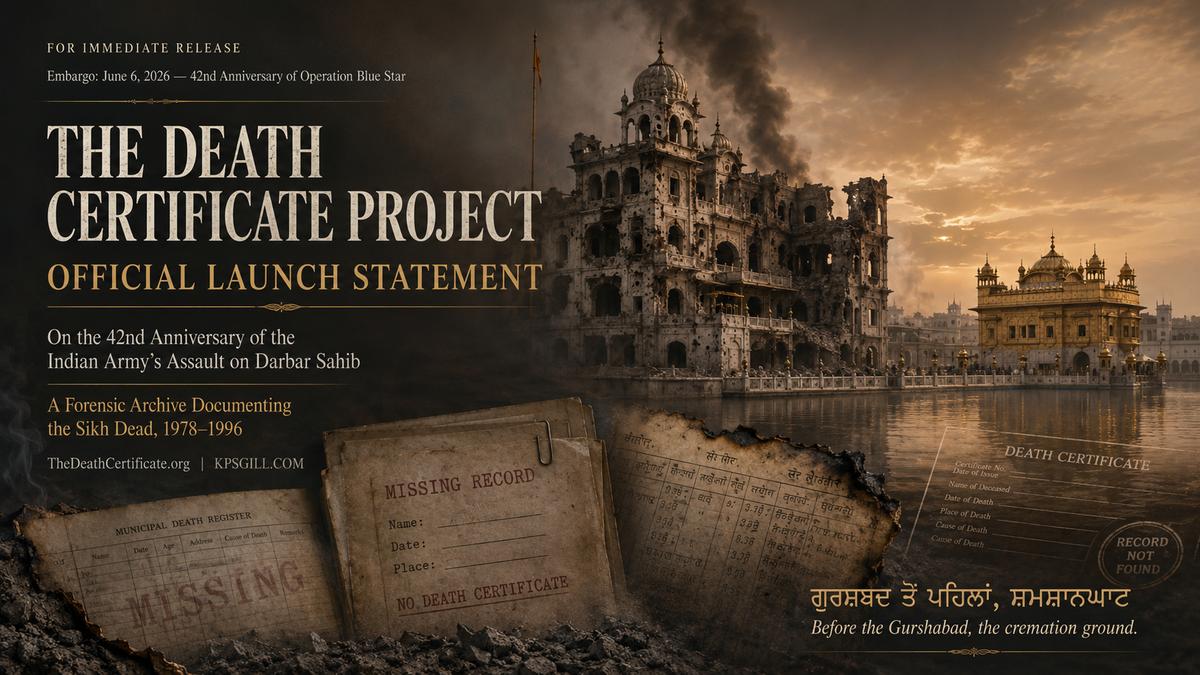
FOR IMMEDIATE RELEASE
Embargo: June 6, 2026 — 42nd Anniversary of Operation Blue Star
Contact: Dr. Kanwar Partap Singh Gill, M.D. |
Platforms: TheDeathCertificate.org | KPSGILL.COM
THE DEATH CERTIFICATE PROJECT: OFFICIAL LAUNCH STATEMENT
On the 42nd Anniversary of the Indian Army’s Assault on Darbar Sahib
A Forensic Archive Documenting More Than a Quarter-Million Sikh Men, Women, and Children Killed by Indian Security Forces, 1978–1996, Publishes Its First Major Series — As the Indian Government Moves to Block the Archive Under Section 69A
FRESNO, CALIFORNIA / AMRITSAR, PUNJAB — June 6, 2026
On this day, forty-two years ago, the Indian Army — acting on the orders of Prime Minister Indira Gandhi and executed on the ground by Chief of Army Staff General Arun Shridhar Vaidya and Western Army Commander Lieutenant General Krishnaswamy Sundarji — breached the perimeter of Darbar Sahib, the holiest complex in the Sikh faith, and subjected the Akal Takht — the Throne of the Timeless One, the five-centuries-old seat of Sikh temporal sovereignty — to a direct military assault that included, by the documented testimony of survivors and the subsequent investigation of foreign intelligence services, more than eighty main gun rounds fired at a structure that Sikh civilization regards as coequal in sanctity to the Golden Temple itself.
The Akal Takht was reduced to rubble.
The men, women, pilgrims, scholars, and worshippers inside the complex — including thousands who had come to Amritsar for the Gurpurab of Guru Arjan Dev Ji, the fifth Guru who was the first Sikh martyr — were killed, wounded, or trapped inside a military cordon that lasted for days. The official death toll, produced by a government that had simultaneously expelled every foreign journalist from Punjab, cut every telephone line, and imposed a complete information blackout, placed the dead at 493. Independent investigators, survivor testimony, and the subsequently declassified British government records obtained under the Freedom of Information Act have confirmed that the true number was a multiple of the official figure.
The assault on Darbar Sahib on June 5–6, 1984, was not a security operation that went wrong. It was a security operation that produced precisely the outcome its architects required: the physical destruction of the institutional seat of Sikh sovereignty, the killing of the armed defenders and of thousands of unarmed pilgrims alongside them, and the initiation of a twelve-year counterinsurgency campaign that — according to the documented findings of India’s own Central Bureau of Investigation, its own Supreme Court, and its own National Human Rights Commission — ultimately consumed the lives of more than 250,000 Sikh men, women, and children across Punjab between 1978 and 1996.
On this anniversary, The Death Certificate Project announces its official launch.
THE PROJECT
TheDeathCertificate.org is a forensic accountability archive published under First Amendment protections in the United States by Dr. Kanwar Partap Singh Gill, M.D., a board-certified family medicine physician practicing in Fresno, California, and a native of Amritsar. The Project operates in conjunction with KPSGILL.COM, a long-form First Amendment forensic publication covering state violence, administrative accountability, and Sikh civilizational memory.
The governing editorial principle of the archive is expressed in its Punjabi title phrase:
ਗੁਰਸ਼ਬਦ ਤੋਂ ਪਹਿਲਾਂ, ਸ਼ਮਸ਼ਾਨਘਾਟ
Before the Gurshabad, the cremation ground.
Before the Word could rise, the fire was already burning. Before the recitation, the ash. Before the argument about what happened in Punjab, the demand: go to the cremation ground first. Account for the dead before you account for yourself.
The archive begins not with ideology, but with a register. Somewhere in the administrative record of Amritsar District — a record that a single private Sikh citizen named Jaswant Singh Khalra found in the cremation-ground logs of three municipal burning sites in 1994 and 1995, and for which he was subsequently abducted, held for forty-nine days in unacknowledged police custody, murdered, and his own body disappeared — are the entries documenting more than two thousand human beings cremated without names, without families, without death certificates, and without the inquest that Indian law unconditionally required.
That missing death certificate is the title and the thesis of this archive.
THE SCALE OF WHAT IS DOCUMENTED
The Death Certificate Project takes as its foundational evidentiary basis the full forensic record of the Sikh genocide as it unfolded from the Nirankari massacre of Baisakhi 1978 through the peak counterinsurgency years concluding in 1996:
The Central Bureau of Investigation, acting under the direct supervision of the Supreme Court of India in proceedings arising from the habeas corpus petition filed by Paramjit Kaur Khalra following her husband’s abduction, confirmed 2,097 illegal cremations in Amritsar District alone — across the cremation grounds at Patti, Tarn Taran, and Durgiana Mandir. Of these, 585 were fully identified, 274 were partially identified, and 1,238 were entirely unidentified: cremated without a name, without a family notification, without a lawfully required inquest.
The Supreme Court of India described these findings as representing a “flagrant violation of human rights on a mass scale.”
The CBI-confirmed figure of 2,097 is the floor, not the ceiling. It covers three cremation grounds in one district across one portion of the counterinsurgency period. It does not account for illegal cremations in the dozens of other districts where the Punjab counterinsurgency apparatus operated simultaneously.
The total accounting, as documented in the scholarly record including the landmark study The Politics of Genocide, places the number of Sikh men, women, and children killed by Indian security forces — through extrajudicial execution, enforced disappearance, custodial torture, fake encounters, and organized state violence — at more than 250,000 persons across the period 1978–1996. This figure encompasses the Nirankari massacre of 1978, the Operation Blue Star assault of June 1984, the anti-Sikh pogrom of November 1984, Operation Wood Rose and its rural Punjab sweep, the industrial-scale illegal cremation campaign of the counterinsurgency years, and the systematic targeting of Sikh community leadership, human rights defenders, journalists, and religious figures through the network of covert auxiliary killing squads — the Black Cats and the Alam Sena — that operated in Amritsar and across Punjab under the supervision of the Punjab Police command structure.
These dead do not have death certificates.
This archive is the death certificate they were denied.
THE PERPETRATORS AND THE ARCHITECTURE OF COMMAND
The Death Certificate Project is not a general history of Punjabi grievance. It is a forensic administrative indictment of specific institutions and identifiable individuals who held specific statutory offices and exercised — or deliberately failed to exercise — specific legal powers.
Operation Blue Star was not an accident of history. It was authorized by Prime Minister Indira Gandhi, scion of the Kashmiri Brahmin Nehru family, whose administration had spent months manipulating, prolonging, and ultimately refusing to resolve the Sikh political grievances articulated in the Anandpur Sahib Resolution — a constitutional document demanding the same federal autonomy that India’s every other major linguistic and cultural community had received. It was planned and commanded by Chief of Army Staff General Arun Shridhar Vaidya and executed on the ground by Lieutenant General Krishnaswamy Sundarji of Western Army Command. Both officers subsequently received the highest military honors India could confer. General Vaidya was assassinated in 1986 by Sikh militants in Pune. General Sundarji became Chief of Army Staff.
The military chain of command for Operation Blue Star is a matter of institutional record. What this archive documents with equal forensic seriousness is the civilian chain of command that enabled the twelve-year counterinsurgency killing machine that followed Blue Star’s first shot.
That civilian chain runs through the office of the Deputy Commissioner and District Magistrate of Amritsar — the most powerful civilian office in the district where the majority of the 2,097 confirmed illegal cremations took place:
- Ramesh Inder Singh, IAS — DC Amritsar, June 1984–1987. His tenure established the administrative template: no Section 58 warrantless arrest reports demanded from the counterinsurgency apparatus; no Section 174 death reports received from the cremation grounds; no Section 176(1) magisterial inquiries into police-connected deaths. He was subsequently awarded the Padma Shri, India’s fourth-highest civilian honor. He has received, to this date, the Padma Shri for the period during which the counterinsurgency killing template was institutionalized in his district.
- Sarabjit Singh, IAS — DC Amritsar, 1987–1992. His tenure coincided with Operation Black Thunder, the peak industrial-scale illegal cremation period, and the accumulation of the majority of the CBI-confirmed entries at Patti, Tarn Taran, and Durgiana Mandir. He, too, was awarded the Padma Shri — after the CBI had confirmed 2,097 illegal cremations covering his tenure. No departmental inquiry was ever initiated into his exercise of statutory oversight powers.
- Karan Bir Singh Sidhu, IAS — DC Amritsar, May 1992–August 1996. His tenure encompasses the period of Jaswant Singh Khalra’s investigation, abduction, forty-nine-day unacknowledged detention, murder, and body disposal. Sidhu has admitted in his own published writings that he received information about Khalra’s abduction and “marked an inquiry.” The inquiry file has never been produced. He was subsequently elevated to Special Chief Secretary of Punjab. He maintains an active Substack newsletter of more than one thousand articles on governance, diplomacy, and the philosophy of public service. Not one of those articles has produced the ADM inquiry file for the Khalra abduction. Not one has named the 1,238 entirely unidentified persons cremated in his district without a death certificate.
This archive has named them. It is waiting for him to do the same.
THE INAUGURAL PUBLICATION SERIES
Launched across June 5–6, 2026 — the forty-second anniversary of the night the Indian Army entered Darbar Sahib — The Death Certificate Project has published the following inaugural series at TheDeathCertificate.org:
Punjab ’95 Forensic Series — On the Amritsar DC Record:
- “The Civil Signature of Impunity” — The administrative architecture of the Punjab disappearances: how the civilian DC office enabled the killing machine through systematic statutory non-compliance across three consecutive tenures. A forensic reconstruction of the Triad of Amritsar.
- “The Van Without a Log” — Operation Blue Star, the district administration’s unproved warning narrative, and the birth of Amritsar’s paperless death regime. The administrative template that made the subsequent decade possible.
- “The Van Without a Log: A Real-Time Cross-Examination of Ramesh Inder Singh” — A structured adversarial examination of the DC’s published account of the Blue Star period, conducted as if in open court, using his own statements as prosecution exhibits.
- “The Audit of the Silent Pen” — Section 174 and Section 176 of the Code of Criminal Procedure, and the engineered collapse of the Amritsar magisterial ledger, 1984–1996. The statutory duties that were never performed.
- “The Open Ledger” — The records the State was bound to create, the archive of their absence, and the Right to Information as the instrument that will not let the question close.
- “The Unbroken Line” — Three District Magistrates, twelve years, zero inquests. The institutional continuity of administrative dereliction and the foreclosure of the single-officer defense.
- “The Absent Defense” — K.B.S. Sidhu’s announced inquiry and the forty-nine days of Jaswant Singh Khalra. The document that would exonerate him, if it existed.
- “The Durgiana Discrepancy” — The May 1996 Prime Ministerial visit, the flawless administrative machine it activated overnight, and the cremation ground at the same gate that the same administration would not see.
- “The Rewarded Silence of the Cadre” — The Manchester exit: how the Indian state certifies its administrators clean through study leave, cadre reviews, and foreign degrees.
- “The Chronicle of the Out-Published History” — Ex post facto containment: the selective archive of a prolific administrator and the one jurisdiction his pen will not enter.
Punjab ’95 Forensic Series — The KBS Sidhu Cross-Examination (Ten Articles):
- “The Man Who Wrote the Manual” — Sidhu’s 1989 treatise on the Sub-Divisional Magistrate, his magisterial authority in Amritsar, and the impossibility of administrative ignorance.
- “The Batala Laboratory” — The Police District of Batala, 1988–1990, the civil magistracy of counterinsurgency, and the posting Sidhu claims but his service record does not show.
- “The ADC Was Not a Tourist” — Sidhu’s 1990–1992 Amritsar posting, development administration under terror, and the files a second-in-command could not avoid.
- “The File Appears When the Victim Is an Aircraft” — Sidhu’s 1993 hijacking record, the Prime Minister’s Commendation, and the administrative contrast with Jaswant Singh Khalra.
- “The SPO Doctrine Returns to Its Author” — Sidhu’s Salwa Judum writing, the magistrate’s power to appoint Special Police Officers, and the civil signature behind deniable force.
- “Article 21 for Everyone Except the Disappeared” — Sidhu’s due-process writing on the NSA, UAPA, and preventive detention, and the Sikh men whose custody ended in fire.
- “The Count at the End of the Shabad” — Sikh scriptural numeracy, Sidhu’s theology of the Guru Granth Sahib’s self-auditing integrity, and the state’s refusal to count the dead.
- “Satkar After Death” — Sidhu’s constitutional defense of reverence for Sri Guru Granth Sahib Ji, the legal dignity of the human body, and the Sikh dead cremated without name.
- “Guru Ki Nagri, Governed Like a Security Zone” — Sidhu’s Galliara Project, the administrative conversion of sacred geography, and the death map that was never made.
- “The Sarbat da Bhala Affidavit” — A public cross-examination of Sidhu’s Sikh governance claims, civil-service ethics, and missing administrative record, 1989–1996.
Major Long-Form Forensic Articles:
- “The People Against Silence” — A 467-question comprehensive forensic cross-examination of K.B.S. Sidhu, IAS, Deputy Commissioner and District Magistrate of Amritsar, May 1992–August 1996. The full prosecution record.
- “The Ashes He Did Not Count” — A forensic response to Sidhu’s Substack essay “From the Ashes, a People Rises.” On the dead of Amritsar a District Magistrate did not record and the reckoning that excludes itself.
- “I Am Anokh Singh” — A first-person shahid-naama of Bhai Anokh Singh Babbar, martyred in Amritsar District on August 30, 1987. Reconstructed from primary community testimony, the Khalsaspirit.com memorial record, Panthic sources, and the forensic pattern. A witness account in the voice of the disappeared.
- “The Instrument Within” — A forensic history of contested loyalty, institutional failure, and the limits of betrayal in the post-Guru Sikh world, 1708–2026. Six centuries of the architecture of managed impunity, from the Udasis to the present.
THE CENTRAL FINDING: WHERE ARE THE DEATH CERTIFICATES?
The question at the center of this archive is not rhetorical. It is a statutory demand. Under Section 174 of the Code of Criminal Procedure, a police officer who learns of a suspicious, unnatural, or custodial death is required to file an injury report. Under Section 176, the District Magistrate is required to hold an inquiry. Under ordinary civil registration law, a death certificate is required before a body can be lawfully cremated. Under every relevant provision of the legal framework that governed Amritsar District from 1984 to 1996, the 2,097 confirmed illegal cremations required 2,097 death certificates, 2,097 magisterial inquest records, and 2,097 family notifications.
None of these records exist. Not one inquest. Not one death certificate for the 1,238 entirely unidentified persons. Not one Section 97 search warrant issued by the DC’s office for the thousands of families who reported missing relatives to district authorities. Not one Section 58 arrest report filed by the counterinsurgency apparatus with the magistracy.
The archive that does not exist is the evidence. The missing paperwork is the indictment. The office that held the statutory pen and chose not to write is the defendant.
The Death Certificate Project has produced, across its inaugural series, more than 350,000 words of forensic documentation organized around this central statutory demand. It has applied a four-tier evidentiary framework that distinguishes rigorously between:
- [PF] Proved Findings — facts established by official records, judicial findings, CBI reports, and Supreme Court findings;
- [DA] Documented Allegations — serious claims grounded in identifiable sources but not conclusively adjudicated;
- [AI] Analytical Inferences — reasoned conclusions drawn from patterns, omissions, timing, and the cumulative structure of the institutional record;
- [PM] Panthic Memory — the civilizational memory, witness testimony, and moral record preserved by Sikh families, institutions, and community historians.
No claim in this archive conflates these categories. No proved finding is dressed as mere allegation. No allegation is inflated to proved fact. The standards applied here are the standards that Karan Bir Singh Sidhu applies to the New York Times when it misspells a four-letter acronym. They are the standards that this archive applies to the record of every District Magistrate who presided over a cremation ground that received police-brought bodies and never once asked where they came from.
THE SECTION 69A BLOCKING PROCEEDING
In April 2026, the Ministry of Electronics and Information Technology of the Government of India issued a Section 69A notification under the Information Technology Act, 2000, targeting KPSGILL.COM — the companion publication to TheDeathCertificate.org — in proceedings identified as Request ID 69A/2026/MIT/11078. Section 69A permits the Indian government to direct the blocking of online content determined to be prejudicial to national security, sovereignty, or public order.
A 73-page written submission was filed with MeitY on April 29, 2026, contesting the notification on the following grounds: that KPSGILL.COM is a United States-based publication operating under the full protections of the First Amendment to the United States Constitution; that the content at issue consists entirely of forensic history grounded in CBI-confirmed findings, Supreme Court rulings, and NHRC proceedings; that the Section 69A notification procedure has not met the due process standards required by the Supreme Court of India’s judgment in Shreya Singhal v. Union of India; and that the use of Section 69A to suppress historical documentation of state-organized atrocity is itself a violation of international human rights law.
Platform non-interference notices were issued to Google LLC and Squarespace. Both publications continue to operate under U.S. First Amendment protections.
The Section 69A notification targeting this archive is itself an exhibit in this archive. A government that moves to suppress documentation of crimes its own CBI has confirmed and its own Supreme Court has adjudicated is not engaged in national security governance. It is engaged in evidence management. The Death Certificate Project treats it accordingly: as one more item in the administrative record of an institution that prefers the archive to remain closed.
The archive will not be closed.
ON THE PERPETRATORS AND THE MORAL RECORD
The Death Certificate Project does not deal in anonymous systems or faceless states. It deals in identifiable individuals who held identifiable offices with identifiable statutory powers and made identifiable choices that had identifiable consequences for identifiable human beings who are still waiting, thirty years later, for a death certificate.
The commanders of Operation Blue Star are named. The political authority that ordered the assault is named. The Army Chief who planned it is named. The General who executed it on the ground is named.
The District Magistrates who presided over twelve years of administrative silence while 2,097 confirmed illegal cremations accumulated in their district are named.
The officers convicted for Khalra’s murder are named.
The IAS officers who were decorated — Padma Shri, Special Chief Secretary — for tenures that encompassed the confirmed illegal cremation record are named.
This is not a polemical choice. It is a forensic one. Administrative accountability requires individuals. A system cannot be held to account. A statutory office can. A specific officer who held a specific statutory power and chose not to exercise it in a specific documented context has a specific name. The Death Certificate Project will publish that name, attached to that record, for as long as the archive operates.
The 1,238 entirely unidentified persons cremated in Amritsar District without a name deserve, at minimum, to be surrounded by the named individuals who held the statutory power to prevent their anonymous incineration and chose not to exercise it.
ON THE 42ND ANNIVERSARY
Forty-two years ago today, an Indian Army column entered Darbar Sahib. The soldiers who crossed that threshold were acting on orders that traced from a Prime Minister’s office in Delhi through a military chain of command to the ground commanders at the gates of the holiest Sikh shrine. They were acting within a system — legal, political, administrative, military — that had calibrated every mechanism of accountability to the requirements of what was about to happen. The press was already expelled. The phone lines were already cut. The journalists were already under curfew. The District Magistrate’s oversight was already set to silence.
The operation was not improvised. The silence that surrounded it was not improvised. And the twelve-year administrative apparatus that processed the consequences of that silence — the unidentified bodies, the unofficial cremations, the missing death certificates — was not improvised either. It was a system. It had a design. It had designers. And it operated, without interruption, across three consecutive civilian administrations of a single district, leaving behind a confirmed evidentiary record that the Indian state has spent thirty years attempting to administratively contain and now, in 2026, is attempting to suppress through the digital blocking mechanism of Section 69A.
The fire at Darbar Sahib on June 5–6, 1984, was the first fire. The fires at Patti, Tarn Taran, and Durgiana Mandir — the cremation grounds where 2,097 confirmed human beings were burned without names, without families, and without the piece of paper that Indian law required — were the administrative continuation of the same fire. And the Section 69A notification targeting this archive is the bureaucratic continuation of the same impulse: suppress the record, manage the archive, keep the question closed.
ਗੁਰਸ਼ਬਦ ਤੋਂ ਪਹਿਲਾਂ, ਬੇਨਾਮ ਲਾਸ਼ਾਂ ਸਨ.
Before the Gurshabad, there were the nameless dead.
The archive begins where the state wanted the story to end: at the ash.
ABOUT THE DEATH CERTIFICATE PROJECT
TheDeathCertificate.org is a forensic First Amendment publication dedicated to the documentary reconstruction of the Sikh genocide of 1978–1996, with specific focus on the administrative accountability of the Deputy Commissioner / District Magistrate of Amritsar across the counterinsurgency period. The Project was founded by Dr. Kanwar Partap Singh Gill, M.D., a board-certified family medicine physician, native of Amritsar, and forensic historical writer practicing in Fresno, California.
The Project applies a four-tier evidentiary framework distinguishing Proved Findings, Documented Allegations, Analytical Inferences, and Panthic Memory in all published analysis. Every factual claim is attributed to a specific evidentiary tier. The Project publishes in both English and Punjabi.
KPSGILL.COM is the companion First Amendment forensic accountability publication, covering state violence, censorship, administrative accountability, and Sikh civilizational memory. Both platforms are hosted in the United States and operate under the full protections of the First Amendment to the U.S. Constitution.
The Project is currently contesting a Section 69A blocking notification issued by the Government of India (Request ID 69A/2026/MIT/11078) through a 73-page formal submission filed April 29, 2026.
ABOUT THE PUBLISHER
Dr. Kanwar Partap Singh Gill, M.D. is a board-certified family medicine physician practicing in Fresno, California. He was born in Amritsar in 1977, educated at Spring Dale School and Khalsa College, Amritsar, and completed medical training at the University of Arkansas for Medical Sciences. He is a native of the Majha region (Khadoor Sahib roots) and maintains direct personal, documentary, and evidentiary connections to the Punjab counterinsurgency period. He publishes forensic historical, legal, and accountability journalism at KPSGILL.COM and TheDeathCertificate.org. He is not affiliated with, and should not be confused with, the late Punjab Director General of Police Kanwar Pal Singh Gill (1934–2017), who is a named subject of forensic accountability analysis on both platforms.
PRESS AND MEDIA INQUIRIES
Email: Media@TheDeathCertificate.org
Web: TheDeathCertificate.org | KPSGILL.COM
YouTube: @DeathCertificateProject
Facebook: The Death Certificate Project
This publication is protected by the First Amendment to the United States Constitution. Reproduction for journalistic, academic, and advocacy purposes is encouraged with attribution.
###
The Death Certificate Project | TheDeathCertificate.org
ਗੁਰਸ਼ਬਦ ਤੋਂ ਪਹਿਲਾਂ, ਸ਼ਮਸ਼ਾਨਘਾਟ — Before the Gurshabad, the cremation ground.