THE ARCHIVE IS THE ANSWER

The About Page On the Noise That Does Not Move Us, the History We Must Write Ourselves, and the Civilization That Was Always More Than Anyone Else's Army
A Founding Declaration for The Death Certificate
thedeathcertificate.org · 2026
I. WHAT THE NOISE IS, AND WHY IT DOES NOT MOVE US
There is a season that returns without calendar. Anyone who has watched the information environment around Sikh history long enough knows its rhythm. A politician speaks. An advocacy organization releases a law-enforcement brief. A television anchor discovers Punjab. A government ministry serves a blocking order on an archive. A diplomatic communiqué references "Khalistani extremism." A think tank produces a report that treats a community's memory of state violence as a security threat to be managed. A commentator — retired, decorated, fluent in the vocabulary of constitutional governance — writes eleven hundred Substack essays about administrative wisdom without once writing the name Jaswant Singh Khalra.
Each of these events arrives as noise. And noise, if one does not have a method, can feel like weather: ambient, total, without direction or authorship. It arrives from everywhere and nowhere simultaneously. It carries the weight of institutional legitimacy — government insignia, academic affiliation, diplomatic language, the cadence of authoritative prose — and it deposits, through sheer accumulation, a sedimentation of framing that the next generation of Sikh children will have to excavate if they wish to understand what happened to their grandparents in Punjab between 1984 and 1995.
This publication was not built to respond to the noise. It was built to make the noise irrelevant by producing, in forensic detail and with evidentiary discipline, the record that the noise was designed to prevent from being built.
That distinction is not semantic. It is strategic. A publication that responds to the noise is organized around the noise's agenda. Its attention follows the noise's sequence: one week it is the Hindu American Foundation (HAF) law-enforcement brief, the next week it is the South Asian Terrorism Portal (SATP) database's omissions, the next week it is the Section 69A blocking order, the next week it is the retried demand that a biographical film about a murdered human-rights investigator remove that investigator's name from its title card. Each response is legitimate in isolation. In aggregate, a publication organized around the noise has allowed the noise to become its editorial calendar.
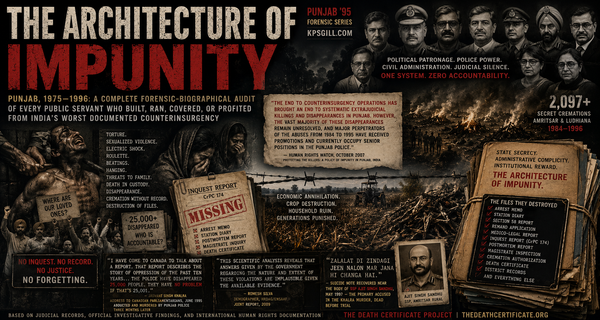
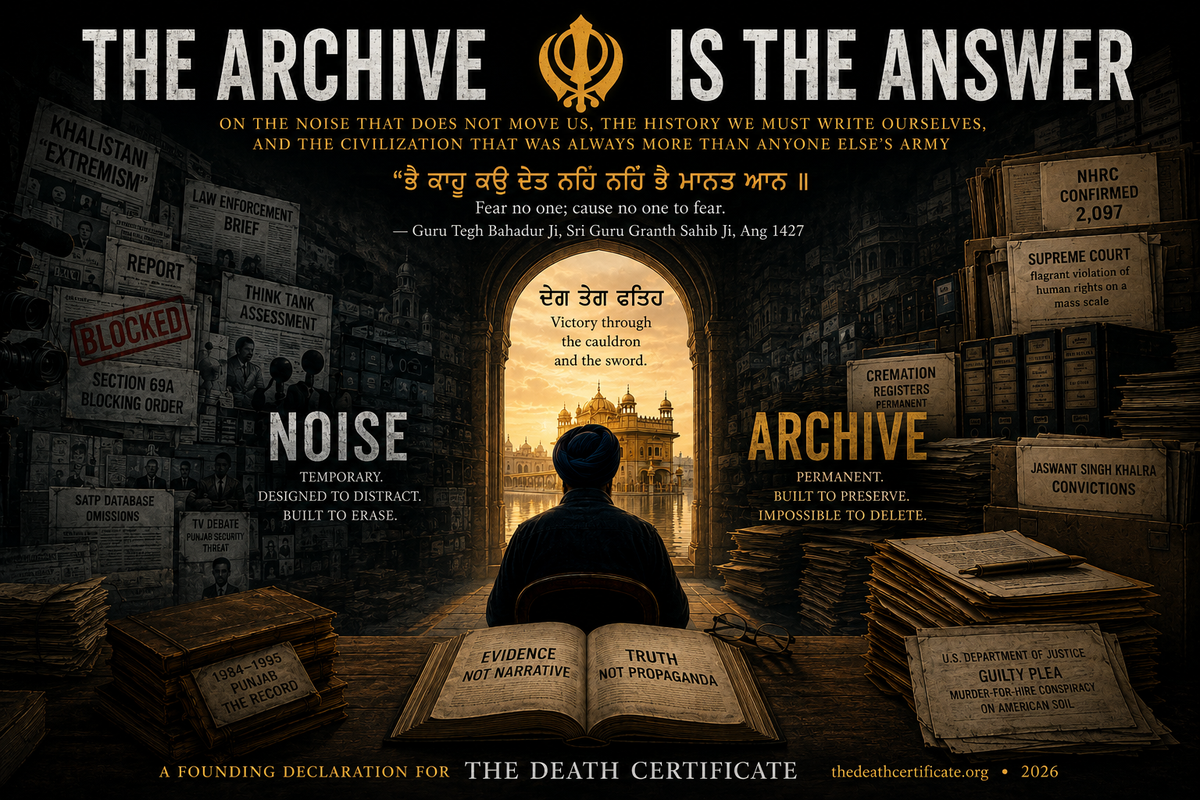
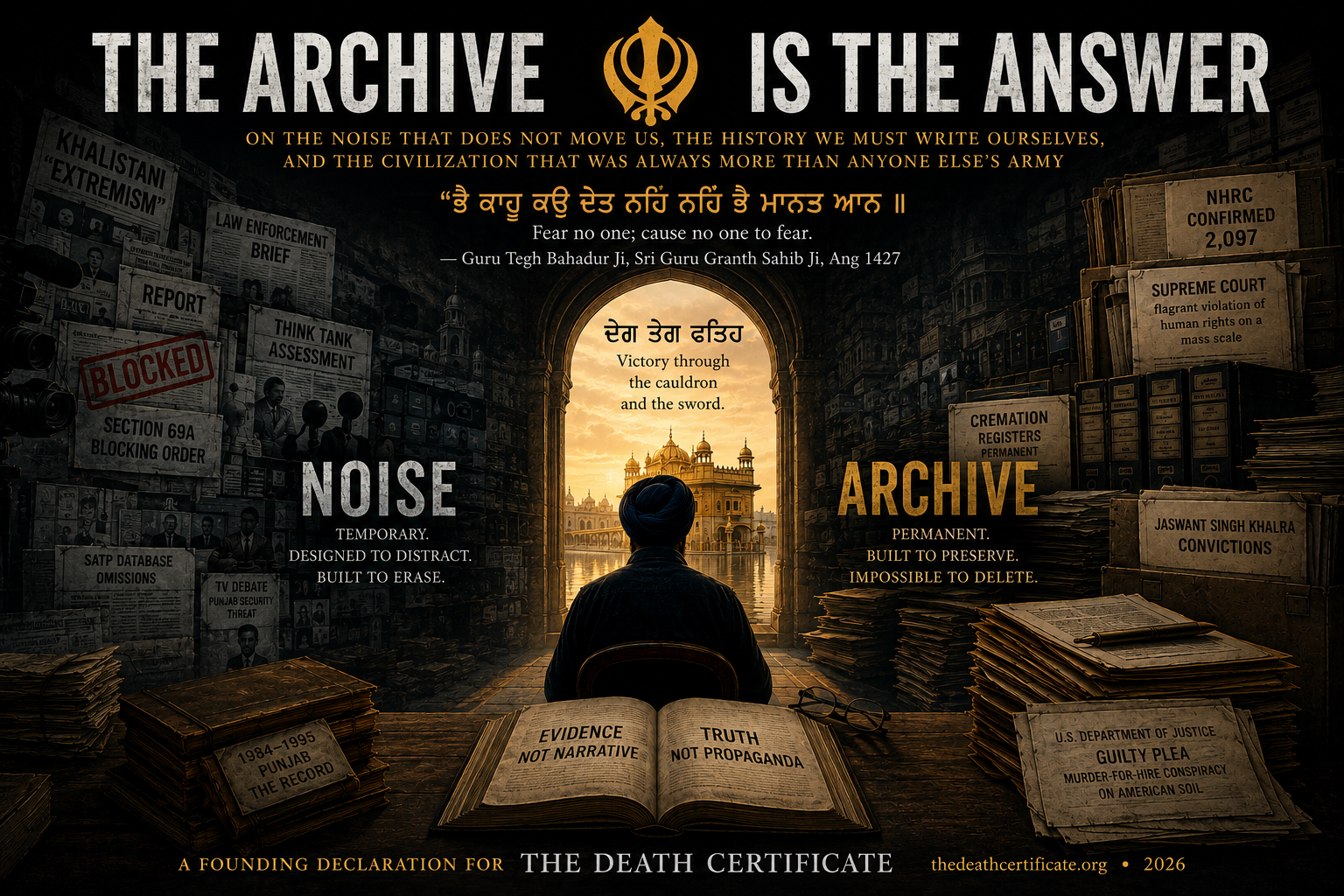
The record — the forensic archive — is not organized around the noise. It is organized around the truth of what happened, sequenced by evidence, graded by evidentiary tier, anchored in primary documentation, and produced with the patience of those who understand that a court of record is built once, carefully, and then stands regardless of what the noise does next. The noise is temporary. The cremation registers are permanent. The NHRC's confirmed 2,097 are permanent. The Supreme Court's characterization of what happened in Amritsar district as a flagrant violation of human rights on a mass scale is permanent. The criminal convictions of Punjab Police personnel for the abduction and murder of Jaswant Singh Khalra are permanent. The US Department of Justice's confirmed guilty plea in a murder-for-hire conspiracy targeting an American Sikh attorney on American soil is permanent.
This archive does not need to respond to the noise. The archive simply needs to exist, to be built to the standard that makes dismissal structurally impossible, and to be published from a jurisdiction — Fresno, California, under the First Amendment of the United States Constitution — where no government committee can reach the delete key.
The noise does not move us. The archive does not ask the noise's permission. These two propositions are the foundational editorial commitments of The Death Certificate, and they explain everything that follows.
II. THE SANT-SIPAHI AND THE CIVILIZATION THAT WAS NEVER ONLY A SWORD
"ਦੇਗ ਤੇਗ ਫ਼ਤਿਹ" Victory through the cauldron and the sword. — Sikh invocation; liturgical tradition
The greatest institutional injury done to the Sikh tradition by those who have managed its public representation — from the colonial ethnographers who invented the "martial race" taxonomy to the Indian nationalist architects who embedded the Khalsa inside the Hindu civilizational frame — is not political suppression. Political suppression is visible, generates martyrs, and is eventually countered by the tradition's own internal resources. The deeper injury is conceptual: the systematic reduction of a complete and sovereign civilization to a single attributed function.
Langri. Watchman. Soldier.
The Sikh as cook of the imperial langar at the Mughal court. The Sikh as guard of India's northern borders. The Sikh as the loyal warrior of other people's armies and other people's nations and other people's sovereignty projects. The Sikh as the man who feeds everyone else and guards everyone else while someone else writes the history, someone else runs the capital, someone else issues the edicts, and someone else defines what it means to be civilized in the subcontinent.
This is the conceptual cage. It was built across centuries, and it was built with genuine material incentives: the Khalsa was formidable, and formidable military capacity in the service of other states is rewarded with the honors and the pensions and the regimental flags that make a community believe its subordination is actually recognition. But the cage is a cage regardless of how gilded its bars. And the Sikh civilization, which was constituted on April 13, 1699, at Anandpur Sahib, in the most radical act of human social reconstitution in the history of the subcontinent, was never only a sword.
The Sant-Sipahi is the concept that contains the full civilization, and it is the concept that every reduction of Sikh identity to martial utility is designed to displace. Sant and Sipahi are not two separate functions assigned to two separate categories of person. They are two aspects of a single integrated identity — a unity expressed precisely in the hyphen between the two words, which is not a conjunction but a compression. The saint who is not willing to defend truth is a saint who has made peace with injustice. The soldier who is not grounded in spiritual discipline is a soldier who is available for whoever pays the next contract. The Sant-Sipahi is neither the saint who permits cruelty through quietism nor the soldier who serves whoever deploys him. The Sant-Sipahi serves the Guru's mandate. The Guru's mandate is truth, justice, and the defense of the weak — not the interests of any empire, dynasty, nation-state, or political management apparatus that happens to find the Khalsa's military capacity convenient.
Guru Hargobind Sahib Ji sat in the Akal Takht wearing two swords. That image is the complete constitutional document of the Sikh world. Miri — temporal authority, the sovereignty of this world, the right and the duty to act in the realm of human power, justice, and governance. Piri — spiritual authority, the sovereignty of conscience, the grounding of all action in the Guru's teaching. The two swords do not represent a balance between two separate concerns. They represent the inseparability of the two: the Sikh tradition's foundational insistence that spiritual authority without political accountability is quietism, and political action without spiritual grounding is aggression. The Sant-Sipahi is the person in whom these two cannot be separated because the Guru has fused them at the level of identity.
That fusion is what the "langri and watchman" reduction is designed to undo. Split the spiritual from the temporal: let the Sikh be the pious soldier of someone else's state. Split the martial from the sovereign: let the Khalsa guard the border but not govern it. Split the communal from the political: let the sangat assemble for kirtan but not for Sarbat Khalsa. Each of these splits is an attack on the Sant-Sipahi unity, and each is a specific historical event, not a vague cultural tendency. The "martial race" taxonomy of the British colonial administration was a political instrument: it identified the Sikh as useful for military service while embedding that usefulness in an imperial frame that required the Sikh's own sovereignty claims to remain perpetually subordinate. The Article 25 constitutional subsumption of the Sikh community under the Hindu legal category was a specific legal act: it took the "Hum Hindu Naheen" that six centuries of Khalsa identity had maintained and converted it, through the mechanism of democratic majorities in a constituent assembly, into a legal fiction. The SGPC's statutory architecture, designed as a rescue from mahant capture, became under decades of dynastic political capture the mechanism by which the Akal Takht's sovereign authority was made dependent on the political calculations of whoever controlled the committee's electoral machinery.
Each of these is an attack on the Sant-Sipahi. Each is an attempt to separate what the Guru fused. And the response to each, in the tradition this archive serves, is not complaint or lamentation or the politics of victimhood. The response is the sovereign re-assertion of the fusion: the intellectual warrior, the forensic saint, the archive as sword.
III. THE SIKH WRITES HIS OWN HISTORY NOW
"ਸਚਹੁ ਓਰੈ ਸਭੁ ਕੋ ਉਪਰਿ ਸਚੁ ਆਚਾਰੁ ॥" Truth is higher than everything; but higher still is truthful living. — Guru Nanak Dev Ji, Sri Guru Granth Sahib Ji, Ang 62
The Sikh civilization has always produced writers. What it has sometimes failed to produce is a self-sustaining Sikh institution of forensic historical authorship — an archive built by Sikhs, grounded in Sikh epistemological commitments, protected by Sikh institutional sovereignty, and immune to the various mechanisms by which other parties have historically taken control of the narrative of what happened to the Sikhs.
This is not an accusation against the tradition's intellectual life. The tradition's intellectual life has been extraordinary: from Bhai Gurdas's foundational exegesis of the Guru Granth Sahib to Bhai Kahn Singh Nabha's Ham Hindu Nahin and his encyclopaedic Mahan Kosh, from Bhai Vir Singh's literary reconstruction of Sikh modern consciousness to the scholarly tradition that has produced, in the diaspora and in Punjab both, some of the most rigorous historical and theological analysis of any religious tradition in South Asia. The intellectual resources were always there. What was periodically captured, managed, and redirected was the institution through which those resources became public knowledge — the gurdwara, the SGPC, the university, the publishing house, the film certification board, the national textbook.
The pattern this archive has documented across its various series is consistent and structural: Sikh intellectual production, when it remains within institutions that the state controls or can influence, is available for management. The textbook that documents Punjab's history can have its most consequential pages removed by a rationalization committee that does not publish the names of its members. The film about Jaswant Singh Khalra can be required by a certification board to remove Khalra's name from a biography of Khalra. The archive that documents the 2,097 illegal cremations can receive a Section 69A notice from a government that does not identify which specific content meets which specific statutory ground. The Jathedar of the Akal Takht can be removed by the statutory committee his institutional authority is supposed to superintend. Each of these events is a specific instance of the same structural pattern: Sikh intellectual and moral authority, when embedded in institutions the state can reach, is vulnerable to the state's management apparatus.
The response this archive makes to that pattern is not to abandon Sikh institutions. It is to build from outside the reach of the management apparatus. A publication registered in the United States, hosted on American infrastructure, authored by an American citizen, and protected by the First Amendment is not accessible to a Section 69A blocking committee that can only restrict access within Indian territorial borders through Indian internet service providers. The publication continues. The URL can be blocked for Indian users through Indian ISPs. The content cannot be changed, the analysis cannot be altered, the evidentiary framework cannot be revised, and the forensic record cannot be sealed by any administrative action that the Indian state has the authority to take.
That is not defiance for its own sake. It is the specific institutional choice required by the specific vulnerability of Sikh intellectual and historical authorship when it remains within the reach of states that have a documented interest in managing the record of what those states did to the Sikh community. The choice to publish from Fresno under the First Amendment is as structural as Jaswant Singh Khalra's choice to read the municipal cremation registers: it is the choice of the instrument that the institutional management apparatus cannot reach.
And the Sikh who publishes forensic history from outside the apparatus's reach is not doing something historically unprecedented in the Sikh tradition. Guru Gobind Singh Ji wrote the Zafarnama — the Letter of Victory — to Emperor Aurangzeb from a position of material vulnerability and physical displacement, and that letter has outlasted the empire it addressed. Rani Jind Kaur maintained her sovereign claim against British annexation from exile in Nepal and eventually from London, and the tradition has remembered her claim rather than the empire's annexation. The physical location of the archive is not its vulnerability. The quality of its evidence is not its weakness. The reach of the management apparatus is the cage, not the content. And the First Amendment is, for this purpose, not an ideological commitment but an instrumental choice: it is the institutional architecture within which this tradition's forensic historical authorship is currently most fully protected.
The Sikh writes his own history now. Not through institutions the state manages. Not through publication platforms the state can threaten. Not through archives the state can rationalize out of existence. Through the specific evidentiary discipline of a forensic publication that does what Khalra did in the municipal records office: reads the primary documents, follows the numbers, names the offices, publishes the gaps between statutory duty and documented conduct, and stands behind every inference with the label that identifies it as an inference rather than a proved fact.
The archive is the answer to the question of what Sikh authorship of Sikh history looks like in the twenty-first century. It looks like this.
IV. THE PROFESSIONAL SIKH: DOCTOR, LAWYER, TEACHER, WRITER, ACCOUNTANT, POLITICIAN, SAINT
"ਸੋ ਸਿਖੁ ਸਖਾ ਬੰਧਪੁ ਹੈ ਭਾਈ ਜਿ ਗੁਰ ਕੇ ਭਾਣੇ ਵਿਚਿ ਆਵੈ ॥" That person is a Sikh, a friend, a relative and a sibling who walks in the Will of the Guru. — Sri Guru Granth Sahib Ji, Ang 601
One of the most persistent and most damaging misreadings of what the Khalsa is, in contemporary discourse about Sikhs, is the misreading that produces the "langri or watchman" binary as the only available forms of Sikh communal contribution. The Sikh feeds others through the langar — this is genuine, beautiful, and constitutive of Sikh communal identity. The Sikh guards through martial service — this is documented, honored in the tradition's own memory, and embedded in the Sant-Sipahi identity at the level of constitutional doctrine. But the reduction of the Sikh to these two functions, to the exclusion of every other form of contribution that the full Sant-Sipahi civilization makes available, is not a description of the Sikh tradition. It is a description of how other civilizations have preferred to receive Sikh participation: as service without sovereignty, as labor without authority, as presence without authorship.
The Guru Granth Sahib is the most complete statement of what the Sikh human being is constituted to become. It does not describe the Sikh as a cook or a soldier. It describes the Gurmukh — the person turned toward the Guru — as someone whose inner life is organized around the continuous practice of Naam Simran, whose social life is organized around Seva and Sangat, whose economic life is organized around Kirat Karni (honest labor in all its forms), and whose relationship to power is organized around the principle that no temporal authority holds sovereignty over the conscience of the Khalsa. The Gurmukh can be a farmer, a banker, a physician, a lawyer, a teacher, a writer, a scholar, an engineer, a civil servant, a musician, a politician, or a trader. The Gurmukh's occupation is not prescribed by caste, because the entire point of the Khalsa's constitution is the dissolution of caste as a determinant of human possibility. The Gurmukh's relationship to the Guru does not depend on the occupation. It depends on the inner orientation from which the occupation is practiced.
This is not a merely theological observation. It is a structural argument about the full range of Sikh contribution to any community the Sikh inhabits — in Punjab, in the diaspora, in the republic of India, in the constitutional order of the United States, in every country and every professional field where Sikh men and women have built lives. The Sikh physician brings to her practice of medicine the same orientation that the Sikh warrior brings to battle: a grounding in service rather than aggression, a commitment to the defense of the weak (in medicine, the patient; in warfare, the community), and an understanding that the highest form of professional excellence is the form that is offered in the spirit of Seva rather than in the spirit of personal advancement. The Sikh teacher brings the same orientation to the classroom: not the transmission of information as a commercial transaction, but the transmission of truth as a form of communal service. The Sikh lawyer, the Sikh accountant, the Sikh politician, the Sikh journalist — each carries the Sant-Sipahi fusion into the specific domain of their professional practice, and each produces from that fusion a form of professional excellence that is distinct from the excellence produced by purely instrumental professional motivation.
That distinction matters in every professional domain, but it matters most acutely in the domain of historical writing. A Sikh who writes forensic history is not simply a historian. A Sikh who writes forensic history is a Sant-Sipahi of the archive: grounded in the Guru's mandate of truth-telling, armed with the specific weapons of evidentiary discipline and methodological rigor, and committed to the defense of the weak — in this case, the 2,097 people cremated without names in three Amritsar district grounds, whose families are still waiting for the accounting that the statutory apparatus of the Indian state has declined to produce at the command level. The forensic archive is not merely scholarship. It is Seva in its forensic form: the offering of a life's most rigorous and sustained intellectual work to the project of restoring dignity and truth to those the state converted into administrative entries.
And the physician who practices medicine in Fresno, California, and simultaneously publishes forensic history about the state that killed Jaswant Singh Khalra, is not experiencing a contradiction between professional identity and Sikh identity. He is living the Sant-Sipahi unity in its fullest available contemporary form: healing bodies in the clinic, healing the historical record in the archive. The two activities are organized by the same Guru's mandate. They draw on the same inner orientation. They serve the same civilizational project.
This is what the Sikh civilization makes available to every Sikh in every professional domain: the possibility of practicing any human skill with the Sant-Sipahi's integration of service and sovereignty, of excellence and conscience, of technical mastery and spiritual grounding. The Sikh does not become less Sikh by becoming a doctor. The Sikh does not become less Sikh by becoming a lawyer, or a teacher, or a civil servant, or a writer. The Sikh becomes more completely Sikh by bringing the Guru's teaching into every domain of professional and intellectual life — by refusing the separation of the spiritual from the temporal that every absorptive project has historically required, and by insisting instead on the Sant-Sipahi unity in whatever field the Guru's Will has placed them.
The Sikh who feeds others is doing Seva in the langar. The Sikh who guards others is doing Seva in the uniform. The Sikh who heals others is doing Seva in the clinic. The Sikh who writes the forensic history that the state has declined to write — the history that names the offices, documents the statutory duties, and fills in the evidentiary record where the management apparatus has left administrative silence — is doing Seva in the archive. All of these forms of service are expressed by the same Sant-Sipahi fusion. None of them is more or less Sikh than the others.
V. THE GURU GRANTH SAHIB AND THE PROFESSIONAL WORLD: THE SEPARATION THAT DOES NOT EXIST
"ਗੁਰ ਮੰਤ੍ਰੁ ਹਿਰਦੈ ਜਿਸੁ ਲਾਗੋ ਤਿਸੁ ਜਨ ਐਸੀ ਬਣਤ ਬਣਾਈ ॥" That person in whose heart the Guru's Mantra has been enshrined — that humble being is fashioned in such a way. — Sri Guru Granth Sahib Ji, Ang 805
The modernist project — whether in its colonial British form or its post-Independence Indian form — has required of Sikh professionals a specific internal partition: be fully Sikh in the private domain of family and gurdwara, and be fully secular in the public domain of professional practice and civic participation. Wear the turban because it is your personal religious expression, but leave your Sikh political theology at the gurdwara door when you enter the office building, the hospital, the court, the parliament. Your faith is a private matter. Your professional conduct is a public one. The two must not cross.
This partition is structurally identical to the partition between spiritual and temporal that the Miri-Piri doctrine refuses, and it is demanded with particular urgency of Sikh professionals precisely because the Sikh political theology — the insistence on sovereign communal identity, on the Akal Takht's authority, on the accountability of the state to the Khalsa's standards of justice — is incompatible with the managed minority status that the majoritarian state prefers. A Sikh physician who practices medicine is unthreatening. A Sikh physician who practices medicine and simultaneously publishes forensic history holding the Indian state accountable for 2,097 illegal cremations is someone the state's management apparatus regards as requiring a Section 69A notification.
The partition demand is therefore a political demand disguised as a professional norm. The Sikh professional is asked to leave the Sant-Sipahi unity at the door not because professional excellence requires its absence, but because the state that has something to account for requires the Sikh who knows the record to confine that knowledge to domains where it cannot generate institutional consequence.
This publication refuses that partition. The physician who operates this archive does not experience the practice of medicine and the practice of forensic history as two separate lives requiring two separate identities. They are organized by the same Guru's mandate: truth, service, the defense of the dignity of every human being, and the refusal of the managed silence that institutional convenience requires. The clinic and the archive are two expressions of the same Sant-Sipahi orientation. The patient in the examination room and the 2,097 cremated without names in the Amritsar district grounds are both within the same field of obligation. The Guru's teaching does not stop at the clinic door and resume at the gurdwara entrance. It governs the entire field of a human life: professional, intellectual, political, communal, spiritual.
This is not unique to this publication's author. It is the structure of every Sikh professional life conducted in accordance with the Guru's teaching. The Sikh lawyer who takes on the civil rights cases that other firms decline because the clients cannot pay is not doing something separate from her Sikh identity. She is doing Sikh identity in the specific domain of legal practice. The Sikh teacher who insists on historical accuracy about Punjab's twentieth-century experience in a classroom where the official curriculum has been rationalized to remove the relevant chapter is not doing something separate from his Sikh identity. He is doing Sikh identity in the specific domain of pedagogy. The Sikh civil servant who files the Section 176 inquiry that the record demonstrates was not filed during the counterinsurgency years would have been doing Sikh identity in the specific domain of administrative governance.
The Guru Granth Sahib is the living Guru not because it is a beautiful book of poetry, though it is that too. It is the living Guru because it provides, in the continuous practice of Naam Simran and the continuous reference to Gurbani's teaching, the inner orientation that makes every professional action an expression of the same spiritual commitment rather than a disconnected sequence of secular activities performed by someone who happens also to be Sikh in their personal time. The professional who is genuinely connected to the Guru Granth Sahib is not more effective at medicine or law or teaching or writing because the connection makes them calmer or more centered in some vague therapeutic sense. The connection makes them more effective because it provides the motivation that purely professional ambition cannot sustain at the level of moral seriousness that the Guru's mandate demands: the motivation to do the work that needs to be done regardless of whether it is rewarded, recognized, or even legally protected; the motivation to read the cremation registers when no one has asked you to read them; the motivation to publish the forensic record from Fresno when the state whose record you are publishing is sending you Section 69A notifications.
The Sant-Sipahi does not separate personal identity from professional practice, spiritual commitment from intellectual rigor, or Sikh civilization from the specific domains of human activity in which that civilization's members earn their living, raise their children, and build their communities. The Sant-Sipahi carries the hyphen across every domain of life. That hyphen is the architecture of the Sikh civilization's contribution to the world.
VI. FORENSIC HISTORY AS PANTHIC OBLIGATION
"ਜਸੁ ਗਾਵਤ ਤੇਰੋ ਦਾਸੁ ਤਰਾਵੈ ॥" Singing Your praise, Your servant is carried across. — Sri Guru Granth Sahib Ji, Ang 820
The Panth has always maintained its martyrology not to produce grief but to prevent the management of grief into administrative neutrality. The Ardas names the martyrs because naming is the refusal of the "unidentified" category that Punjab's cremation grounds were using to process the state's illegal killings. The tradition says the specific name of the specific person because without the specific name, the specific accountability collapses into generalized tragedy, which the state's management apparatus can then enclose in commissions of inquiry that produce compensation payments rather than criminal accountability.
Forensic history is the contemporary institutional form of this martyrology obligation. It is the specific practice of naming, dating, documenting, and grading the evidentiary quality of every claim about what happened to the Sikh community, so that the resulting record is not dismissible as polemic, not vulnerable to the charge of unsourced allegation, not reducible to the community's emotional response to historical events, but available as a body of evidence that meets the standards of proof that any serious institutional audience is required to apply.
The four-tier evidentiary framework that organizes every article in this publication is not an academic convention. It is a Panthic obligation given institutional form. Proved Findings are proved because they rest on court judgments, NHRC proceedings, CBI investigation records, Supreme Court orders, and official documentation — the state's own apparatus confirming the state's own crimes. Documented Allegations are documented because they rest in the reports of Human Rights Watch, Amnesty International, Ensaaf, and the People's Union for Civil Liberties — organizations whose methodological standards are internationally recognized and whose specific findings about Punjab are on the global public record. Analytical Inferences are labeled as inferences because intellectual honesty requires the distinction between what the record proves and what the record compels as logical conclusion, and that distinction is what makes the overall record credible rather than polemical. And Panthic Memory is labeled as such because the community's living transmission of its own history is not inferior to the colonial documentary apparatus — it often preserves what the documentary apparatus was specifically designed to erase — but it is a different category of evidence, and the record is strengthened rather than weakened by being honest about the difference.
This discipline is the Sant-Sipahi's intellectual weapon. It is the specific form of Sikh sovereignty assertion that the twenty-first century makes most urgently necessary: not the sovereignty of arms (though the tradition honors that too, and those who exercised it in defense of the Guru's house are named in the Khalsa Test of Sovereignty that this archive maintains) but the sovereignty of the documented record, the sovereignty of the verified fact, the sovereignty of the forensic case that cannot be dismissed because every claim in it has been graded by the standard it actually meets.
This publication was founded on the understanding that the most powerful form of Sikh resistance in the current moment is not political organizing, not diplomatic advocacy, not cultural celebration, and not even the very important work of caring for the Sikh community's material and spiritual welfare. The most powerful form of Sikh resistance in the current moment is the production of a forensic historical record so precisely sourced, so evidentarily graded, and so institutionally immune to dismissal that the state's preferred narrative of normalization — the narrative that says what happened in Punjab has been adequately addressed, that the Sikh community's accountability demands have been sufficiently managed, that the future belongs to development and democracy rather than to the difficult history of illegal cremation grounds and abducted human rights investigators — cannot survive contact with the specific evidence.
The state's narrative requires amnesia to function. The forensic archive is amnesia's specific institutional defeat.
VII. WHAT THIS PUBLICATION IS AND WHAT IT WILL NOT BECOME
"ਸ਼ਬਦ ਤੋਂ ਪਹਿਲਾਂ, ਸ਼ਮਸ਼ਾਨਘਾਟ।" Before the Word, the cremation grounds. — kpsgill.com, governing editorial principle
This publication is called The Death Certificate for a reason that is simultaneously forensic and poetic. The death certificate is the state's claim to have processed, documented, and closed a human life. It says: this person existed, they are now gone, the record is complete. It is, for most human beings, an accurate and sufficient document. The state administered its obligation and the living administered their grief.
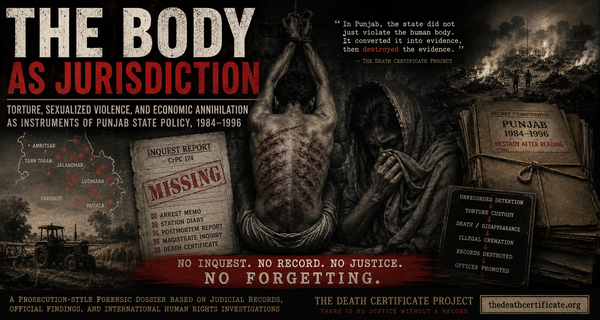
For the 2,097 persons cremated in three Amritsar district grounds between 1984 and 1994 — cremated without names, without family notification, without legal inquest, without the death certificate that the law required to be produced for every death — the death certificate is the thing the state refused to issue. It is the missing document. It is the record whose absence is the proof of the crime. Jaswant Singh Khalra's forensic methodology was, at its most fundamental level, the attempt to reconstruct the death certificates the state had declined to produce: to establish, from the municipal administrative record that the state had kept for its own purposes, the identities and the circumstances of the persons the state had converted from human beings into "unidentified cremation entries."
The Death Certificate takes its name from that project. Every article in this publication is, at some level, an attempt to produce for someone the accounting that the state withheld. To issue the document the bureaucracy of erasure declined to issue. To put a name where the register says "unidentified" and to put a statutory duty where the administrative record shows a gap.
This publication will not become a platform for political advocacy in the ordinary partisan sense. It will not serve as the communications infrastructure of any political party, any electoral formation, any diplomatic lobby, or any government's preferred framing of any question. It will not produce content calibrated to any audience's existing beliefs about what happened to the Sikh community. It will produce content calibrated to what the evidence supports, graded by the standard the evidence meets, and published under the editorial principle that gave this archive its intellectual architecture: before the Word, the cremation grounds. You go to the difficult truth first. You do the accounting before the rhetoric. You read the registers before you write the history.
This publication will not become an echo chamber for community grievance without evidentiary foundation. The Khalsa Test of Sovereignty that this archive maintains is not a device for celebrating every Sikh who has ever been wronged. It is a device for holding every Sikh who has held institutional authority accountable for what they did with that authority when the Panth was under assault. The Tier III analysis — the analysis of those who provided the state's violence with their institutional presence, their administrative silence, their command authority, or their symbolic Sikh face — is as integral to this publication's mission as the Tier I analysis of those who refused at the cost of their lives. A forensic archive that only documents the community's suffering without examining the community's own institutional failures is not a forensic archive. It is hagiography with evidentiary footnotes.
This publication will not cease publication because a foreign government's ministry sends a Section 69A notification. The notification has been received, the formal response has been filed, and the publication continues. The First Amendment protects it. The evidence base sustains it. And the tradition it serves — the tradition that preserved Khalra's testimony after his murder, that maintained the accountability claim after three decades of institutional obstruction, that continued the Ardas for the named dead and the unnamed cremated across four decades of normalization management — that tradition does not accept the state's preferred closure. Neither does this archive.
This publication will not become the voice of despair about what was done to the Sikh community. The Khalsa tradition has survived Aurangzeb's Mughal state and the British Empire and the 1947 Partition and 1984 and the decade of illegal cremation and the state's transnational assassination apparatus now confirmed in operation on Canadian and American soil. It has survived all of these not through despair but through the consistent application of the Sant-Sipahi principle: the spiritual discipline that sustains the body's capacity for action, and the martial readiness that makes the body's action morally disciplined rather than simply reactive. This archive is organized by the same principle. It documents what was done to the Sikh community with the rigor that truth demands and the moral seriousness that the community's dead deserve. It does not perform grief. It produces evidence. Evidence is the Sant-Sipahi's specific contemporary weapon, and it is more durable than any weapon forged in steel.
VIII. THE SIKH AS AUTHOR, NOT AS ARTIFACT
"ਸਭੁ ਕੋ ਊਚਾ ਆਖੀਐ ਨੀਚੁ ਨ ਦੀਸੈ ਕੋਇ ॥" Call everyone high; none appears low. — Guru Nanak Dev Ji, Sri Guru Granth Sahib Ji, Ang 62
The Sikh civilization has been, across six centuries, the object of other people's historical narratives. The Mughal administration narrated the Sikh community as a persistent administrative problem. The British colonial apparatus narrated the Sikh community as a martial race whose military utility justified their subordination within the imperial project. The Indian nationalist tradition narrated the Sikh community as a subset of the Hindu civilizational whole. The Indian security-state tradition narrates the Sikh community as a terrorist threat requiring management. The diaspora advocacy organizations that have sprung up in the vacuum of Sikh self-representation have sometimes narrated the Sikh community as a victim population whose primary function in the world is to receive the sympathy of Western liberal institutions.
None of these narratives is authored by the Sikh community. None of them asks the Sikh community's permission before it is produced. None of them is constrained by the Sikh community's own understanding of what the Sikh civilization is, what it has contributed to human history, or what it requires in terms of accountability and justice from the states that have governed the territory where Sikhs live and have historically lived.
The assertion of this publication — the foundational claim of this About page, the governing editorial philosophy of every series it runs — is this: the Sikh civilization is not an artifact to be narrated by others. It is a subject that narrates itself. It is a civilization with its own epistemological framework (the four-tier evidentiary system this archive employs), its own institutional authority (the Guru Granth Sahib as Living Guru, the Akal Takht as temporal seat of Panthic sovereignty, the Sarbat Khalsa as constitutional assembly of the Guru Panth), its own historical record (the specific and documented record of what was done to the Sikh community and what the Sikh community has done and continues to do in response), and its own intellectual tools for producing knowledge about itself and about the world in which it exists.
The Sikh physician who writes forensic history is not performing a hobby in his off-hours from a professional career. He is exercising his civilization's sovereign authority to produce the account of what happened to his community on the terms his civilization's epistemological framework requires. The Sikh lawyer who litigates 1984 accountability cases is not doing charitable work as a supplement to her billable hours. She is exercising the Khalsa's specific obligation to stand in defense of the weak and the wronged even when the institutional apparatus of the state is arrayed against that standing. The Sikh teacher who insists on historical accuracy about Punjab's twentieth century in a classroom where the curriculum has been rationalized is not being politically difficult. He is doing the Guru's teaching in the specific domain of educational transmission: truth is higher than everything, but higher still is truthful living.
The Sikh is author of the Sikh civilization's story. Not an artifact in someone else's. Not a function in someone else's army or someone else's economy or someone else's management apparatus. The full Sant-Sipahi — physician, lawyer, teacher, writer, accountant, politician, farmer, engineer, civil servant, scholar, musician — is the subject of this civilization's ongoing production of itself, and this archive is one of the most recent and one of the most forensically precise instruments through which that production is occurring.
IX. THE NOISE WILL PASS; THE ARCHIVE WILL STAND
"ਆਦਿ ਸਚੁ ਜੁਗਾਦਿ ਸਚੁ ॥ ਹੈ ਭੀ ਸਚੁ ਨਾਨਕ ਹੋਸੀ ਭੀ ਸਚੁ ॥੧॥" True in the beginning, true through all ages. True now, O Nanak, and forever true. — Guru Nanak Dev Ji, Sri Guru Granth Sahib Ji, Ang 1
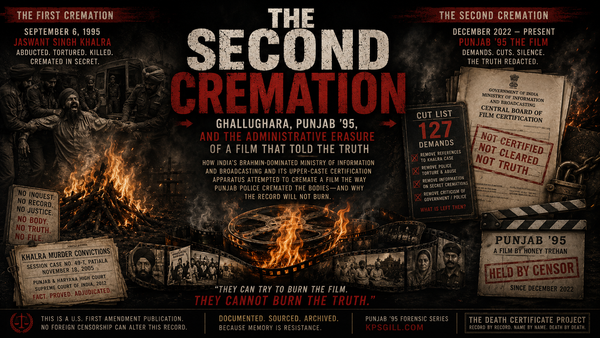
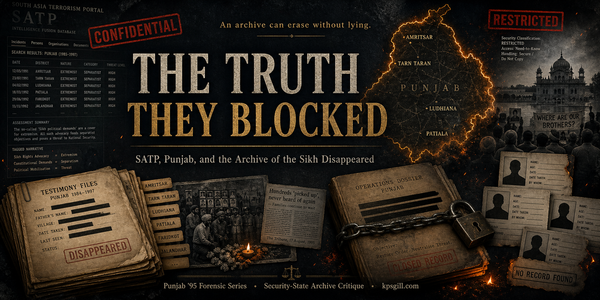
The noise has many addresses. It comes from the South Asia Terrorism Portal, which was founded by the man who commanded the counterinsurgency apparatus within which 2,097 people were illegally cremated and is now cited in Western parliamentary committees as a neutral research resource. It comes from the Hindu American Foundation, which circulates law-enforcement-facing materials to California police departments characterizing Sikh political advocacy as terrorist extremism while its own institutional connections are the subject of a Foreign Agents Registration Act complaint filed with the US Department of Justice. It comes from the The Central Board of Film Certification (CBFC), a statutory film-certification body in the Ministry of Information and Broadcasting of the Government of India CBFC, which has demanded 127 modifications to a biographical film about Jaswant Singh Khalra including the removal of Khalra's name from the biography of Khalra. It comes from the NCERT rationalization committee, which has removed the anti-Sikh riots of November 1984 from the History curriculum of a republic whose own supreme court has confirmed that thousands of Sikh civilians were killed in organized, politically facilitated mass violence in the nation's capital. NCERT stands for the National Council of Educational Research and Training. It is an autonomous organization established by the Government of India in 1961 to improve the quality of school education by designing curriculum, publishing textbooks, and training teachers.
It comes, in its most sophisticated form, from the retired official KBS Sidhu ex-IAS, who writes more than a thousand public essays about administrative wisdom, constitutional governance, and the teachings of Gurbani, without once writing the name of the man who was abducted from a street within the administrative boundaries of his district while he held the office of District Magistrate and was legally obligated to oversee the investigation of suspicious deaths in his district's police custody.
All of this is noise. Not because it is unimportant — the noise has real consequences for real Sikh communities in Canada, the United Kingdom, the United States, and Australia, whose members find themselves characterized as security threats on the basis of materials produced by institutions with documented conflicts of interest that the consuming governments have not examined. The noise is consequential. But it is noise in the specific sense that it is organized around the suppression of the signal — around the prevention of the specific evidentiary record from reaching the specific institutional audiences who would be required, if they encountered the record in its full and properly graded form, to ask questions that the noise's producers do not wish those audiences to ask.
The signal is the archive. The signal is the 2,097. The signal is the Central Bureau of Investigation (CBI's) investigation, the National Human Rights Commission, India (NHRC's) findings, the Supreme Court's characterization of flagrant human rights violations, the criminal convictions of Punjab Police personnel for the murder of the man who documented the signal. The signal is the US Department of Justice's confirmed guilty plea in the murder-for-hire conspiracy targeting an American Sikh attorney. The signal is the Royal Canadian Mounted Police's charges against Indian nationals for the assassination of a Canadian Sikh community leader on Canadian soil.
The signal does not require the noise's permission to exist. The signal has been produced, in most of its crucial dimensions, by the states whose noise management apparatus subsequently denied it. It is in the states' own judicial records, their own investigative agency reports, their own quasi-judicial body findings, their own legislative proceedings. The noise cannot erase the signal. It can only obscure it. And the archive's specific function is to make the obscuration fail: to produce the signal in a form, and from a location, and through a methodology, that resists the specific instruments the noise's producers have available to deploy against it.
This archive will stand when the noise has passed. The noise always passes. Empires pass, administrative architectures pass, institutional management projects pass. What remains is the record: the firewood voucher, the cremation register entry, the CBI chargesheet, the Supreme Court judgment, the NHRC finding, the Unites States' DOJ indictment, the RCMP arrest. These are the materials of the signal. The archive assembles them, grades them by evidentiary tier, connects them by analytical inference, preserves them from institutional management, and publishes them from a jurisdiction that cannot be reached by the management apparatus whose subjects they document.
The noise will pass. The archive will stand. That is the mission of The Death Certificate. That is the promise of this About page to every person who reads it: the Sikh community's forensic history will be written by the Sikh community, on the Sikh community's evidentiary terms, from the Sikh community's sovereign institutional position, and published in the permanent record of the world's information environment in a form that no government committee, no blocking order, no rationalization exercise, and no administrative normalization project can remove.
Before the Shabd (word), the cremation grounds.
The accounting has begun. The record is open. The archive will not be closed.
ABOUT THIS PUBLICATION
The Death Certificate is a forensic historical archive and public-interest publication founded to document, analyze, and present in evidentiary form the historical record of state conduct toward the Sikh community in Punjab and in the global diaspora. It is published under the First Amendment of the United States Constitution from Fresno, California.
All factual claims in this publication are organized by the four-tier evidentiary framework: [PF] Proved Finding, grounded in judicial records, official documents, and confirmed institutional findings; [DA] Documented Allegation, carried in credible human-rights reports and sworn testimony; [AI] Analytical Inference, drawn explicitly from the pattern of the documented record; and [PM] Panthic Memory, the living historical transmission of the Sikh community, cited as such and distinguished from institutional documentation.
The publisher and editorial director is Dr. Kanwar Partap Singh Gill, M.D., a board-certified family medicine physician in Fresno, California, who is the author, publisher, and editorial director of kpsgill.com, a companion First Amendment forensic history publication. He is originally from Khadoor Sahib in the Majha region of Punjab and trained in medicine in Amritsar and at the University of Arkansas for Medical Sciences in Little Rock, Arkansas. His forensic publications are a continuation of the Sikh tradition of bearing witness to what the state has declined to document about its own conduct.
This publication does not accept advertising.
This publication does not modify its content in response to foreign government administrative proceedings.
This publication applies its evidentiary framework to every claim in every article, including claims about the Sikh community's own institutional conduct.
This publication will correct every factual error on the production of evidence.
The archive will not be closed.
ਵਾਹਿਗੁਰੂ ਜੀ ਕਾ ਖ਼ਾਲਸਾ, ਵਾਹਿਗੁਰੂ ਜੀ ਕੀ ਫ਼ਤਹਿ।
The Khalsa belongs to the Eternal. Victory belongs to the Eternal.
© thedeathcertificate.org · All Rights Reserved · 2026
Published under the First Amendment to the United States Constitution.
[PF] Proved Finding · [DA] Documented Allegation · [AI] Analytical Inference · [PM] Panthic Memory