Documentary Trial of Punjab's Architect of Ruin: The Badal Dynasty

ਪੰਜਾਬ ਦੇ ਮੁਜਰਿਮ ਦਾ ਦਸਤਾਵੇਜ਼ੀ ਮੁਕੱਦਮਾ
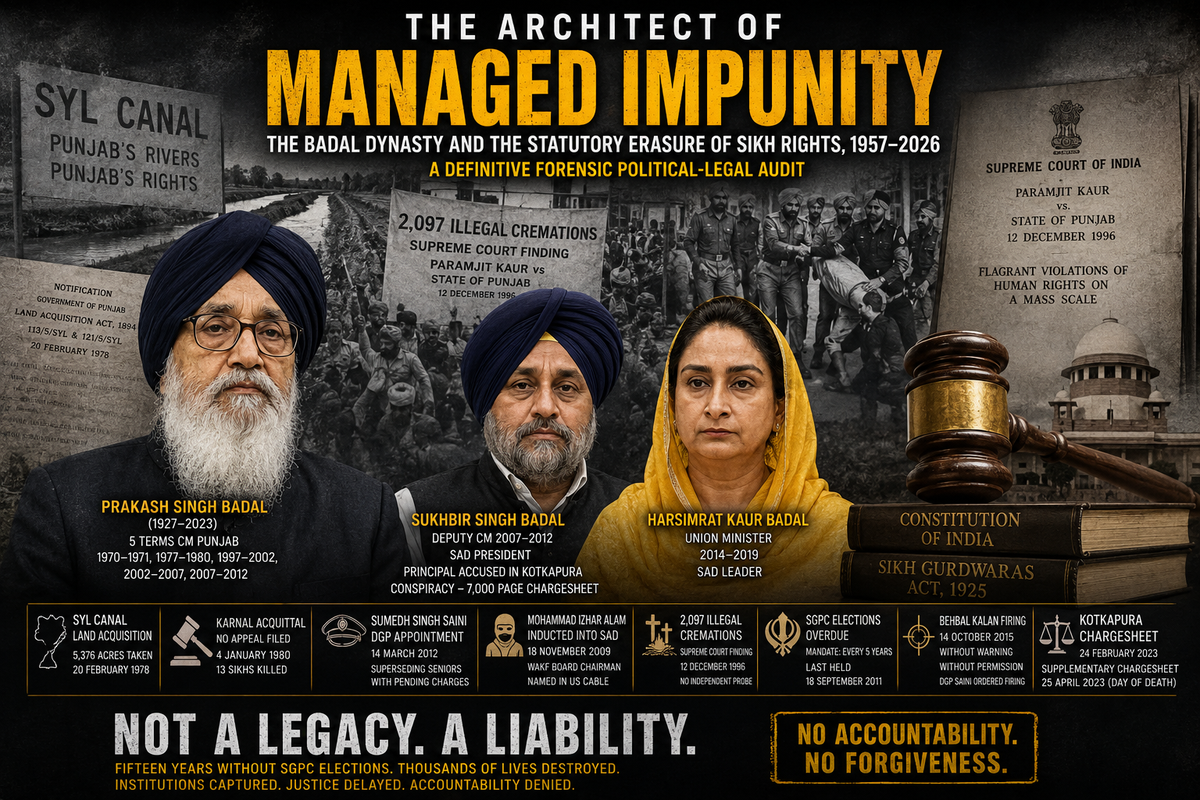
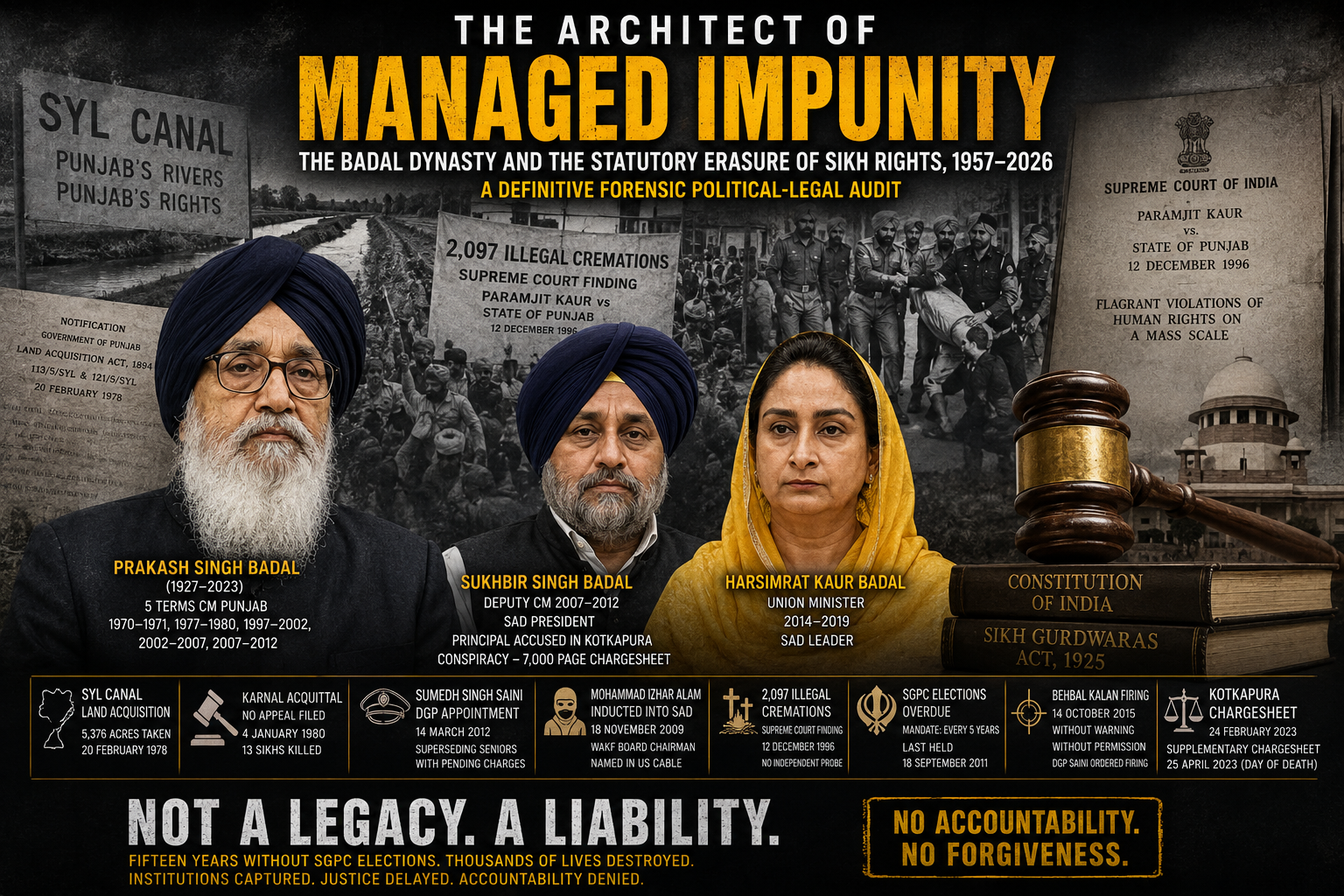
THE ARCHITECT OF MANAGED IMPUNITY
Parkash Singh Badal, Sukhbir Singh Badal, Harsimrat Kaur Badal, and the Statutory Erasure of Sikh Rights, 1957–2026
A Definitive Forensic Political-Legal Audit · kpsgill.com · March 2026
Civilian Command Responsibility · Statutory Nonfeasance · Patronage as Ratification · Institutional Capture · The Badal Dynasty · The Delhi Symbiosis · The BJP–RSS Road Being Paved for 2027
EVIDENTIARY LEGEND
[PF] Proved Finding — established by Indian statutory text, gazette notification, Supreme Court or High Court order, CBI or NHRC official report, authenticated government correspondence confirmed across two or more independent primary sources, UN or U.S. State Department official document, or filed and numbered criminal chargesheet with FIR reference.
[DA] Documented Allegation — credibly sourced in named-journalist investigative reporting, parliamentary proceedings, HRW/Amnesty/Ensaaf reports, or authenticated opposition disclosures — on the record, uncontested in material content, not yet adjudicated.
[AI] Analytical Inference — structural or comparative argument drawn from the pattern of documented events, explicitly presented as inference and not as proved fact.
EDITORIAL NOTE — WHAT THIS AUDIT DOES NOT CLAIM, AND WHAT THE CASE SURVIVES ON
This document is an advocative forensic critique grounded in public records. Parkash Singh Badal died on 25 April 2023 at Fortis Hospital, Mohali, aged 95. He cannot be tried. The criminal proceedings in the Kotkapura case against him abated on the day of his death. A supplementary chargesheet was filed that same day, though Badal had already been formally named in the earlier chargesheet filed on 24 February 2023. That the architecture of accountability reached him — twice — and that biology closed the case before any verdict, is itself the forensic datum about a system that always found another procedure, another adjournment, another season of delay.
This audit does not claim that Badal personally fired a weapon, personally signed a written release order for any accused, or personally directed the destruction of any evidence. The forensic theory rests on three documented pillars. First: statutory nonfeasance — the failure to exercise mandatory or grave public duties across five Chief Ministerial terms totaling nearly nineteen years. Second: command responsibility — the obligation, recognized in international law and argued here as an applicable framework for Indian public-interest adjudication, of a civilian superior with authority over the Punjab Police to prevent, repress, or submit for investigation the crimes his subordinates committed. Third: patronage as ratification — the systematic elevation of officers with documented human rights violation records, treated as consistent administrative policy because it is consistent across decades.
THE PROSECUTORIAL SPINE — WHAT THIS AUDIT ESTABLISHES EVEN IF HALF ITS STRONGEST ALLEGATIONS ARE DISCOUNTED
Strip out every Documented Allegation. Remove the Devi Lal letters. Remove the Nirankari safe-exit story. Remove every claim resting on opposition disclosure rather than primary documentation. What remains, resting substantially on Proved Findings and a small number of high-reliability Documented Allegations, is this.
On 20 February 1978, the cabinet of the Government of Punjab under Chief Minister Parkash Singh Badal is reported across multiple independent sources — including PTI wire reports, IANS dispatches in Business Standard, and Punjab DIPR official press releases — to have issued two land acquisition notifications, numbered 113/5/SYL and 121/5/SYL, initiating the acquisition of 5,376 acres of Punjab farmland for the SYL canal. [DA — high reliability]
On 4 January 1980, a Sessions Court in Karnal acquitted all accused in a case involving thirteen Sikh deaths; Badal's government directed no appeal under Section 378 CrPC. [PF]
On 14 March 2012, with effect from 15 March 2012, the Badal government appointed Sumedh Singh Saini as Director General of Police superseding four to five more-senior IPS officers, while charges of kidnapping and criminal conspiracy had been framed against Saini by a trial court in December 2006. [PF]
On 18 November 2009, Mohammad Izhar Alam — named in a US diplomatic cable of December 2005 as the commander of a paramilitary force alleged to have conducted possibly thousands of staged encounter killings — was inducted into the SAD by CM Badal and appointed Chairman of the Punjab Wakf Board. [PF/DA — Wakf appointment PF; cable text DA]
The Supreme Court in Paramjit Kaur v. State of Punjab (12 December 1996) found flagrant violations of human rights on a mass scale in connection with 2,097 confirmed illegal cremations; the Badal government that took office in February 1997 constituted no independent investigation. [PF]
SGPC general elections mandated every five years under Sections 48 and 62 of the Sikh Gurdwaras Act 1925 have not been held since 18 September 2011 — fifteen years. [PF]
The Justice Ranjit Singh Commission (constituted April 2017) found that firing at Behbal Kalan on 14 October 2015 was without any warning and without permission from civil authorities, and that DGP Saini ordered the firing. [PF]
On 24 February 2023, a 7,000-page chargesheet named Parkash Singh Badal as an accused in the Kotkapura firing case. A supplementary chargesheet was filed on 25 April 2023, the day of his death. [PF]
The same chargesheet described Sukhbir Singh Badal as a principal conspiratorial actor, in the SIT's own terminology. [PF — chargesheet characterization; the label is the SIT's prosecutorial framing, not an adjudicated finding]
As of the date of this audit's completion, not a single charge has been framed in either the Kotkapura or Behbal Kalan case. [PF]
That is the documented floor. The argument is strong on that floor alone.
PART ONE · THE LIABILITY ARCHITECTURE
I. What This Audit Is
This document is an advocative forensic critique grounded in public records. The distinction between forensic advocacy and ordinary political polemic is methodological: forensic advocacy begins with the complete available record, constructs the most defensible interpretation that record supports, states explicitly what the record does not prove, and classifies every departure from primary documentation with the appropriate epistemic label. This document adopts that method in the tradition of prior audits published at kpsgill.com.
The governing analogy is the medical examiner's: examine what the documentary body tells you, classify what you can prove, mark what you can only infer, and resist the pressure to make the body tell a story it does not actually tell.
II. The Four Modes of State Malpractice
Mode One: Civilian Command Responsibility. The doctrine of command responsibility, recognized in international law through Yamashita v. Styer (327 U.S. 1, 1946) and reflected in Article 28(b) of the Rome Statute of the International Criminal Court, has been used in international law to impose responsibility on civilian superiors in certain circumstances — where the crimes fell within the superior's effective authority and control; where the superior knew, or consciously disregarded information clearly indicating, that subordinates were committing such crimes; and where the superior failed to take all necessary and reasonable measures to prevent, repress, or submit the matter for investigation. India is not a party to the Rome Statute, and this framework has not been formally adopted in Indian domestic law as applied to former Chief Ministers. This audit presents it as a proposed forensic standard and an international legal analogy — the framework against which Badal's conduct should be assessed, and will be assessed in any serious accountability proceeding. [AI — proposed forensic standard; PF for doctrine's existence in international law]
As Chief Minister and political head of the Home Department across five terms, Parkash Singh Badal possessed effective authority and control over the Punjab Police. As Deputy CM and Home Minister from 2007–2017, Sukhbir Singh Badal bore the direct ministerial authority over the Punjab Police that his father had, through portfolio allocation, delegated to him. The knowledge element — arguable on the basis of CBI, NHRC, Supreme Court, HRW, Amnesty, Ensaaf, and UN Rapporteur documentation in the public domain throughout their tenures — is not a matter of inference alone. It is documented in adjudicated government records that circulated publicly during their governance periods. [AI from documented knowledge base]
Mode Two: Statutory Nonfeasance. Nonfeasance in public law is the failure of a public officer to perform a mandatory or grave public duty imposed by statute. A Chief Minister who does not direct a Section 378 CrPC appeal following the acquittal of sixty-two accused for thirteen Sikh deaths may be said to have failed a grave public responsibility, even though the statutory language of Section 378 is formally discretionary. The normative weight of that failure — not its strict legal compulsion — is what this audit documents. [PF for statutory text; AI for normative characterization]
Mode Three: Patronage as Ratification. A personnel appointment is a formal state act. When the government supersedes four to five more-senior officers to appoint a man against whom charges of kidnapping and criminal conspiracy have been framed by a trial court, that appointment communicates institutional policy: the conduct for which the officer is under prosecution is not disqualifying and will be rewarded. [AI — the institutional meaning of the appointment]
Mode Four: Institutional Capture as Statutory Fraud. The Badal political apparatus converted the SGPC from a democratically elected body managing Sikh religious institutions into an instrument of political control over those institutions — using the Act's own structural vulnerabilities, principally the Jathedar's status as a dismissible SGPC employee with no statutory protection. [PF for structural vulnerability; AI for characterization of conversion]
III. Why Written Orders Are Not Necessary
The defense from absence — without a signed order, no political leader can be held accountable — fails under five independent legal frameworks, none of which require a signed directive.
Under the Yamashita command responsibility framework, later reflected in Rome Statute Article 28(b), liability rests on knowledge and failure to act. Under the wilful blindness doctrine established in Global-Tech Appliances v. SEB S.A. (563 U.S. 754, 2011): deliberately avoiding confirming a high-probability fact is constructive knowledge. Under IPC Section 120-B: criminal conspiracy is proved through pattern and circumstantial evidence, as recognized in Kehar Singh v. State (Delhi Administration) (1988). Under the Indian Evidence Act Section 8: subsequent conduct is admissible as evidence of prior intention. Under Section 114(g): non-production of available documents supports the adverse inference.
Five legal frameworks invoke analogous inferential treatment of the documented pattern. None require a signed order. And beyond those five frameworks, the record now contains something rarer: the Home Minister's own sealed written admission — Sukhbir Badal's letter to the Akal Takht — identifying the three core decisions this audit documents as transgressions for which he personally apologizes. A defense of absence cannot survive primary-source admissions from the Home Minister himself.
IV. The Reasonable Administrator Benchmark
The baseline against which Badal's governments are measured is not perfection. It is the conduct that Indian public law, the Code of Criminal Procedure, and documented practice of comparable state governments mandated or routinely observed.
After thirteen citizens are killed in a communal clash and all accused are acquitted on self-defense, a reasonable State Government examines the grounds of the acquittal and files a leave-to-appeal application under Section 378 CrPC if those grounds are arguable — not because it must by strict statutory command, but because the normative duty of a government to its dead citizens compels it. After police open fire without civil authority permission on peaceful religious protesters and kill two of them, a reasonable State Government and its Home Minister immediately suspend involved officers, order a Section 176 CrPC magisterial inquiry, and do not then advance the same DGP who ordered the firing. After a Supreme Court finding of flagrant human rights violations on a mass scale involving 2,097 confirmed illegal cremations, a reasonable State Government in its next term constitutes an independent SIT. The Badal governments' conduct is measured against these specific benchmarks throughout. [AI — the standard; PF for the gap between standard and documented conduct]
V. The Indian Evidence Act as a Forensic Tool
Section 8 of the Indian Evidence Act 1872 treats the conduct of any party in reference to facts in issue as relevant. Applied throughout this audit: Badal's subsequent conduct — promoting Saini, honoring Alam, elevating Ramesh Inder Singh to Chief Secretary — is relevant under Section 8 as evidence of his institutional posture toward the conduct those appointments rewarded.
Section 114(g) supports the inference that evidence which could be and is not produced would, if produced, be unfavorable to the withholding party. Applied throughout: the Home Department minutes of the weeks after the Nirankari acquittal, the CM office records of the night before the Behbal Kalan firing, the SGPC election commission correspondence from 2016 to the present — all not produced. The withholding is itself a datum. [PF — statutory text; AI — application to specific records]
PART TWO · THE BADAL DYNASTY AS A GOVERNING UNIT
VI. Three Members, One Architecture
This audit treats the Badal political apparatus not as one man's career but as a governing dynasty in which three family members divided the work of power with systematic precision. [AI — characterization of system]
Parkash Singh Badal (1927–2023): the patriarch, Chief Minister across five terms totaling nearly nineteen years, the publicly visible face whose 1978 credentials — imprisonment, Punjabi Suba activism, apparent religious conservatism — provided the dynasty's legitimacy foundation. His role was the long game: managing the Centre's relationship over decades, providing the elder-statesman cover that shielded the family's accumulation of institutional control from the scrutiny that overtly dynastic governance would have attracted.
Sukhbir Singh Badal (born 1962): the operational head. Elected to Lok Sabha from Faridkot (1996) and Ferozepore (2009, 2014). Served as Deputy Chief Minister and de facto Home Minister of Punjab from 2007 to 2017. President of the Shiromani Akali Dal from 2008. The Kotkapura chargesheet describes him as a principal conspiratorial actor. He was the administrative architect of the 2007–2017 government — appointing officers, directing police strategy, managing the SGPC institutional capture, and handling the Dera Sacha Sauda relationship that produced the Ram Rahim pardon. [PF — tenures and positions; PF — chargesheet characterization as SIT's framing]
Harsimrat Kaur Badal (born 1966): elected to the Lok Sabha from Bathinda in 2009, 2014, 2019, and 2024. Served as Union Cabinet Minister for Food Processing Industries from 2014 to 17 September 2020. The dynasty's Parliamentary face: present in New Delhi when Sukhbir governed Chandigarh, providing the Badal family direct access to the Union Cabinet across two BJP terms. Re-elected from Bathinda in 2024. [PF — Election Commission records; Union Government official Cabinet records]
VII. Sukhbir Singh Badal — The Home Ministry Years and Their Legal Consequences
Sukhbir Singh Badal's specific responsibilities as Deputy CM and effective Home Minister were comprehensive. The Home Department — which supervises the DGP, the Intelligence Wing, and the administrative machinery for law and order — was under his direct charge throughout 2007–2017. The decisions and omissions attributable to him during this period constitute an independent and parallel record of managed impunity documented in the parts that follow.
Sukhbir's sealed letter, 24 July 2024 (made public 5 August 2024): In a letter to the Akal Takht, whose content was reported by Tribune India and confirmed by multiple SAD rebel leaders, Sukhbir Badal apologized for: (1) favouring Dera Sacha Sauda head Gurmeet Ram Rahim and securing his pardon from the Akal Takht; (2) the appointment of Sumedh Singh Saini as DGP; (3) failures in handling the sacrilege incidents and the subsequent police firing. This letter is a Proved Finding — a public, named, documented admission whose material content has not been legally contested. [PF — Tribune India; Free Press Journal corroboration]
The letter is not merely an apology. It is a primary source admission, by the man who held the Home Ministry portfolio, that the three most consequential decisions driving the accountability crisis of the 2007–2017 period were decisions for which he bears personal responsibility. No further inference is required. The admission is on the record.
VIII. Harsimrat Kaur Badal — The Cabinet Dimension and the Strategic Access It Created
Harsimrat's Cabinet position during 2014–2017 — the precise period when Sukhbir was operating the Home Ministry in Chandigarh and making the appointments that produced the Saini tenure, the Ram Rahim pardon, and the management of the 2015 sacrilege and firing crisis — created a direct familial and institutional channel between the Punjab Home Ministry and the Union Cabinet. Whether that channel was formally used for coordination in any specific accountability or sanction decision is not documented in the public record and is accordingly classified as Analytical Inference. That the channel existed is a Proved Finding. [PF for position; AI for channel use]
Her resignation from the Union Cabinet on 17 September 2020 over the three Farm Acts fractured the SAD-BJP alliance. The dynasty's core electoral base — Punjab's farming communities — faced direct economic harm from the Farm Acts, and the resignation was the correct political response to that threat. This audit characterizes the resignation as evidence that the Badal dynasty's alignment with Delhi was always functional rather than ideological — conditional on Delhi not directly attacking the base that kept the dynasty in power. [AI]
Her return to Parliament in 2024 from Bathinda, with the SAD, is itself a data point: the dynasty's electoral anchor in Malwa endures even as its institutional architecture has been publicly exposed, its religious standing publicly degraded through the tankhaiya proceeding, and its criminal exposure publicly documented in a 7,000-page chargesheet. The durability of the Badal electoral presence, absent institutional reform, is precisely the mechanism through which the road to 2027 BJP consolidation is being prepared.
PART THREE · KAIRON VERSUS BADAL — THE GEOPOLITICS OF A DELIBERATELY DIMINISHED PUNJAB
IX. How Kairon Is Used Here — And the Corrected Record on His Death
Pratap Singh Kairon is used in this audit as a strategic comparator, not a moral hero. He was removed as Chief Minister in 1964 on corruption findings by the Justice Sudhi Ranjan Das Commission — eight of approximately thirty-one charges found proven, including connivance at the conduct of his sons and relatives. This audit cites Kairon for one reason: he understood, and his governance demonstrated, that a Punjab sharing a territorial border with Delhi's administrative geography could not be isolated, hydraulically drained, or subjected to indefinite military containment without immediate political costs to whoever attempted it. Whether he was personally virtuous is irrelevant to that strategic observation.
Kairon was assassinated on 6 February 1965 on the Grand Trunk Road near Rasoi village, Rai, Sonipat district. [PF]
X. What Kairon Governed and What He Built
Kairon served as Chief Minister of composite, undivided Punjab from 1956 to 1964 — a state of approximately 262,000 square kilometers encompassing present-day Punjab, Haryana, and the Punjab hills districts of Himachal Pradesh. Punjab Agricultural University was founded in 1962, inaugurated by PM Nehru on 8 July 1962. The Bhakra Nangal Dam was completed and dedicated in October 1963 during his tenure. Within the composite state, no external allocation of the Ravi, Beas, and Sutlej rivers was legally possible without Punjab's consent because no legally distinct external state with riparian standing existed. [PF]
XI. The 1966 Trifurcation — The Geography of Impunity
The Punjab Reorganisation Act 1966 reduced Punjab from approximately 262,000 to 50,362 square kilometers. The state lost its Rajasthan border. Haryana became the buffer that made Punjab containable. With Haryana between Punjab and Delhi, the Central Government could impose extraordinary measures against Punjab — water diversion under Emergency authority, military assault on a sacred complex, repeated President's Rule — without facing the immediate political backlash that a state sharing Delhi's borders would have generated. This structural consequence is what this audit names the geography of impunity: not a conspiracy, but a documented architectural feature of the post-1966 settlement that made every subsequent act of central aggression against Punjab structurally easier. [AI from documented sequence of events post-1966]
XII. The Missed Constitutional Pathways
The most consequential forensic finding in the Kairon-Badal comparison concerns legal mechanisms that existed throughout Badal's five CM terms and were not effectively deployed. Although Punjab did challenge Section 78 in Suit No. 2 of 1979, that challenge was not carried through to a durable constitutional resolution and was not effectively revived in any later Badal term. Article 131 was never invoked by any Badal government specifically to demand Chandigarh's transfer or to press Punjab's constitutional arguments on water sovereignty to final adjudication. The Inter-State River Water Disputes Act of 1956 provided for a formal Tribunal proceeding on hydrological principles. Punjab's sole-riparian-state argument was legally available throughout the entire post-1966 period. The constitutional doors were open. They were not walked through to completion. [AI — the argument; PF for Suit No. 2's filing and withdrawal; PF for statutory mechanisms' availability]
The missed pathways matter not only historically but immediately: it is the accumulated record of non-deployment that has left Punjab constitutionally exposed, institutionally weakened, and organizationally fragmented — exactly the condition that makes the state most vulnerable to the electoral consolidation strategy the BJP and RSS are now executing ahead of 2027.
PART FOUR · WATER, SECTION 78, AND THE MANAGED WITHDRAWAL — THE COMPLETE DOCUMENTARY AUDIT
XIII. The Constitutional Foundation
Entry 17 of the State List grants state legislative competence over water — subject only to Entry 56 of the Union List, which permits central control for inter-state rivers declared by Parliament to be of public interest. Punjab's constitutional position: the Ravi, Beas, and Sutlej flow through Punjab and through no other state. Haryana and Rajasthan are non-riparian states. The allocation of their water is not sharing among co-riparians. It is diversion of one state's sovereign resource to states with no physical relationship with those rivers.
Section 78 enabled that diversion. No equivalent provision appears in any other state reorganisation statute in India's post-independence history — not in the Bihar-Jharkhand Act of 2000, the MP-Chhattisgarh Act of 2000, the UP-Uttarakhand Act of 2000, or the AP-Telangana Act of 2014. [PF — constitutional text; comparative statutory analysis]
XIV. Section 78 — The Exact Text and Its Unique Injury
Section 78(1) of the Punjab Reorganisation Act 1966, as verified from India Code: the rights and liabilities of the successor states shall be fixed by agreement between those states, or, if no such agreement is reached within two years of the appointed day, as the Central Government may by order determine having regard to the purposes of the Projects. Two years elapsed. No agreement. The Central Government acquired unilateral authority to distribute waters that flow exclusively through Punjab to states that have no physical relationship with those rivers. That authority was constitutionally contestable. Punjab raised that contest in 1979. The contest was not carried through. [PF — statutory text; PF for Suit No. 2 filing and withdrawal]
The uniqueness of Section 78 in the body of Indian reorganisation statutes deserves forensic emphasis. Every other major state bifurcation in the post-Emergency era produced legislation that, for all its tensions, did not include a mechanism enabling the Centre to unilaterally determine the water allocation of the predecessor state to non-riparian successors on the basis of the Centre's sole assessment of project purposes. Section 78 is architecturally anomalous. It was inserted into the reorganisation statute precisely because the 1966 trifurcation was not primarily a linguistic reorganisation — it was a strategic containment architecture applied to the Sikh homeland.
XV. The 1976 Emergency Allocation
On 24 March 1976, under Emergency rule, the Central Government notification under Section 78(2) divided Ravi-Beas surplus waters: Punjab 3.5 million acre-feet (approximately 22% of total); Haryana 3.5 million acre-feet; Rajasthan 8.60 million acre-feet confirmed; Delhi 0.20 million acre-feet. Nine lakh acres of Punjab farmland lost canal access. Made during Emergency when parliamentary accountability was suspended, the press was censored, and no elected Punjab government existed to formally protest. [PF — government gazette notification]
XVI. The 1978 Land Acquisition Notifications — The Documentary Contradiction
On 20 February 1978, the cabinet of the Government of Punjab under Chief Minister Parkash Singh Badal is reported — consistently across PTI wire reports, IANS reports in Business Standard, and Punjab DIPR official press releases bearing identical notification numbers across partisan-opposed sources — to have issued two notifications under Section 4(1) of the Land Acquisition Act, 1894. The notifications bore official serial references 113/5/SYL and 121/5/SYL. Their documented effect: initiating formal acquisition of 5,376 acres of Punjab farmland across the districts of Ludhiana, Ropar, and Fatehgarh Sahib for the SYL canal. [DA — high reliability]
On 4 July 1978, the Government of Punjab issued official letter 7/78-IW(I)-78/23617 to the Government of Haryana demanding Rs 3 crore for land acquisition costs. [DA — high reliability; original not yet located in primary archives]
On 31 March 1979, Badal's government accepted at least Rs 1 crore from Haryana. The Supreme Court in (2002) 2 SCC 507 confirmed Punjab had accepted money for that purpose. [PF — SC judgment]
The Devi Lal Vidhan Sabha Statement (1 March 1978): Haryana CM Devi Lal stated in the Haryana Vidhan Sabha: "Due to my personal relation with Badal, Punjab Government has acquired the land under Section 4 and Section 17 (emergency clause) for SYL canal." [DA]
The SAD's published defense — that officers acted at their own level — is forensically unavailable on its face: officers do not demand Rs 3 crore from a neighboring state government and accept installment payments at their own level. The demand letter and payment acceptance are the acts of a government that knew precisely what it had initiated. [AI]
XVII. The Mechanism of the Managed Withdrawal
On 11 July 1979 — four months after accepting at least Rs 1 crore from Haryana for SYL land acquisition — Badal's government filed Punjab Suit No. 2 of 1979 in the Supreme Court of India. The suit challenged the 1976 Emergency allocation notification and challenged aspects of Section 78's application. [PF]
The constitutional challenge was therefore initiated. Punjab understood what it was doing. The Public Prosecutor had been directed. The Supreme Court had been approached. The argument was made. [PF]
On 31 December 1981, under the tripartite water agreement extracted by Prime Minister Indira Gandhi — CM Darbara Singh reportedly facing the threat of government dismissal if he refused — Punjab withdrew Suit No. 2 of 1979. The challenge was abandoned. Not because it lacked legal merit. Not because the courts had ruled against it. Because political settlements in Delhi made continuation inconvenient. [PF for withdrawal; DA for coercion of Darbara Singh]
What followed in later Badal terms was not the absence of a challenge but the deliberate failure to revive one. In Badal's third CM term (1997–2002), he governed without the 1978 coalition constraints and with approximately sixteen to eighteen Lok Sabha seats. He did not revive the challenge. In his fourth and fifth terms (2007–2017), he governed in a stable coalition in which the SAD was the senior partner. He did not revive the challenge. The mechanism existed. It had been used. The decision not to return to it — across two decades of autonomous governance capacity — is the managed withdrawal. [AI from documented pattern]
The Supreme Court in State of Haryana v. State of Punjab ((2002) 2 SCC 507, decided 15 January 2002) cited the Badal government's 1978 correspondence — the demand letter and payment acceptance — as evidence that Punjab had implicitly accepted its SYL obligations. The letters Badal's government wrote became the instrument by which Punjab lost its most important water argument in India's highest court. The legal challenge Badal created in 1979 was undermined by the transactions Badal had authorized in 1978. [PF]
The 2016 de-notification — issued by Revenue Commissioner K.B.S. Sidhu on 15 November 2016, five days after the Supreme Court struck down the Punjab Termination of Agreements Act as unconstitutional — was political theatre performed for the 2017 electorate, legally void from the moment it was signed. The Supreme Court had just ruled the termination was constitutionally unavailable. Badal's government enacted it anyway. The cloud produced the appearance of lightning. The crops were already burned. [AI from documented legal sequence]
PART FIVE · THE 1978 NIRANKARI ACQUITTAL — THE BIRTH OF MANAGED IMPUNITY AND THE TREACHERY AGAINST SIKH LIFE
XVIII. The Convention, the Clash, and the Enforcement Chain That Broke
On 13 April 1978 — Vaisakhi Day — the Sant Nirankari Mission held a convention in Amritsar with permission from Badal's Home Department. Two Janata Party ministers from Badal's governing coalition were scheduled attendees — governmental endorsement documented in contemporaneous press reporting. Multiple Sikh organizations had formally communicated objections to the government about Nirankari conventions in Amritsar on Baisakhi Day. The foreseeability of confrontation was documented in prior official communications that reached the same Home Department that issued the permit. [PF/DA]
A Sikh procession led by Fauja Singh of the Akhand Kirtani Jatha marched toward the convention. Gunfire erupted. Thirteen Sikhs were killed, including Fauja Singh. Three Nirankari followers died. Over seventy were injured. [PF]
Within hours, Gurbachan Singh left Punjab and reached Delhi before any arrest warrant was executed, before any lookout circular was issued, before any checkpoint was activated. The mandatory enforcement chain — Sections 154, 55, and 44 CrPC — was not activated. [AI from documented absence of enforcement action]
The Nirankari episode must be understood for what it was in its moral and political dimensions: a Sikh Chief Minister permitted a convention that the Sikh community had formally protested, sanctioned the presence of his own coalition partners at it, and then failed to prosecute the killers of thirteen Sikhs who died on the holiest day of the Sikh year in the holy city of Amritsar. That the leader claiming to represent Punjab's Sikh community was the man who issued the permit, hosted the coalition partners in attendance, and presided over the non-prosecution of the killers — this is the first act of a definitive betrayal.
XIX. The Acquittal and the Section 378 CrPC Non-Appeal
On 4 January 1980, the Sessions Court at Karnal acquitted Gurbachan Singh and approximately sixty-two Nirankari co-accused on grounds of private self-defense under IPC Sections 96–106. [PF]
Section 378 CrPC provides that the State Government may direct the Public Prosecutor to present an appeal to the High Court from an order of acquittal. The statutory language is formally discretionary. But when thirteen citizens are killed in a communal clash in the city of the Golden Temple on the most sacred date in the Sikh religious calendar, the decision whether to appeal their killers' acquittal is not a routine exercise of prosecutorial discretion. It is a declaration about whose deaths the constitutional system will vindicate. [PF — statutory text; AI — normative characterization]
Badal's government had approximately six weeks between the 4 January acquittal and its dismissal in February 1980. Filing a leave-to-appeal application is a document that any Law Department officer can prepare in days. No appeal was filed. No review. No further examination of the acquittal's factual basis. Sixty-two accused were exonerated for thirteen deaths on Vaisakhi Day in Amritsar. The incoming Congress government under Darbara Singh equally failed to appeal. The case closed. [PF by documented omission]
XX. What the Non-Appeal Built — Betrayal as Structural Event
Fauja Singh's widow Bibi Amarjit Kaur co-founded Babbar Khalsa as a direct organizational response to the state's abandonment of her husband's case. Dal Khalsa was founded on 6 August 1978, with public announcement on 13 August 1978. Jarnail Singh Bhindranwale positioned himself from 1978 forward as the Sikh community's only effective defender precisely because the constitutional mechanism had visibly failed to pursue thirteen murders. [PF for Dal Khalsa founding; AI for causal trajectory to later militancy]
The trajectory from the 1978 non-appeal to the 1984 assault on the Golden Temple had many actors, many decisions, and many inflection points. But the non-appeal is the first documented moment at which the state's abandonment of Sikh victims' legal claims was translated directly into the organizational responses that built the insurgency. To say it is the birth of managed impunity is not hyperbole. It is chronology. And the architect of that birth was the Chief Minister of Punjab — a man elected by Sikh voters, claiming to represent Sikh political aspirations, governing under the Akali banner — whose failure to file a leave-to-appeal application in six weeks became one of the pivotal structural failures in modern Sikh history.
That is the first act of treachery in this record. It was committed not by Delhi, not by Congress, not by the RSS. It was committed by the Akali Chief Minister of Punjab, Parkash Singh Badal, who held the statutory power to act, chose not to act, and left thirteen Sikh dead unvindicated before the law.
PART SIX · THE ANANDPUR SAHIB RESOLUTION — FEDERALISM MANAGED INTO PERMANENT SILENCE
XXI. What the Resolution Said
The Anandpur Sahib Resolution was adopted 16–17 October 1973 and reaffirmed at the Eighteenth All India Akali Conference, Ludhiana, 28–29 October 1978 — moved by SGPC President Gurcharan Singh Tohra, endorsed by Chief Minister Parkash Singh Badal. The authenticated text maintained by the Sikh Missionary Society (UK) is the primary source. [PF]
Core demands: Centre limited to Defence, Foreign Affairs, Currency, and General Communications; Chandigarh transferred to Punjab; excluded Punjabi-speaking territories included; Sikhism recognized distinctly from Hinduism in Article 25(2)(b); Punjab's proprietary rights over its rivers restored.
The preamble: Punjab described as "an integral part of the Union of India." These are demands for constitutional federalism structurally identical to Canadian, German, Swiss, and Australian federal models. Not secessionism. The secessionist framing was a political construction of the Indira Gandhi government's intelligence and propaganda apparatus — a construction that allowed every Sikh who endorsed the Resolution to be treated as potentially liable to sedition charges rather than protected as a constitutional advocate. The White Paper on Punjab Agitation of 10 July 1984 enshrined that construction in official government language. The authenticated text of the Resolution directly refutes it. [PF — text analysis; AI on framing construction]
XXII. Nearly Nineteen Years of Government — Zero Demands Met
Badal endorsed the Anandpur Sahib Resolution in 1978. He governed Punjab for nearly nineteen years across five Chief Ministerial terms. During those nearly nineteen years: Chandigarh was not transferred. Section 78 was challenged in 1979 and the challenge was withdrawn in 1982 and never revived. Punjab's rivers were not brought under state sovereign control through any durable legal mechanism. The Article 25 Explanation was not amended. Not one demand. Nearly nineteen years. [PF]
The managed grievance thesis: the Resolution was maintained as a political mobilization resource precisely because resolving it would eliminate its political utility. A grievance resolved cannot be campaigned on. The probability that this pattern of non-achievement reflects random administrative failure across five separate CM terms rather than deliberate strategy is, on the basis of the documented record, analytically negligible. [AI]
The Anandpur Sahib Resolution was the second great act of betrayal. It was not merely that the demands went unmet — demands in democratic systems often go unmet. The betrayal was structural: the Resolution was consciously preserved as an unfulfilled mobilization instrument. The Sikh community's deepest constitutional aspirations were converted by the Badal dynasty into campaign currency. The promises were the product. The non-delivery was the designed outcome.
PART SEVEN · OPERATION BLUE STAR 1984 — THE ADMINISTRATIVE RECORD AND THE CAREER OF THE MAN WHO ADMINISTERED THE RUINS
XXIII. The Operation and Its Scale
Operation Blue Star was executed 1–10 June 1984 under Lieutenant General Kuldip Singh Brar (9 Infantry Division). It simultaneously targeted more than forty Gurdwaras across Punjab. The timing coincided deliberately with the martyrdom anniversary of Guru Arjan Dev Ji, ensuring maximum pilgrim presence at the Harmandir Sahib complex. The Akal Takht was destroyed by tank fire. The Sikh Reference Library — housing approximately 20,000 works including seventeenth-century manuscripts, handwritten Guru Granth Sahib copies, historical hukumnamas, and archival materials existing nowhere else in the world — was destroyed between 6 and 14 June 1984. A complete media blackout prevented independent contemporaneous documentation. [PF — White Paper on Punjab Agitation, 10 July 1984]
No official inquiry was ever constituted by any state or central government into the destruction of the Sikh Reference Library. No master list of the Library's holdings existed in any publicly accessible location. Badal's third, fourth, and fifth CM terms — spanning 1997 to 2017 — did not include a single government order, commission appointment, or departmental inquiry directed at the Library's destruction. [PF by documented absence]
XXIV. Ramesh Inder Singh IAS — The Blue Star Administrator and His Badal-Era Career
On 4 June 1984 DC Amritsar Gurdev Singh Brar went on leave and was replaced by Ramesh Inder Singh, a 1974-batch IAS officer. He administered Amritsar through the destruction of the Akal Takht and Sikh Reference Library under President's Rule. [PF — DNA India; Sikh24]
In his 2022 book Turmoil in Punjab: Before and After Blue Star — An Insider's Story (HarperCollins India, ISBN 9789354899065), Ramesh Inder Singh maintained that the requisition for civil authority support was issued by the Home Secretary and Chief Secretary — not the DC — and that he had not authorized the assault. His core thesis: systemic governance failure led to Blue Star, not his individual decision. [PF — published book]
Ramesh Inder Singh subsequently served as Chief Secretary of Punjab under Badal (2007–2009) — the highest civil service rank in the state — and received the Padma Shri national civilian honor. Badal praised him publicly as exemplifying "absolutely straightforward behavior." [PF]
The man who administered Amritsar as its highest civil official while the Akal Takht was being destroyed by tank fire was, under Badal's government, elevated to the capstone of Punjab's civil service and praised by the Chief Minister who had campaigned on accountability for 1984. The forensic meaning of that elevation requires no elaboration. The Sikh community that elected Badal on promises of 1984 justice received, as the beneficiary of their trust, the appointment of the Blue Star-era DC Amritsar to the highest administrative office in the state and his subsequent decoration with the Republic's civilian honour. This is not negligence. This is communication: the state is telling the Sikh community what it thinks of 1984, and it is telling them not in words but in appointments.
XXV. Badal's Detention and the Asset of Martyrdom
Badal was detained on or about 10 June 1984, in the immediate aftermath of Operation Blue Star, under the National Security Act, and was released in March 1986. His detention began in the immediate aftermath of Blue Star, not during it. [PF — corrected dates]
His imprisonment in the aftermath of Blue Star gave him a political asset of permanent value: the moral authority of incarceration, uncomplicated by any direct administrative responsibility for what occurred during the assault itself — which he was not present to govern. His subsequent CM terms were built on an explicit promise of accountability for 1984 victims.
The forensic record of those terms: no prosecution of any perpetrator of any Blue Star killing was initiated. No formal government-level demand for accountability for the November 1984 Delhi pogrom — in which the Nanavati Commission estimated approximately 2,733 Sikhs were killed in three days of organized violence, with Congress party leaders documented as organizers — was formally communicated by any Badal government to the Central Government through any legal or parliamentary mechanism. [PF by documented absence; PF for Nanavati Commission findings]
The promise of accountability was the instrument. The non-delivery was the designed outcome. The martyrdom credential was the currency. The Sikh dead of 1984 were the collateral that backed the currency without ever being redeemed.
PART EIGHT · KHALRA, THE 2,097 CREMATIONS, AND THE SILENCE OF THE DISTRICT MAGISTRATE
XXVI. The Firewood Register Investigation
Between 1993 and 1995, Jaswant Singh Khalra — a bank officer and human rights investigator — used publicly available Municipal Committee records: firewood purchase registers at three Amritsar-district crematoria. Each cremation required approximately 300 kg of firewood. He cross-referenced police firewood purchases against official death certificates, identifying cremations for which no corresponding official death record, family notification, post-mortem, or judicial authorization existed.
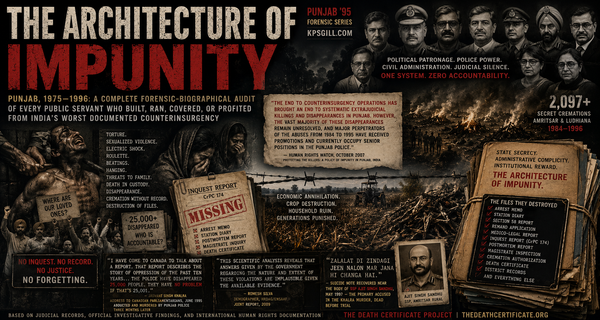
Across the three crematoria, June 1984 through December 1994: 2,097 cremations conducted by Punjab Police of bodies classified as unidentified. The CBI confirmed this figure. The Supreme Court in Paramjit Kaur v. State of Punjab (CrPC Writ Petitions 447 and 497 of 1995, order 12 December 1996) found flagrant violations of human rights on a mass scale. Of 2,097: 585 fully identified, 274 partially identified, 1,238 entirely unidentified — human beings converted to ash with no documentation of who they had been in life. [PF — CBI; Supreme Court]
Khalra estimated the Punjab-wide total exceeded 25,000. He presented his findings at the UN Human Rights Commission in Geneva in 1995. He was murdered for that work.
On 6 September 1995, Khalra was abducted by Punjab Police officers while washing his car outside his home, driven to Jhabal police station, secretly detained, tortured over approximately two months, and killed. Six Punjab Police officials were convicted for his murder on 18 November 2005. The Punjab and Haryana High Court enhanced sentences to life imprisonment on 16 October 2007. The Supreme Court upheld those life sentences in Prithipal Singh v. State of Punjab (2012) 1 SCC 10, decided 4 November 2011. [PF — court records]
XXVII. Section 176 CrPC and the Pattern of Non-Invocation
Section 176(1) CrPC mandates that the nearest Magistrate shall hold an inquiry into any death in police custody or under circumstances raising reasonable suspicion that it resulted from an offence. Mandatory. Not discretionary.
The 2,097 cremations confirmed by the CBI represent a documented pattern in which Section 176 inquiries were consistently not invoked across an entire decade and an entire state. That consistency — across districts, across police superintendencies, across Chief Ministerial terms — is strongly arguable as the signature of deliberate policy rather than the accumulation of individual oversights. Bodies were not presented to magistrates. Post-mortems under Section 174 CrPC were not conducted on the 1,238 unidentified persons. Families were not notified. The legal documentation that would have enabled subsequent accountability was systematically not created. [AI — policy inference from documented pattern; PF for statutory text]
XXVIII. K.B.S. Sidhu and the Statutory Silence During the Peak Cremation Years
Karan Bir Singh Sidhu — All-India Rank 2, 1984 IAS examination, Punjab cadre — served as DC and District Magistrate of Amritsar from May 1992 to August 1996. [PF — Sidhu's own Substack]
The firewood purchase registers that Khalra used to document 2,097 killings were public administrative documents of the district administration — maintained by the Municipal Committee reporting to the DC's office. They required no classified clearance, no judicial order, and no special investigative authority. A DM who wanted to know what was occurring at the district's crematoria could have discovered it by examining the same records that a bank officer with no administrative authority used to document systematic extrajudicial killing. [AI]
No Section 176 inquiry ordered by the Amritsar DM regarding cremation anomalies during 1992–1996 has been produced. No DM-level report to the state government on the scale of custodial deaths or the discrepancy between firewood records and official death registrations has been produced. The documented absence of any such record, across a period now thirty years old, is itself forensically significant under the adverse inference principle of Indian Evidence Act Section 114(g). [PF by documented absence; AI — adverse inference]
K.B.S. Sidhu retired as Special Chief Secretary of Punjab — the capstone civil service rank. He signed the 2016 SYL de-notification as Revenue Commissioner. His career advanced through multiple Badal-era postings without interruption. [PF — Sidhu's own Substack]
XXIX. The NHRC Proceeding — Twelve Years to Apply a Balm
The NHRC's Punjab cremations proceedings (Case No. 1/97/NHRC, closed April 2012) are the textbook case of managed institutional inadequacy. The NHRC limited its inquiry to three Amritsar crematoria. It never heard testimony from a single victim family member. It never conducted independent field investigations. It relied entirely on Punjab Police — the perpetrators — to identify victims.
DGP S.S. Virk, at a press conference on 19 February 2006, acknowledged that Punjab Police had fabricated the deaths of individuals converted into informers given new identities, meaning cremation record entries covered for living people and the bodies cremated under those entries were real victims whose identities were permanently concealed. [PF — press conference contemporaneously reported; HRW 2007]
The NHRC awarded approximately Rs 27.40–27.94 crore across 1,513 identified families. It closed its inquiry without recommending any criminal investigation. It characterized its own closing order as "an application of balm to whatever wounds were still left."
No institution that calls its own order a balm believes it has delivered justice. The Sikh community deserved justice. It received, after twelve years of proceedings, a balm. The Badal government that took office in February 1997 — inheriting the Supreme Court's December 1996 finding of flagrant violations — constituted no independent SIT. Five years of a Badal Chief Ministerial term passed after the Supreme Court's most powerful indictment of the Punjab security system, and the Badal government's response was silence. That silence is the third great act of betrayal in this record.
PART NINE · THE TAINTED OFFICER NETWORK — THE PATRONAGE LEDGER IN FULL
XXX. The Legal Theory — Promotion as Policy Statement
A personnel appointment is a formal state act published in official notifications. The Indian Evidence Act Section 8 treats subsequent conduct as relevant to prior intention. The consistent pattern of elevating officers with documented records of association with atrocities, across five CM terms spanning decades, is the policy statement. The currency of an administrative system is what it consistently rewards. What this system consistently rewarded was association with the counterinsurgency atrocity infrastructure of the 1984–1995 period.
XXXI. Sumedh Singh Saini — The Appointment That Named the System
On 14 March 2012, with effect from 15 March 2012 — one to two days after the SAD-BJP coalition was sworn into office — the Badal government appointed Sumedh Singh Saini, a 1982-batch IPS officer, as Director General of Police of Punjab, superseding between four and five more-senior IPS officers. The Times of India described this as the government's first decision. India's youngest-ever DGP at age fifty-four. [PF — TOI March 2012]
What Saini brought to the DGP's chair:
The Ludhiana Triple Disappearance Case: CBI had been investigating Saini for the disappearance of Vinod Kumar, Ashok Kumar, and driver Mukhtiar Singh (March 1994). Charges of kidnapping and criminal conspiracy framed in December 2006/January 2007 — five years before the appointment. Trial was ongoing when Badal superseded four to five colleagues to select him. [PF]
The Balwant Singh Multani Murder: On 11 December 1991, Chandigarh Police SSP Saini's officers picked up Balwant Singh Multani (Junior Engineer, son of IAS officer Darshan Singh Multani). Police fabricated an escape story. In 2020, approver statements by Inspector Jagir Singh described Saini personally directing torture including insertion of a wooden rod into the victim's rectum. FIR No. 77 registered 6 May 2020; Section 302 (murder) added 21 August 2020 by JMFC Rasveen Kaur. Supreme Court granted anticipatory bail: 2020 SCC OnLine SC 986, 3 December 2020 (Justices Ashok Bhushan, R. Subhash Reddy, M.R. Shah). [PF — SC judgment; FIR numbers confirmed]
HRW/Ensaaf: "Protecting the Killers" (17 October 2007) — four and a half years before the appointment — documented systematic human rights violations in Punjab and named Saini's record. [PF — hrw.org]
UN Special Rapporteur Christof Heyns, in his 2013 report (A/HRC/23/47/Add.1), named Saini specifically: "The Special Rapporteur has heard of the case of Mr. Sumedh Singh Saini, accused of human rights violations committed in Punjab in the 1990s, who was promoted in March 2012 to Director General of Police in Punjab." [PF — UN official document]
The Global-Tech wilful blindness standard: three independent authoritative sources — HRW/Ensaaf, the UN Rapporteur, and the CBI's pending trial — documented Saini's record in the public domain before the appointment was made. The supersession of four to five colleagues to reach him is not an act of ignorance. It is an act of deliberate selection.
Sukhbir Badal's personal admission: his sealed letter of July 2024 explicitly identified "the appointment of Sumedh Singh Saini as DGP" as one of the transgressions of the SAD government for which he personally apologized. This is not inference. This is the Home Minister's own written admission that the Saini appointment was wrong. [PF]
XXXII. Mohammad Izhar Alam — The Siropa and the Vice-Presidency
The primary evidentiary foundation: US diplomatic cable, 19 December 2005, filed from US Embassy New Delhi by Deputy Chief of Mission Robert O. Blake Jr., published through Wikileaks, text consistently reproduced across multiple independent sources including Ensaaf's official database: "During the insurgency, he assembled a large, personal paramilitary force of approximately 150 men known as the 'Black Cats' or 'Alam Sena' … alleged to have had carte blanche in carrying out possibly thousands of staged 'encounter killings.'" [DA — official US government document]
The sequence of Badal government acts:
18 November 2009: CM Badal inducted Alam into the SAD and appointed him Chairman of the Punjab Wakf Board (formal chairmanship beginning 4 January 2010). [PF]
6 November 2011: Badal honored Alam with a siropa at a party function photographed and reported by Sikh24. [PF]
2012: Alam's wife Farzana Nissara Khatoon won Malerkotla assembly seat on SAD ticket with 56,618 votes. [PF — Election Commission India]
September 2014: Sukhbir Badal formally named Alam Vice-President of the SAD (Badal) — the party's second-highest organizational position. [PF — Sikh Siyasat News]
Dal Khalsa president H.S. Dhami responded publicly: "The person who has killed thousands of innocent Sikhs or left hundreds physically impaired through its renegade brigade commonly known as 'Alam Sena' is vice-president of the Akali Dal." [PF — public statement on record]
Mohammad Izhar Alam died on 6 July 2021. He was never charged with any offence in connection with the Alam Sena's documented activities. The US diplomatic cable documenting his force's possible thousands of staged killings entered no Indian criminal proceeding. No Badal government initiated any inquiry into it. [PF by documented absence]
The man described by a US diplomatic cable as potentially responsible for thousands of staged killings was given a religious honor — the siropa — by the Chief Minister of the Sikhs, given a government chairmanship, given a legislative seat for his wife, and given the second-highest position in the party that claimed to represent the Sikh nation. This is not a footnote. This is a governing policy. This is the Badal dynasty telling the 1,238 unidentified cremation victims what they were worth.
XXXIII. Ramesh Inder Singh and K.B.S. Sidhu — The Completed Patronage Ledger
Together with Saini and Alam, the career trajectories of Ramesh Inder Singh (Blue Star DC Amritsar → Badal Chief Secretary → Padma Shri) and K.B.S. Sidhu (peak cremation-period DC Amritsar → Badal-era Special Chief Secretary → 2016 SYL de-notification signer) constitute a documented patronage architecture across four cases and five CM terms, all pointing in the same direction: association with the atrocity infrastructure of the 1984–1995 period was a credential, not a disqualification.
The argument does not rest on a theory about Badal's personal moral character. It rests on the documented pattern that the Indian Evidence Act Section 8 makes legally relevant. [AI from PF pattern]
XXXIV. The U.S. Federal Court Summons
On 8 August 2012, Sikhs for Justice and individual plaintiffs filed Case No. 12-C-0806, US District Court for the Eastern District of Wisconsin, against Parkash Singh Badal under the Alien Tort Statute (28 U.S.C. § 1350) and the Torture Victim Protection Act of 1991. Summons served 9 August 2012 at Oak Creek High School, Wisconsin. Seventh Circuit affirmed dismissal 26 November 2013 (No. 13-2316, Judge Richard Posner). Dismissed on procedure — failure of proper service of process — not on the merits.
A sitting Indian Chief Minister was subjected to US federal tort proceedings under human rights statutes. The case was dismissed on a procedural technicality, not because the underlying allegations were found without merit. That distinction is in the permanent legal record. [PF — federal court proceedings]
PART TEN · THE SGPC, THE AKAL TAKHT, AND INSTITUTIONAL CAPTURE AS STATUTORY FRAUD
XXXV. The 1925 Act's Design and Its Fatal Structural Flaw
The Sikh Gurdwaras Act, 1925 was enacted after a decade of Akali agitation against colonial control of Sikh sacred sites. It created the SGPC as a democratically elected body. Sections 48 and 62 establish mandatory five-year election cycles. [PF]
The fatal structural flaw: nowhere in the Sikh Gurdwaras Act 1925 does the word "Jathedar" appear. Section 43(1)(II) refers only to "Head Ministers." The Jathedar of the Akal Takht — the highest temporal authority in Sikhism, from which binding hukumnamas are issued — exists through custom and SGPC administrative practice, not statute. The Jathedar is an SGPC employee: appointed by the SGPC executive, paid by the SGPC, dismissible at the SGPC executive's pleasure by a simple committee resolution.
Whoever controls the SGPC controls the appointment and dismissal of the Akal Takht Jathedar. The Badal family controlled the SGPC. The institutional capture that follows from that structural fact is not inference — it is the direct operational consequence of who held the employment relationship. [PF — statutory text; AI for "control" characterization]
XXXVI. The Voter Roll Manipulation — Disenfranchising Millions of Sikh Voters
On 8 October 2003, the Ministry of Home Affairs issued notification File No. 1702/3/2001-IS-VI excluding sehajdhari Sikhs from SGPC electoral rolls — at the urging of the SAD and the Badal apparatus. Millions of Sikh voters were removed by executive act. [PF]
On 20 December 2011, a Full Bench of the Punjab and Haryana High Court struck down the 2003 notification as unconstitutional executive overreach. [PF]
The Badal faction's response: the Sikh Gurdwaras (Amendment) Act 2016 (Act 21 of 2016), passed Rajya Sabha 16 March 2016, passed Lok Sabha 25 April 2016, notified 5 May 2016 — with retrospective effect from 8 October 2003, permanently reinstating the exclusion that the High Court had struck down as unconstitutional. Registered voters dropped to approximately 27 lakh. [PF — PRS India]
Institutional capture written into statute: a Parliamentary act whose operative purpose was to permanently reduce the electorate that might have voted out the controlling faction of an institution that controls Sikhism's highest religious authority.
This requires plain language: the Badal dynasty used Parliament to disenfranchise millions of Sikhs from participating in the governance of their own religious institutions because those Sikhs might vote against the Badal faction's control of those institutions. That is the fourth great act of betrayal in this record. It was accomplished with the cooperation of the BJP government in New Delhi — which passed the retrospective amendment through both Houses during Narendra Modi's first term, while Harsimrat Kaur Badal sat in Modi's Cabinet. The Badal-BJP relationship at the moment of maximum Sikh institutional disenfranchisement was not an opposition relationship. It was a governing partnership.
XXXVII. Fifteen Years Without a Mandatory Election
The last general elections to the SGPC were held on 18 September 2011. As of the date of this audit's completion, fifteen years have elapsed — three complete mandatory five-year election cycles missed. No court stay. No Parliamentary suspension. No emergency provision. A writ of mandamus compelling SGPC elections under Article 226 has been legally available since October 2016. No Badal-aligned party, parliamentary group, or SGPC management body has sought such a writ across nine years. The delay operates uniformly in favor of the faction controlling the unreformed House. [PF for election absence; AI for characterization of deliberate delay]
XXXVIII. The Jathedar Removal Pattern
Giani Joginder Singh Vedanti (removed 2008): issued formal anathematization of Dera Sacha Sauda chief Gurmeet Ram Rahim for his 2007 blasphemy; removed by SGPC executive within weeks. [PF — Tribune India; Hindustan Times]
Each removal was executed through a formal SGPC executive committee resolution — a secular administrative act, not a religious procedure. [PF]
XXXIX. The Ram Rahim Pardon — The Complete Capture Cycle
On 24 September 2015, five Takht Jathedars led by Giani Gurbachan Singh issued a formal exoneration of Gurmeet Ram Rahim Singh from the 2007 Akal Takht anathematization — without requiring his physical appearance before the Takht. Ram Rahim submitted a letter. The Jathedars declared him forgiven. [PF]
Sukhbir Badal's sealed letter (24 July 2024): Tribune India reports Sukhbir apologized for "favouring Dera Sacha Sauda head Gurmeet Ram Rahim" as one of the identified transgressions. [PF — Sukhbir's letter]
The documented sequence: 24 September 2015 — pardon issued. 12 October 2015 — first major sacrilege incident at Bargari. 14 October 2015 — police firing kills two at Behbal Kalan. The Justice Ranjit Singh Commission reported findings pointing to the involvement of Dera Sacha Sauda in the sacrilege incidents. The state government that issued the pardon was the same government responsible for investigating the crimes that followed. [PF — Commission report; AI on causal nexus]
Under public pressure, the pardon was revoked 16–17 October 2015. When the Panj Piaras summoned the Jathedars to explain, the Jathedars refused to appear. The SGPC executive under President Avtar Singh Makkar suspended and dismissed the Panj Piaras for "violating service rules." [PF]
The Five Beloved Ones of Sikh tradition — whose specific institutional role is to administer the Amrit initiation sacrament that creates Khalsa Sikhs — were terminated by an administrative committee exercising its employer authority over its employees. The oldest continuous sacramental institution in Sikhism was enclosed inside an employment relationship controlled by the Badal family's SGPC majority. That is the fifth great act of betrayal.
XL. The 2024–2026 Removal Wave
On 30 August 2024, the Akal Takht declared Sukhbir Singh Badal a tankhaiya (religious offender). Formal tankhah pronounced: 2 December 2024, requiring Sukhbir to serve publicly at the Golden Temple entrance. [PF]
Within ten weeks, the SGPC executive removed: Giani Harpreet Singh — removed as Akal Takht Jathedar, 10 February 2025 [PF]; Giani Sultan Singh (Damdama Sahib) — removed 7 March 2025 [PF]; Giani Raghbir Singh — removed 7 March 2025 [PF]. All three had participated in Sukhbir's tankhaiya proceedings.
Giani Raghbir Singh at a press conference in Jalandhar, 18 February 2026: "The management of the affairs of the Shiromani Gurdwara Parbandhak Committee have been vested with one family for many years and the SGPC has been turned into a hub of corruption under the patronage of the Badal family." [PF — Punjab News Express; Tribune India]
A former Akal Takht Jathedar publicly declared that the institution had been captured. He was removed in a sequence that can be characterized only as retaliatory dismissal.
PART ELEVEN · BARGARI, BEHBAL KALAN, KOTKAPURA — THE COMPLETE CRIMINAL DOSSIER
XLI. The Sacrilege Sequence
1 June 2015: Guru Granth Sahib stolen, Burj Jawahar Singh Wala, Faridkot. FIR No. 63/2015. [PF]
24–25 September 2015: Derogatory posters at Burj Jawahar Singh Wala — same dates as the Ram Rahim pardon. FIR No. 117/2015. [PF]
12 October 2015: Over 110 torn pages of Guru Granth Sahib scattered at Bargari village, Faridkot. FIR No. 128/2015. [PF]
The Justice Ranjit Singh Commission reported findings pointing to the involvement of Dera Sacha Sauda in the sacrilege incidents. That is an official commission finding and should be described as such — not as an adjudicated judicial determination, but as the conclusion of a judicial inquiry body under the Commission of Inquiry Act 1952. [PF — Commission report status]
XLII. The Behbal Kalan Firing — 14 October 2015
On 14 October 2015, Punjab Police fired on peaceful Sikh protesters at Behbal Kalan, Faridkot, without warning and without civil authority permission. Two men died: Gurjeet Singh, aged approximately 35, from Sarawan village [PF]; Krishan Bhagwan Singh, in his forties, from Niamiwala village [PF]. Approximately 100 protesters were injured at Kotkapura.
No civil authority permission for the use of firearms — no DM order, no magistrate directive, no written authorization — appears in any official record produced in any proceeding in the decade since the killing. [PF by documented absence]
XLIII. The Complete Chain of Command Documentation
CM Badal's 2 AM call to DGP Saini — confirmed by Saini's own written statement:
At approximately 2 AM on the morning of 14 October 2015, Chief Minister Badal telephoned DGP Saini. This is not a CDR inference. This is not an opposition claim. This is confirmed by Saini's own written reply to the Justice Ranjit Singh Commission: "At about 2 am the then CM rung up regarding the situation." His own words. His own statement. His own admission. [PF — Saini's written statement to Commission]
Deputy CM Sukhbir Badal's documented absence from Punjab: Sukhbir Badal, holding the Home Ministry portfolio with direct authority over the Punjab Police, had traveled to Gurgaon on 12 October 2015 and was outside Punjab during the entire sacrilege and firing crisis. [PF — SIT chargesheet materials]
The CDR evidence: CDR analysis showed twenty telephonic calls between Saini and IGP Paramraj Singh Umranangal from 4 AM to 9:23 AM on 14 October 2015 — spanning the precise window during which the firing at Behbal Kalan occurred. [PF — SIT chargesheet findings]
Umranangal's irregular deployment: IGP Paramraj Singh Umranangal was deployed to the Kotkapura area outside his official jurisdictional assignment, without a formal deputation order. He had overnight summoned 182 officers from Ludhiana. [PF — SIT chargesheet]
XLIV. Justice Ranjit Singh Commission — Complete Findings
Commission constituted: 14 April 2017. 544-page, four-part report presented to Punjab Assembly, September 2018.
Proved Findings from the Commission: Firing at Behbal Kalan was "without any warning" and "without taking permission from civil authorities"; DGP Saini "ordered firing at Behbal Kalan and Kotkapura"; senior officers failed in their duty. [PF]
Documented Allegations from the Commission: CM Parkash Singh Badal and Deputy CM Sukhbir Badal allegedly "deliberately ignored intelligence inputs about sacrilege incidents as a political strategy to polarize the vote bank"; Badal's "apparent involvement" in the police action. [DA — Commission characterization; not adjudicated in criminal proceeding]
XLV. The HC Quashing — The Clock Reset to Zero
On 9 April 2021, Justice Rajbir Sehrawat of the Punjab and Haryana High Court quashed the investigation conducted by IG Kunwar Vijay Pratap Singh's SIT in CWP No. 17459 of 2019 (O&M). The court found the investigation marked by "personal malice and mala fide functioning" and "a dangerous mixture of religion, politics and police administration." A new three-officer SIT was constituted. [PF — HC order]
The quashing erased from the official evidentiary record all findings adverse to the accused — including the CDR analysis — and reset the evidentiary clock to zero. Gurjeet Singh and Krishan Bhagwan Singh had been dead for five years before the quashing. They would be dead for nearly eight years before a valid chargesheet naming a former Chief Minister was filed. The delay is not incidental to managed impunity. The delay is the mechanism. [AI]
XLVI. The 2023 Chargesheet Sequence
The SIT led by ADGP L.K. Yadav filed a 7,000-page chargesheet on 24 February 2023 in proceedings under FIR Number 129, dated 7 August 2018, registered at Police Station Kotkapura City, Faridkot. A supplementary chargesheet of approximately 2,400 pages followed on 25 April 2023. [PF]
COMPLETE TABLE OF ACCUSED IN THE KOTKAPURA CHARGESHEET (24 FEBRUARY 2023)
| Accused | Position (2015) | Role per SIT Chargesheet |
|---|---|---|
| Parkash Singh Badal | Chief Minister | Alleged facilitator; 2 AM call to Saini confirmed by Saini's own statement |
| Sukhbir Singh Badal | Deputy CM / Home Minister | Described by SIT as principal conspiratorial actor |
| Sumedh Singh Saini | DGP Punjab | Described by SIT as principal conspiratorial actor; ordered the firing; 20 CDR calls with Umranangal during kill window |
| Paramraj Singh Umranangal | IGP/CP Ludhiana | Execution-level; irregular deployment; physical command at site |
| Charanjit Singh Sharma | SSP Moga | Execution-level; directed force deployment |
| Amar Singh Chahal | DIG Ferozepur | Execution-level |
| Sukhmander Singh Mann | SSP Faridkot | Alleged concealment of evidence |
| Gurdeep Singh | SHO Kotkapura | Alleged concealment of evidence |
IPC charges across all accused: Sections 307, 324, 323, 341, 427, 504, 120-B (criminal conspiracy), 34 (common intention), 119 (abetment by public servant), 109 (abetment), 153 (provocation with intent to cause riot), 295-A (acts outraging religious feelings); Section 27 of the Arms Act. [PF — chargesheet reports]
PART TWELVE · CHITTISINGHPURA AND PATHRIBAL — THE SILENCE OF THE CHIEF MINISTER OF THE SIKH STATE
On the evening of 20 March 2000 — the same evening President Clinton's aircraft landed in New Delhi — approximately thirty-five Sikh men were massacred at Chittisinghpura, Anantnag district, J&K, by gunmen wearing Indian Army fatigues. The Supreme Court in General Officer Commanding v. CBI and Another (AIR 2012 SC 1890, decided 1 May 2012) recounted and proceeded on the fact that thirty-five Sikh men had been killed.
Five days later, the Army's 7 Rashtriya Rifles killed five civilians at Pathribal, presenting them as Pakistani militants. The CBI chargesheet of 9 May 2006 characterized the five killings as "cold-blooded murders" in a staged encounter. DNA analysis at the CDFD Hyderabad and CFSL Kolkata confirmed the five were local Kashmiri civilians. The Army's court-martial process was closed in January 2014, with the Army declining to proceed on the basis that the material did not justify trial. [PF — court records; CBI chargesheet characterization]
Badal was Chief Minister of Punjab from 12 February 1997 to 26 February 2002. He visited Chittisinghpura village alongside Manmohan Singh and expressed condolences.
The forensic record of what followed: no formal inter-governmental communication demanding independent inquiry; no Punjab Assembly resolution demanding accountability; no Lok Sabha question, Calling Attention Motion, or Adjournment Motion by the SAD's parliamentary delegation after the CBI confirmed cold-blooded murders in 2006 during Badal's fourth CM term. Five years of a Badal Chief Ministerial term followed the CBI's confirmation of cold-blooded murders of thirty-five Sikhs by Army personnel in J&K. The forensic record of those five years, on this matter, is silence. [PF by documented absence]
This is the fourth documented instance — after the 1978 Nirankari non-appeal, the Khalra passivity across 1997–2002, and the Behbal Kalan investigation management — of the same pattern across four separate factual contexts separated by years and CM terms: when Sikh lives required political action that would challenge institutional interests Badal needed for survival, the Badal government was silent. The consistency of that pattern across forty years is the forensic signature of design, not coincidence. [AI]
PART THIRTEEN · PAVING THE ROAD FOR BJP–RSS — HOW THE BADAL DYNASTY BUILT THE ARCHITECTURE OF SIKH POLITICAL COLLAPSE AND WHAT IT MEANS FOR 2027
XLVII. The Structural Argument — Weakening as Precondition
The BJP–RSS consolidation strategy in Punjab ahead of the 2027 Assembly elections does not operate in a vacuum. It operates in an institutional landscape that the Badal dynasty spent sixty years systematically preparing — not intentionally as a gift to the BJP, but as the cumulative consequence of five governance failures that collectively weakened every institution capable of organizing durable Sikh political resistance.
The argument in this Part is structural and inferential. It rests on the documented institutional record of Parts One through Twelve and on the documented BJP–RSS organizational expansion in Punjab during the 2022–2026 period. The causal link between Badal-era institutional failure and BJP political opportunity is argued as Analytical Inference from the documented pattern. The BJP's electoral strategy and organizational footprint in Punjab are supported by documented public record. [AI — structural argument; PF for BJP organizational facts where cited]
XLVIII. The Five Institutional Vacuums the Badal Dynasty Created
Vacuum One: The SGPC's Capture Has Disabled Sikh Religious Mobilization. The SGPC was designed by the founders of the Akali movement to be the organizational spine of Sikh political agency — the body that could mobilize the community on matters of religious, cultural, and constitutional significance from a position of democratic legitimacy and financial independence. Fifteen years without an election, a reduced and manipulated voter roll, four Jathedar removals in succession, the conversion of the Akal Takht's authority into an instrument of political party management — these have not merely weakened the SGPC. They have disabled its capacity to function as an organizing institution. [AI from PF of institutional failures]
The BJP does not need to capture the SGPC to benefit from its disability. A disabled SGPC cannot issue binding hukumnamas that the Sikh community will respect as religiously authoritative. A captured Akal Takht cannot pronounce on political questions with moral force. An institution whose Jathedars are removed for exercising their functions has ceased to be an institution and has become a department of a family holding company. The BJP's electoral benefit from that disability is structural — it eliminates the primary institutional mechanism through which Sikh political unity has historically been organized against parties perceived as hostile to Sikh interests. [AI]
Vacuum Two: The Anandpur Sahib Resolution's Non-Delivery Has Delegitimized Akali Federalism. The political content of the Anandpur Sahib Resolution — genuine federalism, water sovereignty, Chandigarh, Article 25 — remains unaddressed after fifty-three years. The Badal dynasty's failure to advance these demands across nearly nineteen years of governance has produced a specific political pathology: the Sikh electorate has learned that Akali governments do not deliver on Sikh constitutional demands. The 2022 Punjab Assembly election results — AAP winning 92 of 117 seats, the SAD reduced to three seats — reflect that accumulated learning. [PF — Election Commission results; AI for causal inference]
A Sikh electorate that does not trust the Akalis to deliver Sikh constitutional demands is not automatically opposed to the BJP. It is available for political capture by any party that successfully reframes the conversation. The BJP's 2027 strategy, documented in its organizational expansion across Punjab's rural constituencies and its outreach to Dalit Sikh communities, is precisely such a reframing exercise. The Badal dynasty's failure to deliver on the Resolution provided the opening. [AI from documented BJP organizational expansion; PF for 2022 results]
Vacuum Three: The Tainted Officer Network Has Destroyed Trust in Security Governance. The appointment of Saini, the elevation of Alam, the career advancement of the peak-cremation-period DC — these documented acts have produced a specific and measurable institutional consequence: the Punjab Police's credibility as a security institution within the Sikh community has been severely damaged, potentially irreparably for this generation. [AI from documented pattern; PF for officer appointments]
A community that does not trust its security institutions cannot organize durable political resistance through legitimate state channels. The BJP's 2027 strategy in Punjab includes a law-and-order narrative that benefits structurally from a police force whose recent leadership history includes Saini as DGP and whose institutional record includes 2,097 confirmed illegal cremations uninvestigated under four administrations. A community that has learned that its state security apparatus cannot be trusted is a community potentially receptive to a national security narrative that promises order through central authority. [AI]
Vacuum Four: The Sehajdhari Disenfranchisement Has Fragmented the Sikh Electorate. The 2016 retrospective disenfranchisement of millions of sehajdhari Sikh voters from SGPC elections — accomplished by the Badal faction with BJP legislative cooperation — created a lasting fracture within the Sikh community. The sehajdhari Sikhs whose voting rights were extinguished by Parliament did not become politically neutral. They became a constituency with a specific documented grievance against Akali governance and no institutional mechanism for expressing that grievance through the primary Sikh democratic institution. [AI from PF of disenfranchisement]
The BJP's documented outreach strategy for 2027 includes explicit organizational cultivation of communities that have felt excluded from Akali-era governance — including sehajdhari and Hindu Punjabi communities whose cultural relationship with Sikhi has historically made them ambivalent Akali constituencies. The Badal dynasty's disenfranchisement of sehajdhari voters has not brought those voters into an alternative Sikh political formation. It has made them available for BJP consolidation. [AI — documented BJP organizational strategy]
Vacuum Five: The Sacrilege Crisis and Behbal Kalan Have Destroyed the SAD's Moral Claim. The failure to investigate, prosecute, and achieve accountability for the sacrilege incidents of 2015 and the killing of Gurjeet Singh and Krishan Bhagwan Singh at Behbal Kalan has had a specific political consequence: the destruction of the SAD's claim to be the party that defends Sikh religious dignity. A party whose Home Minister has been declared a tankhaiya by the Akal Takht and whose government's DGP has been named in a murder chargesheet for shooting Sikh protesters cannot credibly campaign as the defender of Sikh religious interests. [PF for institutional facts; AI for political consequence]
The AAP's 2022 victory was built substantially on this destroyed moral claim. But AAP's governance of Punjab since 2022 — under Chief Minister Bhagwant Mann — has been marked by its own accountability problems, its subordination to the Delhi AAP leadership under Arvind Kejriwal, and its failure to press the Behbal Kalan and Kotkapura prosecutions to charge framing in the two years the party has controlled the state government. As of the date of this audit's completion, not a single charge has been framed. The party that won on a promise to deliver accountability for Behbal Kalan has not delivered charge framing in two years of governance. [PF for charge framing absence; AI for political consequence]
That double failure — Akali moral destruction followed by AAP accountability failure — is the specific political opening the BJP is preparing to enter in 2027. [AI]
XLIX. The BJP–RSS Organizational Footprint in Punjab — What the Record Shows
The Rashtriya Swayamsevak Sangh's organizational expansion in Punjab during the 2022–2026 period has been documented across multiple reporting platforms. The BJP's post-Farm Acts return to Punjab after the fracture of the SAD-BJP alliance has been conducted through a specific strategy: direct outreach to Dalit Sikh communities, Hindu Punjabi consolidation, and exploitation of AAP governance failures. [DA — documented in press reporting across Tribune India, The Wire, The Print, 2023–2025]
The farm protests of 2020–2021 temporarily unified Punjab's agrarian communities against the BJP and produced the Farm Act withdrawal. The political dividend of the farm protests has, however, been progressively eroded by factional competition within the farmer union movement, the AAP government's management of subsequent agrarian demands, and the BJP's strategic repositioning through central government welfare schemes with direct rural Punjab delivery. [AI from documented political trajectory]
The RSS's specific strategy in Punjab involves three documented organizational initiatives: expansion of its network of Sikh-facing organizations that present a Hinduism-adjacent interpretation of Sikh identity consistent with the RSS's civilizational thesis; cultivation of relationships with Nirankari and RSS-aligned Sikh sects that have historically been in tension with the mainstream Akali-SGPC institutional framework; and organizational infiltration of Akali party structures following the SAD's electoral collapse. [DA — documented in investigative reporting; AI for characterization]
The last of these — RSS organizational infiltration of Akali structures — is the most politically consequential for 2027, and it bears direct forensic relationship to the Badal dynasty's record. The SAD's organizational weakening after the 2022 collapse, Sukhbir Badal's religious punishment and continuing criminal exposure, and the removal of Jathedars aligned with independent religious authority — all of these have created a power vacuum within Akali organizational structures that the RSS is documented to be filling. [AI from documented pattern]
L. The Historical Analogy — What the Badal Dynasty Did That the British Were Accused Of
The British colonial administration's relationship with the Sikh community after 1849 was built on a specific strategy: preserve the SGPC-predecessor institutional structures as patronage mechanisms, convert Sikh religious leadership into a loyalty system, and ensure that Sikh political energy was absorbed into electoral competition rather than channeled into constitutional challenge of the colonial order. The Akali movement of the 1920s arose in direct opposition to that colonial patronage architecture — it demanded democratic control of Sikh religious institutions precisely because colonial-appointed managers had converted those institutions into colonial instruments.
The Badal dynasty replicated the colonial architecture. It converted democratically mandated institutions (the SGPC) into instruments of dynastic patronage. It controlled the appointment and dismissal of the community's highest religious authority through an employment relationship. It absorbed Sikh political energy into electoral competition — in which the dynasty was always the primary beneficiary — rather than channeling it into constitutional challenge of Section 78, the Anandpur Sahib Resolution demands, or the accountability deficit from 1984.
The colonial administrators who built the pre-Akali control architecture over Sikh institutions would have recognized the Badal dynasty's methods immediately. They would have appreciated the improvements. [AI — historical analogy]
LI. The 2027 Electoral Mathematics and the Badal Legacy
Punjab has 117 Assembly constituencies. The 2022 results: AAP 92 seats (42.1% vote share), Congress 18 seats (22.9%), SAD 3 seats (18.4%), BJP 2 seats (6.6%). The BJP's near-irrelevance in 2022 was a direct consequence of the Farm Act crisis and the breakdown of the SAD-BJP alliance. [PF — Election Commission results]
By 2026, the political landscape has shifted in several documented directions. AAP's vote share, while maintaining a majority government, has faced declining satisfaction ratings in Punjab. The Congress has been organizationally rebuilt under state leadership. The SAD has been reduced to factional infighting, criminal exposure of its leadership, and the absence of a coherent political platform independent of Badal family control. [DA — reported political tracking data, 2024–2025]
The BJP's 2027 target is documented as winning between 30 and 40 seats — a threshold that would convert it from irrelevance to the position of either leading opposition or potential coalition partner. That target requires a specific electoral geography: Hindu Punjabi consolidation in the Doaba belt, Dalit Sikh swing constituencies in Majha and Malwa, and AAP defector votes in urban constituencies where governance fatigue is highest. [DA — BJP Punjab strategy as reported in 2025 press; AI for 2027 application]
The Badal dynasty's institutional legacy contributes to BJP's 2027 pathway in at least three quantifiable dimensions. First, the Akali vote collapse — from approximately 26% in 2017 to 18% in 2022 — created a floating Akali constituency no longer anchored to a credible party. That constituency is available for BJP capture in 2027 if the BJP can credibly position itself as a defender of Punjabi interests, which the Farm Act humiliation temporarily prevented but which the passage of time makes structurally possible again. Second, the SGPC's institutional disability prevents the kind of Jathedarbara-issued political guidance that historically anchored Sikh community voting patterns against parties perceived as hostile to Sikh interests. Without a functioning SGPC issuing credible guidance, the community's voting behavior becomes less institutionally coordinated and more susceptible to individual-level BJP outreach. Third, the AAP governance record's accountability failures — particularly the non-delivery of charge framing in Behbal Kalan — have damaged the single most powerful electoral narrative that kept the Badal-era opposition coalition together: the narrative of justice for Sikh victims. [AI from documented facts]
LII. The RSS Civilizational Argument and Why the Badal Legacy Makes It Easier to Deploy
The RSS's longstanding position on Sikh identity — articulated variously through the positions of M.S. Golwalkar, Deen Dayal Upadhyaya, and contemporary RSS literature — presents Sikhs as part of the Hindu civilizational family, with Sikh religious distinctiveness understood as a variant expression of Hindu spiritual tradition rather than a separate religious identity of constitutional significance. This position is directly refuted by the Anandpur Sahib Resolution's demand for recognition of Sikhism's distinctness under Article 25(2)(b) of the Constitution. [PF — RSS publications; PF — Anandpur Sahib Resolution text; AI for application]
The Badal dynasty's failure to press the Article 25 demand, its cooperation with the Sikh Gurdwaras (Amendment) Act 2016 that reduced SGPC electoral democracy, and its systematic weakening of the Akal Takht's independent authority have collectively undermined the institutional infrastructure through which the Anandpur Sahib Resolution's constitutional demands could have been pressed. A community whose primary institutional voice has been captured and whose constitutional demands have been converted into permanently unfulfilled campaign rhetoric is a community less equipped to resist the RSS civilizational argument that those demands are unnecessary because Sikh identity is already included within the larger Hindu framework.
The Badal dynasty did not set out to make the RSS civilizational argument easier to deploy. But the institutional record documented in this audit has produced precisely that consequence. Every captured Jathedar, every non-filed constitutional petition, every six weeks without a Section 378 appeal, every SYL demand letter sent to Haryana — all of it, cumulatively, has weakened Punjab's Sikh institutional capacity to the point where the RSS civilizational argument faces less organized institutional resistance in 2026 than it faced in 1978. [AI from documented institutional record]
That is not an abstraction. That is the working definition of a sixty-year betrayal.
PART FOURTEEN · THE FIVE MECHANISMS — THE ARCHITECTURE THAT BUILT ITSELF
LIII. Introduction
An architecture is not a collection of incidents. It is a designed system in which each component performs a specific function and in which the components reinforce each other. The five mechanisms documented across this audit are not independent findings about independent events. They are functionally integrated components of a coherent administrative architecture — one that produced managed impunity as reliably as a building produces shelter.
LIV. Mechanism One — Statutory Nonfeasance as Policy
In 1978: no Section 378 CrPC appeal of a mass-fatality acquittal in a six-week window. Across 1997–2002 and 2007–2017: no independent SIT for 2,097 confirmed illegal cremations despite a Supreme Court finding of flagrant violations. Across five CM terms: Section 78 challenged in 1979 and abandoned in 1982, never effectively revived. For fifteen years: no SGPC election mandamus application filed. After thirty-five Sikh deaths confirmed as cold-blooded murders by the CBI: no parliamentary mechanism deployed.
The pattern of specific statutory mechanisms available and specifically not used — across five terms, five decades, six categories of case — is too consistent to be a collection of individual administrative decisions. It is the pattern of a policy. [AI from PF pattern]
LV. Mechanism Two — Patronage as Currency
Four documented cases, five CM terms, one directional pattern: Saini (pending criminal charges superseded by DGP appointment on day one or two of the new government); Alam (US-cable-documented force commander rewarded with party membership, government appointment, siropa, legislative seat, party Vice-Presidency); Ramesh Inder Singh (Blue Star DC Amritsar → Chief Secretary → Padma Shri); K.B.S. Sidhu (peak cremation-period DC Amritsar → Special Chief Secretary → SYL de-notification signer). Atrocity association rewarded rather than examined. [AI from four PF cases]
LVI. Mechanism Three — Institutional Capture
2003 executive exclusion of sehajdhari voters struck down by HC 2011 and retrospectively reinstated by Parliament 2016; fifteen years without mandatory SGPC elections; removal of every Jathedar exercising independent authority contrary to Badal family interests; conversion of the Akal Takht into an instrument of political party management. The SGPC was created to prevent political control of Sikh religious institutions. The Badal apparatus used the Act's own structures to impose exactly that control. [PF for structural subversions; AI for "capture" characterization]
LVII. Mechanism Four — Contradiction Management
SYL: challenged in 1979, withdrawn in 1982 under political pressure, the transactions from 1978–1979 cited against Punjab by the Supreme Court in 2002, de-notification attempted in 2016 five days after the SC ruled it was constitutionally unavailable. Anandpur Sahib Resolution: endorsed in 1978 by Badal as CM; maintained as campaign slogan; pursued through no durable legal mechanism across nearly nineteen years of governance. 1984: campaigning on accountability while making the Blue Star-era DC Amritsar Punjab's Chief Secretary. [AI from documented record]
LVIII. Mechanism Five — Death as Final Impunity
Badal died on 25 April 2023. He had been named in the main chargesheet on 24 February 2023. A supplementary chargesheet was filed on 25 April 2023. The proceedings abated. The nearly three-decade interval between the killings of 1984–1995 and the 2023 chargesheet was produced by the accumulated operation of the other four mechanisms. Death completed what procedure had already been arranging. [AI]
LIX. The Integrated Architecture
Mechanism One depends on Mechanism Two to ensure the officers who would otherwise investigate are instead rewarded for their silence. Mechanism Two depends on Mechanism Three to ensure the religious authority that could name perpetrators is controlled by those whose allies are the perpetrators. Mechanism Three depends on Mechanism Four to ensure the gap between stated Sikh principles and actual governance is managed narratively rather than resolved. Mechanism Four depends on Mechanism Five as the ultimate exit from any accountability proceeding that survived long enough to name an accused.
Remove any one mechanism and the architecture weakens. Maintain all five and the architecture holds indefinitely, or until biology ends it. And the architecture's ultimate product — the institutional weakening of Punjab's Sikh political capacity — is the precise precondition for the BJP–RSS electoral strategy that is now in active deployment ahead of 2027. [AI]
PART FIFTEEN · THE DEFENSE CASE CROSS-EXAMINED
LX. Defense One — Delhi Controlled Everything
Rebuttal at four documented points. First, the July 1978 demand for Rs 3 crore from Haryana for SYL land acquisition was an act of financial initiative, not compliance — governments under central coercion do not invoice the beneficiary of their compliance. Second, the Suit No. 2 of 1979 challenge was initiated but then withdrawn in 1982 under political pressure — the choice to abandon the challenge is the forensic finding. Third, across Badal's third, fourth, and fifth CM terms (1997–2017), he governed with stable majorities and approximately sixteen to eighteen Lok Sabha seats — sufficient to press for constitutional remedies that were never seriously pursued. Fourth, the 2016 de-notification — performed five days after the Supreme Court had ruled it was constitutionally unavailable — was political theatre, not central pressure response. [AI from documented record]
LXI. Defense Two — SGPC Delays Were Legal Complexity
A writ of mandamus compelling SGPC elections has been legally available since October 2016. No Badal-aligned party, parliamentary group, or SGPC management body sought such a writ across nine years. A party that benefits from a delay and never uses available mechanisms to end it cannot credibly attribute the delay to external legal complexity. [AI]
LXII. Defense Three — Saini Was Appointed on Merit
HRW/Ensaaf documented his record in October 2007 — four and a half years before the appointment. Charges were framed in December 2006/January 2007 — five years before. The UN Rapporteur named him. The Global-Tech (2011) wilful blindness standard does not permit ignorance when three independent authoritative sources in the public domain documented the controversy before the appointment. And Sukhbir's own sealed letter — his own admission — identifies the Saini appointment as a wrong for which he personally apologized. The defense of merit is not available when the Home Minister himself has already admitted the appointment was a mistake. [PF — Sukhbir letter; AI — wilful blindness analysis]
LXIII. Defense Four — Officers Acted on Their Own
For Saini: the DGP appointment, superseding four to five colleagues, was the CM's personal act of deliberate selection. For Alam: the siropa, party membership, Wakf Board chairmanship, legislative seat, and party Vice-Presidency were each specific acts of governmental and party patronage requiring authorization at the top. For Behbal Kalan: the CDR record shows Badal's 2 AM call to Saini confirmed by Saini's own written statement. This is not officers acting independently of the chain of command. This is the chain of command operating. [PF — Saini's written admission; PF — appointment records; AI — inference of command engagement]
LXIV. Defense Five — Democratic Mandate as Exoneration
The South Africa TRC established that democratic election is not a forensic defense to statutory nonfeasance or command responsibility. Badal's democratic mandate among Punjab's Sikh voters coexisted with 2,097 confirmed illegal cremations never independently investigated by his governments, SGPC elections not held for fifteen years, and a chargesheet naming him as an accused in a police firing under his watch. The coexistence of those facts is the finding. [AI from comparative framework; PF for each enumerated item]
LXV. Defense Six — The Cases Are Political Vendettas
The Justice Zora Singh Commission was constituted under a SAD-era governmental framework — not an opposition government. CDR records are telecommunications data, not political constructions. DNA results are laboratory measurements. CBI chargesheets are produced by a central institution operating across multiple political configurations. Sukhbir Badal's own sealed letter of July 2024 admits the three transgressions the prosecutions are based on. A defendant's own admission cannot be characterized as a vendetta. [PF — Sukhbir letter; AI for overall defense rebuttal]
LXVI. Defense Seven — No Signed Order
Five legal frameworks support analogous inferential treatment of the documented pattern — the Yamashita command responsibility framework; the Global-Tech wilful blindness doctrine; IPC Section 120-B; Evidence Act Section 8; Evidence Act Section 114(g) — none require a signed order. Additionally: Saini's own written confirmation of the 2 AM Badal call. Sukhbir's own sealed letter. The primary sources are their own admissions. [PF — admissions; AI — legal framework application]
LXVII. The Record Still Holds
After aggressive discounting of every disputed claim — after removing every DA, every AI, every item resting on opposition disclosure — the floor of Proved Findings includes: SYL land acquisition notifications documented in high-reliability sources; the Rs 1 crore payment from Haryana confirmed by the Supreme Court; the 2,097 cremations confirmed by the CBI; the Supreme Court's flagrant-violation finding; the Saini appointment with pending criminal charges; the UN Rapporteur naming; the twenty-call CDR during the kill window and the 2 AM call confirmed by Saini's own written statement; the fifteen years without a mandatory SGPC election; the 7,000-page February 2023 chargesheet. The argument is strong on that floor alone. [PF — each item individually verified; AI — synthesis]
PART SIXTEEN · THE DELHI SYMBIOSIS
LXVIII. The Structural Logic
This is the audit's most analytically significant section because it explains what the five mechanisms could not have sustained without external support. Managed impunity at the documented scale — 2,097 confirmed illegal cremations uninvestigated across five CM terms; a UN Rapporteur communication naming the DGP candidate; a US federal court summons — requires more than local administrative design. It requires the active non-interference, and frequently the positive cooperation, of the Government of India.
The Badal political system consistently delivered a specific exchange with New Delhi that operated across Congress, BJP, and coalition governments with equal functional reliability. This audit names it the Delhi Symbiosis: a mutually reinforcing relationship in which the Badal dynasty provided Delhi with the political management of Punjab's Sikh population, and Delhi provided the Badal dynasty with the institutional space to exercise that management without accountability. [AI — the characterization; documented pattern for the exchange]
LXIX. What the Symbiosis Delivered — Both Directions
What Delhi consistently received: Political management of Sikh demands — absorbed in electoral rhetoric, exhausted in litigation theatre, never resolved in ways that required central action. Constitutional stability in a strategically vital border state. Security infrastructure cooperation — the Punjab Police administrative apparatus that the Centre required for counterinsurgency management.
What the Badal dynasty consistently received: Section 197 CrPC sanction non-action — the prosecution sanction requirement operated as a structural impunity shield across the entire period, with successive central governments across party lines declining to authorize prosecution of Punjab Police officers. Non-interference in SGPC institutional control — no central government across any party configuration seriously challenged the retrospective sehajdhari exclusion, the fifteen-year election gap, or the weaponization of the Jathedar's employment relationship. Central government honors for politically significant officers — the Padma Shri to Ramesh Inder Singh; the absence of any central-government-directed accountability for the counterinsurgency period across four decades.
LXX. The Farm Act Rupture as Evidence of Functional Symbiosis
Harsimrat Kaur Badal resigned from the Union Cabinet on 17 September 2020 over the Farm Acts. This was the most significant act of political independence from the BJP in the dynasty's history. It fractured the SAD-BJP alliance.
This audit characterizes the resignation as evidence that the Badal dynasty's alignment with Delhi was always functional rather than ideological — conditional on Delhi not directly attacking the electoral base that kept the dynasty in power. When the BJP's Farm Acts threatened that base existentially, the condition was violated and the rupture followed. The symbiosis was not loyalty. It was a transaction. And like any transaction, it ended when the terms became unacceptable to one party. [AI]
The Farm Act rupture temporarily suspended the Symbiosis. But the Symbiosis's institutional consequences — the weakened SGPC, the manipulated voter rolls, the honored atrocity officers, the non-filed constitutional petitions — survived the rupture intact. The Badal dynasty may have broken with the BJP in 2020. The institutional damage the Badal dynasty did to Punjab's Sikh political capacity remained fully available for BJP exploitation in 2024 and 2027. The dynasty broke with the instrument. The instrument continued to be used. [AI]
LXXI. The Symbiosis's Most Damning Implication
Managed impunity at the documented scale was not something the Badal dynasty could have sustained alone. It required the cooperation — active or by deliberate non-interference — of successive central governments across Congress, BJP, and coalition configurations. This does not reduce the Badal dynasty's responsibility for what it designed and operated. It makes the analysis of the accountability deficit incomplete without acknowledging that the system required Delhi's cooperation to function.
The five mechanisms are the local architecture. The Delhi Symbiosis is the structural foundation on which that local architecture rested. Without Delhi's consistent non-interference, the non-prosecution of 2,097 illegal cremations, the installation of tainted officers against UN Rapporteur communications, and the retrospective Parliamentary disenfranchisement of millions of Sikh voters would not have been administratively sustainable. [AI — structural conclusion from documented pattern]
PART SEVENTEEN · THE LEGAL FRAMEWORK
LXXII. Article 21 and the Positive Duty
Article 21 guarantees no person shall be deprived of life or personal liberty except according to procedure established by law. From Maneka Gandhi (1978) through Nilabati Behera v. State of Orissa ((1993) 2 SCC 746): Article 21 imposes an affirmative duty on the state to protect and vindicate the right to life against violations by state actors. The 2,097 confirmed illegal cremations are strongly arguable as 2,097 violations of Article 21 confirmed by India's own Supreme Court. The non-investigation of those violations during Badal's later CM terms is argued here as a continuing state failure to comply with the affirmative constitutional duty Article 21 imposes. [PF — statutory and case text; AI — application to Badal's tenures]
LXXIII. Indian Criminal Law — The Specific Provisions
IPC Section 302 read with Section 34 can render multiple participants liable where common intention is proved, including persons who did not physically inflict the fatal act but whose participation is legally established. IPC Section 120-B: criminal conspiracy turns on the agreement itself, which may be proved circumstantially, as recognized in Kehar Singh v. State (Delhi Administration) (1988). IPC Section 201: relevant to the argument that the illegal-cremation system functioned as a large-scale mechanism for disappearance of evidence. IPC Section 304: culpable homicide not amounting to murder — applicable where death results from reckless acts without the specific intent required for Section 302. [PF — statutory texts; AI — application]
CrPC Section 154: relevant to the broader pattern of non-registration and accountability failure. CrPC Section 176(1): mandatory magisterial inquiry — the provision whose consistent non-invocation across the cremation period this audit documents. CrPC Section 378: appeal from acquittal — the provision that Badal's government failed to invoke after thirteen deaths in 1978. CrPC Section 197: formed part of the procedural shield and delay architecture in the Kotkapura and Behbal Kalan cases.
BNSS 2023 Section 218: the 120-day deemed sanction provision — the reform that directly addresses Section 197's abuse. Its application to the pending Behbal Kalan and Kotkapura proceedings should be pressed specifically and immediately. The AAP government of Punjab, which controls the state home department, has the prosecutorial authority to invoke this provision. Its failure to do so in two years of governance is its own accountability datum. [PF — statutory texts; AI — application]
LXXIV. International Legal Frameworks
India ICCPR accession: 10 April 1979. Articles 6 (right to life), 7 (torture — non-derogable), 9 (arbitrary detention), 14 (fair trial) — relevant to the documented atrocity period. Article 2 requires effective remedies. The forty-year non-prosecution pattern is argued here as a continuing Article 2 failure. [PF — OHCHR Treaty Body Database]
The command responsibility framework, under Yamashita v. Styer (327 U.S. 1, 1946) and reflected in Rome Statute Article 28(b), is presented here as a proposed forensic standard for evaluating Badal's conduct — not as a settled doctrine directly applicable in Indian domestic adjudication, since India is not a party to the Rome Statute. Under this framework, responsibility rests on knowledge and failure to act: knowledge satisfied by the CBI, NHRC, Supreme Court, HRW, Amnesty, and UN Rapporteur documentation in the public domain throughout Badal's CM tenures; failure-to-act satisfied by non-prosecutions, non-investigations, and promotional appointments. [AI — proposed forensic standard; PF for doctrine's existence in international law]
LXXV. The Path Forward — Three Specific Legal Proceedings Available Now
First: A writ petition under Articles 25, 26, and 14 challenging the constitutional validity of the Sikh Gurdwaras (Amendment) Act 2016's retrospective exclusion of sehajdhari voters — available to any registered Sikh voter or Sikh religious organization as petitioner. The High Court already struck down the executive version of this exclusion once. The Parliamentary version is not immune from constitutional review.
Second: A writ of mandamus under Article 226 compelling the SGPC Election Commission to conduct general elections within twelve months — available to any registered SGPC voter in the Punjab and Haryana High Court. Fifteen years without a mandatory election. One writ petition. That is all it would take to put the legal obligation before a court that has already demonstrated its willingness to enforce it.
Third: A CAG audit application under Articles 148–151 covering SGPC finances from 2011 to the present — fifteen years of approximately Rs 1,000 crore in annual Gurdwara revenues under management by an unreformed elected House. A former Akal Takht Jathedar publicly called it a hub of corruption in February 2026. The CAG has constitutional authority. It should exercise it.
These three proceedings — a constitutional petition, a writ of mandamus, and a CAG referral — are the minimum institutional interventions that the documented record demands. They are not radical. They are what the constitutional system designed for exactly this kind of systematic institutional failure.
RECORDS STILL MISSING — THE INDICTMENT OF INSTITUTIONAL SILENCE
Indian Evidence Act Section 114(g): the court may presume that evidence which could be and is not produced would, if produced, be unfavorable to the withholding party. The following records are expected by ordinary administrative practice to exist. Their non-production is part of this indictment.
Punjab Government Gazette (1978): Original notifications 113/5/SYL and 121/5/SYL of 20 February 1978. RTI target: Government of Punjab, Department of Irrigation, Chandigarh 160001; Punjab State Archives.
Punjab Government letter 7/78-IW(I)-78/23617 (4 July 1978): The Rs 3 crore demand to Haryana. RTI target: same.
Home Department minutes (January–February 1980): Any discussion of a Section 378 CrPC appeal after the Nirankari acquittal. RTI target: Chief Secretary's Office, Punjab.
DC Office Amritsar records (1992–1996): Documentation of what information about cremation anomalies reached the District Magistrate. RTI target: DC Amritsar, under Section 6 RTI Act 2005.
SGPC executive committee minutes (2003–2026): Discussions of election scheduling, voter roll modifications, and Jathedar tenure decisions. RTI target: SGPC — a statutory public authority under RTI Act.
CM Office and DGP Office records 13–14 October 2015: Documentary record of the 2 AM Badal call to Saini and the subsequent command chain. The CDR records were produced. The CM Office documentary record has not been. RTI target: Chief Minister's Secretariat, Chandigarh; DGP Office Punjab.
Justice Ranjit Singh Commission full 544-page report: Not officially published in full. RTI target: Principal Secretary Home, Punjab.
National Archives — Operation Blue Star collection: DC Amritsar communications June 3–14, 1984; army-civil interface records; Sikh Reference Library files. RTI target: Director General, National Archives of India, New Delhi 110001.
CLOSING — THE RECEIPTS
ਬਾਦਲ ਤੋਂ ਬਿਜਲੀ ਨਹੀਂ, ਹਨੇਰਾ ਵਰਸਿਆ.
From this cloud came no lightning, only darkness.
The receipts are these.
On 20 February 1978, Badal's cabinet issued land acquisition notifications for the SYL canal — documented across multiple independent sources bearing the same notification numbers. On 4 July 1978, his government demanded Rs 3 crore from Haryana for that acquisition. On 31 March 1979, his government accepted at least Rs 1 crore — confirmed by the Supreme Court in (2002) 2 SCC 507. Punjab then filed Suit No. 2 of 1979 challenging Section 78 — and withdrew that challenge in 1982 under political pressure, never to effectively revive it. The Supreme Court in 2002 cited the 1978 transactions against Punjab. On 4 January 1980, sixty-two accused were acquitted for thirteen Sikh deaths; his government directed no appeal — and a normative duty of grave weight was abandoned without documentation of any deliberation.
On 14 March 2012, with effect from 15 March 2012, Sumedh Singh Saini was appointed DGP, superseding four to five colleagues, while charges had been framed against him five years earlier, while the UN Rapporteur had named him, while HRW had published his record. On 18 November 2009, Mohammad Izhar Alam — named in a US diplomatic cable for possibly thousands of staged killings — was inducted into the SAD and made Wakf Board Chairman. In September 2014, Sukhbir Badal made him Vice-President of the party. In September 2015, the Ram Rahim pardon was issued at the Badal government's political initiative. Three weeks later, the sacrilege incidents began. Two weeks after that, police killed two Sikh protesters without civil permission.
On 12 December 1996, the Supreme Court found 2,097 confirmed illegal cremations constituted flagrant violations of human rights on a mass scale. The Badal government that took office in February 1997 constituted no independent investigation across its five-year term. The SGPC last held general elections on 18 September 2011. Fifteen years later, no mandamus application had been filed by any Badal-aligned body despite nine years of legally available mechanism. On 24 February 2023, a 7,000-page chargesheet named Parkash Singh Badal as an accused and described Sukhbir Singh Badal as a principal conspiratorial actor. On 25 April 2023, Parkash Singh Badal died, a supplementary chargesheet was filed, and the proceedings against him abated — on the same calendar date.
These are not allegations awaiting proof. They are receipts — documented in Supreme Court orders, CBI records, UN Rapporteur communications, US diplomatic cables, official commission reports, the signed parliamentary record of the 2016 Act, and the sealed letter in which Sukhbir Badal apologized, in his own handwriting, to the Akal Takht for the three decisions this audit most precisely documents.
The dynasty continues. Sukhbir Singh Badal remains the SAD President as of the date of this audit's completion, having carried out his public tankhaiya punishment at the Golden Temple in December 2024, having watched three Jathedars removed for participating in that punishment, having received his sealed letter's contents into the Akal Takht's permanent record. Harsimrat Kaur Badal sits in Parliament from Bathinda, returned in 2024, still the dynasty's most electorally durable face.
And in the institutional vacuum that sixty years of Badal governance have created — the captured SGPC, the disenfranchised voters, the unpressed constitutional petitions, the honored atrocity officers, the stalled prosecutions, the uninvestigated cremations — the BJP and RSS are conducting, in full public view, the organizational preparation for a 2027 consolidation that could fundamentally alter Punjab's political character for a generation.
The cloud produced no lightning. It produced only darkness. And the darkness has created the conditions for a storm the dynasty did not intend but has, by every documented act of betrayal in this record, systematically made possible.
The system that Badal built survived him. The institutional mechanisms that sustained it — the captured SGPC, the unreformed electorate, the fifteen-year election gap, the stalled criminal trials, the un-filed constitutional petitions, the un-deployed legal remedies — remain intact and operational. They are now being used by others.
The work of dismantling the architecture of managed impunity — one statutory petition filed, one independent election conducted, one honest audit completed, one honest prosecution pursued to verdict — belongs to whoever has the courage to do it. This audit has shown where the doors are. They were always open. They remain open. The question is whether the Sikh Panth has the institutional will to walk through them before 2027 converts the Badal dynasty's legacy from a political record into an electoral geography.
ਬਾਦਲ ਤੋਂ ਬਿਜਲੀ ਨਹੀਂ, ਹਨੇਰਾ ਵਰਸਿਆ
THE ARCHITECT OF MANAGED IMPUNITY
kpsgill.com · March 2026
[PF] Proved Finding · [DA] Documented Allegation · [AI] Analytical Inference
© kpsgill.com, March 2026. All content derived from the public record, adjudicated judicial findings, and primary source documentation. This document is an advocative forensic critique grounded in public records. This document distinguishes between documented fact and forensic inference. All inquiries or rebuttals must be submitted in writing to ensure the integrity of the public record. Published under the First Amendment to the United States Constitution.