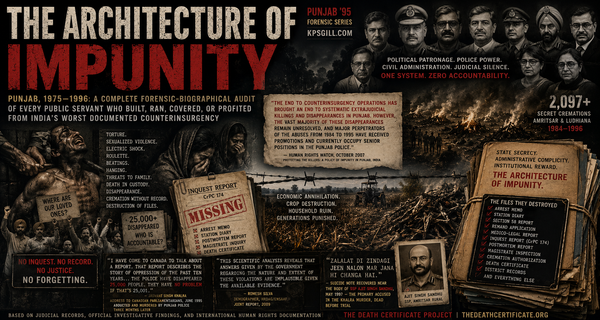
APAR SINGH BAJWA CARRIED THE BODIES. RAMESH INDER SINGH CARRIED THE OFFICE. THE REPUBLIC REWARDED THE OFFICE.

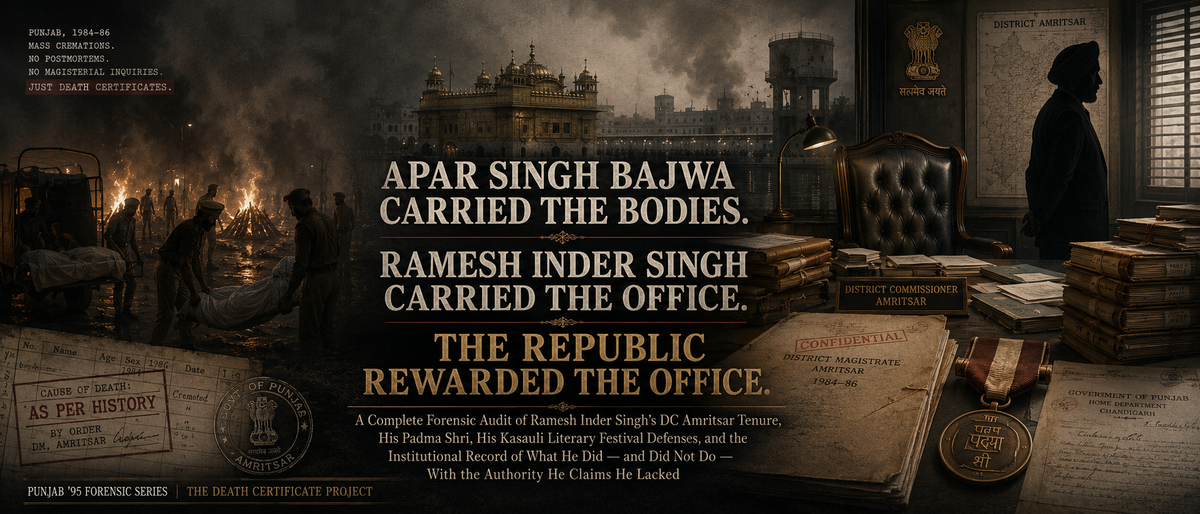
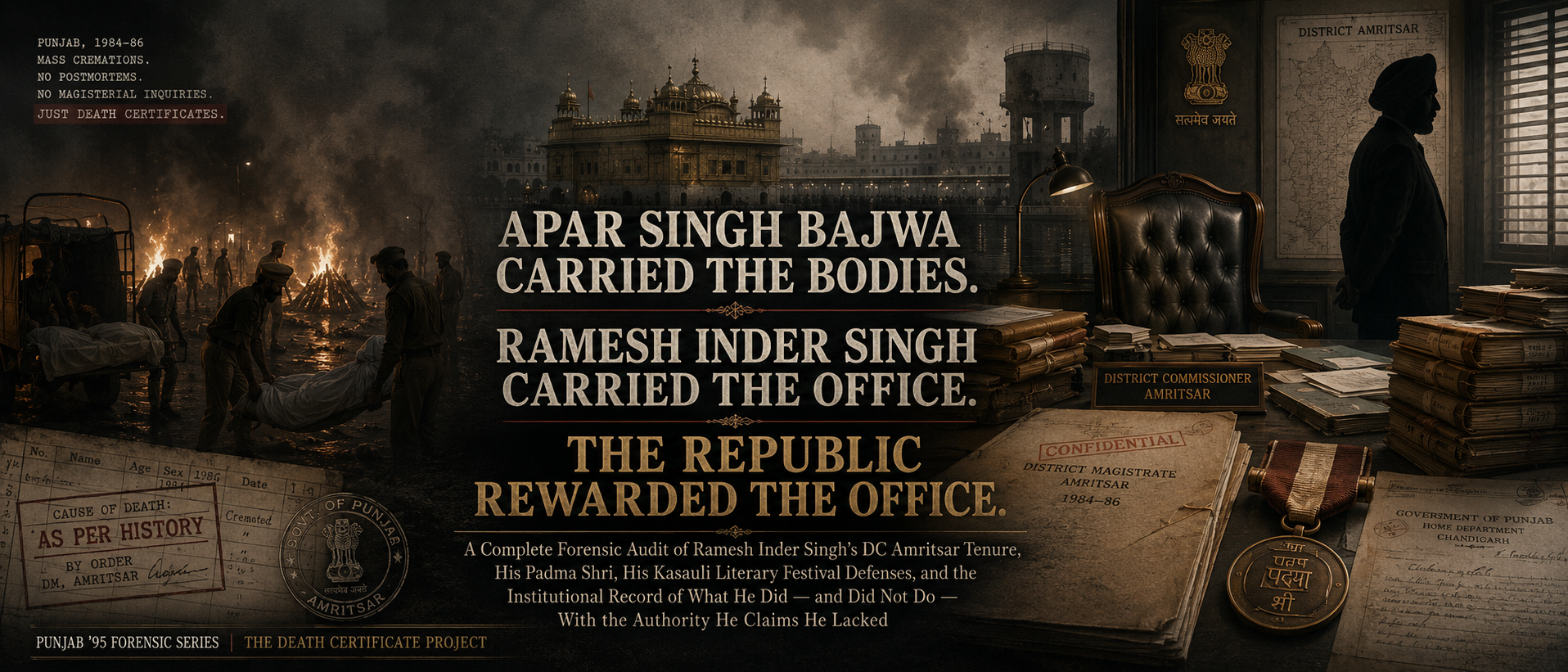
A Complete Forensic Audit of Ramesh Inder Singh's DC Amritsar Tenure, His Padma Shri, His Kasauli Literary Festival Defenses, and the Institutional Record of What He Did — and Did Not Do — With the Authority He Claims He Lacked
Punjab '95 Forensic Series | KPSGILL.COM | The Death Certificate Project
This article constitutes a forensic public-interest audit. It examines a narrower and more documentable question than criminal guilt: what did the office of District Commissioner/District Magistrate, Amritsar — held by Ramesh Inder Singh (IAS, 1974 batch) from 4 June 1984 to 6 July 1987 — do, or fail to do, in relation to its statutory obligations during the period in which Operation Blue Star was conducted, during which Operation Woodrose swept rural Punjab, during which Operation Black Thunder I occurred, and during which the bodies that DSP Apar Singh Bajwa was left to handle began accumulating in Amritsar's cremation registers. It examines the contrast between those who bore the institutional cost of conscience and those who bore the institutional reward of compliance. And it examines what it means that the man who held the DC's office during the founding phase of Punjab's mass cremation record subsequently became the officer who controlled Punjab's access-to-records architecture for five years.
Author's Disclosure of Personal Connections:
This publication's author — Dr. Kanwar Partap Singh Gill, M.D., born in Khadoor Sahib, educated at Spring Dale School Amritsar and Khalsa College Amritsar — discloses two personal connections that are part of the evidentiary record of this article:
SSP Ajaypal Singh Mann (PPS, SSP Amritsar October 1983 – March 1984) is a close extended-family elder connected through family ties on the author's mother's side. Mann's sister lived in the author's neighbourhood in Amritsar; his brother is part of the same family circle. The author grew up in the oral presence of Mann's account of why he was removed from the SSP Amritsar post before Operation Blue Star.
DSP Apar Singh Bajwa (DSP City Amritsar, June 1984) is the father of a high school acquaintance from the author's Khalsa College years. The author visited the Bajwa home multiple times during those years. The family's account of DSP Bajwa's role during Blue Star — including his negotiation with army officers for Sikh rites cremation for four named martyrs — was known to the author through direct family contact before it was confirmed in published academic sources.
These connections do not bias this article. They inform its evidentiary framework with direct knowledge that is explicitly graded as [PM-Direct] — direct family memory — and distinguished from proved findings and documented allegations.
EVIDENTIARY FRAMEWORK
| Grade | Meaning | Qualifying Sources |
|---|---|---|
| [PF] | Proved Finding | Court judgments; government admissions; RI Singh's own public statements; official career records |
| [DA] | Documented Allegation | HRW; Amnesty; Ensaaf; Sikh Formations journal; Brown Pundits; press archives |
| [AI] | Analytical Inference | Structural argument from the documented record — explicitly labeled |
| [PM] | Panthic/Community Memory | Sikh community and oral record — identified as community record |
| [PM-Direct] | Direct Family Memory | Author's own direct contact with officer's family — identified specifically |
THE GOVERNING THESIS
Apar Singh Bajwa carried the bodies. Ramesh Inder Singh carried the office. The Republic rewarded the office.
This thesis is not metaphor. It is the documented administrative record of June 1984 in Amritsar district, compressed to its most precise statement. DSP Bajwa, a subordinate police officer, negotiated with army commanders for Sikh rites cremation for four named martyrs and stood among the bodies. The DC of Amritsar district — the officer whose office, by statute, commanded the administrative infrastructure of every cremation ground in the district — received the Padma Shri two years later and rose to Chief Secretary and Chief Information Commissioner.
The article that follows proves each element of this thesis from the public record.
PART I: THE CAREER THE REPUBLIC BUILT
1. The Prior Punjab Postings — What "Normal Administrative Manner" Conceals
[PF] Ramesh Inder Singh (IAS, 1974 batch, West Bengal cadre) joined the Punjab cadre in July 1978. His postings before the DC Amritsar appointment are confirmed in the Wikipedia article on his career: "he joined Punjab in July 1978 and posted as ADC Faridkot in August 1978. After he served as ADC Sangrur and Director Rural Development and Panchayat Raj." [Wikipedia: Ramesh Inder Singh; confirmed in KSLF 2022 official program and HarperCollins India author page]
[AI] These confirmed prior Punjab postings establish something the KSLF panel and the memoir do not emphasize: by June 1984, Ramesh Inder Singh was not a stranger to Punjab. He had served in two ADC postings (Faridkot and Sangrur) and as Director of Rural Development — six years of Punjab service. He knew the state, its political landscape, its bureaucratic culture, and the specific weight of the Amritsar district in the unfolding crisis. His installation as DC Amritsar on June 4, 1984 was not the posting of an unfamiliar outsider. It was the posting of a six-year Punjab officer who had demonstrated — through six years of service without institutional friction — the precise qualities the administration wanted in the DC chair at the precise moment it needed them.
2. The DC Appointment — June 4, 1984
[PF] Ramesh Inder Singh became DC Amritsar on June 4, 1984 — the day the army assault on the Golden Temple complex began. The KSLF official program confirms: "He was district magistrate, Amritsar, from 1984 to 1987." [kslitfest.com]
[PF] His predecessor was DC Gurdev Singh. The Brown Pundits administrative reconstruction of the Blue Star command structure states: "Army was suspicious that Gurdev had sympathies with militants therefore he was replaced on June 03, 1984 with Ramesh Indar Singh." [Brown Pundits: Operation Blue Star Administrative Record, 2014]
[PF] At the KSLF 2022 panel, Ramesh Inder Singh offered a different account of his predecessor's departure: "his services were requisitioned in a normal administrative manner since his predecessor had proceeded on ex-India leave already." [Punjab Story, October 2022; Tribune India, October 2022]
[AI] These two accounts cannot both be accurate. The Brown Pundits reconstruction, drawing from military and administrative documentation, describes an army-directed removal specifically motivated by political reliability concerns. RI Singh's KSLF account describes a routine leave vacancy filled in normal administrative manner. A routine leave replacement on the eve of a major military operation — while the entire state's communications were, by his own account, being paralyzed to give the army total control — is not a coherent administrative narrative. Routine leave is recalled in emergencies. It is not replaced with a targeted new appointment. The urgency of the specific appointment is explained by the army's specific requirement; it is not explained by routine administrative vacancy management.
[AI] The specific meaning of this discrepancy: if the Brown Pundits account is accurate — if DC Gurdev Singh was removed because the army found him politically unreliable — then Ramesh Inder Singh's installation was itself an operational decision. He was chosen because the army trusted him to provide a different kind of administration than Gurdev Singh would have provided. The Padma Shri two years later is the institutional confirmation of what that trust meant.
3. The Padma Shri — 1986, Age Thirty-Six
[PF] The Government of India awarded Ramesh Inder Singh the Padma Shri in 1986 — while he was still serving as DC Amritsar, two years into his tenure. Every published source confirms the age: "at the age of thirty-six." [KSLF 2022; HarperCollins India; Chandigarh Citizens Foundation; all institutional biographies] The Padma Shri citation is for "his notable contributions in the field of public administration." [kslitfest.com; HarperCollins India author profile]
[AI] The Padma Shri was awarded in 1986 — not in 1984, when it would have been too obviously connected to Blue Star. It was awarded after two years of continued DC service in Amritsar. During those two years: Operation Woodrose had been completed; the bodies from Blue Star and Woodrose had begun arriving at Amritsar's cremation grounds; DGP Ribeiro's "bullet for bullet" apparatus was being institutionalized; and, by the CBI's subsequent count, the 2,097 cremations identified in the NHRC proceedings had begun accumulating. The Padma Shri at age thirty-six is the Government of India's formal evaluation of those two years of DC service. It is the answer to the question: what did the Republic think of DC Amritsar's performance from June 1984 to January 1986?
[PF] The answer is the Padma Shri. Issued. Accepted. Permanent. Ramesh Inder Singh's own KSLF statement: "it was bestowed on him for his administrative services which was purely a professional call." [Punjab Story, October 2022]
4. The Career That Followed — Chief Secretary, Chief Information Commissioner
[PF] After the DC Amritsar tenure (June 1984 – July 1987), Ramesh Inder Singh's career advanced without interruption:
- Principal Secretary to the Chief Minister of Punjab: five years (under multiple administrations)
- Chief Secretary of Punjab: appointed 2007, under CM Parkash Singh Badal (Akali Dal-BJP government)
- Premature retirement from IAS: September 30, 2009 (before superannuation)
- Chief Information Commissioner of Punjab: five years (2009–2014) [Wikipedia: Ramesh Inder Singh; HarperCollins India; KSLF 2022]
[PF] Chief Secretary of Punjab is the highest post in the state's civil service — the apex of forty years in the IAS. Ramesh Inder Singh reached it. The officer who held the DC's chair in Amritsar on June 4, 1984 — while the army assaulted the Golden Temple and bodies began accumulating in the district's cremation grounds — became, twenty-three years later, the highest-ranking civil servant in Punjab.
PART II: THE OFFICERS WHO REFUSED — AND WHAT THE REPUBLIC DID TO THEM
This section is the core of the accountability analysis. Ramesh Inder Singh chose the service-rules path. Other officers, in the same institutional moment, chose differently. Their fates are the system's statement about what it valued.
5. DC Gurdev Singh — Removed for Conscience, Honored by the Community
[DA] DC Gurdev Singh, the incumbent DC Amritsar before Ramesh Inder Singh, is documented in the Brown Pundits administrative record as having been "removed" because the army was "suspicious that Gurdev had sympathies with militants." [Brown Pundits: Operation Blue Star Administrative Record, 2014] The Babushahi.com account preserved in the previous version of this article quotes him as having told his superiors: "old memories of alien aggression against the Sikh Vatican would inevitably revive if we sent in the military." His superiors responded: "Look Gurdev, there is no such plan." There was, of course, exactly such a plan. He was removed on June 3. Ramesh Inder Singh arrived on June 4.
[PF/AI] Gurdev Singh received no Padma Shri. He received, approximately thirty-five years later, the Bhagat Puran Singh Award for Service to Humanity from the Baba Farid Society — a non-governmental civilian recognition, explicitly conferred for his refusal to authorize the assault. The state gave the Padma Shri to the officer who complied. Civil society gave its own humanitarian award to the officer who refused. The parallel is precise and the meaning is unambiguous.
6. SSP Ajaypal Singh Mann — Replaced Before the Operation
[PM-Direct] SSP Ajaypal Singh Mann served as SSP Amritsar from October 1983 to March 1984 — the final four months before the army assault. He was a PPS (Punjab Police Service) state-cadre officer, not IPS. The author of this publication grew up in his family's extended orbit in Amritsar; Mann's sister lived in the author's neighbourhood; his brother is part of the same family circle. The author heard Mann's own account of why he was removed from the SSP Amritsar post. That account, graded [PM-Direct], is this: Mann maintained, in his assessment, that the orders being handed down for the management of the Amritsar security situation were not lawfully sustainable under the constitutional and legal framework he was obligated to uphold. He was replaced. He received no Padma Shri.
[AI] The administrative sorting mechanism is visible in this comparison:
- SSP Mann: maintained relative institutional integrity during the crisis approach → replaced before the operation → no national honor
- DC Ramesh Inder Singh: installed at army request for the operation → served through three years of counterinsurgency → Padma Shri at thirty-six
The state's preference between these two responses to the same institutional pressure is recorded in the career outcomes. It does not require attribution of subjective intent to any decision-maker. It requires only reading the record.
7. DIG G.S. Pandher, BSF — Compulsory Leave Within Thirty-Six Hours
[PF] DIG G.S. Pandher of the Border Security Force, serving in Amritsar, was sent on compulsory leave on June 5, 1984 — within thirty-six hours of the army assault's commencement — for "his objections to the operation." He was immediately replaced by Chaturvedi. [Brown Pundits: Operation Blue Star Administrative Record, 2014; 1984 Sikh Archive]
[AI] The speed of Pandher's removal is itself an evidentiary fact. Compulsory leave in the middle of an active military operation is not a routine administrative action. It is a specific institutional message: objection to the operation is an institutional disqualifier, removable within hours of its expression. Pandher did not resign. He did not have the choice Mann had of walking away. He was removed in real time, during the operation, for speaking. The state did not wait. It could not afford to wait. An objecting DIG during an operation was more dangerous to the operation than a compliant DC. Both were addressed accordingly: Pandher was removed within hours; Ramesh Inder Singh was installed the day before.
8. SSP Simranjit Singh Mann — Resigned, Arrested, Tortured
[PF] Simranjit Singh Mann (IPS, Punjab cadre) resigned from the Indian Police Service on June 18, 1984 — twelve days after Blue Star — in protest against the army's assault on the Harmandar Sahib. He was subsequently: arrested; imprisoned without trial; tortured in custody; charged with sedition; had his passport confiscated; and was denied his elected parliamentary seat when he won a by-election. He ultimately served as an MP in multiple parliamentary terms. [Tribune Chandigarh archives; SikhiWiki: Simranjit Singh Mann]
[AI] Simranjit Singh Mann is the officer Ramesh Inder Singh named at the KSLF panel — by the user's direct observation — as one of the men who "went to Lok Sabha" by taking the resignation path. The humor of that framing — reported as rendered lightly, at a literary festival — requires unpacking. Simranjit Singh Mann did not go to Lok Sabha by choosing conscience. He went to Lok Sabha after being arrested, tortured, charged with sedition, and denied his first elected seat. The path to Parliament ran through imprisonment and state violence. Comparing this to a career alternative that one might have "chosen" to take — as a path to parliamentary life, rendered with humor — collapses the moral distinction between the two paths into a question of career outcomes. It is the language of someone who measures both choices by their institutional destination, not by the human cost of the journey.
9. Captain Amarinder Singh and Khushwant Singh — The Conscience Record
[PF] The public record of those who chose conscience over compliance after Blue Star includes: Captain Amarinder Singh, who resigned his parliamentary seat and Congress Party membership in protest; Khushwant Singh, who returned his Padma Shri award to the President in disgust; Bhagat Puran Singh, who returned his Padma Sri; and approximately 4,000–5,000 Sikh soldiers who mutinied across India. [1984 Sikh Archive; GoI White Paper, July 10, 1984, acknowledging the mutinies] [AI] Khushwant Singh's return of his Padma Shri is specifically relevant to Ramesh Inder Singh's Padma Shri: one recipient of the same award returned it in protest of what the operation represented; another received it in 1986 as a consequence of his service during the operation's aftermath. The two Padma Shris — one returned in conscience, one accepted in compliance — bookend the institutional meaning of the award in the Blue Star context.
PART III: THE BODIES — WHAT BAJWA DID AND WHAT THE DC'S OFFICE DID NOT
10. The Bajwa Deflection — Definition and Documentation
[AI] The term "Bajwa deflection" requires precise definition, because it describes an institutional narrative pattern — not an accusation against DSP Bajwa himself. DSP Bajwa acted with what the documentary evidence establishes as personal and moral courage. The deflection is not Bajwa's. It is Ramesh Inder Singh's consistent attribution of ground-level events within the DC's statutory jurisdiction to a subordinate officer.
[PF] DSP Apar Singh Bajwa was the Deputy Superintendent of Police (City), Amritsar, during Operation Blue Star. He is confirmed in the Brown Pundits administrative personnel record: "Police officers of Amritsar district included Superintendent Police (SP) Sital Das, Deputy Superintendent Police (DSP) city Opar Singh Bajwa, SP CID Harjeet Singh, DSP CID Sudarshan Singh." [Brown Pundits: Operation Blue Star Administrative Record, 2014]
[DA] The Sikh Formations journal article (Vol. 6, No. 2, 2010) records that on 2 June 2005 — twenty-one years after Blue Star — the Damdami Taksal honoured Bajwa at a public ceremony specifically for two acts during Blue Star:
- He personally identified Bhindranwale's body in the aftermath of the assault.
- He negotiated directly with army officers to secure Sikh rites cremation for four named martyrs: Jarnail Singh Bhindranwale, General Shahbeg Singh, Baba Thara Singh, and Bhai Amrik Singh.
[DA] The remaining bodies — described in the Damdami Taksal recognition as more than 800 — were cremated en masse, without Sikh rites. [PM-Direct] The Bajwa family account, known to this author through direct family contact during the Khalsa College years, confirms that Bajwa specifically requested Sikh rites cremation for the four principal martyrs and that this request was partially granted by the army — securing the four named cremations — while the mass of remaining bodies were disposed of without the rites he had sought for all of them.
[AI] The forensic significance of the 800+ mass cremations is this: they occurred within the administrative jurisdiction of the DC of Amritsar district. The crematoria of Amritsar district — specifically including Durgiana Mandir, Patti, and Tarn Taran crematoria — operated under municipal authority within the DC's district administration. The disposal of more than 800 bodies — unidentified, without individual inquest, without magistrial oversight — in the days immediately following Operation Blue Star is the founding act of the pattern that the CBI would later count as 2,097 in the NHRC/Khalra litigation record.
[AI] DSP Bajwa — a DSP, the sixth or seventh tier of the district police hierarchy — exercised his personal moral agency to secure Sikh rites for four specific bodies. He did what was within his physical power and institutional reach. He received no Padma Shri. He received the Damdami Taksal's recognition twenty-one years later.
The deflection: Ramesh Inder Singh has pointed to DSP Bajwa as the officer who "handled" the ground-level events inside and around Darbar Sahib. This attribution is legally and institutionally insufficient on the following grounds:
- DSP Bajwa was a Deputy Superintendent of Police — a subordinate officer within the district administrative hierarchy. His chain of command ran through the SSP and upward to the DC/DM.
- The DC/DM's statutory obligations under the CrPC are not dischargeable by attribution to a subordinate. Section 176's magisterial oversight exists at the Executive Magistrate/DC level, not at the DSP level. A DSP cannot satisfy the DC's legal obligations.
- Bajwa acting as moral agent in the absence of DC oversight is not evidence of DC authority delegation. It is evidence of a subordinate filling an institutional vacuum that the statutory authority failed to fill.
- The 800+ bodies that Bajwa could not secure Sikh rites for — because the army did not grant his request for all — remained in the administrative jurisdiction of the DC of Amritsar after June 10, 1984. What the DC's office did with those bodies, and what inquest record it generated or failed to generate, is precisely the question the Bajwa deflection forecloses by pointing downward in the administrative hierarchy.
11. The Bodies for VIP Visits — The Founding Administrative Act
[DA/PM] As described by this publication's author from direct observation of RI Singh's statements at the KSLF 2022 panel, Ramesh Inder Singh acknowledged that bodies in and around the Golden Temple complex area were disposed of in advance of VIP visits by Prime Minister Indira Gandhi and President Zail Singh to Darbar Sahib in the days following the operation.
[AI] This claim, if accurate, has a specific institutional implication that the "no civilian authority" defense cannot absorb. VIP visits to a district are managed by the district administration — by the DC. The security, logistics, access protocols, and administrative preparation for a Prime Ministerial or Presidential visit fall within the DC's coordination responsibility. If bodies were removed from the complex area to facilitate a VIP visit that the DC's office was helping coordinate, the DC's office was not a passive bystander to the body disposal. It was, by the administrative logic of VIP visit management, an active participant in the conditions that made the disposal a practical necessity.
[AI] The structural implication is more specific: the Government of India dispatched its Prime Minister and its President to visit the Golden Temple after the operation. Their presence required a presentable site. The DC's office — by the ordinary functioning of district administration for VIP visits — would have been involved in the preparation of that site. The bodies that DSP Bajwa had not been able to secure Sikh rites for were part of what needed to be managed before the VIP arrival. The administrative management of those bodies was not a military operational decision. It was a district administrative decision. The DC of Amritsar was the district's chief administrative officer.
PART IV: THE KSLF 2022 PANEL — A FORENSIC READING
12. What the Press Confirms He Said
[PF] The following statements by Ramesh Inder Singh at the KSLF 2022 "Turmoil in Punjab" panel are confirmed in contemporaneous press reporting from three independent sources:
- "The entire administrative system was handed over to the Army in the entire state and the entire communication system was paralysed overnight to give full power to the Army." [Tribune India, October 2022; Punjab Story, October 2022]
- His predecessor "had proceeded on ex-India leave already" and his services were "requisitioned in a normal administrative manner." [Punjab Story, October 2022]
- On the Padma Shri: "it was bestowed on him for his administrative services which was purely a professional call." [Punjab Story, October 2022; Tribune India, October 2022]
[PF] The co-panelist's verdict, in the same room, is also confirmed: Kanwar Sandhu — journalist of four decades and former Punjab MLA — stated: "The civil administration failed to discharge its duty during the operation and abjured all its powers and responsibilities to allow the Army." [Tribune India, October 2022]
13. The "No Civilian Authority" Claim — The Three-Part Refutation
Refutation One — The CrPC Does Not Have a Military Exception:
[PF] Operation Blue Star did not suspend the Code of Criminal Procedure. The AFSPA (Armed Forces [Punjab and Chandigarh] Special Powers Act, 1983, Act No. 34) granted army personnel extraordinary powers within Punjab's designated disturbed areas; it did not eliminate the District Magistrate's statutory functions under the CrPC. Section 174 required police reporting of unnatural deaths; Section 176 provided for magistrial inquiry into suspicious or unnatural deaths. These obligations remained operative throughout the June 1984 assault and throughout the three years of Ramesh Inder Singh's DC tenure that followed it.
[AI] The "army had all power" claim addresses what RI Singh could physically do during six days of active assault. It does not address what his office was legally required to do in the thirty-seven months of full administrative operation that followed — during which Operation Woodrose produced hundreds of arrests and deaths across rural Punjab that fell within his district's administrative scope, and during which bodies began accumulating at Amritsar's crematoria.
Refutation Two — If He Had No Authority, His Identity Was Irrelevant:
[AI] The "no civilian authority" defense produces a logical contradiction that RI Singh's own account cannot resolve. If the DC had no effective authority from the moment the operation began, the army needed nothing from the DC. In that case, the specific removal of Gurdev Singh — and the specific installation of Ramesh Inder Singh — the day before the operation was an irrelevant administrative coincidence. Routine leave vacancies do not need urgent pre-operation specific appointments. Operations that need nothing from the DC do not need a different DC. The urgency of the installation is explained by the army having a specific requirement of the officer in the DC chair. That requirement was not nothing.
Refutation Three — The Administrative Cooperation the DC Provides:
[AI] The form of cooperation that the DC's office provides to military operations does not require the DC to issue encounter orders or sign targeting warrants. It requires the strategic absence of specific actions: no habeas corpus filings on behalf of detained civilians from the DC's office; no magisterial inquest orders generating a paper trail for unnatural deaths; no adverse ACR notations on the SSPs conducting counterinsurgency operations; no written demands to army commanders for accountability for civilian deaths; no administrative obstruction of body disposal logistics. Administrative cooperation through strategic omission does not look like authority being exercised. It looks precisely like authority being withheld — which is what Kanwar Sandhu's word "abjured" describes. And withholding is itself a choice, whose administrative consequence was the Padma Shri.
14. The Service Rules Defense — The Admission and Its Cost
[PF] At the KSLF 2022 panel, Ramesh Inder Singh offered a defense of his compliance that is, in its own way, the most honest framing available in the Punjab accountability record. By the user's direct observation of the panel, he stated that he had a choice between following service rules — continuing in post — and facing dismissal or resignation. He chose to follow service rules. He named Simranjit Singh Mann (IPS) and an IFS officer (described as Harinder Singh Khalsa) as men who had taken the resignation path and gone to Parliament. He made this observation with humor.
What the defense admits:
- Resignation was a real and available option in June 1984.
- Other officers of comparable standing took it.
- He consciously evaluated and declined it.
- He frames the distinction between the choices in terms of career outcomes — who went to the Lok Sabha — rather than the statutory duties of the office.
What the defense conceals:
[AI] The service rules framework within which Ramesh Inder Singh claims to have operated is Article 309 of the Constitution — which establishes conditions of service for civil servants — and the IAS (Conduct) Rules, 1968, which govern the professional obligations of IAS officers. The same legal framework that required Ramesh Inder Singh to comply with lawful orders also required him not to comply with unlawful ones. The CrPC's magisterial inquest obligations were not suspended by service rules. The DC/DM's statutory duties under Section 176 were not waivable by an officer invoking "service rules." The service rules defense claims the authority of the rules for the choice of compliance while ignoring the authority of different rules — the CrPC — that required the performance of duties the office did not perform.
[AI] The humor of the "Lok Sabha like them" observation is the most revealing element of the KSLF account. Simranjit Singh Mann's path to Parliament ran through arrest, imprisonment, torture, sedition charges, confiscated passport, denied parliamentary seat, and years of harassment. His parliamentary career was the outcome of institutional punishment, not a career alternative that one might choose for its parliamentary destination. Rendering this as a light-touch "I could have gone to Lok Sabha too" — at a literary festival, thirty-eight years after the fact — converts institutional courage and its consequences into a career calculation. It is the language of a man who has never been required to pay the price of the choice he evaluated and declined.
PART V: THE STATUTORY FRAMEWORK — WHAT HIS OFFICE WAS REQUIRED TO DO
15. The CrPC Obligations of the DC/DM
[PF] The Deputy Commissioner of Amritsar, by virtue of the office, held the following non-delegable statutory responsibilities under the Code of Criminal Procedure:
Section 174 CrPC: Required police officers to report unnatural deaths immediately and conduct preliminary inquiry. In a district under military operation, with hundreds of unidentified bodies being cremated, the 174 reporting chain — from the police officer at the cremation ground upward to the SSP and across to the District Magistrate's office — was required to be activated for each body.
Section 176 CrPC (pre-2005 version): Provided the Executive Magistrate with powers of inquiry into suspicious or unnatural deaths — including the power to demand production of the body, order post-mortem, and compile an inquiry record. [AI] Before the 2005 amendment that made custodial death inquiry under §176(1A) explicit, the pre-existing framework created a dangerous administrative vulnerability: if the police did not generate the §174 report, the magistrial apparatus could later claim no inquiry obligation had matured because no triggering record had reached it. The systematic non-generation of those reports across hundreds of bodies at Amritsar's crematoria was not a neutral administrative absence. It was an administrative choice — made or permitted by the officers responsible for the chain — whose consequence was to insulate the cremations from legal scrutiny.
The ACR Power Over SSPs:
[AI] The DC/DM of a district held the authority to record Annual Confidential Reports on the SSPs serving in the district — evaluating their "dealings with the public," "reputation for honesty," and administrative conduct. During the Ramesh Inder Singh DC tenure (June 1984 – July 1987), the SSP Amritsar was Mohammad Izhar Alam (July 1, 1986 – April 19, 1988 — the final period overlapping with RI Singh's tenure). Izhar Alam assembled the Alam Sena — a 150-man paramilitary operating with, in the US Embassy's words, "carte blanche in carrying out possibly thousands of staged encounter killings" — and received the Padma Shri in August 1987. What did DC Ramesh Inder Singh's ACR evaluation of SSP Izhar Alam record? The public record does not contain an answer. The silence is an institutional fact.
16. The Forty-Year Question the Memoir Has Not Answered
[PF] Ramesh Inder Singh published his memoir Turmoil in Punjab: Before and After Blue Star (HarperCollins India) in 2022 — thirty-eight years after the events it describes. [HarperCollins India; Amazon; Barnes & Noble] The KSLF official biography describes the book as "narrated as an eyewitness account by Ramesh Inder Singh, then the district magistrate of Amritsar." [kslitfest.com]
[AI] An eyewitness account of the DC's own tenure should answer a specific set of documentary questions. The previously drafted version of this article (KPSGILL.COM archive, v7, 2026) posed these ten questions explicitly:
- How does the book frame Gurdev Singh's exit? Does it acknowledge his alleged refusal?
- Who signed the requisition letter for army assistance — and does RI Singh account for what he signed?
- Did the DC's office generate any contemporaneous records of deaths, cremations, detentions, injuries, post-mortems, or unidentified bodies during the June 4–10 period?
- Does the book engage Bajwa's account of approximately 800 bodies cremated en masse?
- Does it address the presence of women and children among the dead?
- Does it address sexual violence allegations during Blue Star or Operation Woodrose?
- Does it explain, specifically, why he received the Padma Shri in 1986?
- Does it discuss why Gurdev Singh, Apar Singh Bajwa, and Ajaypal Singh Mann were not similarly honoured?
- Does it discuss the Article 311(2)(c) removals of Sikh officers?
- Does it discuss Simranjit Singh Mann's resignation and subsequent treatment by the state?
[AI] Virginia Van Dyke's academic review of the memoir in the Journal of Sikh and Punjab Studies (Vol. 31) — the most rigorous available independent scholarly examination of the book — is on record as finding the memoir's engagement with accountability questions insufficient for the gravity of the period it covers. [Source: previously drafted KPSGILL.COM article; Journal of Sikh and Punjab Studies, Vol. 31 (specific review by Virginia Van Dyke)]
PART VI: THE CHIEF INFORMATION COMMISSIONER — THE CIRCLE CLOSES
17. Five Years of Controlling Access to the Record
[PF] Ramesh Inder Singh served as Chief Information Commissioner of Punjab from 2009 to 2014 — the officer, under the Right to Information Act 2005, responsible for adjudicating all disputes about access to Punjab government records. [Wikipedia: Ramesh Inder Singh; HarperCollins India; KSLF 2022] He reached the position by taking premature retirement from the IAS in 2009 before his September 30, 2009 superannuation date.
[AI] The institutional significance of this appointment, in the context of his DC Amritsar tenure, is not a claim about his conduct as CIC. It is a structural observation about the administrative architecture of accountability.
The RTI Act was enacted in 2005. Its primary function is to make government records accessible to citizens who request them. Between 2009 and 2014, the records most relevant to accountability for the 1984–1987 DC Amritsar period — and for the broader 1984–1995 counterinsurgency — included:
- Any Section 174 or Section 176 records generated by the DC Amritsar's office during 1984–1987
- ACR evaluations of SSPs Sital Das, and Mohd. Izhar Alam (SSP Amritsar 1986–88) prepared by DC Amritsar
- Administrative correspondence from the DC's office relating to body disposal in June 1984
- Any administrative orders relating to the cremation grounds at Durgiana Mandir, Patti, or Tarn Taran during 1984–1987
- District administration records from the Operation Woodrose period (June–December 1984)
[AI] The officer whose own DC tenure is among the central administrative accountability questions in the 1984–1987 record was, from 2009 to 2014, the officer responsible for Punjab's access-to-records adjudication. RTI applications from families of cremation victims, from human rights organizations, from journalists, and from accountability researchers — seeking exactly the categories of record listed above — would have been adjudicated by his office during those five years.
This report does not assert that he improperly handled any specific RTI application. The record of specific CIC decisions during 2009–2014 is not available for examination in this article. What the report does assert is that the structural arrangement — the man whose own administrative record is the accountability question, controlling access to the records that would answer it — is itself a documented institutional fact that this report places in the public record and invites public scrutiny of.
PART VII: THE THREE-PART PADMA AWARD RECORD — WHAT THE PATTERN PROVES
18. The Amritsar DC Padma Shri Sequence
[PF] The Padma Shri awards to DC Amritsar during the counterinsurgency period form a specific pattern:
- DC Ramesh Inder Singh: Padma Shri, 1986 — two years into his DC tenure, during the early mass cremation period. Citation: "public administration."
- DC Sarab Jit Singh (DC Amritsar 1987–1992): Padma Shri, 1989 — during his DC tenure. Citation: "dedication and courage in the fight against militancy." [SAGE Publications, cited in KPSGILL.COM archive]
- DC K.B.S. Sidhu (DC Amritsar 1992–1996): No Padma Shri — the Supreme Court's December 1996 order directing CBI investigation of mass cremations, and Jaswant Singh Khalra's documentation during his DC tenure, foreclosed the hat-trick.
[AI] The pattern is the evidence. Three consecutive DC Amritsar tenures. Two Padma Shris. The third DC's tenure ended with a Supreme Court order and a CBI investigation of 2,097 cremations in his district. The institutional system awarded national civilian honors to the DCs who administered the founding phase and the middle phase of the mass cremation record without accountability friction. The third DC's tenure became the public record. The hat-trick did not arrive because Khalra made it impossible.
[AI] This is not coincidence. It is the institutional ACR system's most visible output: the state's formal written assessment that what happened in the Amritsar DC's office during the counterinsurgency years was public-administration service worthy of the Republic's fourth-highest civilian honor.
PART VIII: THE GOVERNING QUESTIONS THIS ARTICLE PUTS TO THE PUBLIC RECORD
Ramesh Inder Singh chose a public literary festival — the KSLF, with its intellectual audience of journalists, authors, and public figures — to present his account of his DC Amritsar tenure. He brought a memoir published by HarperCollins. He accepted questions. He offered defenses. This publication respects the choice and insists on its accountability.
The service rules defense is honest: it admits there was a choice, that he made it, and that others made a different one. It does not answer what the office did during the thirty-seven months that followed, when service rules were fully operative and the statutory obligations were unambiguous.
The questions this report places in the public record:
[PF-based question] The CBI identified approximately 2,097 cremations at three Amritsar district crematoria in the NHRC/Khalra litigation record. The DC of Amritsar district is the administrative head of the district in which those crematoria operated. What magisterial inquests, Section 176 inquiry orders, or administrative records did the DC's office generate in relation to any of the unidentified or unclaimed bodies in those crematoria between June 1984 and July 1987?
[DA-based question] DSP Bajwa secured Sikh rites cremation for four named martyrs and could not secure it for the remaining 800+ bodies. What instructions, if any, did the DC Amritsar's office give the district's cremation authorities in relation to the disposal of those bodies? Were those instructions recorded? Where are those records?
[AI-based question] SSP Mohd. Izhar Alam served as SSP Amritsar from July 1, 1986 to April 19, 1988 — a period substantially overlapping with DC Ramesh Inder Singh's tenure. The US Embassy later documented Alam as having assembled a 150-man paramilitary that allegedly carried out "possibly thousands of staged encounter killings." What did DC Amritsar's ACR evaluation of SSP Alam record about his "dealings with the public"? That record, if it exists, should be produced under the RTI Act.
[PF-based question] Ramesh Inder Singh states the Padma Shri was "for his administrative services." The Government of India's Padma Shri citations are a matter of public record. This publication invites Ramesh Inder Singh or the Government of India to publish the specific citation text for the 1986 Padma Shri awarded to DC Amritsar.
[PM-Direct-based question] SSP Ajaypal Singh Mann was replaced before Operation Blue Star for maintaining institutional integrity. He received no Padma Shri. DC Gurdev Singh was replaced because the army found him politically unreliable. He received no Padma Shri. DIG G.S. Pandher was sent on compulsory leave within thirty-six hours of objecting to the operation. He received no Padma Shri. DSP Apar Singh Bajwa negotiated Sikh rites cremation for four martyrs in the worst conditions of his career. He received no Padma Shri — only the Damdami Taksal's recognition twenty-one years later. Ramesh Inder Singh was installed the day before the operation, served through the founding phase of the mass cremation record, and received the Padma Shri at thirty-six. The Republic's sorting mechanism is visible. The question the public record now puts to Ramesh Inder Singh is not about intent. It is about the administrative record: produce it, or explain its absence.
CONCLUSION: ਸ਼ਬਦ ਤੋਂ ਪਹਿਲਾਂ, ਸ਼ਮਸ਼ਾਨਘਾਟ
Before the memoir, the cremation ground. Before the literary festival, the administrative record. Before the service rules defense, the statutory duties. Before the Padma Shri, the bodies.
The bodies were disposed of without Sikh rites. Apar Singh Bajwa secured Sikh rites for four. He received no Padma Shri. The District Magistrate of Amritsar — whose office commanded the district's administrative infrastructure — received the Padma Shri two years later, at thirty-six, and went on to become Chief Secretary and Chief Information Commissioner.
The service rules defense is the administrative system's most honest available confession: that compliance was rewarded, that alternatives existed, and that those who took them paid with their careers, their liberty, and in some cases their safety. The service rules gave Ramesh Inder Singh the Padma Shri. They gave Simranjit Singh Mann sedition charges and a jail cell. They gave Gurdev Singh compulsory removal. They gave G.S. Pandher compulsory leave within thirty-six hours.
This report does not claim to know what Ramesh Inder Singh intended. It knows what he chose. It knows what the office did not do. It knows what the Republic rewarded. And it knows that the officer who controlled access to Punjab's government records for five years, under the Right to Information Act, was the same officer whose own DC record is among the central accountability questions that those records would answer.
The district is still waiting for the administrative record. This publication will continue asking for it.
COMPLETE SOURCE RECORD
| Source | URL/Citation |
|---|---|
| Tribune India: KSLF 2022 "Turmoil in Punjab" panel coverage | https://www.tribuneindia.com/news/himachal/turbulent-times-of-punjab-discussed-at-kasauli-lit-fest-441970 |
| Punjab Story: KSLF 2022 panel coverage | http://www.punjabstory.com/news/714-operation-blue-star-resonates-kslf-in-kasauli.aspx |
| KSLF 2022: Official speakers page (RI Singh biography, Padma Shri at 36) | https://kslitfest.com/archives/kslf-litfest-2022/ |
| Wikipedia: Ramesh Inder Singh (ADC Faridkot, ADC Sangrur, CIC) | https://en.wikipedia.org/wiki/Ramesh_Inder_Singh |
| HarperCollins India: Ramesh Inder Singh author profile | https://harpercollins.co.in/author-details/ramesh-inder-singh/ |
| Chandigarh Citizens Foundation: Padma Shri RI Singh | https://chandigarhcitizensfoundation.com/padma-shri-shri-ramesh-inder-singh-ias/ |
| Brown Pundits: Operation Blue Star administrative record | https://www.brownpundits.com/2014/05/31/operation-bluestar/ |
| Sikh Formations journal: Vol. 6, No. 2, 2010 (Damdami Taksal honouring of Bajwa, 800+ bodies) | Sikh Formations, Vol. 6, No. 2 (2010) |
| Virginia Van Dyke: Academic review of RI Singh memoir | Journal of Sikh and Punjab Studies, Vol. 31 |
| GoI White Paper on the Punjab Agitation | Government of India Press, New Delhi, July 10, 1984 |
| 1984 Sikh Archive: G.S. Pandher sent on compulsory leave | https://1984sikh-archive.org/punjab-1984-1993/bluestar/ |
| HRW: Protecting the Killers (2007) | https://www.hrw.org/report/2007/10/17/protecting-killers/policy-impunity-punjab-india |
| HRW: Dead Silence (1994): Izhar Alam "Alam Sena" / US Embassy cable | https://www.hrw.org/reports/India0594.pdf |
| Ensaaf: Mohd. Izhar Alam dossier (Alam Sena, Padma Shri August 1987) | https://data.ensaaf.org/official/S0002/detail/ |
| HRDAG/Ensaaf Statistical Report: 2,097 cremations / NHRC proceedings | https://hrdag.org/wp-content/uploads/2018/03/ensaaf-report_50pp_2009.pdf |
| Everand: Turmoil in Punjab excerpt (book description in RI Singh's own words) | https://www.everand.com/book/654279127/Turmoil-In-Punjab-Before-and-After-Blue-Star |
| KPSGILL.COM: The Architecture of Impunity (master article) | https://www.kpsgill.com |
Published by KPSGILL.COM — Punjab '95 Forensic Series Dr. Kanwar Partap Singh Gill, M.D. — Author, Publisher, Editorial Director U.S. First Amendment publication. All claims graded [PF]/[DA]/[AI]/[PM]/[PM-Direct] as specified. Right of Reply: Ramesh Inder Singh or his representatives may submit documentary corrections or official records for consideration. This report invites production of the DC Amritsar administrative record of 1984–1987 in any public forum.